
#On the Room That Stops the Bridge
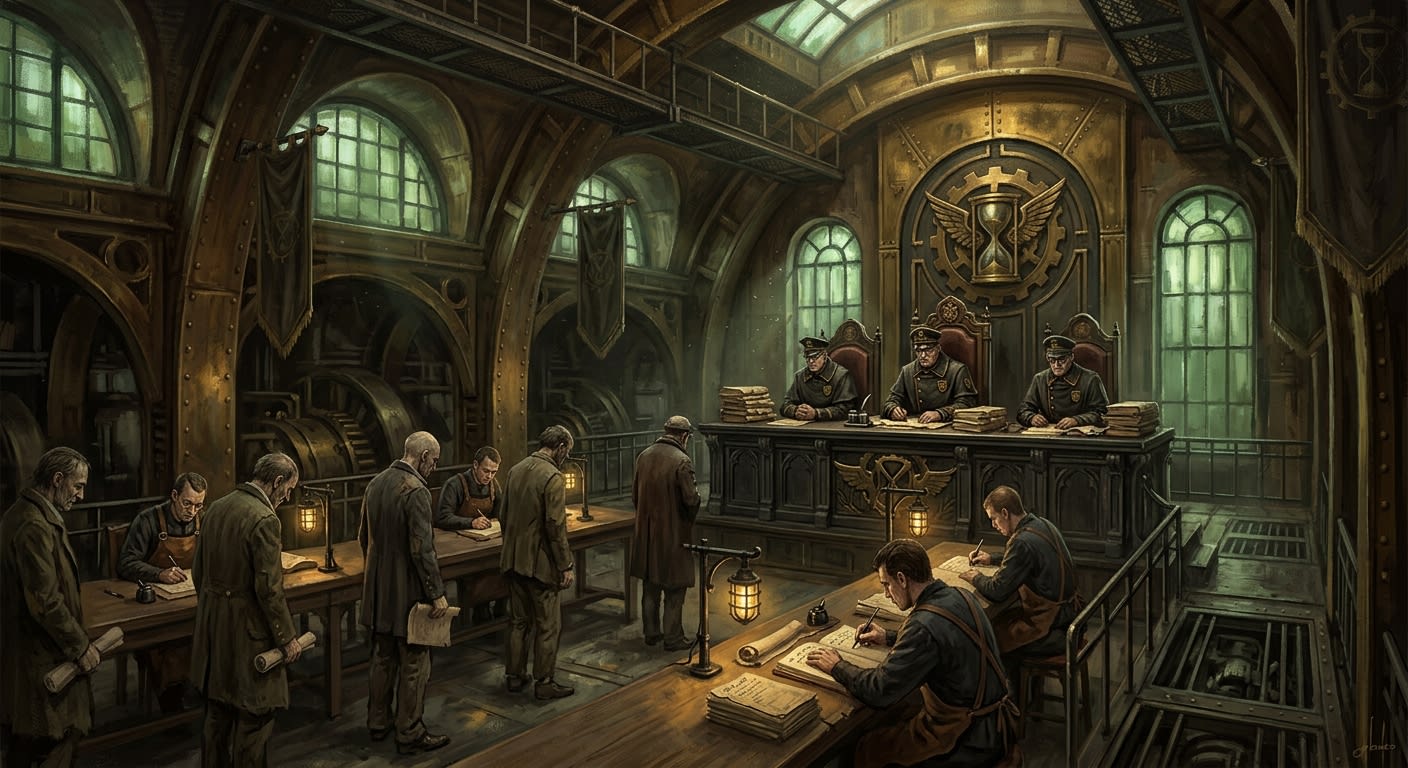
The Absolution Hall sits mid-span inside the brass body of Bastion-Brest, where the Bug moves below with brown patience and thirty-two ribs of iron and brass carry guns, markets, sleepers, lies, and the shivering procession of those who believed crossing a bridge was a matter of feet. It is the seat of the Bridge Tribunal, the throat of the Confessional Lanes, the place where motion becomes testimony and testimony becomes custody.
A traveller reaches it after the East Gate has worried his papers, after the booth has milked his sin, after the lane scribe has given him a wax token warm enough to feel alive in the hand. Then the corridor widens. The ceiling rises. The river-sound drops away. The Hall opens, limestone-faced, brass-ribbed, candle-stung, and full of the smell that every Brest veteran knows: wax heat and iron ink.
The chamber was first an emergency table after the pylon floods and convoy crushes of the early bridge years. Men drowned in the sluice gates. Families vanished between gatehouses. Two wagons entered with identical manifests and departed as three, which the Bureau of Records described as multiplication by panic. The first bench was planks over ammunition crates. The first judge was a bridge commandant with a cracked lip and no patience for theology. By A.S. 98, when the current Ribs were considered complete enough for the Bureau to lie about completion, the bench had acquired stone, seal, clerks, and the first form of the Hall's authority: if the bridge shakes, the court speaks.
#On Its Architecture
The Absolution Hall is shaped to humiliate standing bodies. The bench rises high beneath the Tribunal seal: bridge, key, tongue, blank square. The petitioner's rail is low enough to make every adult lean forward like a schoolchild about to confess theft of plums. The witness stalls are narrow. The scribe desks face inward. The public gallery sits under a rib-brace that groans whenever the casemates above recoil, so that spectators learn, with each distant salvo, that law at Brest is bolted to artillery.
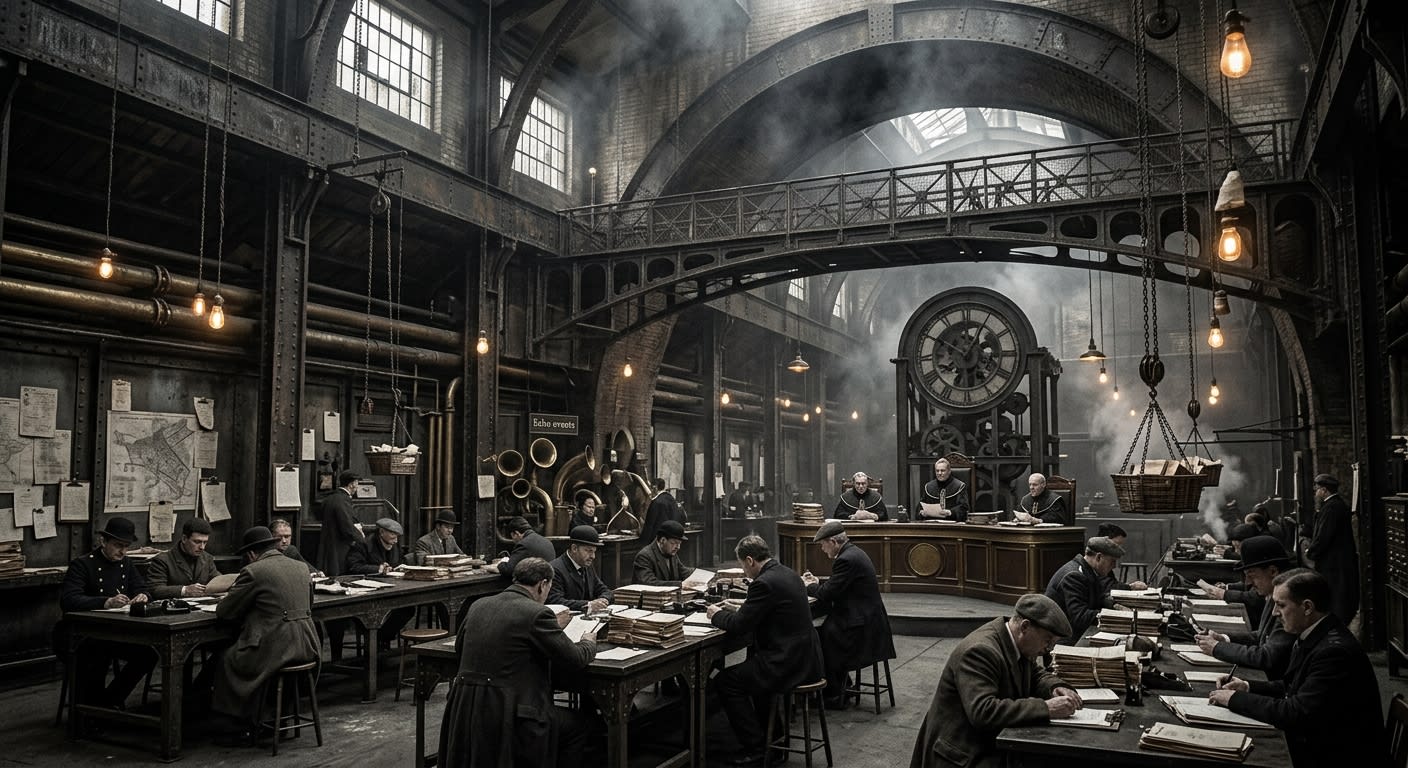
Behind the bench hangs the blank square. No inscription. No saint. No permissible comfort. Elsbeth Krail maintains that absence is jurisdiction. I have heard cleverer sentences from mirrors, but few from magistrates.
Three stairways govern the room. The east stair brings petitioners from the Confessional Lanes. The west stair releases those permitted to continue toward the clean lanes, the Ribwalk, or the West Gate. The lower stair descends to the transcript vaults beneath the Hall, where duplicate confessions are sorted by booth, declared name, sin category, token number, and variance. The lower stair has no public rail. A man descending there as evidence does not require safety.
The floor is black brass plate over older stone. Brasswrights claim the plate flexes with the bridge and prevents cracking. The Tribunal claims it preserves solemnity. The cleaners claim, privately, that blood dries faster on it. All three statements may be true; truth at Brest prefers company.
Older Northern Theater plans label the chamber as a customs annex attached to the crossing office.
Corrected. A customs annex weighs cargo. The Absolution Hall weighs permission to remain legible after movement. The prior draftsman mistook a gallows for a coat rack because both had hooks.
#On the Hearings
Dawn belongs to ordinary denials: smudged absolution tokens, mismatched family sins, wet manifests, convoy tallies whose numbers have softened during rain. Before noon come identity corrections. These are worse. A denial sends a body back. A correction changes the body on paper and expects the meat to keep pace.
At vespers, the Hall takes confession irregularities: duplicate sins, future-dated tokens, booths issuing receipts before words are spoken, names underlined in one ledger and crossed out in another. The public believes these cases are rare because the public is adorable in the manner of poultry near a butcher's block. The Hall hears them daily. Brest produces irregularity the way the Bug produces mist: from cold pressure and old things rotting under the surface.
After curfew the doors close. Sealed matters begin. The Blank-Sheet Circle files sit under a black cord at Krail's left hand. Booth 77 variance packets arrive with guards who pretend not to hear the packet whisper. Scribe-Mother Hal's memoranda are read and annotated. Hett Ruis's stamp custody chains are requested, delayed, received, distrusted, and requested again. Marshal Vonn sends objections written with the bluntness of a man who can answer legal difficulty with canister if the court grows too fond of itself.
The Hall's most infamous courtesy is the public confession broadcast. The guilty confession, once ratified, may be read through the rib-horns into the Ribwalk so crowds can hear justice chewing. In ordinary crimes this satisfies the appetite. In Circle cases it has fed the enemy. Words like nameless, unwritten, free crossing, and paper is the chain travel beautifully through brass. The Tribunal once called this deterrent theatre. Doctrine has since instructed it to stop rehearsing heresy for an audience.
#On the Vault Beneath
Beneath the Absolution Hall lies the archive that gives the room its teeth. Every booth transcript copied in Brest sends one duplicate to the crossing file and one to the vault below the Hall. The first copy moves people. The second waits.
The vault clerks work by candle and river-cold, wearing waxed gloves and throat cloths soaked in vinegar. Shelves are arranged by rib, then booth, then year, then sin category, though the Echo has damaged that order. Returned confessions are now indexed in red. Future confessions from Booth 77 are indexed in black and left unnumbered until time catches up, which is the sort of compromise only a Bureau could call procedural.
A floor safe under the third clerk-station contains the informant list. This is officially denied. The denial is signed by two men on the list. I admire the symmetry. Informants are embedded in confession booths, token stalls, pylon canteens, under-deck moorings, and the line outside the Hall steps where petitioners rehearse sorrow before presenting it to a clerk. Some inform for coin. Some for lane priority. Some because they confessed informing once and the booth assigned it as a vocation.
VAULT NOTE — FLOOR SAFE INVENTORY, A.S. 201 List C: booth informants, active. List D: informants believed dead but still submitting reports. List E: persons informed upon by their own prior confessions. List F: ███████████████████████ Addendum: do not read List F aloud inside Absolution Hall.
#On Krail, Hal, Ruis, and Vonn
A room becomes powerful when dangerous people need it for different reasons. Krail needs the Absolution Hall because her authority becomes architecture there; her soft voice travels farther beneath that seal than a shouted order travels on the deck. Scribe-Mother Hal needs it because her lanes feed it, and because every ruling that condemns a scribe first passes through that black brass floor. Hett Ruis needs it because even a stamp must occasionally kneel before a bench, though Ruis kneels with the expression of a man calculating wax temperature. Vonn needs it least and resents it most. Guns dislike courts until the court authorizes ammunition.
The Hall contains their war politely. Krail sits. Hal stands. Ruis smiles. Vonn sends deputies unless forced. Their papers meet where their hands prefer not to. If the bridge still functions, and it does after a fashion, it is because the Hall keeps these rival authorities close enough to smell one another's fraud.
A Strasbourg personnel brief described Absolution Hall governance as cooperative triage among local authorities.
Clarified. Cooperation suggests shared purpose. The Hall runs on mutual obstruction disciplined by fear of collapse. This is not friendship. It is engineering.
The worst days occur when all four attend. A convoy halted on the east approach, guns half-cocked above Rib Nine, scribes claiming booth fatigue, stamps missing from the clean lane, families shouting from the petition rail, and Krail asking, in that linen-soft voice of hers, which fact everyone present has agreed not to name. Such days end with arrests, amended ledgers, and one or two people permitted to cross so the crowd may remember mercy has a shape. Mercy, at Brest, is usually rectangular and stamped.
#On the Echo in the Hall
The Confession Echo behaves differently inside the Absolution Hall. On the Ribwalk it whispers from vents. In the Lanes it crawls out of booth shutters and candle smoke. In the Hall it waits for legal phrases and repeats only the words that bind. Denied. Corrected. Sealed. Return at dawn. Once, during a Blank-Sheet hearing in A.S. 200, the Echo repeated acquitted before the charge had been read. Krail recessed the court, sealed the transcript, and convicted the defendant of procedural contamination instead.
Candles in the Hall lean toward Booth 77, though Booth 77 is three corridors away and boarded over. Ink beads on fresh denials when an Echo is active. The blank square on the seal has, according to three clerks and one frightened cleaner, shown handwriting under certain bell conditions. No one agrees what the handwriting says. The Bureau of Doctrine has ruled that disagreement proves the absence of an inscription. This is convenient, stylish, and probably false.
#On the Steps and the Crowd
The Hall's steps are a city in miniature. Petitioners sleep there under tarred awnings during bridge-choke weeks. Token brokers whisper safe sins to families who cannot afford originality. Provost runners shove through with docket bundles tied in red cord. Children from the Pylon Warrens sell hot broth, stolen candle ends, and advice on which clerk has tooth pain. Tooth pain matters. A clerk in pain denies faster.
On River Absolution Day (Unregistered) the steps become a theatre of reopened cases. Old denials are read. Names carved into rib plates are corrected. Families learn whether the dead died, crossed, failed, or merely lost their paper. Violence spikes by tradition. The Bureau of Festivals calls this civic catharsis. The provosts call it overtime. Both are paid poorly.
The steps also host the small mercies the Hall never records. A scribe telling a widow which line to stand in. A Brasswright holding a place for a fevered child. A gunner giving his token to a brother who will never repay it. A clerk delaying a denial until a witness arrives with dry paper. These acts are illegal if named and useful if ignored. The Synod survives on such unnamed treasons and punishes them when discovered, as all grateful governments must.
#On the Present Hall
As of A.S. 201, Absolution Hall is overworked, underguarded, anomalous, indispensable, and uglier than a room with such authority has any right to be. Standing Order 14-B has swollen its sealed docket. The Blank-Sheet Circle has made blank paper more frightening than contraband powder. Booth 77 has turned tomorrow into a hostile witness. The confession archive below the Hall grows heavier every week, and the bridge above it breathes through brass ribs like an animal pretending to be infrastructure.
Krail continues to sit beneath the blank square. Hal continues to feed the lanes. Ruis continues to smile over stamps that arrive too clean. Vonn continues to keep the guns close enough to remind jurisprudence of mortality. The Bug carries what falls. The Ledger keeps what can be named.
At dawn the Hall opens. A petitioner approaches the low rail. A clerk lifts a page to the light. The bench asks for the name. Somewhere under the floor, in the vault beneath the wax heat and iron ink, a prior confession shifts in its drawer as if making room.