

#On the Office
"An institution is best known by its worst day, because that is the day it writes the most." — Drax, marginal annotation
The Church holds one deed of the Rationalist Prefecture of Public Instruction, two explanations of that deed, and a great deal of silence. The Prefecture worked in Vienna, capital of the Rationalist Republic, the city where the Council of Nine sat in the Imperial Palace and where the Concordats of Ulm were drafted in lecture halls. Thirty-seven Philosophical Prefectures governed outward from that city. Nobody can say whether Public Instruction was one of the thirty-seven, answered to the Council directly, or sat in some third arrangement of desks that the Republic thought too obvious to write down. Its charter is lost, or was never written, or is filed somewhere I have not yet been allowed to look. No source the Bureau will let me cite names any of its officers. Nobody recorded when it closed.
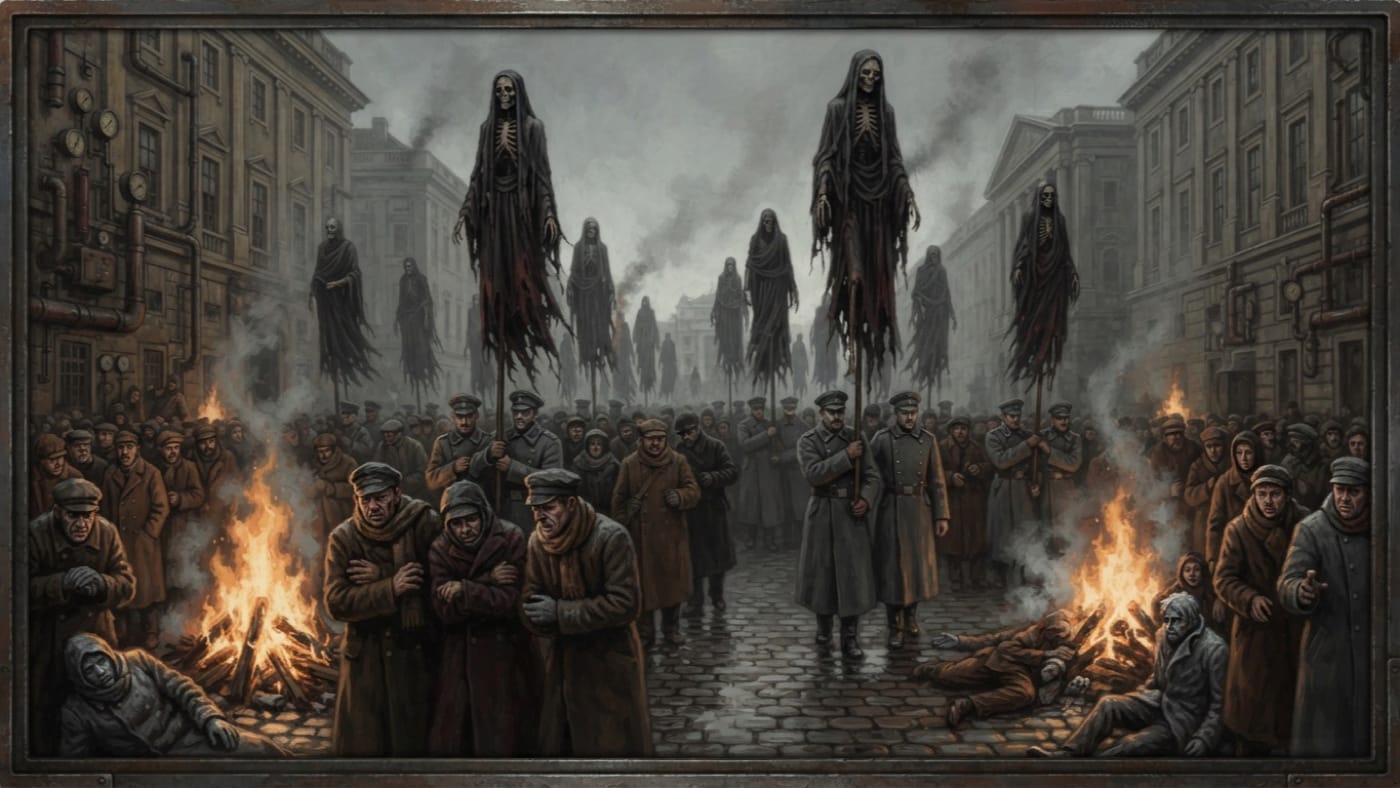
What we have is November of A.S. 30, three days after the Treaty of Regensburg, and forty-seven effigies of saints in mourning cloth.
I confess a professional interest. I have spent my career serving an administration that organizes belief. This was an administration that set out to organize belief's absence in public, with a procession, a set of squares and a supply of pitch. One studies the enemy's ledgers to learn about the enemy. Now and then one also studies them and recognizes the handwriting.
#On Instruction as Spectacle
Swords had already done the hard part. The Holy See of Vienna was dissolved at swordpoint in the settlement of Regensburg, and a dissolved See does not object. What remained was the lesson, and the Prefecture seems to have understood that a lesson nobody watches has not been taught.
It chose its materials with a liturgist's care. It chose effigies because an effigy can be carried through a city and burned in an afternoon, and it chose mourning cloth because a funeral is the one rite every citizen knows how to attend. It chose a procession through the boulevards because the Church had taught Vienna for centuries that holy things move through the streets in order and the crowd parts before them. And it built pyres in the public squares because the Church had also taught Vienna what fire is for.
Every element was borrowed, and I do not begrudge the Prefecture its cleverness. Any Viennese grandmother would know a procession of black-draped saints when she saw one. The Prefecture kept the form and reversed the verdict. The saints went out as they always had, carried high with the people around them, and at the end of the route the people were supposed to watch them burn and feel nothing.
That is my reading, not theirs. No statement of the Prefecture's purposes survives. I infer its intent from the instruments it chose, the way one infers a confessor's opinion from the length of the penance.
#On the Black Procession
The treaty was signed. Three days later, the effigies came out.
Forty-seven of them, each draped in mourning cloth, were carried through the boulevards of the capital to pyres in the public squares. The Heldenplatz was the chief of these. The pyres were fed with pitch. Pitch burns hot and long, which is why the Church's own executioners prefer it when the weather is poor and the sentence is final. The effigies were lit, and they burned.
The flames rose bright enough to be seen across the square. On this point the accounts agree: the fires gave light, and they gave no heat.
Those at the front of the crowd, who had pressed forward to see a saint consumed, began to suffer frostbite. Hands went numb and faces stiffened. In November, beside a pitch-fed fire, three citizens died of exposure within six feet of the flames.
I record how many there were. The record gives no names, no trades and no reason for standing so close, and I will supply none. The Bureau of Records has invented biographies for lesser purposes. These three have been made into enough already: a portent, a classification, a reason to raise columns. They were Viennese who came to watch a lesson and froze within reach of a bonfire. That is everything known about them, and it is sufficient.
The record is equally silent about what the Prefecture's officers did at the scene. I will say only what any administrator would understand. A spectacle is a promise made in public. When the fire will not warm the square it was lit to instruct, the promise breaks in front of everyone who came to see it kept. The Prefecture had arranged for Vienna to watch its saints burn without consequence. Instead, Vienna watched three of its own die in the cold.
An earlier chronology in this Codex dated the Black Procession to A.S. 124.
The Procession took place in A.S. 30, three days after Regensburg, in a Rationalist capital that was still functioning, fifteen years before the Sundering and ninety-four years before the date formerly assigned. There was one procession. The Bureau of Records offered to create a second so that both entries could stand. The offer was declined.
#On the Explanation
Then the Prefecture, or whoever held the Republic's pen that week, did what institutions do. It explained.
An atmospheric explanation was published. The Rationalists also described the fires as "a chemical marvel." I cannot say whether these were one statement or two, or whether they came from the Prefecture or from an office above it, and I will not forge a signature to tidy the paragraph. Both are attributed to the Rationalists. Both survive in the Church's account because the Church found them useful.
The second day of celebrations was cancelled.
I have read a great many explanations, and written more than I have read. I know how the thing is built. You name the phenomenon in the vocabulary of your own doctrine, so that it becomes an instance instead of an exception. You choose a word like atmospheric or chemical that sounds as though somebody measured something. You publish quickly, before the witnesses can compare notes. And you quietly cancel whatever was scheduled next, because an explanation is only a document, and a second day would give the fires a second chance.
The Prefecture's men were heretics. Their paperwork was orthodox.
In A.S. 92, sixty-two years later, the Bureau of Doctrine filed an explanation of its own. It classified the cold fires as a First-Order Portent, Providential Warning, Category: Elemental Rebuke. Nobody in that office had stood in the Heldenplatz, and nobody needed to. The classification was retrospective, as much of the Bureau's best work is. The event had supplied the cold. The Synod, constituted two years earlier at the Concordat of Strasbourg, supplied the meaning.
The Republic said the air did it. The Synod said the Creator did it. Each office published, stamped and moved on. I note only that the Rationalists had three days to explain their own failure and the Bureau of Doctrine had sixty-two years, and that the Rationalists' prose is the more hurried of the two.
#On the Custody of the Memory
After the Procession, the Prefecture does not appear again in any record I can cite. The Year Without Dawn came two years later, and the Republic's presses had other treatises to print. The Sundering came in A.S. 45, bringing the legions of the Great Deceiver and, in time, the slow undoing of the capital. I cannot tell you when or how the Prefecture of Public Instruction shut its doors, who took over its desks, or whether a single page of its correspondence outlived the Republic it served. I have asked. I was answered with a form.
In A.S. 95, Clemens Stahlhand reclaimed the city, and the Heldenplatz was reconsecrated that same year. Seven basalt columns were raised on the sites of the old pyres. They are warm. They hold at thirty-seven degrees, the temperature of a living body, and pilgrims under the supervision of the Bureau of Pilgrimage press their palms against them. The columns do not say whether their warmth answers the cold fires or merely occupies the same ground. The Bureau of Doctrine says rather more than the columns do.
What I can say is that the Church kept the Prefecture's lesson and changed its subject. It kept the same square and the same pyre sites. It placed a public object where the crowd would gather, filed a classification, and expected a correct feeling from the people who came to touch it. Sixty-five years after the Procession, at the same address, the Prefecture's lesson was taught again with the verdict reversed once more. The Prefecture had set out to teach Vienna that a saint burns like anything else. The Synod now teaches Vienna that the Prefecture was mistaken, and it charges the shrine-city admission for the instruction.