

#On the Hours of Trade
"The dead are placed. The map is mercy." — Propaganda line of the Mortuary Cartography Office
The Reed Market is one of the seven named districts of the Ash-Glyph Marshworks. The Marshworks is the mortuary settlement at the mouth of the Danube, where the eastern dead of the Sagittal Line come down by barge and go into the mud by coordinate. Six of its districts do work the Church can name in a sermon. The Glyphyard stakes the dead and the Lantern Rackway lights the channels. Diver's Gut sorts what comes up, and the Charnel Moorings receive the barges. Seal Shed Row stamps the paper. The Causeway Gate takes its fee. The seventh district trades after curfew in defiance of three separate Bureau mandates, and the other six could not be kept working for a fortnight without it.
The record does not name the three mandates. It also leaves out the offices that issued them, the years of issue and the penalties attached. I know the number and nothing else. So far three prohibitions have had exactly the effect of none, and the Bureau of Records will one day file that as a saving in enforcement.
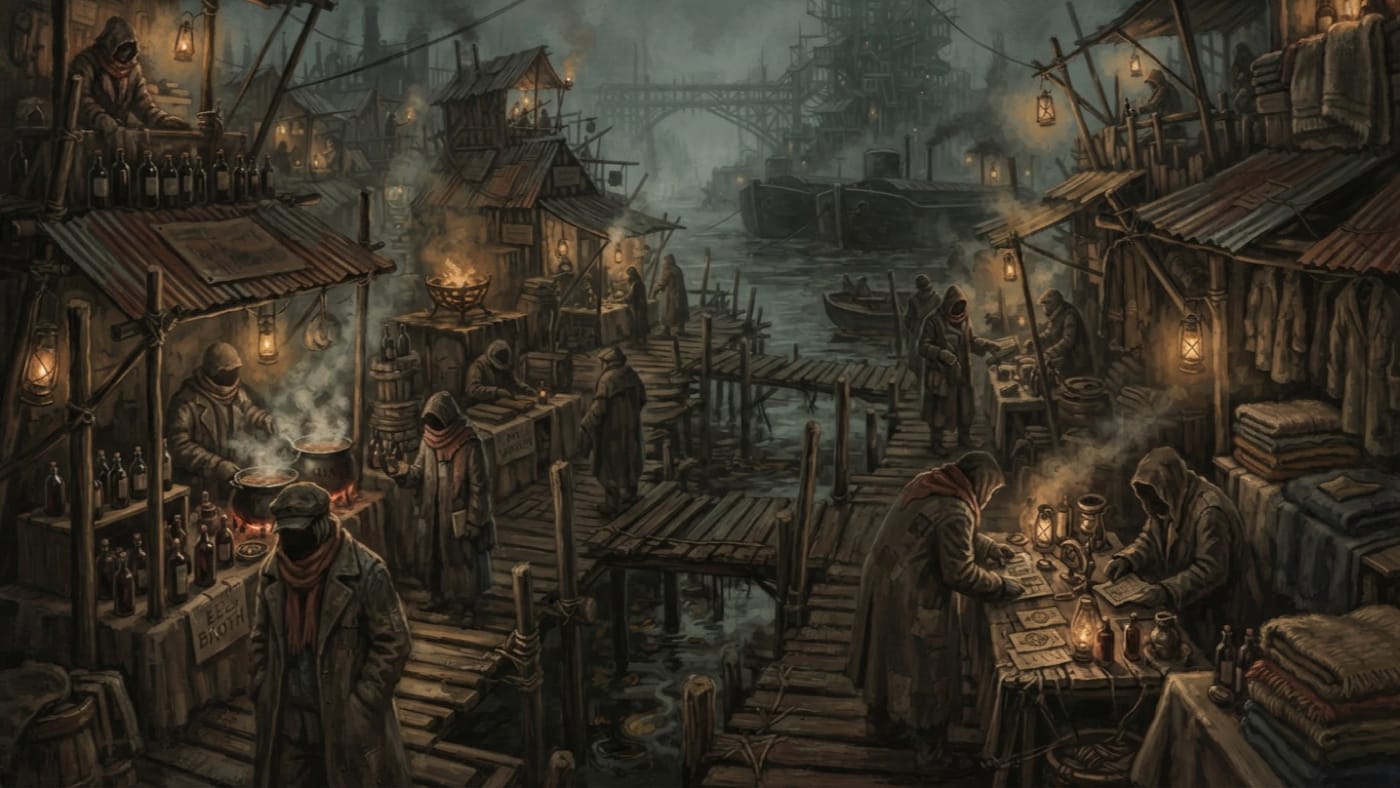
The district smells of smoke and eel broth. It stands as the rest of the Marshworks stands, on stilts and lashed timber, on rope bridges and floating platforms over brackish pools. It lies somewhere off the Ropewalk, the raised spine that carries the settlement from the Gate to the Moorings. The record gives it no boundary, no count of stalls and no compass position, and I will not draw it a street plan. The ground in the Marshworks moves. Cartographer-Provost Lysa Vane already redraws her maps every morning, and she needs no extra map to correct.
The settlement survey says the markets go silent at night. The parent entry says this one trades after curfew. The two accounts agree better than they first appear to, because silence describes the voices and says nothing about the ledgers. A market that deals in murmurs under shaded lamps is still a market.
#On Oil, Broth and Dry Cloth
What the Reed Market sells first is what keeps a body working. The record names three goods: lamp oil, eel broth and dry cloth. Each meets a need that the settlement's own offices create and do not supply.
Lamp oil is passage. The Marshworks moves after dark by lamp and by Guild mark, and a crew without good oil stays where it is or drowns where it went. The Rackway burns tallow under Guild control. The oil sold in the Reed Market goes into every other lamp in the delta, and the Guild fills none of those.
Eel broth is the cheapest hot thing in a cold marsh. Dry cloth is rarer. The survey lists five forms that wealth takes in the Marshworks: dry clothing, clean water, good lantern oil, an official tag and a safe route at night. Three of the five are openly for sale in the Reed Market. The other two are sold there as well, though nobody calls them merchandise.
Payment is made in coin, salt chits, stamped paper, bone tokens and route marks, which are the Guild's lamp passes. I give no prices. The record contains none, and a price invented for colour would be the first forged document in this entry.
The customers are the settlement itself: glyph-stakers, map scribes, lantern riggers, divers, barge-handlers, tag clerks, lime haulers, and the untagged drifters at the bottom of the order. No census of the market's trade exists. The list above is the settlement's labour roll, and anyone who labours after dark has to eat after dark.
Debt is what sends most of them out at that hour. The causeway fees are higher than salvage wages, so a man who came for one diving season stays permanently, as a matter of arithmetic. The Ashbound Wardens enforce the quarantine and sell exemptions from it. Debts are worked off in night lantern shifts, which have the highest mortality, or in diver rotations, which the Bureau links to "cognitive irregularity." Both sentences are served in the dark. The Reed Market keeps the same hours, and its customers arrive wet from their shifts.
The Codex entry for the Gate reports that the market's intermediaries buy the Wardens' tolerance one night at a time. I repeat that much and add no rate, schedule or name.
#On Provenance Sold by the Staple
"Some relics climb out of the mud on purpose." — Reed Market saying
Beyond the broth, the record mentions goods whose provenance would distress the tag clerks. The settlement's black market as a whole deals in counterfeit tags, "yesterday relics," forbidden lamp dyes and under-route charts, and it sells boat-luring and body disposal as services. The survey does not place all of this trade in the Reed Market, and I will not move it there wholesale. What the survey does assign to the market is a figure, the reed-market broker, who deals in oil, secrets and "new" relics. That will do.
The Mud-Relic Syndicate, known locally as the Yesterday Finders, works two districts: Diver's Gut and the Reed Market. In public it does legitimate salvage. The lore records that it plants relics, launders their provenance, forges tags, bribes clerks, and uses violence when bribery fails. The two territories fit together. An object comes out of the mud at Diver's Gut, and its history is bargained over in the Reed Market before it ever reaches Seal Shed Row.
Diver-Boss "Softstep" Maro controls the intake at Diver's Gut and takes his percentage. The record does not make him proprietor of the market or chief of the Syndicate, and this entry makes him neither. It gives Vane and Guildmaster Orren Pike no stalls either, whatever the market says about the two of them.
Every recovered object raises three questions: whether it is materially what it appears to be, whether its recorded custody is true, and whether it may circulate. Seal Shed Row is built to answer only the third. A salvage tag is invalid without a seal, a seal goes unrecognized without a countersign, and the sheds' limited capacity is the settlement's commercial bottleneck. The Syndicate's skill lies in making that third answer pass for the other two. A genuine medallion with a forged history will pass the Bureau of Alchemical Standards, and every other fact about it can be a lie.
Then there are the yesterday finds. These are relics that come up uncorroded, some of them already carrying salvage tags dated days that have not yet come. They have been reported and examined, and nobody has explained them. The parent entry says recoveries rose sharply between A.S. 194 and 200 (1904–1910 CE), and the Syndicate's fortunes rose with them. A broker selling a "new" relic in the Reed Market does not need to know which kind he is holding. A history costs the same whichever kind it is.
#On the Choir's Recruiting
The Glow Choir recruits here. It meets elsewhere, in the reed tunnels and on the off-route shoals beyond the guild-marked channels. To the settlement it presents itself as a society for mourning hymns. Its doctrine holds that the corpse-light is a calling intelligence.
The Bureau of Purity has recorded the recruiting in seven consecutive inspection reports. The parent entry also says the Bureau has investigated the Choir seven times. I cannot show that these are two separate sevens, and I will not add them together to make fourteen. Three of the Choir's members are Purity informants, and two more are the children of Seal Shed clerks. The Codex holds none of their names, ages or reports.
The reason for the Bureau's restraint can be worked out without the names. An arrest in the Reed Market would expose Purity's own sources. It would also put the children of the men who stamp the dead on the wrong side of a stamp. The Bureau has written seven reports, and the recruiting has gone on through all seven.
The record does not say how the Choir chooses whom to approach. The Reed Market is open after curfew to the indebted, the soaked and the sleepless, and I need no further explanation than that.
What the locals know — and what the Bureau's pending review has scrupulously avoided confirming — is that the corpse-light is intelligent.
The Codex entry for the Ash-Glyph Marshworks recorded local belief and Choir doctrine as established fact. The record shows a light that imitates safe channels and is reported to answer lamp sequences. It does not show a mind behind the light. The Bureau of Alchemical Standards has left its classification pending since A.S. 143, which makes fifty-eight years in A.S. 201, and the entry's reference to thirty years of review is withdrawn as well. The light's intelligence is what the Glow Choir teaches in the reed tunnels and recruits for in the Reed Market. The Codex reports that doctrine. It does not share it.
#On the Walk Home
"If it shines, don't follow." — Marshworks proverb
The customer who has bought broth, oil and dry cloth still has to carry them home. The survey gives ambush as the market's characteristic danger, and the curfew provides the cover.
The water is worse than the walk. The recognized night routes belong to the Lantern Guild of the Third Brine, whose marks decide who reaches the Ropewalk by morning. The corpse-light blooms over the burial shallows, imitates safe channels, and is reported to answer the Guild's own sequences. The Guild's response is the Do Not Answer procedure: cover the lamps or put them out, blindfold the rowers, and pull to a bell-click cadence, counting strokes. A man who has just bought a flask of good oil may be ordered not to light it.
Beyond the water is the Gate, which collects the debt, and beyond the Gate is the night shift that starts after the broth is finished.
In A.S. 201 (1911 CE) the Reed Market trades as it has always traded. The three mandates remain in force, the Wardens still collect their fees, and the Choir's recruiting is still recorded in seven reports while three Purity informants sit in its ranks. Nothing on file shows any office moving to close the market, and the market has never waited for permission to open.