
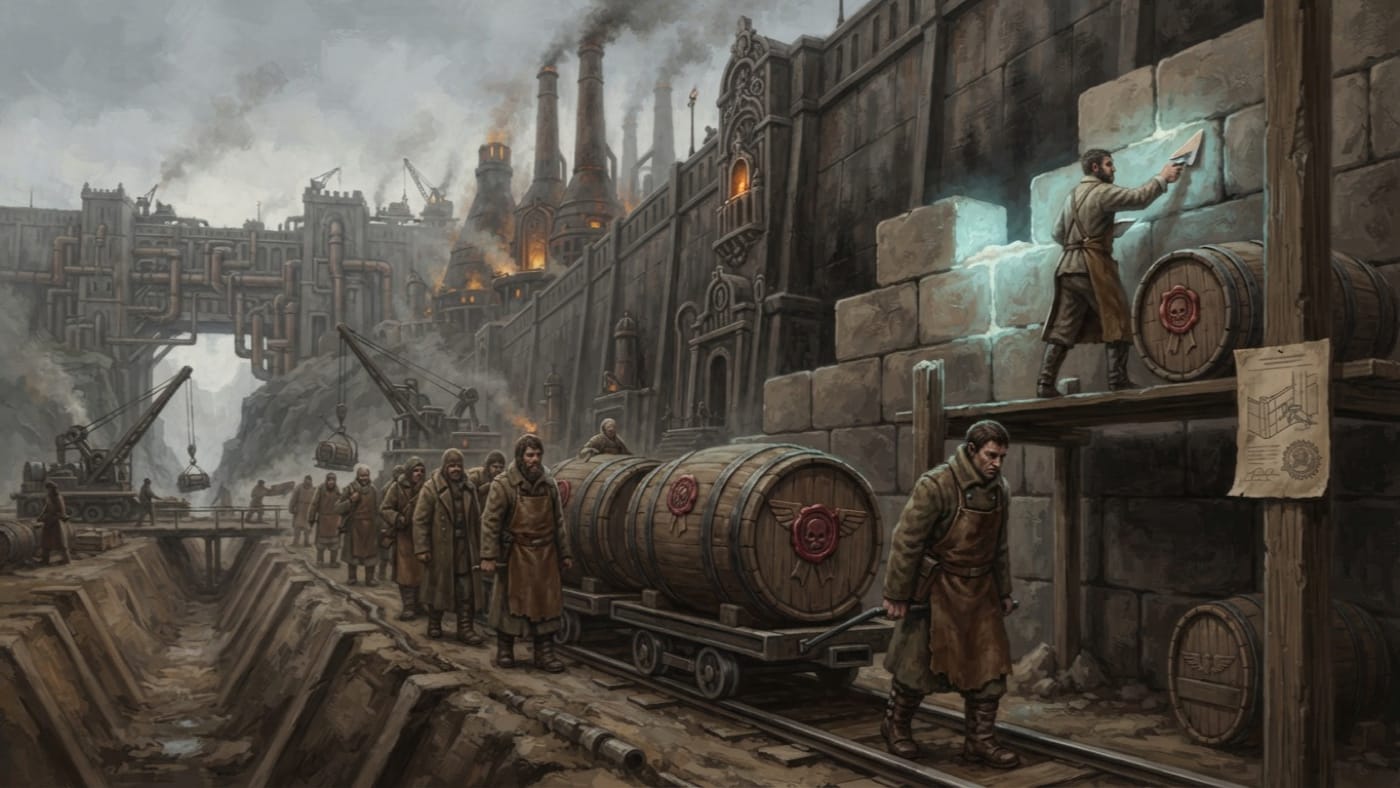
#On the Substance
Bone-lime is the Church's answer to a question it prefers nobody ask aloud: what is a saint for, once the shelf is full?
The answer is weight. A licensed Saint-Bone Melter receives fragments the law has found renderable and burns them in a witnessed kiln. What comes out is a white ash-lime, which yards press into cakes or carry loose in lidded bins. That is sanctified lime. Slaked with water and worked into aggregate at a logged ratio, it becomes sanctified mortar, which masons barrel, seal and spread into the seams of the Sagittal Line. In the trenches both stages are called bone-lime. This Codex follows the trench, having found that correcting soldiers on vocabulary produces more grammar than walls.
A third substance shares the name and carries none of the stamps. The common remains economy burned ordinary bone into road lime, whitewash, culvert seal and cheap walling long before the Acts were drafted, and the Lime Yards of Marrowgate still ship it by the barge. A Marrowgate barrel without a wax batch seal and a render-ledger entry holds the anonymous dead of the cordon, the floods and the fever wards. It contains no saint. Shrine-keepers who write to the Bureau demanding to know which martyr went into the hospital latrine should first examine the cask.
#On the Relic Made Material
The Ossuary Overflow Winters of A.S. 73–76 left the forward racks holding more holiness than any chapel could venerate or any clerk could count. Duplicate femurs disputed a single name. Cracked reliquaries leaked teeth into the sweepings. Fragments arrived with no provenance beyond a crate stencil and a smell.
Then the reports of the Cracked Ring Sieges came up from Bastion-Constantinople. The dispatches said that under Maldrake's bombardment, sections sealed with calcined relic material held where common mortar opened. The Codex prints the observation as the dispatches gave it. It was a wartime correlation, gathered by frightened engineers between shell-falls, and it was enough. Policy has been built on less. Most of it has.
The Saint-Bone Melting Acts of A.S. 96 (1806 CE) turned the correlation into procedure. Relics authenticates the fragment. The Bureau of Tithes values and reclassifies it. The Bureau of Rites withdraws devotional access. The Bureau of Engineering processes it. Doctrine justifies, Records copies, War requisitions. Only surplus, damaged, duplicated, disputed and unassignable fragments may enter the render queue. A protected fragment stays in its vault however loudly a colonel describes the breach. A fragment with a famous name may still carry a valid render classification. The name decides devotion. The tag decides the kiln.
Doctrine calls the result multiplication: a relic is not lessened when its sanctity is spread through a thousand feet of curtain wall. The administrative phrase is reallocation of sanctified function, and the institutions that coined it maintain that it is accurate. Devotional tradition supplies Saint Aurel of the White Wall, who is said to have offered his own bones to a bastion. The tradition comforts the Melters. Its paperwork is thinner than its plaster icons.
#On the Making
Seven steps carry a fragment from crate to seam. Each has its own way of killing someone.
Intake and classification. Crates are opened against their tags, and the tags are checked against the relinquishment papers that the Dead-Goods Tariffer and the Relics clerk have already fought over. Crates of risky provenance are kept apart. A mixed crate is how a protected tooth reaches a kiln, and a protected tooth in a kiln is how a Melter reaches the ash pits.
Cleansing. Salt wash, smoke pass, then the quiet hour under bell hush, with the chamber cloth-draped, emptied of personnel and unwatched. Purity salts are licensed for this stage. An Ash-Hand who mistakes them for contraband and dumps the tub will be corrected loudly and in writing.
Calcination. The kiln burns the fragments to ash-lime while a cantor turns the chant wheel through its stages: First Feed, Rising Heat, White Glow, Full Calcination, Cooling, Slake Preparation, Final Set. The wheel's seven litanies do not line up with the seven steps of the process. This confuses every apprentice, because one list belongs to the hymnal and the other to the batch book. Underburning gives weak lime. Overburning gives brittle lime. Both look white to an amateur.
Slaking. Water meets quicklime and the pit answers with heat, hiss and spit. Slake Runners learn to fear the water before they learn to pray over it. Contaminated water spoils a batch. Careless water blinds a runner.
Mixing. Lime and aggregate go together at the logged ratio, entered in the batch book in ink and witnessed. Ratios get rounded when fuel runs short. The book is where the rounding is caught, or where it is hidden.
Stamping. The barrel receives its wax batch seals and ward-compatibility marks, and a certificate declares the fragments rendered for fortification use and devotional access permanently transferred. From here on the paper outranks the paste. By law an unstamped barrel is common lime, whatever it contains.
Delivery and application. Barrels travel covered and under convoy cord, and the mortar must be applied within the prescribed window. Mortar left open in the rain or kept past its window is reported as spoiled. A mason who spreads it anyway inherits the wall.
#On the Seal and Its Price
Bone-lime goes where a gap would be fatal: bastion curtain walls, bell towers, reliquary vaults, ward-lined culverts, and breaches that must close before the next bombardment. Wardwrights insist that a ward line runs only as far as its mortar runs unbroken, and that a seam patched with common lime is a seam the ward must leap. At Bastion-Irongate, bone-lime grout binds basalt to iron in the gorge works above the Danube. The gasket crews dread a cracked bead of it the way other men dread an unexploded shell.
The material costs dearly in three ways. Fuel is rationed, and a kiln waiting on fuel chits sits cold while a crack widens. Clean water must be sourced, covered and tested. The third cost is the shrine. Every barrel was once a reliquary's contents, a pilgrimage route, a chapel's reason to light candles. Rites sends the parish a notice, a drawing of the wall-section and, in good years, an icon.
Where the cost runs high, fraud follows. Common bone or chalk is passed off as holy yield and sold at the sanctified tariff. Stamped barrels are swapped mid-convoy, with the correct seal pressed onto the wrong cask. Both crimes are most often discovered when a wall fails, the least convenient moment for an audit.
#On the Batch That Fails
Most failures are ordinary, and fatal enough. Underburned lime crumbles in the seam. Overburned lime cracks under load. A bad slake throws caustic paste across the pit. Bad water ruins the set. Mortar that sets early in the barrel becomes a cask-shaped stone, and mortar that never sets becomes a stain. The workers suffer caustic burns, blindness, lung scarring, heat collapse and kiln accidents, and the profession counts its cough as seniority.
Black-lime bloom belongs in another file. Reported symptoms include darkening or a black film, sweating, ticking, singing, whispering when wet, and a refusal to set. No single incident has shown them all.
The Purity Melters trace every bloom to a defect: wrong hymn, wrong ratio, skipped quiet hour, misclassified fragment, illicit binder. Their faith in correctness rests on the Purity Kiln Decree of A.S. 142. Rites and Engineering issued it. The Purity faction enforces it as though its members had written it. The Siege Melters answer that a wall under bombardment cannot wait for the third verse, and that their shortened burns have held often enough to keep them employed. The Additive Heretics answer nobody and sell hardening salts out of their coat linings. Purity cites the reported quiet-hour omission at Irongate in A.S. 161 and its weeping seam. Rites recorded the weeping as condensation.
Purity floor instruction states that every black-lime incident proves a procedural defect.
Corrected: every black-lime incident is to be investigated as a procedural defect. Proof has not been supplied in every case.
The Melters offer another explanation, quietly, in kiln yards after shift: the fragment remembers, resents the burn and objects through the wall. The Codex records this as Melter testimony. Contamination, sabotage, and the Great Deceiver's interference in kiln draft and ash remain competing explanations. No office has ranked them.
BATCH QUARANTINE EXTRACT — YARD AND DATE WITHHELD Barrel exhibited black film at lid seam. Contents ticked at irregular intervals. Batch book removed from yard by ██████ prior to witness count. Wall-section previously supplied from same burn: ██████.
The yard's response is fixed. Seal the pit. Stop the chant. Separate the personnel. Keep the ash, the water and the tags. Scrape nothing until it has been witnessed, and send for the Black-Lime Containment Leads. There is no sanctioned remedy. A Melter who tries to fix the batch becomes part of its record.
#On Present Issue
As of A.S. 201 (1911 CE), bone-lime is still issued along the whole length of the Line. Engineering tried to standardize the ratios in A.S. 147 and still requests samples. Tithes values the intake. Rites blesses the withdrawal. War signs for barrels faster than Records can file them. Marrowgate's common lime keeps rolling south beside the stamped casks, and the clerks keep the two apart by seal colour and price.
The wall holds where it holds. Where it fails, an inspector opens the batch book.