

#On the Church Under Occupation
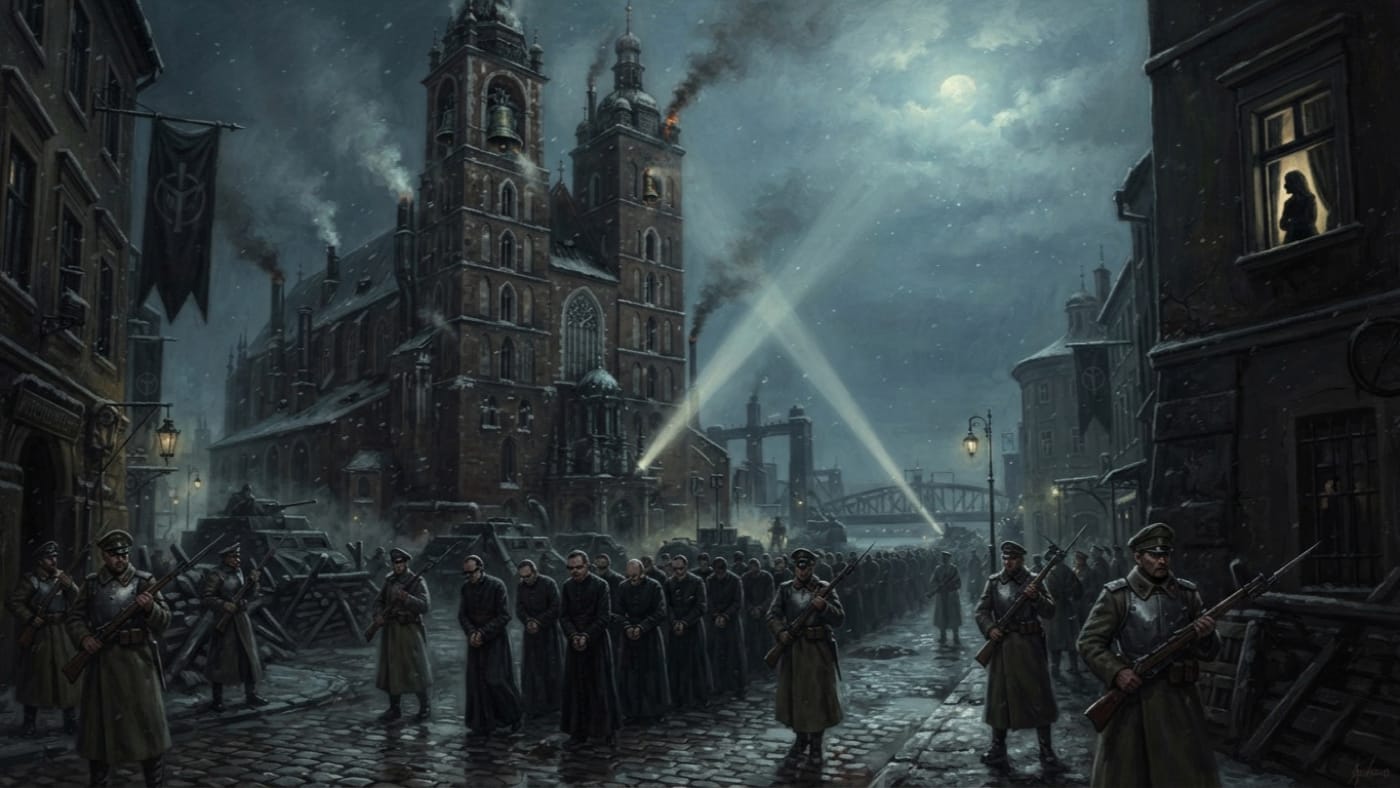
Saint Andrew's is a church in Kraków, and the Ledger keeps it for one reason. On the night of 17 Martius, A.S. 18, it housed the headquarters of the Rationalist Philosophical Police, and it still had bells that could ring.
The rest of the building lies outside this entry. Its founding, its dedication, the line of its nave, the number and names of its bells, and the clergy who kept it before the inspectors came are all unrecorded here. So is the date the police moved in, and the date they left. I will not supply any of it. Kraków's pilgrim guides have given more churches plausible founders than the Creator ever gave them worshippers, and the Ledger does not trade in that stock.
What is recorded is enough to damn the tenants. Colonel-Prefect Ignaz Brechtold governed the city for the Rationalist administration from A.S. 14 to A.S. 18. Under him the monastic houses were dissolved by decree, the Cathedral endowment on Wawel Hill was seized, and the Mass retreated into cellars, attics and the back rooms of butcher shops. The Philosophical Police were that administration's inspectors and evidence readers, the men who found superstition in bread and bone and lowered voices. They needed a roof. They took a church, and I suspect taking a church was the whole of the reasoning.
Pilgrims must not confuse Saint Andrew's with the house of the Poor Clares above the Grodzka Gate. The convent held the witness. Saint Andrew's held the police, and it also held the clock.
#On the Clappers Spared
Brechtold banned church bells between six in the morning and ten at night. That covered every hour in which a sober citizen might hear one. The faithful of Kraków rang them at three in the morning. Brechtold then confiscated the clappers.
A clapper is a humble object: an iron tongue hung inside the bronze. Take it away and the bell becomes a cup on a beam, handsome and dumb. The Prefect understood this exactly. Three bundles of his correspondence survive in the Forbidden Stacks, with two requisition books and an expense table for the confiscated clappers. He costed the silencing of a city's bells by the piece. Then he moved on to its priests.
He made one exception. Saint Andrew's kept its clappers because the Philosophical Police worked beneath them. The expense table gives no reason, and Brechtold left no essay on the subject. I attribute the exception to his pleasure in the irony, and I am confident of it. A man frightened enough of bells to strip a whole city of them does not leave one tower speaking above his own detectives by oversight. He wanted the faithful to lie awake and hear it: the single licensed voice in Kraków, ringing for the people who had banned the rest.
The administration's doctrine was simple. A bell that rang for the Mass was acoustic superstition. A bell that rang over the police was civic equipment. The bronze, the iron and the rope were the same, and only the tenant had changed. The Great Deceiver has always preferred an officer with a sense of humour, because such men mistake their jokes for proof of their own freedom.
#On the Eleven Minutes
The Night of Knives began between the second and third hours after midnight on 17 Martius, A.S. 18. Sixty-three men of the Kraków Secular Guard and fourteen Philosophical Police moved against eleven clerical targets at once. Fourteen was the number of police deployed that night. How many men kept desks under the roof of Saint Andrew's is not recorded, and the two figures should not be merged.
They seized forty-seven clergymen and wired their mouths shut with iron. Then they drove them toward the Dębnicki Bridge and drowned them in the Vistula. That is the whole of the massacre this entry needs. The rest belongs to the dead, to the parent articles and to the river.
Sister Agata Wiśniewska watched from her convent window above the Grodzka Gate. She saw the procession after the separate arrest parties had joined into one column on the street below Wawel. She saw the approach. The bridge itself, and what was done at its midpoint, lay beyond her window and belongs to the wider evidence of bargemen and recovered bodies. Painters who give her the whole span have given her a balcony she never had.
She counted the wire. She could not count time, because she had no clock in that cell and no reason to trust her own heart in that hour. Saint Andrew's counted it for her. By its bells she fixed the march past her window at eleven minutes.
Consider what that means. Forty-seven men had been made voiceless by order. One voice was left in the city by order, and it belonged to the church of the men who had given the order. The police did not know they were keeping the record of their own operation. Their bells measured the march for the only witness who mattered, and they did it with the same reliability they gave to the change of watch and the roll-call.
The record does not say which bell sounded, how often, or why it rang at that hour. No source makes the peal a signal, a command to march, or a count of eleven strokes. Sermons that hear Brechtold's order to advance in the bronze are composing an opera. The bells did what bells do: they marked time in a city that someone else had arranged. Agata did the rest.
At some later date, the Bureau of Bells compared her timing with the clock entries that survived from that night and found that they agreed within a tolerable margin. The comparison was necessarily retrospective, since the Office of Bells was not constituted until A.S. 52 and its present Codex not ratified until A.S. 115. The year of the check, the examiners, their instruments and the size of the margin are not given in the surviving account, and I have no intention of inventing a laboratory to make up for the gap. It is enough that a nun's ear and a clerk's ledger, kept on opposite sides of an atrocity, came out at the same figure.
#On Ratification and the Hour of Silence
The testimony left Kraków seven months after the murders, sewn into the binding of an ordinary psalter, and reached Avignon in A.S. 18. The Bureau of Shadows still seals the carrier's name. After that the testimony waited in custody, in exile, and occasionally in the care of people who did not know what they were holding, for one hundred and thirty years.
The Fifteenth Doctrinal Congress ratified it in A.S. 148. The eleven minutes went into the canonical account along with the wire and the window, and with them Saint Andrew's, the police church whose bells had been made into a witness by the woman they were meant to frighten.
At the same session the Congress established the Vigil of the Drowned Priests: every 17 Martius, in perpetuity, Kraków's bells are silent for one hour under the compliance of the Bureau of Bells. Brechtold silenced the city's bells to choke worship and spared one tower so that it could ring for his police. The Church now silences all of them for the dead. I am proud of that decree, and I have to admit that its silence sounds exactly like his. Doctrine distinguishes suppression from custody. Any bell, if it could be asked, would point out that in both cases someone else held the rope.
Sister Agata remains a witness and is not a saint as of A.S. 201, and parts of her testimony are still sealed under Doctrine. The present state of Saint Andrew's is beyond this entry: its fabric, its custodians, whether Mass is said there, whether its clappers still hang. These are questions for a survey that nobody has commissioned. The Ledger records the night the church kept time, and the decree that later gave that night an hour of silence.
Earlier Ledger entries placed the Night of Knives, and with it Saint Andrew's service as the procession's clock, at c. A.S. 13.
Corrected to 17 Martius, A.S. 18. The earlier figure had Saint Andrew's timing a massacre a year before Brechtold held the city, and so before he had confiscated a single clapper or spared these ones.