

#On the Tower and Its Hour
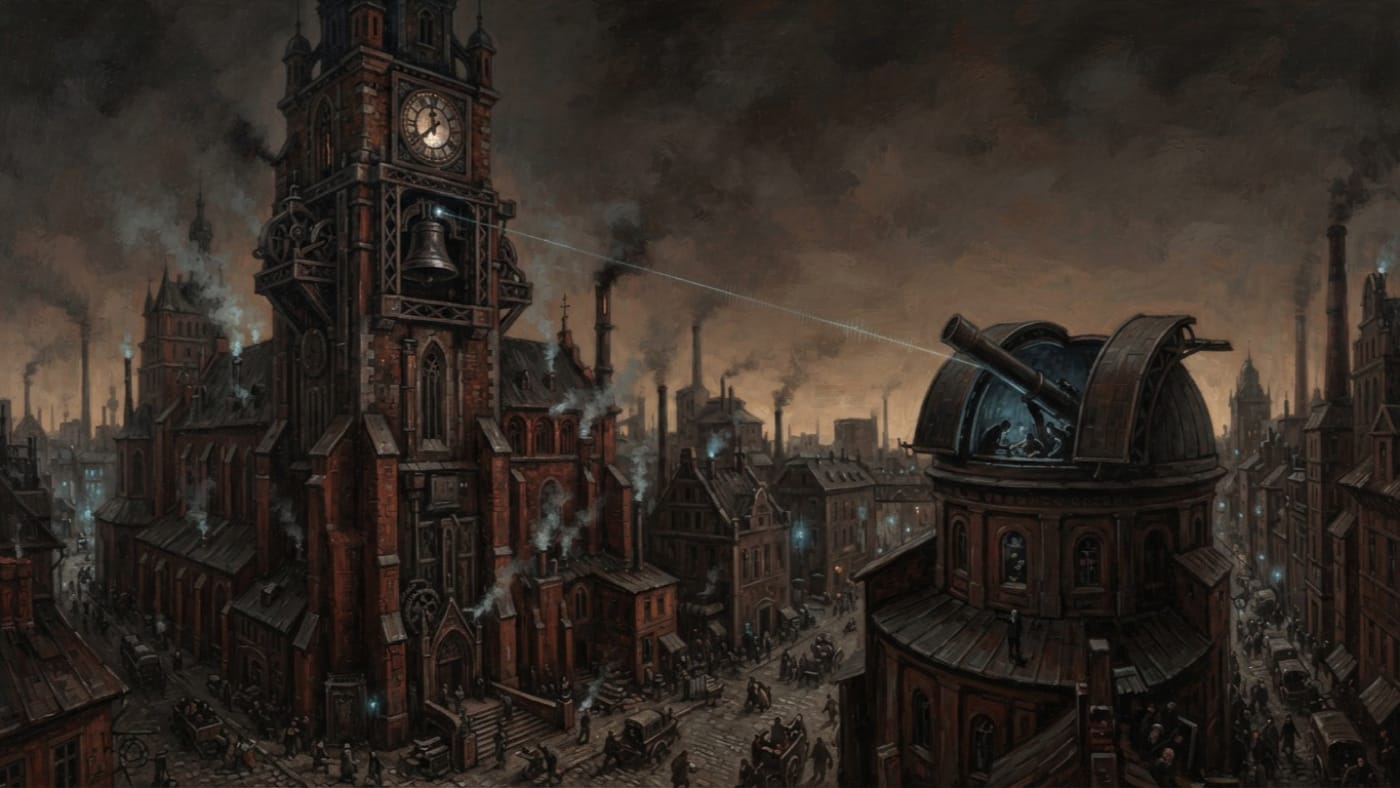
Saint Stanisław's is a church in Kraków. It has a clock in its tower and a bell under the clock, and as far as the Sacred Ledger is concerned that is nearly its whole biography. The saint of its dedication is not before this Bureau, and neither are its parish registers. What is before this Bureau is a single line in the file of the Condemnation of Kraków, sealed in A.S. 199. It records that the university astronomers' telescopes were calibrated against the tower-clock of Saint Stanisław's, whose bell had not been certified for scientific use.
One line. I have built condemnations on less.
The astronomers kept their instruments in a rebuilt lecture hall in the old university quarter, under a roof that opened on mechanical shutters. They did not keep them in the church. The File records no brass tube carried up Saint Stanisław's stair and no sermon on planetary motion preached from its pulpit. If a building may offend, the church offended only by being correct in public, at regular intervals, where any clever person with a notebook could hear it.
Kraków was already known to the Ledger for the Night of Knives of A.S. 18, for priests in the Vistula and for a long Rationalist habit of asking questions in a raised voice. Those are older wounds and other files. Saint Stanisław's enters the Ledger in A.S. 199, by the sound of its bell.
#On Borrowed Time
Anyone who observes the heavens needs an hour to measure against. A star's position is worthless until one can say when. The astronomers of Kraków had no when issued by any Bureau, so they borrowed one from the nearest reliable tower. They set their reckonings by the stroke of Saint Stanisław's. Then they wrote it down, which is where every heresy acquires its paperwork.
Bells in the Church's territories exist to mark the hours of devotion. Since its constitution in A.S. 52, the Bureau of Bells has governed when, how and in what tones they ring. Whole provinces rise, labour, fast and fall silent at Compline because a bell has told them to. A bell is an instrument of summons. It calls the parish to prayer and tells the baker that the loaves are late. Both uses are ancient and approved.
A bell cast to summon a parish has been given no commission to supervise Jupiter.
I can already hear the objection, because every heretic with a pocket-watch raises it: an hour is an hour. On this view an hour struck in a church tower is the same hour whether it calls a widow to her prayers or a student to his eyepiece. The astronomers' whole error sits in that sentence. An hour struck for devotion belongs to devotion. When they carried it across the university quarter and fastened it to a lens, they changed its use, and use is a matter of jurisdiction.
The bell's lack of scientific certification is no charge against the bell. The File mentions the church's ordinary ringing nowhere among the counts. It names none of its clergy among the accused and lays nothing against whoever winds its mechanism. The tower kept faithful time. That was the trouble.
#On the Kraków File
The matter came to the Bureau of Doctrine the usual way, through a student's margin. A provincial catechist found three Kraków students correcting the approved cosmology chart in ink. One note read Mars does not behave as printed. Another read The table is wrong by seven minutes.
Seven minutes, measured against what? The File does not say, and I will not have it say what it does not. I do know which clock in that quarter the astronomers trusted.
Doctrine took the case because Doctrine owns the chart. Twenty-one persons were brought to Strasbourg: six principal astronomers, twelve assistants, two lens-grinders and one clerk with unwisely beautiful handwriting. Doctor Aniela Rudzka was senior among them. Witold Sarnek was the youngest of the principals and the most delighted with himself. The hearing ran two days. On the first the astronomers presented calculations. On the second the Bureau presented jurisdiction, and the decree was sealed at the Tower of the Quill.
The decree's second principle holds that instruments do not confer interpretive licence. Lenses are tools, not ordinations, and calibration is not sacrament. When I set that last clause down in the Gallery, I was thinking of a bell in Kraków.
The astronomers took the Church's own measure of the day and believed it lent them the Church's standing to correct the Church's own diagrams. A thief who sets his watch by the cathedral does not thereby become a canon. The precision was borrowed, and the authority was never in the loan. Sarnek's tables could fix a planet to the minute because Saint Stanisław's had fixed the minute first, under a bell that had been consecrated to an office and had nothing to do with an observatory.
Rationalist philosophy has always made this mistake, and it does so with great confidence. It sees that the hour is accurate and concludes that the hour is free. The Bureau sees that the hour is accurate and asks who rang it.
#On the Division of Clocks
The confiscated inventory in Records Annex K-17 lists nine telescopes, four brass astrolabes, two transit circles, sixteen star charts, forty-seven notebooks, a clock of unacceptable accuracy and one difficult mirror. The tower-clock of Saint Stanisław's is not on that list. A tower is a hard thing to put on a list, and harder to fit in a cart.
The clock was dismantled.
Read: A clock was dismantled. The Kraków File nowhere names the tower-clock of Saint Stanisław's as the clock taken apart and shared among seven Bureau offices, and it records no seizure at the church. Readers will not identify the brass gear in Cabinet Astrum-3 as a fragment of the tower. Petitions to the Bureau of Relics for it as such will be returned unopened.
The sentences fell where the File put them, on the astronomers and their observatory. The astronomers went to the Paper Mines of Ulm. There they count reams with the precision they once wasted on Saturn, and they make the rag-bond on which the approved charts are reprinted. The observatory was sealed for ninety days and reopened as the Institute for Approved Celestial Devotion. Its shutters came off and stained glass went in. The Index Claritatis took parallax and retrograde into restricted lay speech.
Saint Stanisław's received nothing. It had committed no act. It rang.
This is how the Bureau handles measurement, and lesser minds call it inconsistent. A clock in the possession of heretics is an instrument of heresy and comes apart under seal. A clock in a church tower is an instrument of devotion and goes on striking. The two may be equally accurate, and accuracy does not interest the tribunal. Ownership does, and so does the purpose of the stroke.
#On the Question of the Hour
Kraków has given the Ledger a church with no saint on file, no named clergy and no place among the accused, whose only recorded act is keeping excellent time. I would leave it there if the question it raises were small.
The question is who may use the hour. The Creator orders the heavens. The Church rings the hours of that order so the faithful can keep them. Doctrine says what the hours and the heavens mean. A clever person with a notebook may listen to the bell, as every soul in the parish may listen. That person may not take the stroke away, harness it to brass and come back with corrections to the catechism. Measured time, once it is used to interpret, falls under the same jurisdiction as every other instrument of interpretation, which is to say mine.
The tower of Saint Stanisław's has never been surveyed by this office, and I certify nothing about its present condition. Whether it still keeps such excellent time is a matter for Bells.