

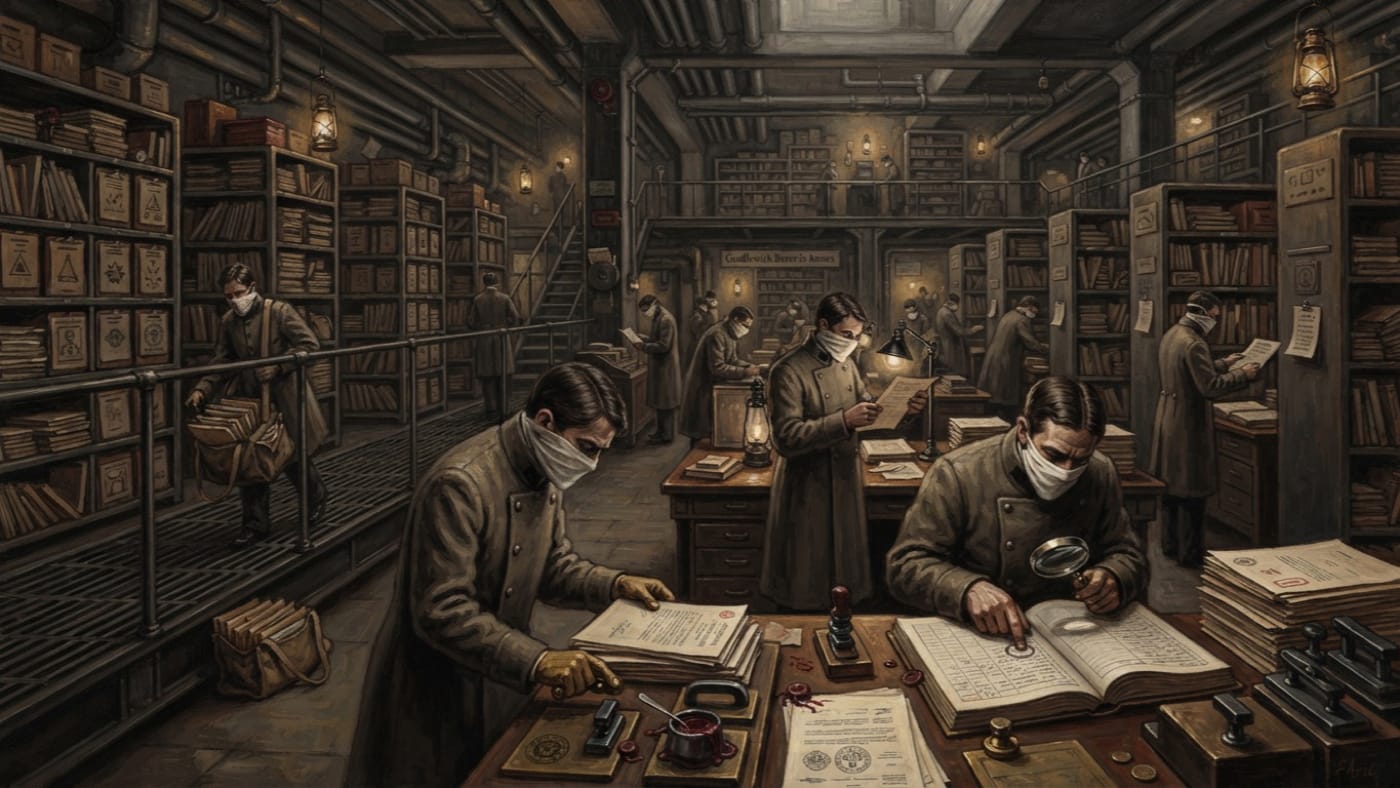
#On the Annex's Jurisdiction
"Nothing is forgotten." — motto of the Bureau of Records
A crate of sanctioned ink leaving Candlewick needs two permissions. The Chromatic Registry certifies that its shade is lawful. The Records Annex supervises the seal that lets it go. Without the second, the first is a pretty colour in a bottle, and a bottle without its export seal has no lawful business at the Seal Locks.
The Candlewick Palatinate governs itself through three instruments. The Seven-House Palatine Guild Compact votes by quota weight. The Synod Charter Court adjudicates. The Records Annex audits, and that is where the Bureau of Records lodges inside a guild city that would prefer to be audited by nobody. Periodic Records audits can override local decisions. The Houses may vote whatever they please. At intervals the Annex decides whether the vote took place.
This arrangement gives the Annex no crown. It holds no seat in the Compact and does not try cases. It has something more durable than either. It can open a ledger at any page and ask why the numbers are so tidy.
The Annex's installation alongside the Palatinate's charter is attested. The year is not secured in any source I am prepared to sign, and I will not take one from an inventory row so that the paragraph looks finished. Records has survived worse gaps. Records usually caused them.
The Annex is surrounded by silent zones. This survey does not record their width, their origin or the price of breaking them. Candlewick's citizens record them anyway, by shutting their mouths several paces before anyone has asked them to.
#On the Materials of Authority
Candlewick supplies wax seals, sanctioned inks and watermarked paper to the whole Synod. A magistrate in a River-belt market town who receives a conscription order checks three things. Is the shade on the registered list? Is the wax whole? Does the watermark show when the sheet is held to the lamp? He cannot assay mordant chemistry, and he was never meant to. He trusts the chain behind the document, and every link of that chain runs back through one canal city.
The chain is recorded in plain words. Mordant salts come from House Vatmarsh on Vatmarsh Row. The ink is bottled at Bottle Quay. The Chromatic Registry certifies it. It is sealed for export under Records Annex supervision. The wax for that sealing comes, like most of the city's wax, from House Wickwarden. The Registry's own published docket names the Annex as its parent authority. I give that as the Registry's statement. The sources supply no complete chart of the Bureau's Candlewick offices, and I have no wish to draw one in fresh ink and watch it grow opinions.
Look at the order of the links. The Annex stands at the last gate, where legitimacy is pressed into wax and sent east. Everything before that gate belongs to someone else: salts to one House, wax to another, glass to the Quay furnaces, shade to the Registry vaults. The Annex audits the Houses that make the ink in which it writes the audit. The Registry certifies the material on which its certificate is written. A recipient in Lyon or on the Line sees the end of this procession and calls it proof.
The Houses know it. Vatmarsh's public face reads "We fix the ink so words endure." Wickwarden's reads "We keep the world lit." Neither sentence mentions the Annex, which needs them more than they need it.
#On the Clerks and the Houses
The Annex wants single-source ink: one recipe for all Bureau inks, held under Registry authority, with one chain of custody and one place to look when a page misbehaves. The Palatinate's published plan lists that unification beside expanded Seal Locks and the purification of the Black Canal. A plan is a list of things that have not happened, and none of these has.
The Houses resist. Recipe autonomy is their profit, their tradition and their leverage over a Bureau that cannot write without them. Vatmarsh holds the salts and fixing agents. Wickwarden holds the wax and, through it, the lanterns, which matters more in Candlewick than outsiders believe. Neither House will hand its formula book to an office that already holds the power to audit it. When the Annex calls a single recipe "security", the Houses hear confiscation. Both are describing the same document.
The struggle is fought in Compact chambers and Charter Court filings. It is paid for on the desk floor. The profession's audit rite is the same wherever Records keeps a seal room. Inspectors smell the wax, scrape seals, test ink, count pages, compare duplicates and check margins first, because margins are where clerks hide things. Audit cycles run monthly. During audit weeks clerks wear face-cloths "to prevent contamination", and nobody asks whose. Page-runners carry the forms. Register-clerks and seal-operators carry the blame.
In Candlewick, Records audits have a known habit of turning into purges. When an audit finds shade variance, it rarely finds a Vatmarsh matriarch. It finds a junior clerk with mismatched wax and a nervous hand, and that clerk is taken behind the screen, where corrections are made in private. The city calls the worst outcome "friendly severance": erasure by correction. It is friendly in the way the stamp is friendly to the wax.
#On the Certified Page
Since A.S. 143 the Annex has supervised the export sealing of a material that sometimes changes its mind.
Hungry Ink was first correlated that year with atmospheric ash in Candlewick mordant stock, after the Year of Ash Rain that followed Maldrake's burning of the Thracian forests. A correlation does not establish a mechanism, and the Bureaus have spent fifty-eight years declining to establish one. The progression is documented. A black halo appears at the margin. Words slough from the fibres. Then come rewritten clauses. Through all of it the ink spares the seal, the signature, the date, the registry shade and the fee stamp.
Set that list beside the Annex's work. Everything the Annex can vouch for survives. The one element it cannot vouch for after the bottle leaves the city is the sentence, and the sentence is what changes.
The A.S. 199 case is the one the public remembers. During the Fading Winter, fourteen conscription orders across the River-belt changed their destination from Bastion-Przemyśl to a village absent from every published map. Three conscripts were delivered there before anyone caught the error. Their escort came back with frost on their cuffs and no memory of the last road. The village's identity and location remain unresolved. I do not attribute the Fading Winter to the ink. I attribute fourteen orders to it, every one with valid seals.
Conscription orders, transit passes, ration permits, quarantine writs, debt instruments, death certificates and property-bearing marriage writs all carry Candlewick ink. An altered page harms its subject while keeping every outward sign that an office meant it. The citizen obeys the seal. The seal was honest. The clause was not.
Certification attests to a batch at the moment of sealing. A seal attests to an issuer. Neither attests to what the page will say next week, and no stamp in the Annex's possession claims otherwise. Neither does an intact seal shield a page from later invalidation by a competent office. The wax promises less than the public reads into it.
Correction is where the Annex's ordinary habits fail. The audit rite scrapes seals and tests ink. The handling protocol for suspect Hungry Ink material forbids scraping, wetting and correction by hand. On suspect paper the auditor must set aside the very tools that define his trade, read the page aloud before three witnesses, seal it under salt-glass, and report before interpreting.
The Chromatic Registry's A.S. 187 manual advised clerks to "overwrite affected text in fresh sanctioned ink."
Withdrawn after the Maastricht quarantine writ produced two contradictory districts, both lawfully sealed and both enforcing. Overwriting feeds the phenomenon. The fresh ink came from the same city, which in hindsight was a poor qualification for a remedy.
The remaining countermeasures are salt-stopping, wax overcoats, cold storage, duplicate copies and witnessed oral recitation. Each is imperfect in its own way. Salt-stopping pales certain shades and invites a variance challenge. Wax overcoats can trap the hunger beneath the surface. Duplicates have altered together. Recitation puts memory in competition with paper, and the Synod has never liked unsupervised memory. Salt treatment proves only that salt was applied. It does not prove that the salts in the vat are clean.
Fire is cleanest and least lawful. Many affected pages are charters, ratified instruments or death records, and burning them is a separate offence. The Annex certified the bottle and may not burn the page.
#On the Present Account
As of this survey in A.S. 201, Candlewick still ships sanctioned ink. The Registry still certifies batches, and export sealing proceeds under Records Annex supervision. Hungry Ink remains a Category Two Localized Scribal Anomaly with reclassification pending. That is three offices continuing their business around a question none of them can close.
The Annex's answer is the single recipe. One formula and one custody, it argues, would leave one chain to audit and one vat to blame. The Houses' answer is that one recipe means one owner, and that the owner would be the office already holding the audit warrant. Each side has stated the other's motive accurately. The dispute is unresolved. The ink is unaffected.
Meanwhile the Black Canal trades in counterfeit seal dies and name packages that rewrite a person's place in Records. The legitimate economy and the illegitimate one now sell the same product, which is a document whose authentication outlives its wording. The canal at least charges less.
The Annex continues its supervision. It does so because the Synod cannot stop writing, and Candlewick is where the writing comes from. Its seal is still honest and its wax is still whole. What the page says on arrival is a matter for whichever office reads it first.