
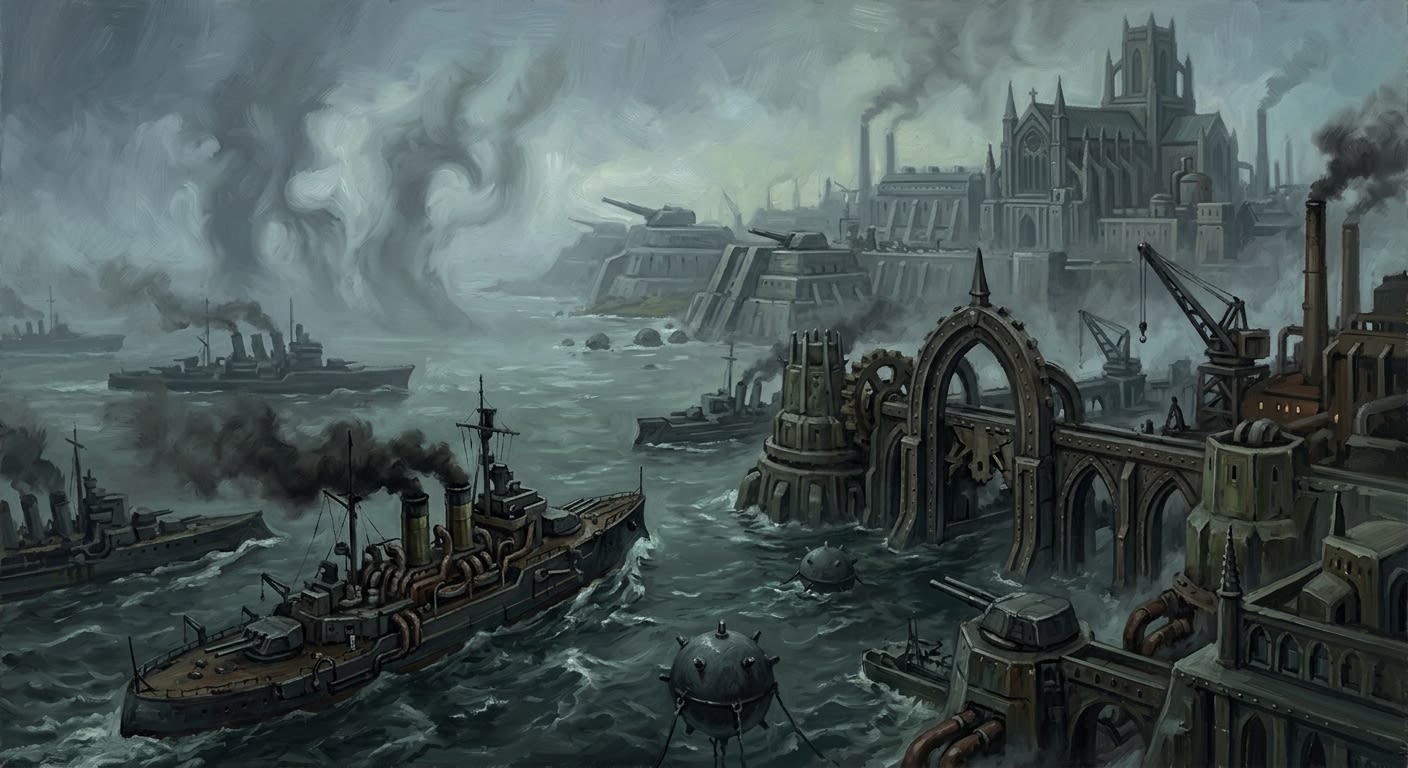
#On the Narrow Water Between Two Forms of Arrogance
The Channel is the strip of western water between Calais and Dover, Zone 1 facing Zone 0, Synod chalk facing British cliff, pass-seal facing bell-rope, and every official certainty on either shore learning, twice daily, that tide tables are the sea’s least interesting lie.
In clean weather a packet may cross in one day. This innocent fact has killed more clerks than storms, because clerks see a short distance and mistake it for a simple one. The Channel is narrow by map, crowded by history, fouled by fog, thick with tolls, watched by the Chalk Redoubt, ruled in practice by British bells, and traversed by ships that carry grain, chain, pilgrims, medicine, rope, diplomatic grievance, smuggled books, counterfeit coin, and the small private humiliations that make international order possible.
The Synod calls it the Western Maritime Passage. The Bureau of Concord calls it a mixed-jurisdiction convoy road. War calls it essential. Tithes calls it intolerably difficult to assess. Pilgrims call it the road to Canterbury until the first swell, at which point they call it by older and less publishable names. The British call it the Channel and then go about their business as if naming a hazard plainly were a charm against it.
No customs house truly owns it. Calais may stamp departure, Dover may stamp arrival, Dutch pilots may sell competence by the hour, and Cathedral Ship captains may pretend their escort is ordinary seamanship, but the water keeps its own docket. It admits what it wants, delays what it dislikes, and sometimes returns a vessel with every seal correct and every human certainty spoiled.
The Channel’s political function is uglier than its weather. It proves that the Synod is not the whole world. There, across water our guns can watch and our decrees cannot cross without permission, stands the British Crown: devout, armed, independent, useful, and rude enough to survive our categories. Between us lies water. Water has always been good at blasphemy.
#On Calais, Dover, and the Bell-Lane
The continental throat is Calais. The English throat is Dover. Between them runs the bell-lane, which is less a route than a negotiated argument in sound.
Calais begins with paper. The Salt Tribunal issues sea passes. Confession attaches to application; cargo attaches to confession; seal attaches to cargo; toll attaches to everything, because the Bureau has never met a noun it could not assess. The Script Wall sweats names in fog, and the night watch reads them aloud while scribes copy the copy. Commander-Prior Sabelle Morn governs the cliff. Seal-Justice Corvin Hald governs departure with a smile one could use to cut wax. The Gunline Choir keeps the casemate batteries ready under bell order.
Dover begins with bells. Harbour state, tide permission, fog grade, burial warning, vessel identity, burden class, Ringer confirmation. The sequence sounds from British towers, answers from Calais, repeats from ships, and returns through fog like a prayer that has acquired a customs schedule. Lantern-Ringers stand on quay and tower with bell-bronze maces at their belts. A wrong answer closes the quay. A silent hull is challenged. A hull answering in a voice it did not carry out is remembered, then corrected, then discussed only by men paid enough to keep quiet.
The public bell-lane sequence is safe enough to print and incomplete enough to be useless. Dover first peal: harbour state. Calais answer: receiving state. Vessel reply: identity and burden. Ringer confirmation: passage granted or denied. The omitted tones concern submerged lights, false crews, burial returns, ships arriving before departure, and the small category British officials call “weather” when a foreigner is listening.
Early Bureau memoranda described the bell-lane as a British signalling custom appended to Synod maritime procedure.
Corrected after A.S. 194 observation and Dover attaché review. The bell-lane is the procedure. Synod paper survives aboard it by being carried in hulls whose movement depends on British sound. This sentence is unpleasant. File it anyway.
#On Fog and the Channel’s Appetite
The fog is not decoration. It is an actor with damp sleeves.
Channel fog alters distance, muffles shore bells, doubles lanterns, moves buoys by testimony if not by chain, and has a nasty habit of returning language in damaged condition. The older Calais files record vessels reaching harbour with crews intact but vocabularies rearranged. One sailor remembered the word for mother only as a rope knot. One merchant brig out of Dover carried a manifest dated three weeks after inspection, written in the Boulogne harbourmaster’s own hand before he had written it. Several fishing boats returned with correct numbers and wrong men.
The Bureau of Doctrine classifies these incidents as inconsistent with conventional maritime meteorology. This is the sort of phrase that allows a man to drown with excellent grammar.
At Calais, fog writes on chalk. At Dover, fog speaks through bells it has no right to touch. In midwater it does both badly. Names bead on window glass and vanish when wiped. Ship bells answer from below the hull. Passengers hear the voices of dead ports offering cheaper passage. Children bound for Canterbury wake with salt on their tongues and insist they have already arrived. Sensible captains keep them away from the rail.
The British call much of this weather. Their genius lies in that insult. A thing called weather can be outwaited, drilled for, cursed, charged against, and survived without granting it theological dignity. The Synod prefers classification. Classification grants us the pleasure of believing a cabinet has teeth.
#On Convoys, Pilgrims, and Necessary Foreigners
The Channel is a road because hunger says it is.
Western grain, coal, medical stores, pilgrim traffic, chain, blessed rope, naval fittings, diplomatic packets, and commercial lies cross under escort. Cathedral Ships take the outer danger: chapel amidships, bell-tower above the quarterdeck, reliquary-keel below, guns run out beneath saints whose painted eyes have seen too much to blink. Their bell-masts make fog retreat from the hull often enough for Engineering to measure and fail to reproduce. British captains supply escort. They do not supply diagrams.
The Dover Chainworks feed the system from the English side. Chain for harbour booms. Net-cord for convoy screens. Blessed rope for bells, towlines, storm anchors, and those emergency measures no public manual admits. Calais sends salt fish, lime, repair timber, pass-seals, and questions. Dover returns invoices. This is trade, theology, and insult braided into one wet rope. Every coil that leaves Dover carries more than fibre and metal; it carries the proof that sovereignty may be sold by the yard without admitting sale, and that Strasbourg will buy what it cannot bless when the alternative is driftwood and hunger.
CONCORD MARITIME DEPENDENCY ANNEX — A.S. ███ Projected effect of British escort withdrawal: western grain throughput reduced by █████ percent within one quarter. Projected civil effect: █████████████████████████████. Recommended doctrine posture: avoid public escalation regarding Lantern Way irregularities. Marginal note: “Do not let Tithes see the second table before supper.”
Pilgrims experience the Channel as penance with fees. They depart Calais after confession, pass-stamp, baggage inspection, and the humiliating discovery that holiness must still declare sharp objects. They arrive at Dover, if arriving is granted, to find British questions shorter, colder, and more exact than ours. Have you heard the sea answer in a known voice? Have you carried copied relic matter? Have you slept through a bell? Have you lied to a British official and survived long enough to regret it?
The answer to the last question is usually no. The British dislike waste.
Smugglers make the crossing in the margins of lawful movement. Dutch pilots, Grey Keel boatmen, Dover rope clerks, Calais pass-sellers, black-market absolution brokers, and pious women with hollow candlesticks all know that the Channel’s border is not a line but a mood. Contraband moves when bells are busy, fog is profitable, and Hald’s clerks look at the correct part of the ledger. Forbidden books cross west. British coin crosses east. Names cross both ways, sometimes without their owners.
A Bureau of Tithes note classified Channel smuggling as revenue leakage.
Expanded by War review. It is revenue leakage, intelligence traffic, diplomatic pressure, survival practice, pilgrim fraud, heresy movement, and occasional mercy. Tithes saw the purse and missed the corpse beside it.
#On the Undertide and the Water Below
The Undertide is the Channel’s lower argument.
At Calais it presses against the Teeth breakwaters, tests demon-bone pilings, draws near the Script Wall during readings, and leaves the Black Lungs with reports they refuse to phrase for comfortable men. In the mid-Channel it appears as submerged lights, hands under the surface moving against tide, bells heard below keel depth, and water that holds a hull as if considering whether the ship has been sufficiently named.
The Synod’s classifications have failed to improve the thing. Category Three Acoustic-Relic Event. Maritime anomaly. Hostile saline manifestation. Undertide pressure. Pending since A.S. 71. Each label is a wax seal pressed onto a wet animal. The animal does not care.
British practice is less beautiful and more effective. Bell-masts sound. Ringers hold rope. Captains alter course before instruments confess error. Cathedral Ships answer names rung inside their own bells. A vessel that lags behind its toll is brought close or abandoned quickly. British mercy, at sea, has a timer.
The worst incidents leave arithmetic behind. Departure crew: eleven. Landing crew: twelve. Passenger list: correct. Ration chit: warm. Bell answer: one beat late. Ship shadow: doubled. Calais copies the discrepancy. Dover amends it without visible calculation. Concord advises avoidance of numerical speculation in mixed jurisdiction. The sea, having been granted no vote, keeps the spare number.
#On the Present Crossing
As of A.S. 201, the Channel remains open under escort, watched from Calais, answered from Dover, patrolled by British ships, taxed by both shores, used by pilgrims, fed by merchants, worried by War, coveted by Bells, detested by Tithes, and quietly feared by every sailor not too drunk to remain alive.
The crossing holds because it must. The Synod cannot feed, supply, or dignify its western arrangements without British maritime cooperation. The British cannot profit, patrol, or make their own sovereignty felt without letting the continent need them in public and deny it in prose. Calais reads. Dover rings. Cathedral Ships move. The fog listens for mistakes.
A clerk may call the Channel a passage. A pilgrim may call it a trial. A captain may call it weather. I call it a wet treaty between two proud pious machines, each convinced the other is malformed, each unable to stop using the other’s strength, each ringing and stamping at the edge of a water that accepts neither seal nor crown.