

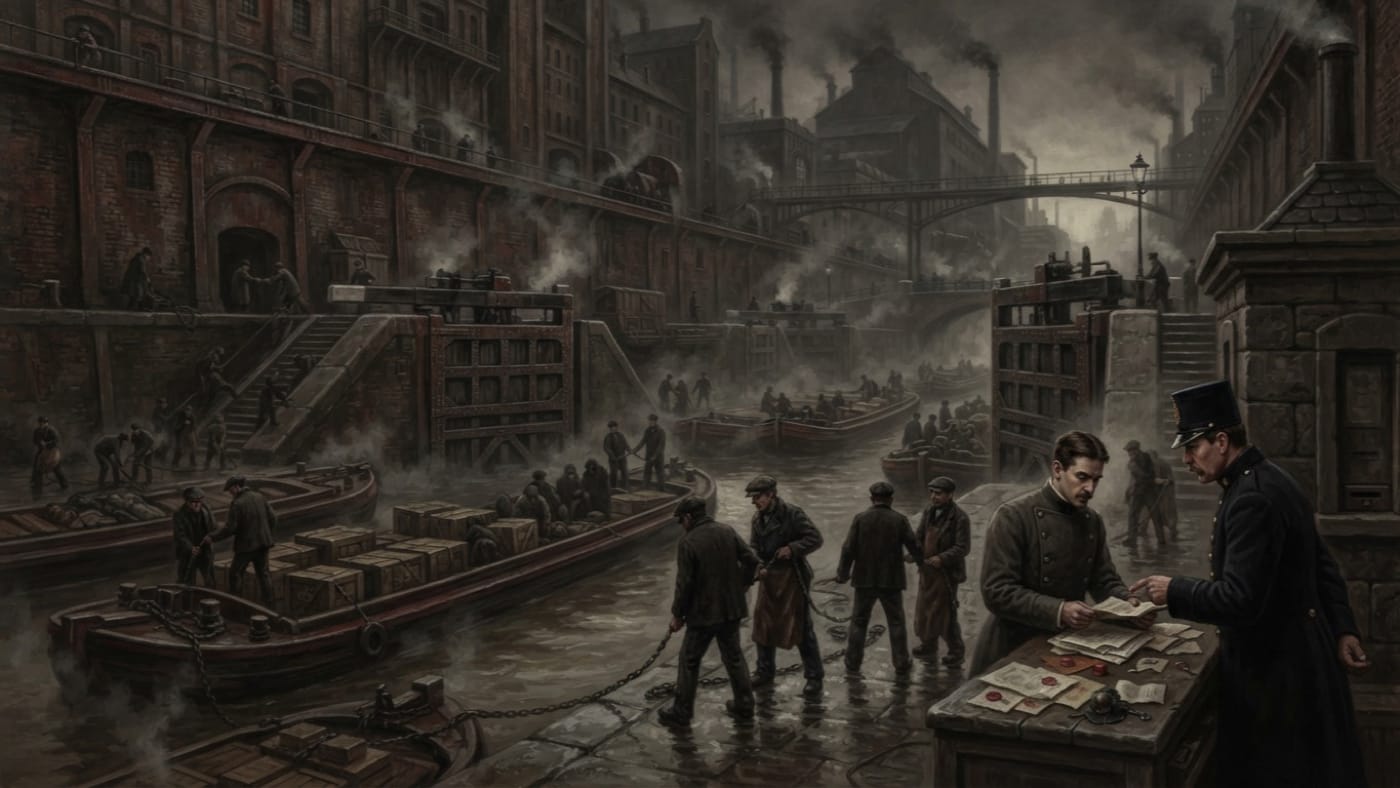
#On the Freight Approach
The Seven Locks are the throat of Essen-of-Hymnsteel. Everything the city swallows has to answer at these gates, and so does every part it sends toward the Line. The gates are never in a hurry. The chambers lie low on the canalized fork beneath the terraces, built of rusted iron, brick laid in bone-lime cement and timber gone black with river damp. At dawn the soot-fog settles on the water like a wet surplice and the gates sweat steam. The district smells of wet rope and wax. The rope belongs to the lockhands and the wax to the seals, and a visitor soon learns which of the two the city values.
Essen has other entries. Sealed wagons run east on the rail spur to Bastion-Constantinople, and permit checkpoints squat on the west road. The Compact still calls the Locks the choke for all freight, and on the point that matters it is correct. The Locks and the Certification Office together are the bottleneck that every clearance must pass, whatever the cargo travels on. How a wagon's papers reach a canal booth is a question for engineers and clerks. I am a theologian, and I record only that nothing ships without seals.
#On Seals and Cadence
Inspection at the Locks is a duet. A clerk of the Bureau of Records in his ink-sash examines the papers and the cargo seals. He looks at the Lock Pass, the certification marks and the Safety Waiver if one is claimed, then at the wax, its impression and the hand that pressed it. Beside him a warden of the Bureau of Orison and Song makes the bearer speak and tests the cadence of the voice, to confirm that the person holding the papers is the person they describe. A perfect seal in an unfamiliar throat is a forgery with good handwriting. A familiar throat carrying a bad seal is an arrest.
A wrong stamp leads to arrest or to conscription, and in Essen the two are neighbouring rooms.
Some cargo can carry no correct stamp at all: unstamped hymnals, unlicensed tuning forks, quiet cloth without the Bureau mark, raw relic bone, Rationalist charts, unblessed sugar and unsealed detonators. The list reads like the confession of a very interesting man. The provincial reader should note that bone-lime goes through by the barge-load. It is mortar. A clerk who mistakes it for relic bone has confused a building material with a sacrament and deserves whatever his superior says to him.
Bribery is impossible at the Seven Locks. Donations to the Furnace Basilica are accepted at every booth. The toll chapels stand within reach of the seal-booths, so that piety and paperwork share a damp wall and, I suspect, a cashbox.
I enter the incident as evidence on one point only: rank buys no passage at the Locks. A Hieromnemon's seal gets the same wet thumb as a tallow-merchant's. The six hours and the eleven days belong to my crate and my humiliation. They are no timetable, and anyone who quotes them as one will be corrected.
#On Those Carried Through
Coal and slag fuel come in, along with bone-lime, grain, tallow, and throat salves for the singers. The coal barges belong to the Bureau of Engines and Furnaces, and Furnace-Marshal Kord counts them the way other men count their pulse. Out go the goods the Sagittal Line cannot do without: bell-cannon throats, hymn-drive housings, reliquary fasteners and the tooling that serves them. Each part leaves under a mark from Arch-Notary Veyl's office, issued for steel that Sister Rauth's choirs have already sung over. Neither office will admit the other did the important half.
People come in through the same queue: refugee labour bound for the warm ducts, and condemned transfers. The same clerks check their papers at the same booths under the same wax, and the transfers are cleared as consignments. A coal barge waits on its seal and so does a barge of the condemned. The coal does not mind.
The lockhands work below all of it. They carry chain keys and haul wet rope, and they rank among Essen's expendable class, beneath every official with the power to suspend their papers. The river beside them is both poisonous and deep. A slip on the lock wall means drowning. A splash in the wrong season means chemical burns. A lockhand who argues with a clerk about either risk will find his own permit marked "pending" before his sleeves are dry.
#On the Lower Passages
There are tunnels beneath the Locks. The record speaks of three of them, unevenly, and I will not tidy it.
The city's own lore records a bribe tunnel under Lock Three. The Essen entry in this Codex says the Bureau of Shadows uses a tunnel there. Both statements can be true. Smugglers and a deniable directorate can share a passage the way rats and priests share a crypt, each convinced the other is the vermin. Neither statement makes the tunnel anyone's property.
Under Lock Five is a tunnel the Shard Market Syndicate uses, according to the same entry. The Syndicate deals in stolen stamps, river skiffs and duct routes, so a way under the very gates that check stamps suits it the way a key suits a lock.
Under Lock Seven is a tunnel that no one claims. I once wrote that this means someone important owns it. I stand by the inference, and I mark it as mine. No proprietor has been identified. Nobody has filed a complaint about the tunnel either, which in Essen is the loudest statement of ownership there is.
I have no record of anything particular at Locks One, Two or Six. Lock Four keeps my letters in its memory and nothing else I can find. I decline to give the seven gates seven saints, seven secrets or a resemblance to anything else that comes in sevens. The Compact numbered them. I leave the numbering as it stands.
#On Closure and Silence
The approved countermeasures against Resonance Bloom include shutting the Seven Locks. The Wrong Choir entry explains the reasoning: closed gates may damp the canal vibration that carries the sub-foundation hum. The word is "may." The same list includes counter-psalms and felted-ash street lining, and superstition adds bone shards nailed into doorframes. Not one item on that list has been shown to work reliably, and the bone costs least.
Closing the gates is a mechanical act. Muting them is a different one. During a panic the Locks can be sound-baffled on purpose and deadened at the freight gates, and the city's own description of the result is "an eerie, lethal hush." It is lethal because a baffled lock hides the warnings along with the noise.
The third silence is the one nobody orders. After a Bloom has sheared rivets, cracked hymnsteel and made listeners bleed from the ears, a whole district can go silent for days. Voices fail to carry and footsteps make no sound. The Bureau cannot license this silence, the Hushwrights cannot sell it, and nobody has ever shown that shutting a gate prevents it.
Lockhands say the gates might one day mute themselves without any command, so that no one could hear the alarm bells. I have found no record that this has happened, and no procedure for what to do if it does.
Compact Report 447-E (A.S. 198) attributed all Resonance Bloom events to Mirror Choir sabotage.
Corrected. Bloom activity predates the Mirror Choir's earliest documented operations by approximately forty years. The Choir has been caught exploiting altered calibration sheets. It did not invent the thing under the city. See Wrong Choir. Shutting the Locks against a heresy and shutting them against a hum use the same chain. Only the second makes the official look foolish.
#On the Present Traffic
In A.S. 201, Strasbourg demands tripled output for hymn-drive siege engines. That means more coal through the gates, more housings out of them, and more papers in the booths. Sister Rauth will not speed up the calibration tempo without liturgical stability guarantees. Kord threatens conscription from the Ash Warrens. If he carries out the threat, the conscripts will come through the Locks under seal like everything else Essen consumes. Veyl's clerks stamp all of it and charge for each stamp.
Every Bloom closure halts a quota. Every quota cuts into the case for closing. The lockhands stand between the two with chain keys in their hands, waiting to be told which risk the Compact prefers this week.