

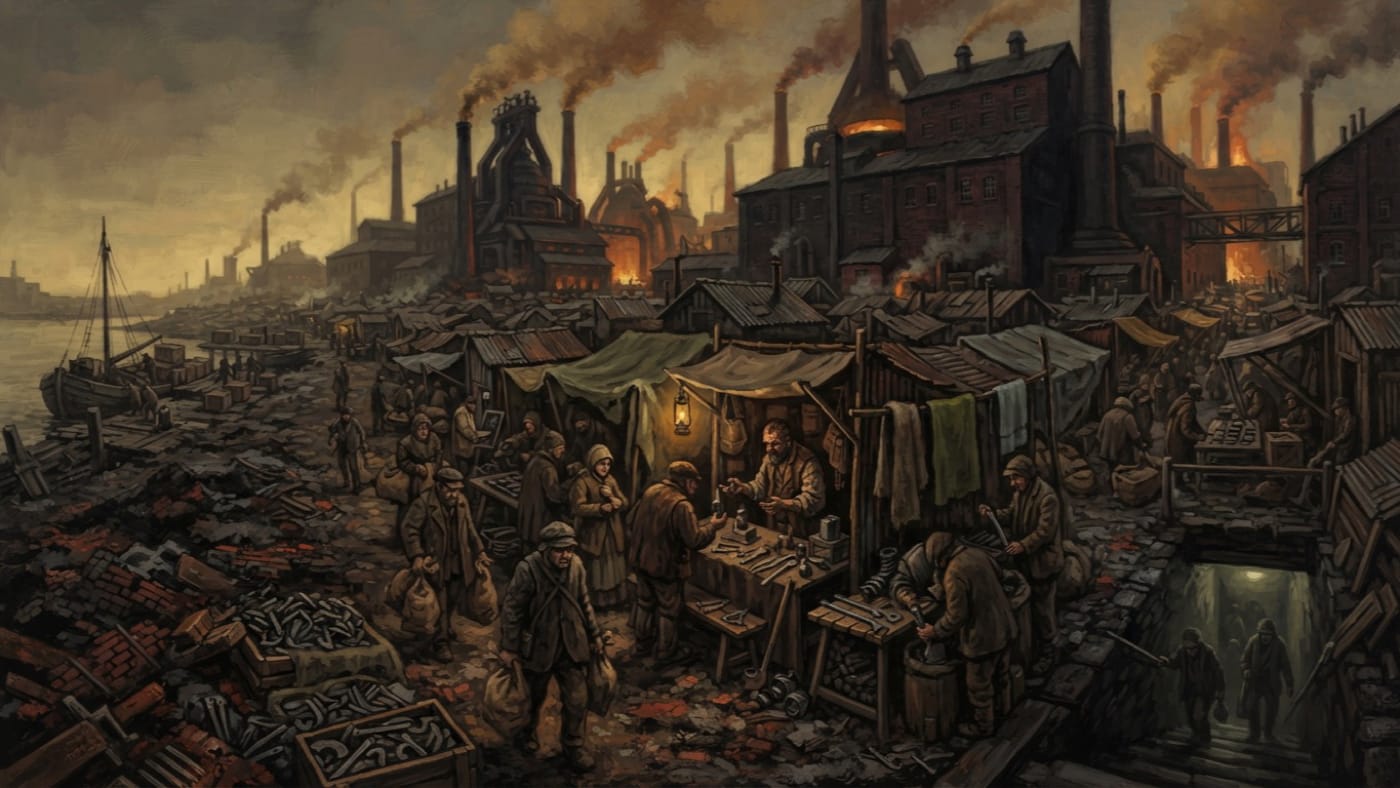
#On the Slag-Ground
The Shard Markets occupy a strip of reclaimed slag-ground between the Foundry Core and the southern terraces of Essen-of-Hymnsteel. They stand above and beside the Ash Warrens and claim to be separate from them, a claim nobody who has walked the place believes. The ground was furnace waste before anyone stood on it and standing room before anyone traded on it. Nobody surveyed it into a district. The brokers came first, and the clerks followed them with forms.
The Markets smell of ozone and cheap tallow. The thunder of the Core reaches them a beat late, the way a sermon reaches the back pews. Rusted iron lies on blackened brick, sorted by gauge. Damp felt hangs from poles. Slag-glass crunches underfoot, and visitors from Strasbourg like to whisper about it. It is a by-product of Essen's own furnaces. Anyone who finds an infernal pedigree in it has supplied the pedigree himself and should pay the duty on it.
Two names need keeping apart. The Shard Markets are a place. The Shard Market Syndicate is a cartel that works part of that place and the underducts beneath it. Most of the people who sell a spanner on the slag-ground owe the cartel nothing more than a careful nod, and some do not owe it that.
#On What Changes Hands
By daylight the trade is scrap. Bent rivets, cracked housings sold by weight, and spanners worn smooth by other men's quotas. A foreman whose certified replacement has been "pending" since the last audit can buy a usable tool here before his gang's ration chits feel the shortfall.
Tooling comes next, and much of it is stolen. A stolen die is still a true die. Theft has changed its owner and left its metal alone. A counterfeit part is a different sin. It lies about what it is made of. A counterfeit seal or a false acceptance slip lies about who inspected the thing and what he found, and of the three lies that one travels furthest. The Hymnsteel file records Shard Market brokers selling false acceptance slips. The Essen survey records a counterfeit ring on the slag-ground selling "safety waivers." Nobody has shown which house that ring belongs to. Each of these is a separate trade, and none of them proves the others.
Then there is quiet. Under Compact Ordinance 7-C, every dampening material needs a current seal from the Hushwright Guild, and unlicensed hearing protection is contraband. The Markets sell hush-cloth, muffling felt, plugs poured from scrap wax, and rooms in the ducts advertised as "false quiet." A riveter who keeps one ear for his old age has committed an offence. He has also stopped being the Guild's customer, and of the two crimes the Guild minds the second more. It lists the Markets among its enemies.
#On Stalls, Skiffs, and Underducts
Kestrel Waxhand keeps a stall of devotional ironwork, small pious iron for small pious purchases, and runs a counterfeit-seal trade behind it. The fingertips are burned. That is all the record certifies about the hands.
Old Juro brokers stolen tooling from a canal skiff that changes its berth every third bell. He smells of ozone, as the Markets do. When the locks are watched, the Warrens account has his ash boys carrying the smaller pieces through the duct-tunnels. Heavy tooling goes by hull, and anything that fits under a coat goes by duct.
The Essen lore names both of them among the Syndicate's figures. It gives neither of them a rank, a founding role or a share of the other's business. I have found no partnership, kinship or division of profits between them, and I have looked with the particular zeal of a man who would enjoy finding one.
The cartel's documented equipment is plain: stolen stamps, river skiffs, duct routes, and the tunnel beneath Lock Five. Those routes exist because the Seven Locks work. At every freight gate a Records clerk checks the seal and an Orison warden tests the bearer's vocal cadence. Paper can satisfy the clerk, but the bearer still has to pass the warden.
After curfew, trade goes below into the hush markets in the ducts. The Ash Warrens and the slag-ground share runners, lovers, debt and knives. One scrap broker up top sells counterfeit tuning fixtures while his sister below rents a listening niche near Warm Duct Twelve. A hush-gear merchant denounces unauthorized silence to the Orison Provost by day and sells muffling felt through a nephew after dark. Not every refugee carries contraband. Every refugee knows someone who does.
#On the Bureau's Permission
The Bureau of Records knows about the Shard Markets and permits them. The Compact regards them as a pressure valve, a controlled leak it prefers to the uncontrolled explosion it fears above everything else. The Syndicate is also listed as an enemy of Records. Both entries stand, and Arch-Notary Veyl has not been heard to reconcile them. Tolerating a piece of ground is different from licensing a cartel. No charter, immunity or private compact between the Syndicate and Ledger Row has been documented, and I will not draft one to make the accounts balance.
Toleration also leaves the registry where it was. A forged Lock Pass may buy a crossing, and a counterfeit ration seal may buy a supper. The rolls that decide whether the bearer exists in the morning stay in Veyl's spire, written in a hand no stall on the slag-ground can reach. The Compact Council describes the Markets' goods as small crimes useful enough to be half-permitted. The phrase is exact, and Veyl decides which half.
There is precedent above the clerks. When the Bureau of War took up its Charter of Crimson Ink in A.S. 105, Essen bargained with its output. If War wanted steel, it would have to accept furnace schedules, labour exemptions and "certain quiet accommodations in the Shard Markets." War accepted and called the acceptance temporary. The record does not date the bargain, and it does not record the Markets' foundation. It shows only that the Synod has long found it cheaper to excuse this ground than to raze it.
#On False Paper and Wrong Sound
Stanza sheets move through the ducts like everything else. Spare sheets, copied sheets and false variants change hands below the slag-ground, and the seizure registers list Discord Scribes buying supplies in that underground trade. Purity has hunted the Mirror Choir since A.S. 187. Its own files complain that the Markets sell false variants to frightened foremen.
The Ledger keeps four separate acts on four separate lines. Selling blank paper is one. Selling a false variant is another. Supporting the Choir is a third. Corrupting a pour on purpose is the fourth. A broker who sells a ream to a copyist has not sung the altered syllable, and Purity, when hungry, forgets the difference. Nothing on file gives the Choir ownership of the Markets or puts the Syndicate inside the heresy.
The false acceptance slip does its damage more slowly. A batch marked "conditionally resonant" passes two desks and a dinner and leaves Essen as "frontline urgent." It reaches the Sagittal Line, where a gun crew taps the throat before firing and learns the truth from the answer. The buyer of the slip is never present when it is tested, and neither is the seller.
The throats that came back from Bastion-Przemyśl cracked along identical grain-lines, although they had been poured on different days by different choirs. Nothing traces that failure to any stall here. It would be convenient if something did.
During Wrong Choir tremors the tools on the slag-ground hum untouched, and below in the Warrens all commerce stops except bone, felt and prayer. Bone wedges go over the duct seams and felt goes over the ears. People attempt these things because they are what is to hand. Nobody has shown that they work. The silence that settles after a Resonance Bloom is a different matter. The Guild cannot install it, and the ducts cannot sell it at any price.
This Codex previously attributed all Resonance Bloom events to the Mirror Choir heresy, per Compact Report 447-E.
Carried forward from the Codex entry for Essen-of-Hymnsteel. Sealed Bureau of Rites review found that Bloom activity predates the Mirror Choir's earliest documented operations by approximately forty years. The withdrawn attribution does not pass to the Shard Markets on its way out of the file. This Codex records no Bloom against any broker, stall or cartel, and it does not intend to find a new culprit simply because the slag-ground is easier to reach than the cause.
#On the Present Trade
As of this assessment, Strasbourg demands three times the output of hymn-drive siege engines. Sister Rauth refuses to speed up the calibration tempo without liturgical stability guarantees. Furnace-Marshal Kord threatens further conscription from the Warrens. The threat has not been carried out, and this office records it only as a threat. Records prints forms for every outcome.
What follows is my expectation, and no tally supports it. A tripled quota wears out tooling faster than the requisition desks can replace it. A threatened draft raises the price of Choir Exemptions above the price of bread. Every crate turned back at a lock sends someone looking for a tunnel. I expect the slag-ground to grow busier. I have not counted a single sale, and I will not give the reader a figure so that this paragraph has something to end on.