

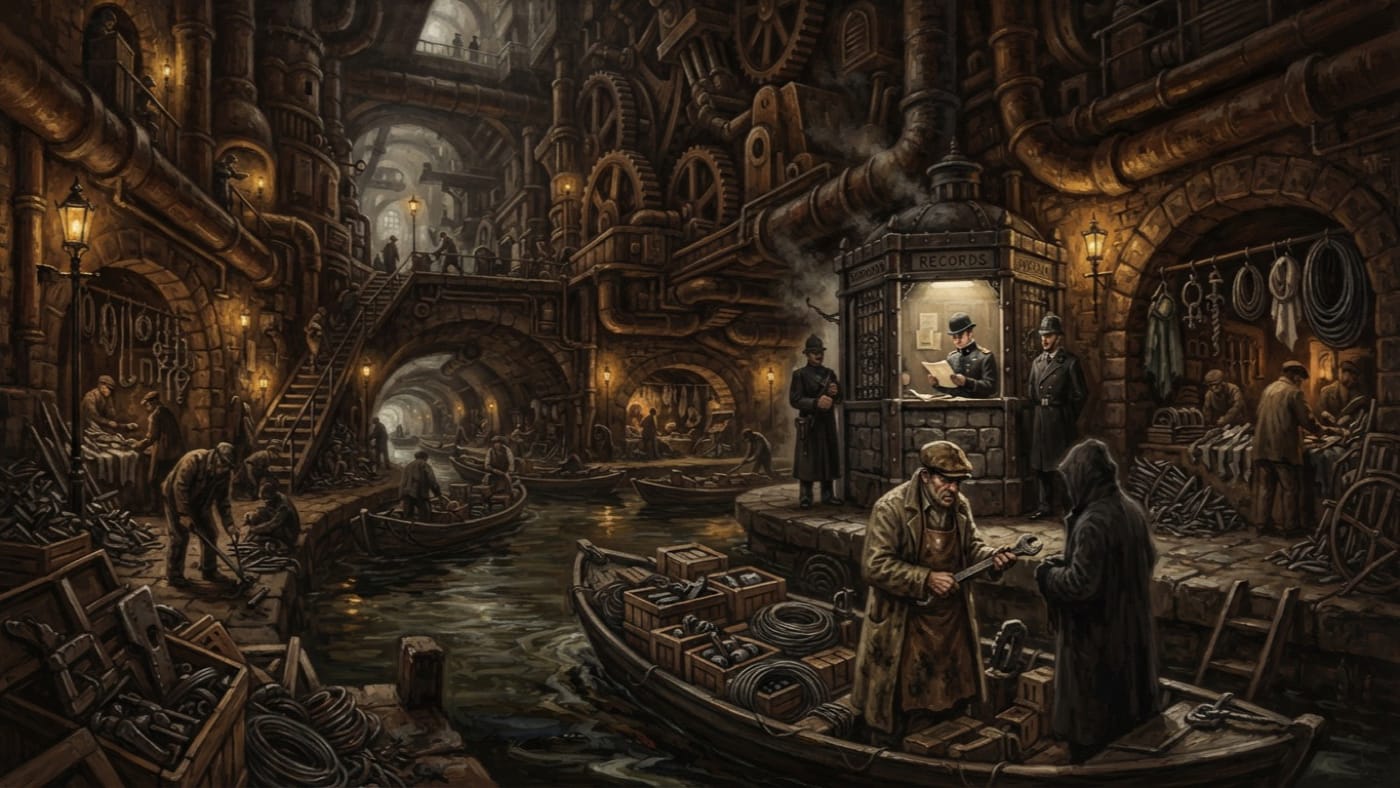
#On the Market Ground
Between the Foundry Core and the southern terraces of Essen-of-Hymnsteel lies a strip of reclaimed slag-ground on which the city never managed to put up anything respectable, so the Shard Markets grew there instead. The bazaar is made up of scrap brokers, counterfeit-parts dealers and hush-gear merchants, and it smells of ozone and cheap tallow. The furnace-thunder from the Core reaches it a beat late. On market days, stamped paper changes hands faster than bread.
The reader must keep two names apart, because the Bureau of Records does. The Shard Markets are a district. The Shard Market Syndicate is a cartel that works that district and the underducts beneath it, behind the frontage of scrap brokerage. Many stall-keepers on the slag-ground owe the Syndicate nothing more than a nervous nod. The ring that sells "safety waivers" there has never been shown to sit inside it. This distinction matters a great deal to Records. It matters rather less to the knife.
By daylight the Syndicate sells scrap: bent rivets sorted by gauge, cracked housings sold by weight, and spanners worn smooth by other men's quotas. When the curfew sirens turn into the night hymn, the trade goes down into the duct-tunnels. There the hush markets offer counterfeit seals, hush-cloth, spare stanza sheets, stolen tooling and rooms advertised as "false quiet." This stock belongs to the underground as a whole. The Syndicate is one tenant of that cellar, and the best armed, but it holds no title deed.
#On Stamps, Skiffs, and Spare Parts
The Syndicate has three methods (theft, forgery and intimidation) and three resources: stolen stamps, river skiffs and duct routes. As far as anyone outside the cartel can judge, its ambition is to control counterfeit parts and the events its brokers call, with a delicacy I envy, "accidental" failures. No ledger shows that the ambition has been achieved. A wish to own every failure is not the same as having caused one.
Two names come up wherever the cartel is discussed.
Kestrel Waxhand has burned fingertips. Kestrel keeps a stall that sells devotional ironwork, and the counterfeit-seal trade runs behind it, where the votive iron is not. Essen seals its documents with tallow-wax, and the Shard Markets do not lack for tallow.
Old Juro smells of ozone. He brokers stolen tooling from a canal skiff that changes its berth every third bell. That is often enough to frustrate a provost and, so far, often enough to keep him in business.
These are separate trades. Seal forgery, part counterfeiting and tool brokerage feed one another, but none of them is the others. No document I have seen makes either Kestrel or Juro the cartel's master, its treasurer, its founder or anyone's partner. The Syndicate keeps no organisational charts, and I will not draw one for it.
Its routes go under the Seven Locks. In the Codex entry for the city I recorded that the tunnel beneath Lock Five is the Syndicate's. The tunnel beneath Lock Three is the Bureau of Shadows'. Lock Seven's tunnel is claimed by no one, and that means someone important owns it. I make no claim that the three tunnels join, and I would ask the reader to make none either.
The tunnels are needed because the Locks work. At every freight gate a Records clerk checks the seal and an Orison warden tests the bearer's vocal cadence. A counterfeit stamp can satisfy the clerk's eye. It cannot lend its bearer the right voice.
#On the Bureau's Permission
The Syndicate is an enemy of the Bureau of Records. The Bureau of Records permits the Shard Markets to operate. Both statements are true, and Arch-Notary Veyl has not been heard to apologise for either.
The reasoning is plumbing. The Markets are a pressure valve, a controlled leak that the Tri-Bureau Compact prefers to the uncontrolled explosion it fears above all else. Records knows where the leak is, roughly what passes through it and who stands nearest it. Tolerating a market is a different thing from licensing a cartel. No charter, immunity or private compact between the Syndicate and Ledger Row has been documented, and this Codex will not supply one to make the arithmetic neater.
The Syndicate's allies are desperate foremen, and Essen produces those without effort. Picture a shift-boss whose tooling has worn past tolerance and whose certified replacement has been "pending" since the last audit. His quota is fixed by bell order, and his ration chit depends on meeting it. He can wait for the Certification Office and watch his gang go hungry, or he can buy his tools by weight from a skiff that will not be there tomorrow. Usefulness is not charity. The cartel that sells him a spanner tonight will collect on the debt in a currency he has not yet been told.
The underducts also undercut the Hushwright Guild. The Guild holds Essen's monopoly on licensed silence: felted ash for the Quiet Gradient and for selected chapels. It lists the Shard Markets among its enemies. Under Compact Ordinance 7-C, silence without authorisation is a violation, every dampening material needs a current Guild seal, and unlicensed hearing protection is contraband. A riveter who stuffs unstamped plugs into his ears to save what hearing he has left has therefore committed an offence. He has also become a customer, and the Guild has lost him as a source of revenue. Not every hush-merchant in the ducts answers to the Syndicate, but every one of them is competing with the Guild's books.
#On Failure and Its Owners
The scrap that leaves the slag-ground does not stay in Essen. The city sends bell-cannon throats, hymn-drive housings and reliquary fasteners to the Sagittal Line. A throat cast in ordinary steel cracks within forty firings. A fastener of doubtful metal gives way at the moment its relic is most needed. A counterfeit part sold in the bazaar can therefore turn up again, at a gun-pit two hundred leagues east, as a casualty report. The Compact treats forged Saint-Metal certification as sacrilege and sabotage together. I name nobody in this entry as having committed that offence. The charge stands on its own.
The Compact has a bad habit of putting every Essen calamity on one stretcher. For the Ledger's sake, these are three separate wounds.
Component fraud is the Syndicate's trade: wrong metal, a false seal, a waiver for a failure nobody inspected.
Altered calibration sheets are a different heresy. One changed syllable in a stanza, introduced during a pour, travels through the grain of the steel. That is how the Mirror Choir works. Spare stanza sheets are sold in the ducts, but buying them does not make anyone a choir.
The Resonance Bloom is a different thing again. It is a disturbance in the city's foundations, and neither forgers nor heretics account for it.
This Codex previously attributed all Resonance Bloom events to the Mirror Choir heresy.
Carried forward from the Codex entry for Essen-of-Hymnsteel. The Bureau of Rites has since established that Resonance Bloom activity predates the Mirror Choir's earliest documented operations by approximately forty years. No Bloom is attributed to the Shard Market Syndicate in this entry or any other. A cartel that sells failures has not thereby been shown to manufacture weather.
I also leave out the cracked throats returned from Bastion-Przemyśl. Each had split along the same grain-line, and the inspector who received them called the pattern "decorative." The evidence does not reach as far as the slag-ground. The Bureau of Purity has already removed the one man who had an opinion about it.
#On the Present Condition
As of this assessment, A.S. 201, the Compact is being asked for more than it can sing. A procurement mandate from Strasbourg demands three times the output of hymn-drive siege engines. Master-Calibrator Sister Rauth will not speed up the calibration tempo without "liturgical stability guarantees." The Bureau of Engines and Furnaces has threatened to conscript from the Ash Warrens. The threat has not been carried out, and this Codex records it only as a threat.
My expectation, which no measurement supports, follows from that dispute. A tripled quota wears out tooling three times as fast, so desperate foremen will multiply. Exemptions will become dearer than bread. Every crate the Locks turn back will become a reason to find a tunnel. The Syndicate does not need to recruit when the Compact does its recruiting for it. I have no tally of cartel sales, and I will not invent one so that this paragraph can end on a number.
The underground has a word for a person whose stamp has been revoked. It calls them waxed. Up on the terraces, Ledger Row uses the gentler phrase "administratively paused." The fortunes of the Shard Market Syndicate depend on how far apart those two words are allowed to drift.