

#On the Guardians of the Seal
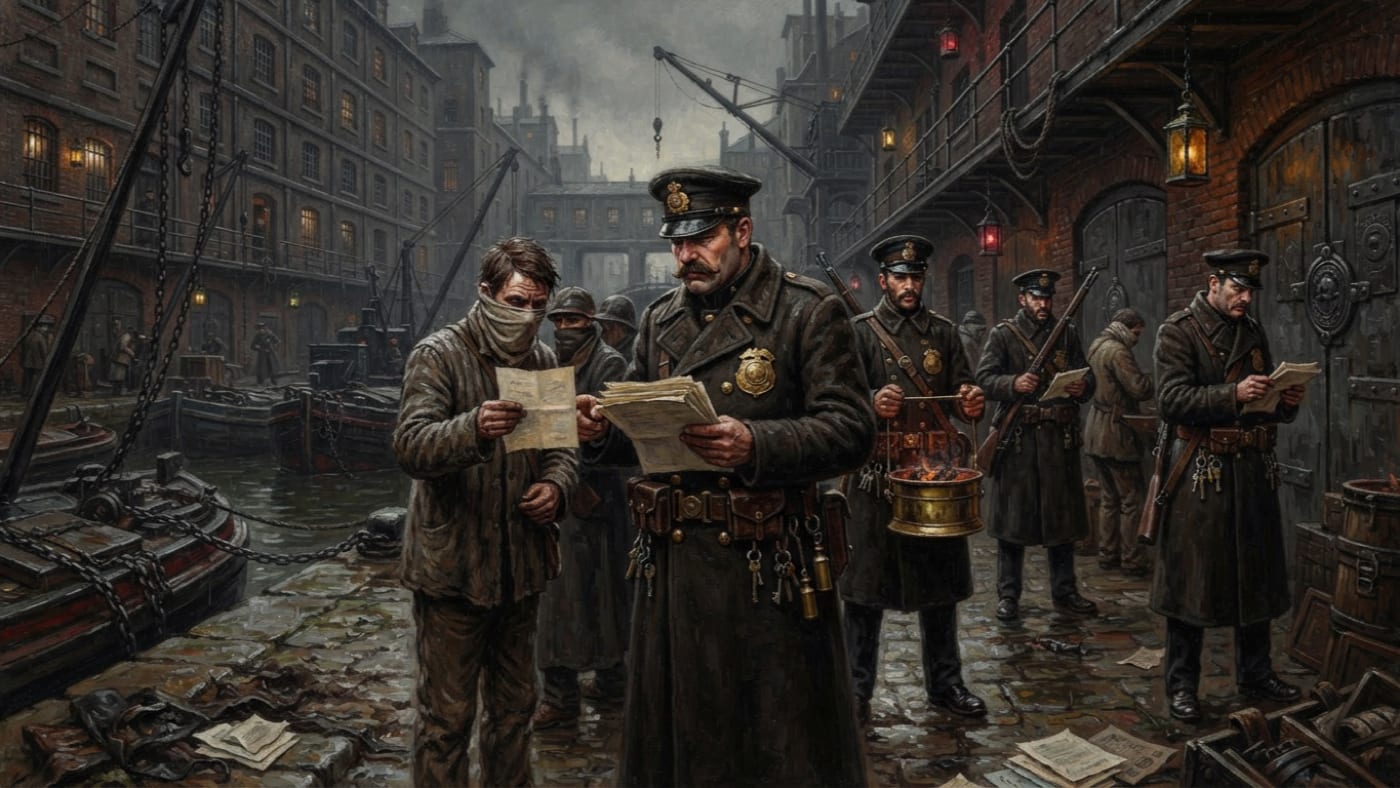
The Seal Provosts of the Candlewick Palatinate put the same question to everyone they stop at the gates, on the docks and in the Registry queues: is this paper what it claims to be? They are the city's militia of colour-law. Publicly they are anti-forgery guardians, and a brass seal-badge on the coat tells the barge-hand, the apprentice and the visiting theologian that the question has been put by someone entitled to put it.
The question matters because Candlewick makes the physical stuff of legitimacy. The Synod issues decrees, and Candlewick supplies the wax that closes them, the ink that makes them readable and the watermarked paper that makes them hard to copy. A transit pass in the wrong shade is a forgery. A forgery protects no one, and the person holding it is, for every legal purpose, holding nothing at all. The Bureau of Records holds that a man without valid papers has no standing before the Ledger. That is a legal claim, and the Provosts are the armed men who make it hold on a wet quay at six in the morning.
No founding charter for the force appears in any register I have been permitted to consult. The Provosts are older than the questions now asked about them, and that is all the Bureau will say.
#On Colour-Law and Its Officers
Three powers handle a disputed shade, and outsiders tend to confuse them.
The Chromatic Registry defines. Its vaults hold the sealed phials that are the legal standard for every sanctioned hue, and its clerks keep colour-law in the Palatinate's Bureau of Records Annex. High Registrar Sable Vorn, the Bureau's chief officer in the city, controls the codes. Shade Auditor Pell smells ink and gives his verdict.
The Provosts enforce. They board barges at the Seal Locks, check tokens at the Mordant Gates and walk the Registry queues looking for a smudge, a doubtful watermark or a token keyed to the wrong district at the wrong hour. They carry warrants. They have boats and chain keys, which in a canal city means the power to stop a cargo in the water, close a channel or open one. Colour-inspectors and Records clerks work the same checkpoints alongside them, and these are separate offices. In a bad week the traveller meets all three. In a good week he meets all three and pays only one.
The Charter Court of Impressions judges. Shade-treason is tried there, before judges who keep seal rubbings of the dead. The Provost's job ends with the accusation and the evidence. What the Court does with the accused belongs to the Court.
Who commands the Provosts is a question the city has learned not to ask out loud. Inquisitorial liaisons and quarantine wardens patrol near them and are not them. The Seven-House Compact funds the city, the Synod Charter Court adjudicates it, the Records Annex audits it, and I have found no document stating plainly which of the three a Provost obeys first. My guess is that he obeys whichever one is standing closest.
The jurisdiction is local. Candlewick wax closes documents from the Baltic to the Tagus, but a Provost's warrant does not reach that far. A seal kit leaving the Seal Locks carries the Palatinate's standard with it. It does not carry the Palatinate's police.
#On Samples, Seizures, and Profitable Ignorance
The methods are raids, seizures, informants and planted samples. I list the last plainly because everyone in Vatmarsh Row already says it, and a doctrine tract that leaves out what the dye-stirrers know will be laughed at.
A typical case runs like this. A sample is taken from a vat, a bottle or a page and judged deviant from the registered phial. The deviation can be very small. The published record of the Palatinate tells of a man's whole stock of vermilion burned for a variance of a quarter-gradation. The stock is seized, or the workshop is sealed shut with a notice on the door. Without the workshop the worker loses his guild's protection. Without that protection he becomes unlicensed labour, which cuts him off from mask rations, shade tokens and the infirmary. Nobody hanged him, and the Bureau has a pleasant name for the result: soft severance.
The red lines are well known, and they make good business. A blank seal die, a sheet of colourless paper or a vial of the reserved blues and greens will each destroy whoever is caught holding it. A minor shade variation can be bought legally if one knows the right clerk. A bureau shade, the official ink of the major Bureaus, is effectively never for sale. The Provost stands on the line between what can be bought and what will hang you, and he charges for directions.
He is paid in kind. Bribes at the Palatinate's checkpoints come as small legal luxuries: a cake of clean wax, a few drops of registered ink, a fresh mask filter. These are valuable goods in a city where the air smells of vinegar mordant and tallow smoke and the queues cough into cloth. A Provost who takes a filter instead of a pass is at least breathing better than the man he let go.
At night the Lantern Mile and the canal windows signal in coloured light, showing which corridors are lawful and which are not. Smugglers read the code. So does everyone else in Candlewick, the Provosts included, though officially they cannot. They are paid to stay ignorant, and they earn the money. Black Canal traffic carries on because of the enforcement around it. I do not claim that every Provost belongs to the Syndicate or that every seizure is fabricated. The lantern code gives no grounds for either claim. It shows only that the men who arrest traffic and the men who let it pass are the same men, on different nights.
Rumour in the queues goes further. It says the Registry keeps a running quota of shade crimes to justify its monopoly, and that some counterfeits never existed until a Provost's phial produced them. I record the rumour. I do not endorse it, and I did not ask anyone whether it was true.
#On Chromatic Reconciliation
In A.S. 199 (1909 CE) the Fading Winter began across Candlewick and the River-belt. Documents lost their text while the seals, signatures and fee stamps that authenticate them stayed intact. Ration chits went blank between breakfast and inspection. A pass at the Seal Locks kept its wax and lost its destination.
For a force whose authority rests on authentic materials, this was the worst possible kind of crime. The faded page was perfectly genuine. It simply said nothing.
The Registry declared a heresy outbreak and responded with chromatic reconciliation. The name sounds like a dyer calibrating his vats. In practice it brought tighter purity standards, which voided much of the city's working paper overnight, and a summons for every household to revalidate its shades. The Provosts carried out raids under audit cover. They arrived with shade knives, sample phials, armed clerks and portable braziers for burning illegal palettes on the spot. By the first month's count, eighteen workshops in Bottle Quay and the Lantern Mile had been shut and forty-seven workers reclassified as unlicensed.
Those figures record closures and changes of legal status. They are not a death toll, and I will not let anyone turn them into one. Forty-seven people kept their bodies and lost their place in the Ledger. In Candlewick the second loss is the one with paperwork attached.
The Provosts blamed the Black Canal workshops. House Vatmarsh blamed counterfeit salts. The Bureau of Alchemical Standards asked for samples. The Provosts' accusations remain accusations. No Court finding has shown that outlaw pigment rings caused the fading, and the older wound underneath it, Hungry Ink, has stayed unexplained since Standards linked it with atmospheric ash in A.S. 143. Hungry Ink rewrites text and the Fading Winter erases it. How the two are connected has not been settled, and a raid cannot settle it.
The countermeasures are poor ones. Salt-stopping protects the margins of a page. Wax overcoats slow the fading. Burning an affected page removes it, but burning a charter may itself be unlawful, so a Provost who puts a faded decree in his brazier may be committing the offence he was sent to stop. No cure has been proven. No Provost raid has stopped the fading. Each raid has stopped a workshop. That is the whole of what the reconciliation figures measure, and it is worth knowing before anyone cites them as proof that the crisis is in hand.
Earlier assessments, including those circulated with the Palatinate's own entry, described the Fading Winter as "a contained incident," with Provost enforcement under chromatic reconciliation credited for the containment.
The Fading Winter is ongoing. Enforcement closed eighteen workshops. It has not been shown to have closed anything else.
#On the Continuing Amber
In A.S. 201 (1911 CE), Candlewick remains at Operational Amber. The Fading Winter continues, and the Registry declines to publish current loss rates. House Wickwarden still controls the wax and House Vatmarsh the mordant salts and fixing agents. The Provosts enforce colour-law inside those two monopolies and give orders to neither. When there is no wax, there is nothing to stamp, and a Provost with nothing to stamp has to look for other work.
The more serious threat comes from below. The published record of the Palatinate reports a counterfeit bureau shade from the Black Canal so precise that three separate auditors certified it as genuine before they were told where it came from. If the Registry's own experts cannot tell that ink from the real thing, every Provost accusation is in doubt. A raid depends on the phial telling the truth. A planted sample depends on the phial being believed. Both now rest on a standard that has already been fooled three times on record. The forgery has not yet entered general circulation. The force has not collapsed. The Syndicate has not taken the city. Those three outcomes are all still possible, and none has happened.
The seal presses still hammer in the Sealworks, and the canal chains rattle in their housings when a Provost boat passes. Masked men queue at the Registry counters holding papers that may still say what they said yesterday. The brass badge is still at the end of the queue, and it still asks its question.
Nihil obstat.