

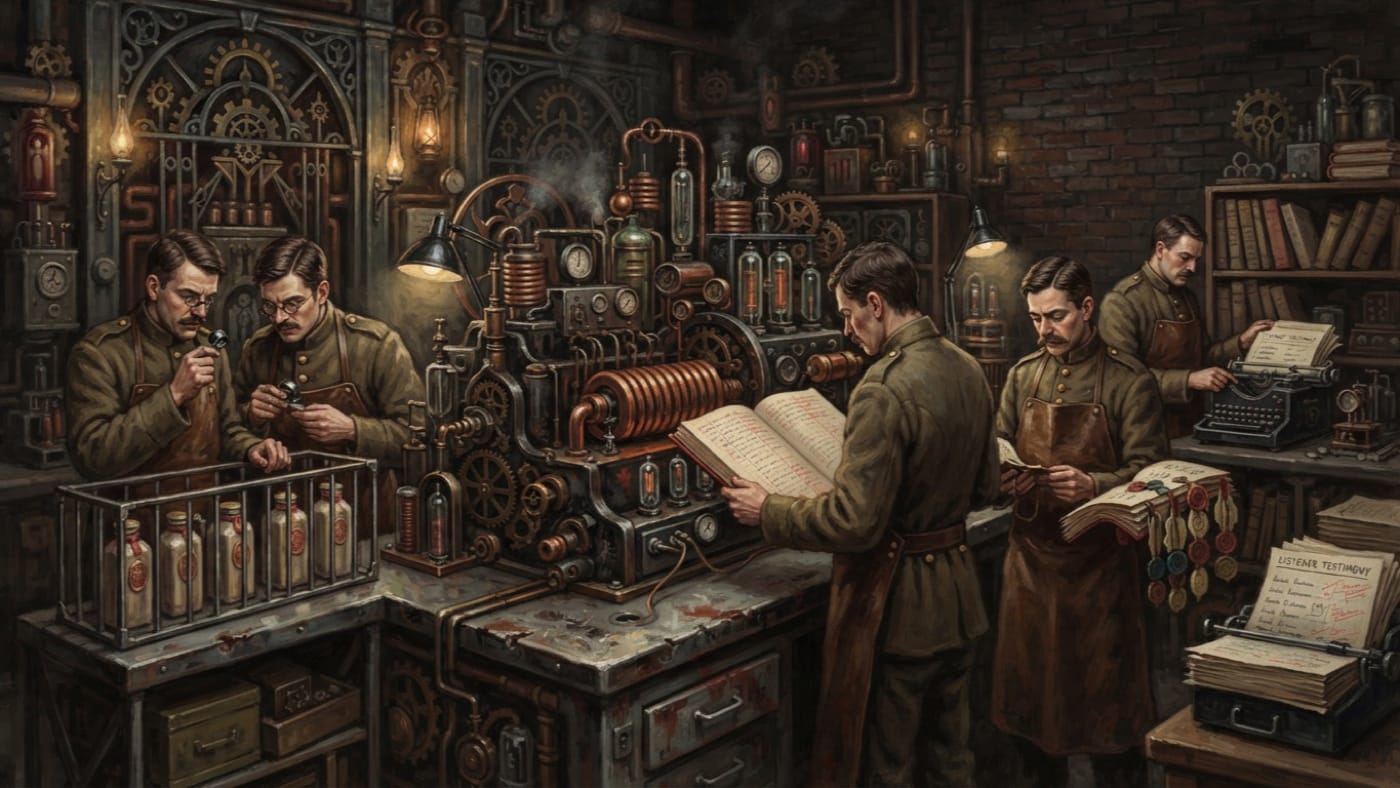
#On the Present Compilation
Present compilation, A.S. 201 / 1911 CE. This is a survey of current procedure, assembled from Directorate abstracts already on file. The year dates the binding. It dates nothing that happened inside it.
When a transmission fails, the Broadcast Directorate asks two questions and files them as one. What happened to the signal? Who heard it? The first is answered with a key, a thermometer and a ledger. The second is answered with people, which is why it comes last and why it is so often answered by someone else.
The Directorate calls the procedure a signal inquest. It looks like an examination and is carried out like an audit, and the Bureau of Doctrine has sealed it as a liturgy, because the Bureau of Doctrine seals everything as a liturgy. I set down here its order of work, the route its testimony takes, and one return from A.S. 198 that the order of work could not swallow.
#On Custody and the Missing First Date
The Directorate holds charter custody under the Living Word charter of the Bureau of Orison and Song, A.S. 92 / 1802 CE. It consolidated its operations across A.S. 94–96 / 1804–1806 CE, while the Orison Licensing Acts of 94 and the early inversion incidents were piling up on every desk in Strasbourg. At some point in those years the question of why a packet that left the Cloister forward had arrived somewhere backward stopped being a complaint and became an order of work.
Records cannot say which year the first inquest sat, and neither can I.
An earlier draft of this survey dated the first signal inquest to A.S. 92.
Withdrawn. A.S. 92 is the year of charter custody. A.S. 94–96 is the period of consolidation. No document on file names the first inquest, its site or its subject. This survey will not supply a year just because an empty column offends the eye.
The inquest is a procedure. It has no bench of its own, no robe and no seal apart from the Directorate's. It sits wherever the failure happened: a coil room in the Cloister of Calibrated Breath, a repeater house on a pilgrim road, a fog tower with salt crusted on the lintel. Its materials come from three places. Orison Signal Engineers supply logs. Records supplies discrepancies. Orison supplies jargon. What the inquest makes of these depends on who needs a finding, and by when.
#On the Order of Examination
There are five checks, and they come in a fixed order. The order is the closest thing the inquest has to doctrine, and like most doctrine it was arranged so that the cheapest truths are found first.
Urn seals first. The saint-dust urns stand under double lock in their cages. The examiner looks at wax, impression and cage. A broken seal opens several kindly possibilities: tampering, theft, dilution, or a hand in the cage that should never have been there. Each of these leads to a person, and a person can be arrested. An intact seal proves that the wax is intact, and the inquest moves on.
Coil temperature second. Copper sweats in incense-damp air and keeps a record of what it went through. A coil that ran hot or bloomed says something about the apparatus. It says nothing about the speaker.
The dust ledger third. The ledger records issue, blend and expenditure: saint-grade for doctrinal packets, front-grade for orders, port-grade for fog towers, and emergency ash for nights when a later prosecution may need a convenient adjective. A ledger that does not reconcile is the most welcome finding the inquest can make. It means black-market cutting, forged dust logs or a clerk with debts, and all of these come with names attached.
Witness marks fourth. These are the wax, cipher and countersign by which the packet was authenticated before it was cast. They show that the words sent were the words authorised.
Witness marks: the marks or signatures of persons who heard the failed transmission.
Corrected. Witness marks belong to the packet and authenticate it before transmission. People who heard the broadcast give testimony, which is taken fifth. The confusion was useful to an office that wanted listeners to sign things. It was wrong all the same.
Listener testimony fifth. It comes last because it is the least obedient kind of evidence.
The order matters because a failed transmission can fail in three ways, and only the first is ordinary. A signal can break: it can be obstructed, drowned or cut, so that the words never arrive. A signal can arrive inverted, with the official wording intact and the meaning underneath it replaced. And the district can answer when no sermon was heard. The first four checks were built for the first kind of failure and do some service against the second. Against the third they examine the furniture.
#On Testimony and Its Reclassification
Listener testimony gets its fifth place by right, with one exception: it can lose its standing as testimony altogether. If it contains names the Bureau dislikes, it is reclassified as crowd emotion and passed to the Bureau of Purity for correction by heat. The Tone Inquisitors stand next door to this process with their bait-cadence boxes. The Directorate notices the drift and Purity supplies the room. By the time the jargon has passed through that room it comes out as confession.
So the listener who reports a name under the third verse has a choice the engineer does not. They can describe an emotion, which is a lie, or report a fact, which is a charge.
The Directorate has its preferences, and I will set them out because no regulation does. It prefers mechanical fault when money is needed, operator fault when blood is needed, enemy action when a larger budget is needed, and miracle when no other noun survives contact with the evidence. This is my description of the institution, and that makes it accurate. It is not a printed rule, and it does not decide every finding beforehand. Honest findings still happen now and then, usually when all four nouns cost the same.
The cost falls where it always falls. An engineer blamed for an inversion faces demotion to port fog duty, penance in a coil room, or worse if the catastrophe was public. The listener's cost is set by Purity. The Orison Hour goes out the next morning regardless.
#On the Deadzone Return of A.S. 198
The following comes from the inquest abstract published with the Sermon-horns tract. I reproduce what it records and leave the redaction in place. It gives no location, and I add none.
SIGNAL INQUEST ABSTRACT: DEADZONE HORN RETURN, A.S. 198 Tower status: silent. Receiver returns: 612 active tones. Street observation: mouths moving in response pattern. Audible sermon: none. Portable horn test: no carrier propagation beyond twelve paces. Witness phrase repeated by three children: ███████████████████████. Disposition: block sealed; horn removed; replacement horn refused installation by crew.
Hold the abstract against the order of examination and it shows how far the procedure can reach. The urn seals, coil heat, dust ledger and witness marks all assume that something was sent. The tower was silent. A portable horn, carried in to test the air, could not push carrier past twelve paces. On the record, then, the district had nothing to answer, and it answered anyway: 612 receivers returned tones, and the mouths in the street moved in a response pattern.
The recorded observations end there. Everything after them is interpretation, and the abstract does not interpret. It does not identify the three children. It does not give the phrase. It names no speaker and no mechanism, and it does not report what became of the block once it was sealed. The crew's refusal to install a replacement horn is recorded as a refusal. Its reasons are not recorded.
The operating manuals instruct that perfect compliance in a designated deadzone be treated as hostile until proven otherwise. Withdraw, file, do not listen. That is an instruction about what to do. It is not a finding about what happened, and a crew can obey it perfectly without knowing who was being answered.
#On Clean Readings
The A.S. 198 return is not the only file in which the apparatus was found blameless. A Directorate inquest note on Port Fog Tower 3, dated A.S. 200, reports clean machine readings and a reconciled dust ledger. Its listener reports set out 417 personal-name undervoices, 62 receiver responses, nine drownings and one infant repeating the curfew decree in an adult male register. The engineer's log reads "pleasant". The tower is still active, and the note's disposition remains under redaction. Those are that note's particulars, and they belong to that tower and that year.
Then there is the Broadcast of A.S. 199, aboard the Vigil Ark Saint Barachiel. Engineering found no fracture and Orison found no inversion. The transcript remains sealed under the Hierarch's Seal, and the voice's identity and mechanism remain unresolved. I cite it here for one point: machinery that works properly does not tell you who is speaking through it. I am not claiming the deadzone return led to it. No document on file says so, and this survey will not say it either.
The worst failures leave perfect paperwork. An inversion that shows in the logs can be explained. An inversion missing from the logs leaves three possibilities: enemy competence, internal falsification or divine contempt. The inquest prefers falsification, because it allows arrests.