

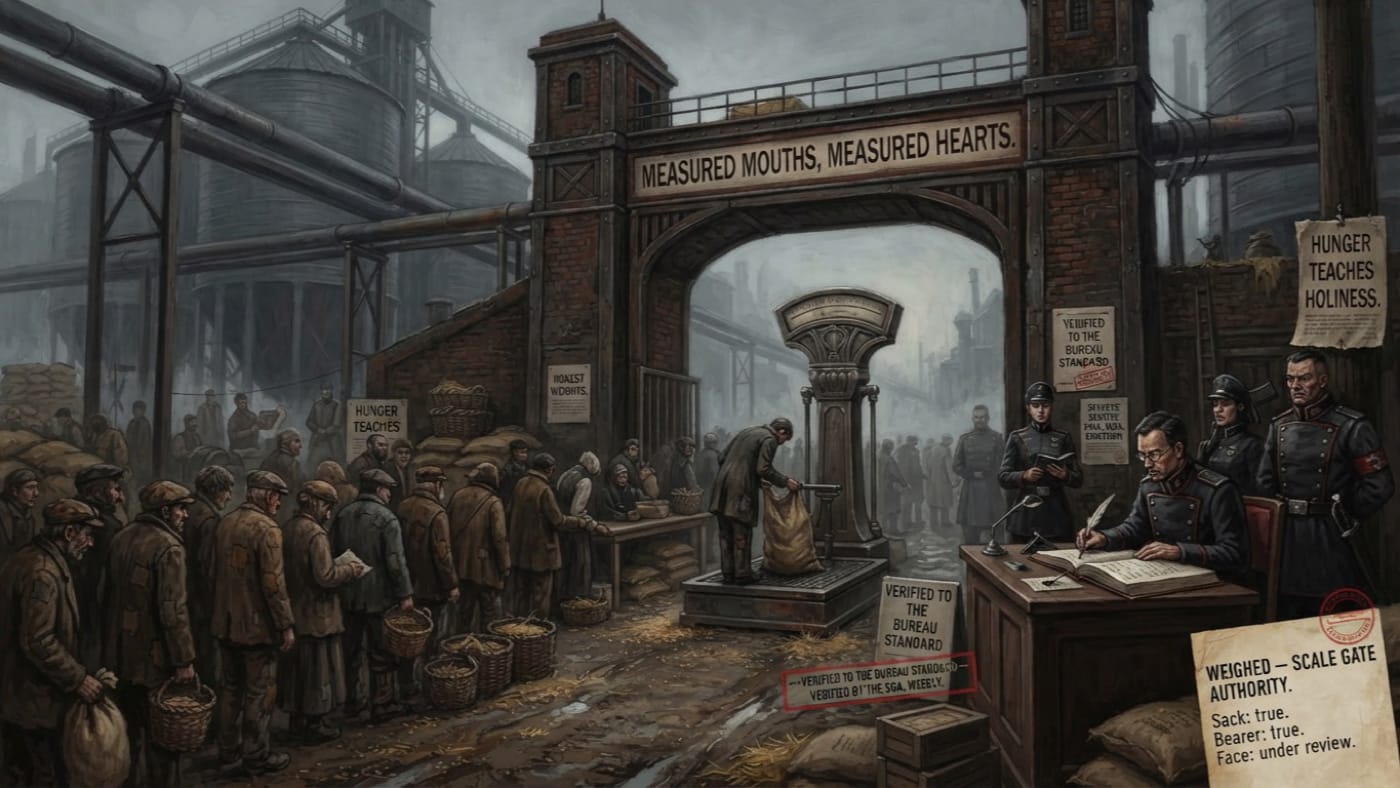
#On the Gate and the Ward
Current institutional survey — A.S. 201 / 1911 CE. No founding or first calibration year is assigned.
"Measured mouths, measured hearts." — Inscription above the Scale Gate, paint renewed quarterly by civic mandate
Visitors to Wexel mix up four names, and the clerks let them, because a confused visitor asks fewer questions. I will separate them once. The Scale Gate is a checkpoint, one of the town's two road chokepoints; the other is the Chit Bridge over the irrigation canal. The Weighline is the work done there: a sack goes onto the iron, and someone writes down what the iron says. Scale Gate Ward is the district around it, a quarter of weigh-stations and inspection benches that smells of iron, sweat and grain dust, with hemp rope groaning under the sacks. The Scale Gate Authority is the body that owns the scales, holds the seals, posts the guards and decides what the iron said. You can cross the Ward without dealing with the Authority. You cannot cross it with a sack.
The Weighline opens at dawn. Ration chits are issued at the same hour, so the queue forms in the dark. The chits are stamped paper sealed with tallow-wax and redeemable at the Chit Market. Before the first sack goes up, a short hymn is sung over the iron. The town calls it the Scale Benediction. It is the only moment of the day when anyone at the Gate addresses the scales directly, and it is the only request the scales are known to grant without paperwork.
Wexel holds thirty-three thousand registered souls in a flat, windy basin of the Hessian lowlands, ringed by fourteen steel silos. The Queue Road feeds it from the west, and a rail spur ties it to the Palatine Switchyard of Lorn, a day away. Grain is the town's reason for existing, its wage and its punishment. The Authority sits wherever that grain has to cross a line. Its public promise is two words long and painted on every placard in the Ward: honest weights.
#On Honest Weights
"Hunger teaches holiness." — Ration Prefecture broadsheet, distributed at every Scale Gate checkpoint
Every sack that enters or leaves Wexel passes the scales. That covers seed grain, flour from the mill yards, a household's lawful half-measure and the carter's sack on its way out. Grain that comes in by the spur is weighed as surely as grain that comes in by wagon. The rule has no exceptions, which the Authority treats as proof of its fairness. A rule without exceptions has no need to be fair. It only has to be enforced, and the Authority enforces it beautifully.
The enforcement contains a refinement. The false weight is the oldest sin in the merchant's catechism; the Church condemned it before it condemned most things. The Scale Gate Authority has not committed that sin crudely. It has made the sin selective. Its weights are tuned for favoured families. A favoured name's sack reads one way. A sack carried by someone the Authority has sorted among the "undeserving" reads another. The difference never shows in any single entry. It shows in a household's year: in the chits it receives, the deficits it is charged with and the questions it is asked.
The placard beside the iron says the Authority's weights are "verified to the Bureau standard." The Authority calibrates its scales every week, and it performs those calibrations itself. The Bureau of Alchemical Standards has asked nine times for independent verification. All nine requests were recorded as received.
The weights of the Scale Gate are verified to the Bureau standard.
The weights of the Scale Gate are verified by the Scale Gate Authority, to the Scale Gate Authority's standard, every week without fail. The placard's wording reflected an aspiration. The aspiration has been received.
Let no one call the Authority idle. A body that tests its own instruments fifty-two times a year is diligent beyond reproach. That it has never found them wanting is a separate matter, and one for which no form exists.
#On the Household Ledger
"A smile is a receipt." — Wexel proverb
The sack is only half of what gets weighed. The citizen brings household papers and presents the chit with both hands, eyes down, in the posture the town considers respectful and the Gate considers mandatory. A clerk checks the documents. Beside the clerk, a Doctrine monitor watches the face.
The monitor's rule is simple enough for a child, and in Wexel children are taught it early. If a citizen presents grain with an expression judged too pleased, the allotment may be cut on grounds of "suspect abundance." A family that looks as if it has enough is presumed to have too much. Feeling has become an entry in the distribution ledger. A citizen's face is read the way a sack is weighed, and with about as much honesty.
Readers should keep the Gate's responsibilities distinct from those of its neighbours, because the Authority depends on that confusion more than on anything else. The curved brass smile gauge belongs to the Mirth Office and to Sister-Lector Neme Varr, who controls Wexel's emotional-compliance inspections. The Authority carries no gauge of its own and does not need one; it has a monitor standing at the clerk's elbow. Household allotments, and whether each one is booked as provision or clemency, belong to Prefect Marwen Kile. Provision is a right and clemency is a debt, and the Prefect has spent years moving the town from one column to the other. The audit names and the locked name drawer under the Parliament's dais belong to Speaker Huld Bex. None of these three runs the Authority. The Authority supplies the numbers all three of them use.
That is enough. The Prefect cannot classify grain nobody has weighed, and the Speaker cannot audit a deficit nobody has recorded. The Mirth Office can cite a smile, but only the Weighline can attach a smile to a sack. In Wexel, the wealthiest possession a household can have is a household ledger with no marks. The Authority adds the marks with a stylus on a wax tablet, as calmly as a man initialling a laundry list. The marks stay. Next season the family finds its chits thinner, its papers questioned and its name a little closer to a drawer it will never see.
#On Grain and Favour
"The ledger eats last." — Canalback proverb
Any checkpoint that decides the law will attract people trying to buy a different law. At the Scale Gate the currency is local and practical: extra flour, clean paper, or someone else's name offered "for review." The flour is consumed. The paper is used for writing. The name does not stay at the Gate, and I did not follow it, because a Hieromnemon does not chase paper through a town where paper chases people.
Confiscation is the Authority's other instrument. A sack that reads wrong can be held. A household whose papers disagree with its sack can lose the sack. Grain taken this way becomes "recorded" grain, which is not the same as "available" grain. Wexel's public accounts insist the two are the same. The town's stomachs disagree. The gap between the Bureau of Records' figures and what is actually in Wexel's bowls is where the Authority does its quiet work. When an ordinary clerk turns up a shortfall there, they learn to stop finding it.
Pressure comes from every side. The Silo Catwalk Choir sings over the grain on its bell schedule and sees every street while it does. The Cellar Circles trade concealed grain and forged chits from under the houses of Canalback, and a forged chit is only worth anything if it can survive a clerk's eye at the Weighline. The Ash-Fine Marshals are a separate body and not the Authority's guards. They serve ash bills on households that fall behind, then come with torches to carry out what the Bureau of Purity calls property purification, and the Bureau of Tithes collects the land assessment afterward. The Authority never lights a fire. It only produces the arithmetic that makes the fire legal.
#On Verification
"If the wind laughs first, don't answer with yours." — Wexel superstition
What remains unresolved is the measurement itself. Nobody outside the Authority has independently weighed what passes the Scale Gate, or at least nobody whose report has reached a ledger I am allowed to read. The Bureau of Alchemical Standards keeps asking. The Authority keeps receiving.
Townspeople talk about the sealed bins, the ones the Authority has locked, inspected and certified empty. They say grain shifts inside them anyway, and that the shifting, to anyone who listens closely, sounds like applause. They also talk about the chaff-winds, which carry grain dust across the Ward and sometimes repeat a citizen's laugh half a second late from the wrong direction. The Mirth Office has made these reports a matter of discipline. The Authority has made them a matter of certification: the bins are empty because the bins have been certified empty. I note the reports. I draw no conclusion from them. Drawing conclusions is the one activity in Wexel that does not yet need a permit, and I prefer to leave it unlicensed for as long as possible.
Wexel remains classified as exemplary. Its scales have been calibrated this week. They will be calibrated next week, by the same hands and to the same standard, and the sacks will cross the iron at dawn after the minor-key hymn, two hands and eyes down, while the monitor watches the faces and the clerk enters what the Authority has decided the iron said.