

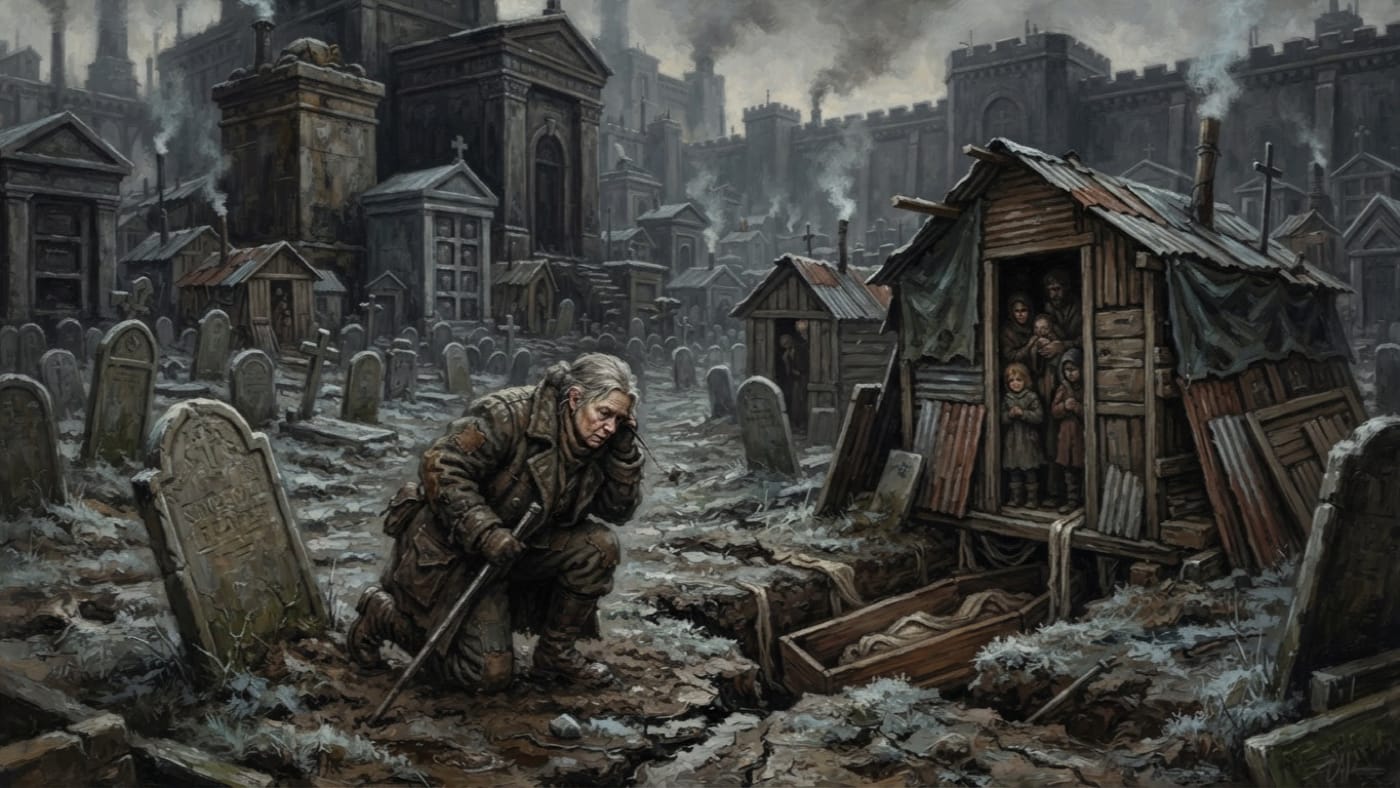
#On Their Place in the Lanes
The Sinkhole Reader is the specialist a Grave-Field Shanty Broker pays to say where the ground will fail before the ground says so itself. The trade lists the Reader among its elite hands, next to the Deed Forger-Priest, and the two belong together. One produces the paper that lets a family sleep on a plot. The other estimates how long the plot will allow it.
A lane lives between graves. Its shacks lean against mausoleum walls, its roofs are pallet-wood, tarpaulin and the occasional coffin-lid, and its floors sit on a thin skin of earth over the old dead. When that skin gives, it takes the roof, the stove, the bedding and whoever was asleep under them. Sometimes it also turns up a stack of burials whose tags do not match the register, which then becomes a separate problem for a separate clerk.
The Reader's job is to see this coming, and it is a real skill. The Reader does not, however, own the lane. A finding belongs to whoever paid for it. In the grave-rings that is usually a Broker, and the Broker most regularly paying is a Stone Shark. The Sharks measure their boundary markers every dawn and employ Readers as a matter of course. Other Brokers hire them as well, borrow them from a neighbouring ring, or get by with a Stake Runner who has learned enough. The title has no guild and no register. Where Records files a Reader at all, it uses "Caretaker, Interment — Auxiliary," the same entry that covers the man who sweeps mausoleum floors.
#On Reading the Ground
Every Stake Runner learns ground sag, the slow settling that warns a lane is about to become a grave itself. The Reader is the one who kept learning. Brokers generally recognise several kinds of lean in a headstone:
- the settling lean of subsidence
- the slack tilt of damp clay
- a forward bow, which they take to mean a coffin has given way beneath
- a sideways lurch, which they put down to roots eating one edge of the plot
- the lean of a stone that human hands moved overnight
These are practitioners' readings. They are not the conclusions of an anatomist with a spade. I have watched them confirmed often enough to respect them, and seen them wrong often enough to keep them in italics.
The ground differs by bastion. On the cemetery terraces of Marrowgate, lime pits have been cut close to the old ridges, seasonal floods turn the lanes into slurry, and quarrying leaves cavities that never appear on a burial plan. At Bastion-Przemyśl, sinkholes are listed among the local hazards, and the grave-rings are packed so tightly that a sag in one plot pulls on three others.
What follows is my own composite of what I watched done at Marrowgate and heard described at Przemyśl. No two Readers I observed did it in the same order. None would admit to having been taught it as a rite.
- Walk the lane at first light, before anyone has swept it and while the frost still shows where the earth moved in the night.
- Sight along a row of stones against a wall known to be true.
- Compare the angles with yesterday's chalk.
- Press a heel into the low corner of each shack.
- Look for standing water that should have drained, a fence post sitting lower in its own hole, a fresh crack in the mortar at a mausoleum footing, and a drainage trench whose sides have started to slump.
- Kneel, and listen.
This produces a forecast. The earth keeps no timetable. A good Reader can tell you a plot is going. Very few can tell you which week it will go, and the ones who name a day tend to be selling something.
A sound stone gives no permission to build either. Rites consecrated the plot, Records catalogued it and Tithes taxes it. The clay answers to none of them.
Lane Brokers showing plots to new families describe a lane under caretaker classification, anchored by graves that would survive audit, as "certified ground."
Corrected. The Bureau of Settlement's Memorandum 14-R (A.S. 178, revised A.S. 194) classifies the shelter for census, tithe and patrol purposes, and expressly concedes no human habitation. It certifies nothing about what lies under the shelter. An anchor grave proves that someone is buried there. It does not prove that the plot will stay level. Consecration sanctifies the ground. It does not drain it.
#On the Warning and Its Purchaser
A collapse involves three separate powers, and the lanes mix them up at their peril:
- knowing the ground will fail
- telling the people asleep on it
- being able to move them somewhere it will not fail
The Reader has the first. The second belongs to whoever controls who hears what in the lane. The third belongs to whoever holds a spare shack, a cart, an understanding with the patrol, and a lane where the newcomers will be tolerated. The Reader seldom holds any of those.
The Sharks get real value from the arrangement, and their critics should admit it. A Shark lane has straight stakes, clean trenches and roofs patched before winter. It has measured boundaries because the Shark paid someone to measure them. Fewer roofs fall into Shark lanes, because the Shark paid to know which ones would. The families there are safer, and they are charged for it.
What the landlord does with the finding is his business, in the old sense of the word. The Sharks pass warnings by paid route and sealed list. A Reader's finding can enter that system like any other piece of information, and the system lets it take several shapes:
- a family in danger moved to a sounder plot at a higher rate
- a family in arrears cleared out under the respectable cover of safety
- a failing plot kept quiet and leased to newcomers who have not heard
I record these as the shapes the arrangement allows. I hold no ledger proving that any one of them is customary, and the Sharks keep their ledgers private, as they always have.
The other factions do different things with the same knowledge. The Caretaker Saints warn every household, by candle, without regard to arrears. At Przemyśl, the stories have the first of them starting out as Stake Runners who learned which lanes would collapse and moved families before the ground opened. Moving them required somewhere to move them to, and the stories do not say where that was.
The Ossuary Allies work from the other end of the problem. A family whose lane is failing is a family that may be ready to give up its anchor-grave rights in exchange for an ossuary tenancy inside the walls. To the Ally, a warning is a chance to make that offer, and the transaction is legal.
No source I trust shows Readers organised into faction branches, or any common rule about who must be told when a stone bows. The Reader tells the Broker. The Broker tells whomever he decides to tell.
#On Vell's Lean
Mother Vell of the Crooked Stones has no canonisation, no register entry and no founder's claim anyone can prove, and she has a lean of her own. The lanes describe her mark as a stone crooked enough to look neglected, stable enough to hold up a roofline, old enough to bore Records and holy enough to discourage Settlement. Lane tradition also holds that Vell moves stones at night: she shelters the families she favours and exposes Brokers who overcharge widows. The Sharks laugh at this. Then they wake to find a boundary marker three paces into a sinkhole, and they lower the rent for a week.
The Reader has to rule on a moved stone, and there are four candidates:
- the earth
- a rival's crowbar
- a desperate tenant who shifted a boundary to gain a pace of floor
- Vell, according to the lanes
The first three leave evidence: scrape marks, disturbed turf, a neighbour who suddenly owns more mud. The fourth leaves bread, and the bread is gone by morning.
The Vell test is a lane custom, not a Reader's protocol, and children learn it before their catechism:
- Tap the stone twice and listen for hollowness.
- Read the lowest name that survives.
- Check for fresh chisel dust.
- Smell the soil.
- Look at the grass.
A surveyor would accept most of this. A hollow ring, new dust and grass growing too thick over a shallow burial are things anyone can observe. The rest is folklore. Lane devotion holds that the soil warms and smells of iron when the dead are displeased, and that grass refuses to grow where something below "has opinions." I do not certify the intentions of what lies under a lane. The Bureau, for its part, will not do foundation work in the grave-rings without triple witness, bell cover and a priest sober enough to pronounce the older names.
A lane that survives a sweep is said to have Vell's lean. A lane that collapses is said to have "stood too straight." Readers repeat both sayings. I have yet to meet one who would authenticate a Vell grave, and the grave sold fourteen times has not asked them to.
#On Their Present Use
As of A.S. 201, Sinkhole Readers work wherever grave-fields have turned into suburbs: the Marrowgate terraces, the Przemyśl grave-rings, the Hintermark fields behind Bastion-Constantinople, the cemetery margins of Cologne, and the lesser rings across Zones Two through Five. None of these places has a Reader office, because none exists anywhere. Wherever a Broker has paid one, fewer roofs fall in.
Everything else depends on other people. The Reader has no standing to order a family off a plot or to open an empty one for them, and no right to be heard by anyone except the Broker who pays. Settlement will not consult Readers, since consulting them would mean admitting that people live in the lanes. Purity watches them, as it watches anyone who knows the ground better than the file does. Purity's interest is in what the ground turns up when it opens.