

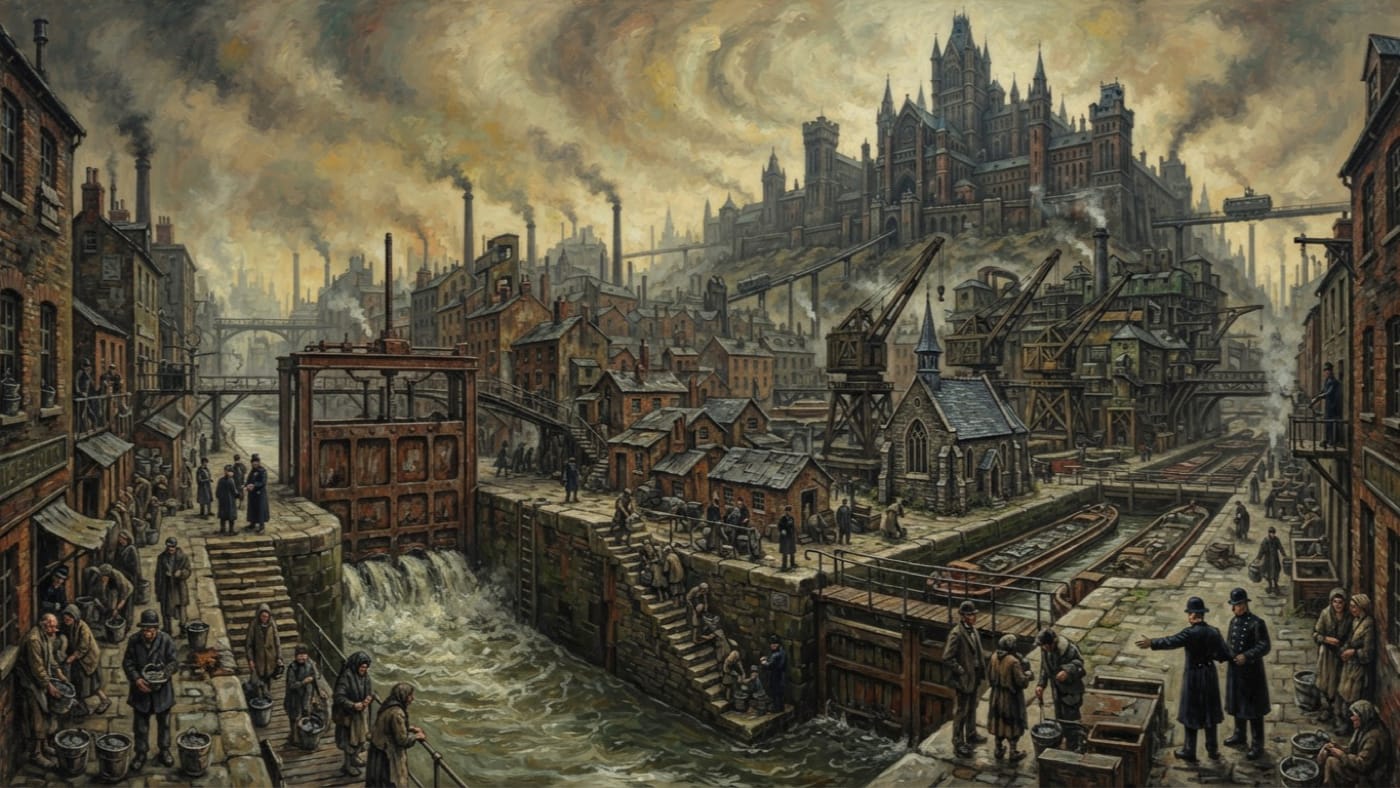
#On the Chapterhouse's Authority
"The Sump is the city's cleansing hand." (Sluice Prefecture placard, Ash-Sluice Line)
The River-Belt Chapterhouse governs the way a bishop governs a diocese he has never visited on foot: by signature, by delegation and by annual report. Its authority in Candle-Sump is real. The Church holds that authority, the Chapterhouse exercises it, and the Sluice Prefecture carries it down the brick steps to where the water is. At the Vire River-Belt Interchange the Chapterhouse left cranes, a shed and a chapel. Everything that can be proved about it lies between these two places.
I decline to manufacture what cannot be proved. The archive yields no charter, no founding year, no seat of stone and no minutes in any council's hand. The Chapterhouse appears in the record the way a seal appears on a writ. It is what makes the document binding, and it is never what the document is about.
The difficulty can be stated once. A Chapterhouse can issue authority. It cannot open Sluice Gate IX, stamp a bone tag or ladle broth. Those acts belong to a Prefect, a Chief Clerk and a Matron, and in Lower Vire the hand on the key has always outranked the hand on the pen.
#On the Administration Before the Concordat
The Lye Flood of A.S. 84 (1794 CE) turned the canal caustic. Ash runoff from the cremation stacks stripped skin, dissolved paper and scarred the brick in lines the residents still read like a psalter of drownings. The Candle-Sump survey records that within the month the Chapterhouse installed the Sluice Prefecture and granted it gate timings, flood releases and the standards by which the district would thereafter be declared clean.
Observe the date. A.S. 84 comes six years before the Concordat of Strasbourg, so there was no formal Synod to respond to anything. There was a Church administration of the provisional kind, whose offices multiplied faster than its constitution. Its Line had been defensible since about A.S. 65–68 and was still unfinished. Its records apparatus had been transformed in A.S. 78, which reformed older functions without creating them. The Chapterhouse acted within that machinery. Clerks writing after 90 gave the act a Synodal accent it did not have while the lye was still running.
The Bureau's entry on Candle-Sump states that "the Synod's response was characteristically efficient: the Sluice Prefecture was installed within the month."
The Synod did not exist in A.S. 84. The installation was an act of the early Church administration through the River-Belt Chapterhouse. The efficiency is not disputed. The Synod may claim it retrospectively, as it claims the calendar.
Bone tagging later passed to the Bone-Tag Registry, an adjunct of the Bureau of Records. The archive gives no year for that annexation, and I will not invent one. The Chapterhouse's own beginning is equally unrecorded. It existed by 84 because it acted in 84. Beyond that the ledger is blank, and in the River-belt a blank ledger is the most honest document available.
Its early descriptions of the district still circulate. One Chapterhouse report called the Sump's smell "devotionally challenging." Its institutional history once called the district a planned expansion and cited Writ 44-C, which authorises a drainage canal and nothing more. The housing came uninvited. The Chapterhouse filed it as intention.
#On Water, Names and Rations
Candle-Sump is ruled through weekly quarantine decrees, drain-priority lists, audit summonses and health-bell schedules. Its revenue comes from ash-fees per household, a candle levy per wick, bone-tag fees, and labour-hours of "sanitation penance" from those who own nothing else. All of it bears Church authority. None of it needs the Chapterhouse present to be enforced.
Follow a single household through a bad week. The gate chart decides whether its street floods, and the drain-priority list decides whether the water leaves. If someone dies, the bone tag decides whether the body enters the Great Ledger as a person or the canal as refuse. If the cordon moves, a quarantine ribbon decides whether the family may walk to the broth line. The broth line decides whether they eat.
Prefect Sera Mott controls the first two. She keeps the keys, the gate charts and the flood releases, and she wears gloves at all hours, which in a district of lye shows that she understands her office. Chief Clerk Dalen Voss controls the tag, with his presses, cabinets and master seals and the power to count a man dead or alive. Matron Ilka controls the calories of the Marrow Kitchens, which is the most dangerous holding of the three. She gave herself the title of saint, and no tribunal has ratified it. No Prefect has been foolish enough to challenge it while hungry.
None of the three heads the Chapterhouse, and the archive gives no reason to think any of them reports to it in a straight line. The Prefecture is its sanitation arm. The Registry answers to Records, and the Kitchens answer to appetite. The Joint Authority Compact, renewed in A.S. 187, binds them in a cooperation that the Prefecture files as "functional." The district experiences it as three dogs and one bone.
The Chapterhouse sits above this arrangement like a spire above a rendering yard. It can be seen from everywhere, and nobody doing the work consults it.
#On the Interchange Works
By A.S. 92 (1802 CE), two years after Strasbourg, the Chapterhouse had raised three timber cranes, a toll shed and a chapel at the barge turn below the old Vire lockfields. The chapel's altar faced the locks. The pious called this symbolism, and the boatmen who watched money float past called it attention to business. These are the Chapterhouse's best-documented works, and I record them as works only. They do not date its foundation, and any clerk who says otherwise is selling a commemorative plate.
The Hook then grew without the Chapterhouse's permission. The first stone quay was laid in A.S. 104. In those years the Palatine Switchyard of Lorn began swallowing the continent's freight, and every river authority west of the forward zones took a sudden interest in masonry. The present Chain-Gantry came later. It has six cranes and hymn-timed gearhouses that would interest the Bureau of Bells more than they interest me. The record does not carry the Chapterhouse's name from the three timber cranes to the six.
The First False Toll of A.S. 106 belongs to the Interchange's bridge-scribes and courts, and no document shows the Chapterhouse ordering it. The Bureau of Tithes, the Bureau of Records and the Bureau of War each claim the Hook for their own reasons. I have found no instrument that gives the Chapterhouse command there. It does not govern the Archivolt Causeyworks either. The Archivolt keeps its own Toll Chapterhouse, Bridge-Scribe Collegium and Lock Authority, and it would be offended by the suggestion.
Freight joins the two parents. Candle-Sump exports candles, broth concentrate, tagged bone-lime and certified corpse cargo. It imports clean water, grain, soap, paper, medicine and fuel, and every one of these crosses the Hook. A quarantine decree in the Sump becomes a stalled barge at the Interchange. A soaked manifest at the Interchange becomes an empty soap shelf in Marrow Row. The toll war with Lorn opened in A.S. 187, the year of the Compact renewal, and the two events have nothing else in common.
#On Acceptable Parameters
The annual report is the Chapterhouse's most regular act, and it shows the most. The report of A.S. 199 declared that "rot-lung incidence in Lower Vire Sanitation Ward remains within acceptable parameters." The parameters were revised that same week, and the revision was never attached to the report.
I will not call this a lie. A lie requires the definition to hold still.
The Prefecture numbers four stages of rot-lung: productive cough, bloody sputum, skin that reacts to paper, and "terminal administrative transfer," which the district calls death. The disease takes clerks first. The Bone-Tag Arcade loses three to five of them each season, and the Paper Loft Quarter keeps a rolling absence that the Registry enters as scheduled maintenance. A.S. 199 was also the year of the Fading Winter, when every office in the River-belt learned to distrust its newest ink. In that year the lungs and the documents of the district were rotting together, and the Chapterhouse sent it a sentence about acceptability.
Since A.S. 194 the Bureau of Purity has held the crypt-route drafts under review as a Category Two Localized Atmospheric-Scribal Disturbance. Residents blame the drafts for the coughing corners and the fuzzed paper near the vents. The Bureau blames nothing it will sign. Beneath the crypt mouths, the Candle-Sump survey records a shadow registry turning names into clean slips, with an unknown hand working below it. No document places the Chapterhouse in that tunnel. Its responsibility is narrower and better evidenced: it wrote the sentence, and it moved the line.
#On the Present Condition
In A.S. 201 the instruments the Chapterhouse delegated are fighting one another. The Registry and the Prefecture dispute ownership of seized clean slips. The Care crews threaten to strike if rations are cut again. Matron Ilka is pressing for autonomy for the Marrow Kitchens. If she wins, the Prefecture loses its hand on the calorie allocation, and Prefect Mott keeps the water with nothing to trade against it. Audit pressure is gathering. A transfer order for Inquisitor Halvyr, called White-Lung, is moving through the Bureau of Purity's approval chain toward Candle-Sump. It has not arrived. Paper travels slowly in this district and rots on the way.
The other inquiry belongs elsewhere. Veyl Hark's scrutiny concerns Lorn and the false manifests of its freight network. The Lock Courts are already rehearsing which way to point if it reaches the Hook. Neither investigation has named the Chapterhouse yet. Either would find it where the record always places it, at the top of the reports and absent from the gates.
The Chapterhouse will issue its report for A.S. 201, and the report will describe the district. The Prefect will open Gate IX at the hour her chart sets, the Chief Clerk will seal what he seals, and the Matron will decide who eats. The Creator sees all three. The Chapterhouse sees the summary.