

#On the Loading Waterfront
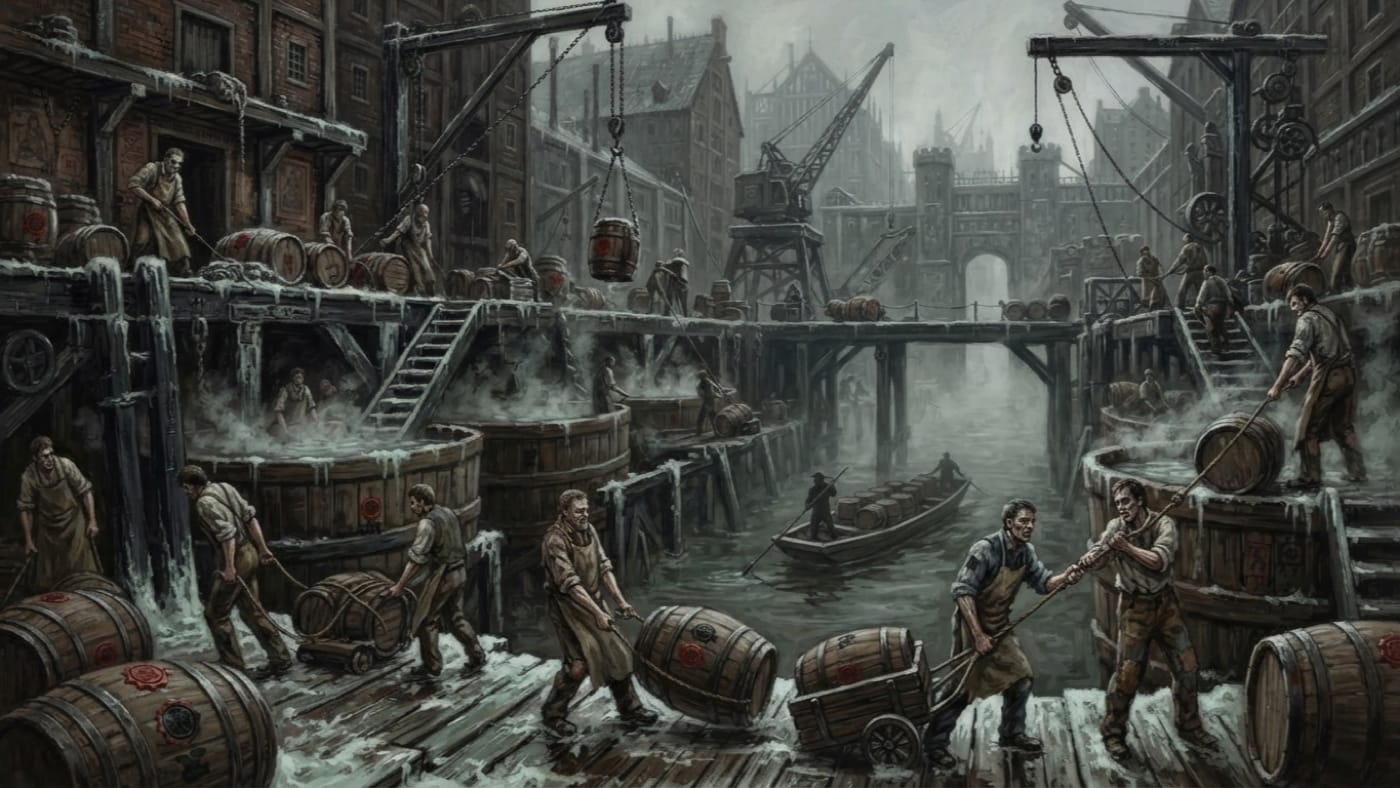
The first thing the Slurry Docks hand a visitor is salt. It reaches the lips before the eye has found the vats: brine carried on the fog, sweetened by something that began to rot some while ago and has received no instruction to stop. The second thing they hand a visitor is a permit inspection. The order does not vary.
Mournwater keeps its dignity on pilings. The Cooperage Yards stand above the flood mark, where oak is split, pitch is boiled and masters sign things in dry rooms. The Slurry Docks lie below that mark, on wharves the river visits whenever it likes. Every timber bears a tide line. Some bear several, one above another, like the countersignatures on a petition that keeps being returned for correction. Catwalks run above the loading vats. Barrel carts grind along planking gone soft as communion bread. Skiffs knock at the pilings with a creditor's patience, and a pale residue lies on every surface that has been wet and then dried, which is every surface.
The district should not be confused with the Slurry Vats, which the town lists separately as a mixing works. No survey I have seen draws the line between the two. The river ignores that line as well.
#On the Cask and Its Papers
Nothing arrives on this waterfront raw. Material out of the Ossuary Shoals has first lain in the shallow glass dishes of the Grading Hall of Settled Light during the settling prayer and, if it was worth the trouble, descended into rosary strata. That is grading. A grader observes. A grader does not certify. Certification belongs to Purity Prefect Sister Halvein, whose office at the White Steps issues the seal that turns an observation into doctrine.
Certified Saint-Dust is suspended in brine, and the result is holy slurry. The soldiers call it saint-soup, and so does anyone who has had to lift it. It goes into coopered casks of oak staves, hooped, with pitch in every seam and confession wax pressed on as shipping insurance. The Cooperage Compact supplies the cask and the manifest. Master Cooper Vell Arno supplies the Compact. Every cask that leaves Mournwater carries two papers: the purity seal of the White Steps and the shipping manifest of the Compact.
Here the jurisprudence becomes elegant. The resin and the seal are separate bottlenecks, kept by separate hands. A tight cask does not vouch for its slurry. A purity seal will not stop a leak. When a shipment fails, the Compact can show that its barrel held and the White Steps can show that the dust settled, and each document will be correct about its own subject.
The loaders do the rest. They take the sealed cask from the vat's edge, roll it across planking the flood softened last season, and put it aboard a vessel bound for the controlled water downstream. Nobody issues them a paper for this.
#On Those Who Carry the Cargo
Mournwater's hierarchy is plain. Certifiers sit at the top, guild masters below them and graders below the masters. Then come the dock crews, and under them only the quarantine poor and the people of the backchannels, whom the ledger does not record. Slurry loaders, pitch runners, seal clerks and coopers sent down to rehoop a weeping stave all work below the flood mark. The people who sign the papers do not.
A man enters this employment through one of four doors: a lock permit, a guild writ, a dust-labour voucher or quarantine intake. The voucher is the commonest on the wharves and quarantine intake the cheapest. Debts on futures slips are enforced by guild bailiffs, and a debtor who cannot pay in coin pays in labour, in names, or by volunteering for quarantine. The town's mandatory grading rotations claim their share of a man's hours too. I recognise a well-drafted instrument when I see one, and these are drafted superbly.
The hazards are those of any waterfront, plus whatever has been dissolved in it. Floods come up through the planking. Brine burns weep on forearms and do not close. Mold fever lives in the wharf timbers, and lung-rot comes off the water itself. The catwalks over the vats are narrow and slick with residue. Floodwater dries on the skin like pale frost, and the loaders brush it off their sleeves with the care of men handling something either holy or contagious. At Mournwater it can be both.
#On Passage and the Backchannels
A loaded cask has not yet left. Certified slurry ships go out through the Seal Locks, which are the only lawful passage, and the lock provosts reset their tolls each morning. After the Locks the cargo travels by waterway, railhead and military supply corridor to bastion chapels, trench shrines and field hospitals along the Sagittal Line. Mournwater does not ship directly to the front. It ships into a chain of hands, and every hand charges something.
When the Locks close, the Docks fill up. Casks wait on the wharves, brine in a waiting cask goes on doing what brine does, and the seal on the lid stays perfectly valid the whole time.
Below the respectable water lie the backchannels: flooded under-streets, side-sluices and fog-banked runs worked at night by flat-bottomed skiffs. Silt-Rook Dema controls these routes, and the information that moves along them, without any commission from the Compact or anyone else. Unsealed dust and unstamped barrels are forbidden cargo in Mournwater. The ban creates their market price. Counterfeit seals, cut dust, smuggled persons and bought quarantine releases all pass close to the loading wharves, because a forgery is worthless until something legitimate is set beside it.
#On Contamination and the Settling Silence
The Bureau of Alchemical Standards classified the anomaly in A.S. 194 as Irregular Settling Pattern, Category Two. The wharves call it Crumble-Wrong. Suspect dust will not settle properly in the grading dish and sometimes settles into anatomy instead: a finger, a rib curve, the line of a jaw. Corpses exposed to tainted dust are reported to fracture into a fine powder that moves with the humidity toward water and toward breath. In the living, the town's own lore describes hairline cracks in the skin, grit between the teeth and a voice drying out. These are reported presentations. I make no claim that every loader with a cough is coming apart.
The precautions are lime washes, salt baths, sealed-sleep masks and pitch burned at the thresholds. None of them is a cure. People on the wharves use them the way they use the confession wax, out of habit and to avoid being blamed afterwards.
Once a day the Settling Bell tolls and the Docks fall silent with the rest of the town. Paddles stop and carts halt. Loaders stand where they are on the catwalks with their mouths shut, while up the hill in the Hall the dust comes down through the water in its dishes. Work resumes only when the answering bell rings, and it rings only when the result allows it. In A.S. 199 the silence lasted nine hours. Every cask on the waterfront waited through it.
The town also keeps a memory, undated in every account I have seen, called the White Spill. An overfilled vat flooded the low streets, and bodies went on crumbling for weeks afterward. The Docks have not forgotten it. When a loader watches the level in a vat, he is thinking of that.
Separately, a shipment sent in A.S. 199 to a garrison on the southern corridor made that garrison's dead crumble. The chaplain filed a report. The Compact blamed handling, which on a waterfront means the loaders.
#On the Present Condition
In A.S. 201 the shipments continue. The Bureaus of Alchemical Standards and Rites completed their joint review in A.S. 200, and the Cooperage Audit remains pending. Casks go down to the vats' edge sealed and manifested, are loaded and pass the Locks. Responsibility is split so finely among grader, certifier, cooper, provost and loader that each party holds the share it can afford to lose.
The question nobody on the wharves can settle is the gap between a test passed in a glass dish and a cask arriving whole at a trench shrine. No document covers the stretch of water between them, and the river has never applied for one.
The purity of slurry loaded at the Slurry Docks is attested by the Bureau of Records' A.S. 200 certification, which affirmed a contamination rate of 0.3%.
That certification has been withdrawn and the rate recalculated. The revised figure has not been published. Readers who relied on the earlier figure were relying on a sealed instrument, and they acted in good faith. Whether the slurry was what the instrument said it was is a separate question.
I stood on the lower wharf at the end of my last visit with residue drying on my cuffs. A loader asked me, politely, whether my permit covered the plank I was standing on. It did not, and I paid the fee.