

#On the Daily Silence
"If it settles, it's true." — Cooperage Compact oath, administered at the Seal Locks
Once each day the Settling Bell sounds over Mournwater, and a river town of coughing labourers is required to hold its tongue.
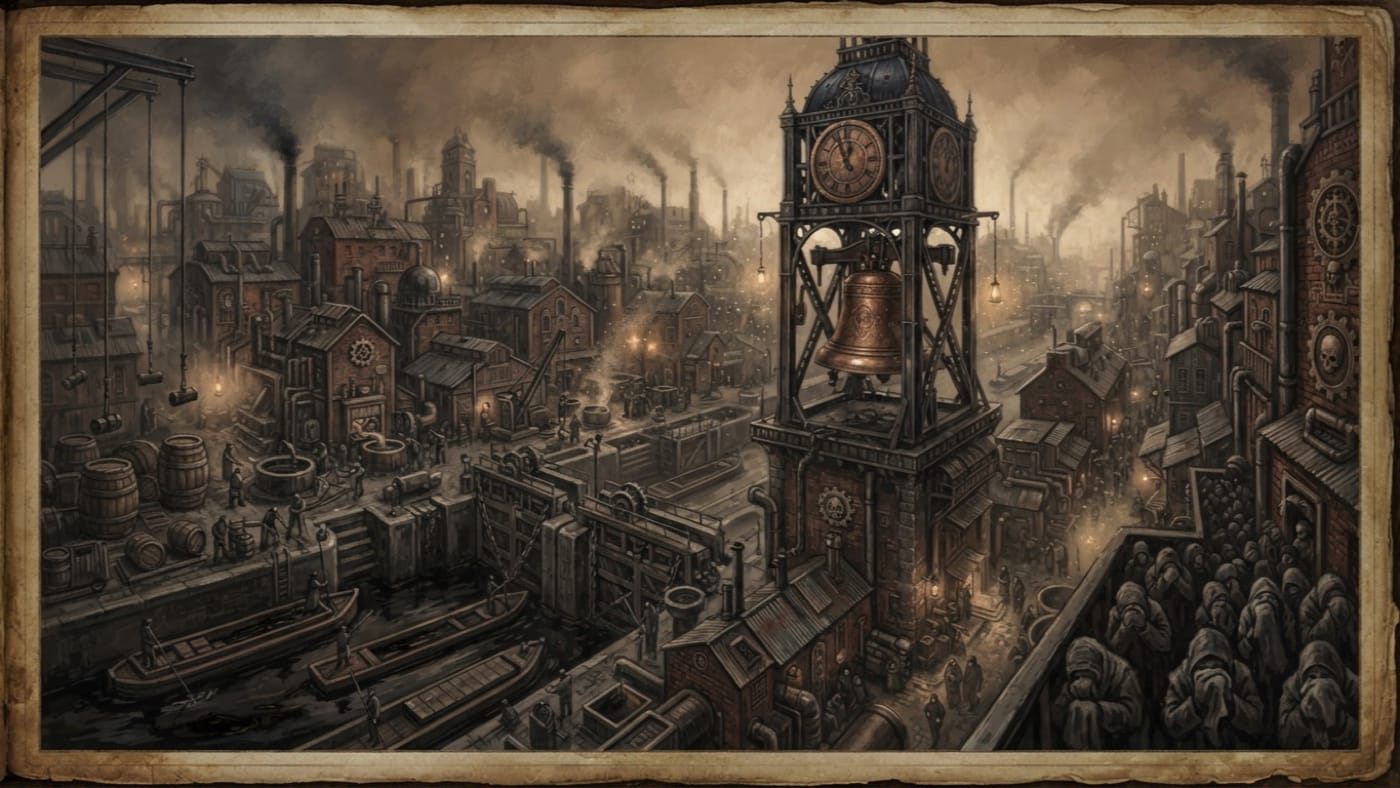
The first toll carries further than its own noise. In the Cooperage Yards, mallets stop above half-driven hoops. On the Slurry Docks, loaders stand at open vats with brine to the elbow and wet oak at their backs. At the Seal Locks the gates hang on their chains and the provosts break off their extortion in the middle of a sentence. Backchannel boatmen plant their poles in black water and wait. In the Crumble Ward the quarantine poor press cloth to their mouths and cough as quietly as the lime permits.
Local rule forbids laughter during the settling prayer. It also forbids stirring settled dust without sanction, which is the same offence committed with the hands.
The doctrine of the silence is purity-as-obedience. Breath disturbs particulate, and speech is breath with opinions. A town that cannot keep still cannot be trusted to keep its dust still, so every soul in Mournwater is drafted once a day, without wage or warrant, into the apparatus of a test most of them will never see.
#On the Test and the Second Toll
The silence exists for the dishes. In the Grading Hall of Settled Light, samples of incoming saint-dust are let fall into shallow glass beneath vinegar lamps. The graders stand at the tables in chalk cuffs with callipers to hand, their faces trained into blankness. Genuine saint-dust descends into what the Hall calls rosary strata. These are layered rings like the cross-section of an oak, each band answering to a grade, each pattern distinct enough to serve a batch as its fingerprint.
Failure is catalogued by manner. Some dust hangs. Some drifts sideways toward the lip of the glass, as though it means to leave. Some rises when it ought to fall. And some settles into anatomy, a finger or a jaw or the curve of a rib, which the Bureau of Alchemical Standards designates Crumble-Wrong and the graders measure with callipers before entering it in red-sealed ledgers marked do not circulate.
If the strata come true, the Bell sounds again. The second toll is the release. Mallets fall. Seals press. The locks turn, dust scrip changes hands, and the accepted dust goes to the vats to be suspended in brine as holy slurry, sealed into pitch-lined oak under confession wax, and sent downriver.
If the strata fail, the answering signal is withheld. No sound announces the withholding. The town learns of trouble only from the length of its own silence, while the graders investigate a cause they may never be able to name.
The record admits two occasions of sound and says nothing of the strokes, pitch, interval or mechanism of either. It does not name the ringer. This is the most orthodox feature of the arrangement. The Bell gives voice to a judgment assembled by several offices, and no one office has signed for the voice.
Observation and certification are separate trades. Graders watch, measure and report. Purity is conferred elsewhere, by the White Steps certifiers under Purity Prefect Sister Halvein, whose seal makes a cask lawful. A grader's eye can condemn a dish. Only a certifier's ink can make a barrel holy.
#On the Hands Behind the Signal
Four powers stand behind the second toll, and none of them stands next to it. The graders supply the observation. Sister Halvein's office supplies the seal. The Cooperage Compact, under Master Cooper Vell Arno, supplies the casks and shipping manifests without which certified dust is only expensive sand. The lock provosts supply passage through the only lawful channel for certified slurry ships, at tolls they set fresh each day.
The Church's general authority over bells is old and well papered. The Office of Bells was constituted in A.S. 52, and the present Bell Codex was ratified in A.S. 115. Neither instrument records when Mournwater began ringing for its dust or who keeps the local keys. The town's own milestones are no help. Its relic trade began with the upriver capsizing of A.S. 98, the Compact received its charter in A.S. 104, and by A.S. 110 Mournwater was a reliquary port that remembered barrel-making. Not one of these dates founds the Bell.
Under the offices are the people who actually keep the silence. Graders confess "doubt" and "tremor," because a shaking hand can ruin a dish. The confession receipts are filed as tithe and kept as leverage. Futures debts are collected as labour, as names, or as quarantine "volunteering." A grader who coughs during the prayer has committed something the ledger knows how to price.
In public, the Graders' Quiet Union concerns itself with safety standards. Its methods are silence tests, whistle codes and slowdowns. Its private marks, cut into hoop grooves and wax ridges, tell dock crews which casks to avoid, which to sell and which to lose. That information trades as briskly as anything Silt-Rook Dema poles through the backchannels under counterfeit seals. A slowdown is a strike, and the Bell's silence is law. Seen from the docks, the two are hard to tell apart, and the Union has noticed this.
#On the Nine Hours
In A.S. 199 the second toll did not come for nine hours. It is the longest silence on record. No official explanation was issued.
The published accounts tie the silence to Dish Twelve. The unofficial accounts travel faster in Mournwater because they need no seal, and they agree that the dust in that dish rose instead of falling and that the suspended grains formed lines resembling script. Within the day the backchannels were saying the dust had begun to settle in a language. The Bureau of Rites denies that the lines were legible.
The only document is a restricted extract:
GRADING HALL INCIDENT 199-SB / DISH TWELVE: Settling failed at first bell. Particulate rose in vertical column, separated into pale strokes, and formed ███████████████. Witnesses reported sound "like teeth in a jar." Grader Elian Voss spoke the phrase ███████ ███████ before collapse. Subsequent silence: nine hours. Body: unavailable. Dish: melted. Bell: no damage recorded.
What the extract establishes is narrow. It preserves what witnesses described, a phrase withheld from the copy, a collapse, and an absence. It gives no cause. It does not say whether Voss lives. Body: unavailable is a custody notation, and Synodal custody notations have never been confessions. The melted dish shows heat, or something the Hall prefers to file as heat. The undamaged Bell shows only that nobody wrote down any damage to the Bell.
The southern-corridor consignment that reduced a garrison's dead was shipped in the same year. The published accounts do not connect it to Dish Twelve, and neither shall I.
#On the Price of Waiting
While the Bell withholds, certified commerce stands still. No seal is pressed, no lock opens for slurry, and no clean cask can be sold as clean. Expectation keeps moving. The futures clerks follow delay with obscene devotion, and by their own published reckoning three minutes shift cask rates, ten minutes move quarantine scrip, and an hour can make a man rich enough to buy a certifier's conscience. Dust scrip has tripled since A.S. 198. Condemned slurry now trades in the backchannels above the price of certified stock, because a condemned batch can ruin a certifier faster than a clean one can heal a corporal.
Downstream, the waiting is counted in other units. Bastion chapels and trench shrines draw on Mournwater slurry. So do field hospitals, for salves and poultices. So do the broadcast houses of the Bureau of Orison and Song, where signal engineers blend saint-dust into transmissions against Pale Chanter unhymns and keep blend logs under custody seal. By their account the dust gives the carrier its ballast. Mournwater is not the Church's only source. Along its stretch of the Sagittal Line, though, each hour the town spends in silence is an hour a quartermaster spends recalculating.
"Mournwater never ships tainted." — standing text of every clean Mournwater certificate
Revised. Batches certified pure at the Grading Hall have turned in transit, settling wrong in sealed casks and reacting to humidity at the point of use. The certificate is still printed with the original wording. This correction binds the Codex only.
#On the Present Application
The Crumble-Wrong classification dates from A.S. 194. The joint review by Alchemical Standards and the Bureau of Rites closed in A.S. 200. In A.S. 201 Mournwater operates under second-settling guidance: certify only after a second settling, unless supply priority overrides.
The terms must be kept apart. The second toll is a signal of release. Second settling is a repeated material test, dust let fall again before seal is set. The guidance multiplies the tests. It does not multiply the Bell. No third toll exists, and no rule makes each settling answer to a sounding. The exception for supply priority means that when a garrison's need outweighs a grader's doubt, the doubt yields and the cask moves.
A successful settling, followed by a lawful toll, guarantees one thing: that the dust behaved in the dish. What it does in the cask, in the chapel steam, or above a body not yet cold is beyond the Bell's jurisdiction. The Church relies on that assurance anyway, every day, because the alternative is to admit that the foundation of the relic supply is a conditional sentence.
The Cooperage Audit remains pending. The locks remain open. A futures slip in circulation predicts that the Bell will fail to ring before the autumn of A.S. 201. It is a prediction, priced like one. The town's older fear is the Great Settling, a day the dust never settles and every seal becomes meaningless. That too is a fear and not an event, and the futures clerks keep it on a separate page.
Each day the first toll sounds, and Mournwater shuts its mouth and waits to be told it may resume trading.