

#On a Form With One Empty Box
This dossier is a present survey compiled in A.S. 201, which is 1911 by the common reckoning. The year dates the compilation and nothing else. The Stone-Mutes keep no founding day that this office could print, and I have not made one up for them.
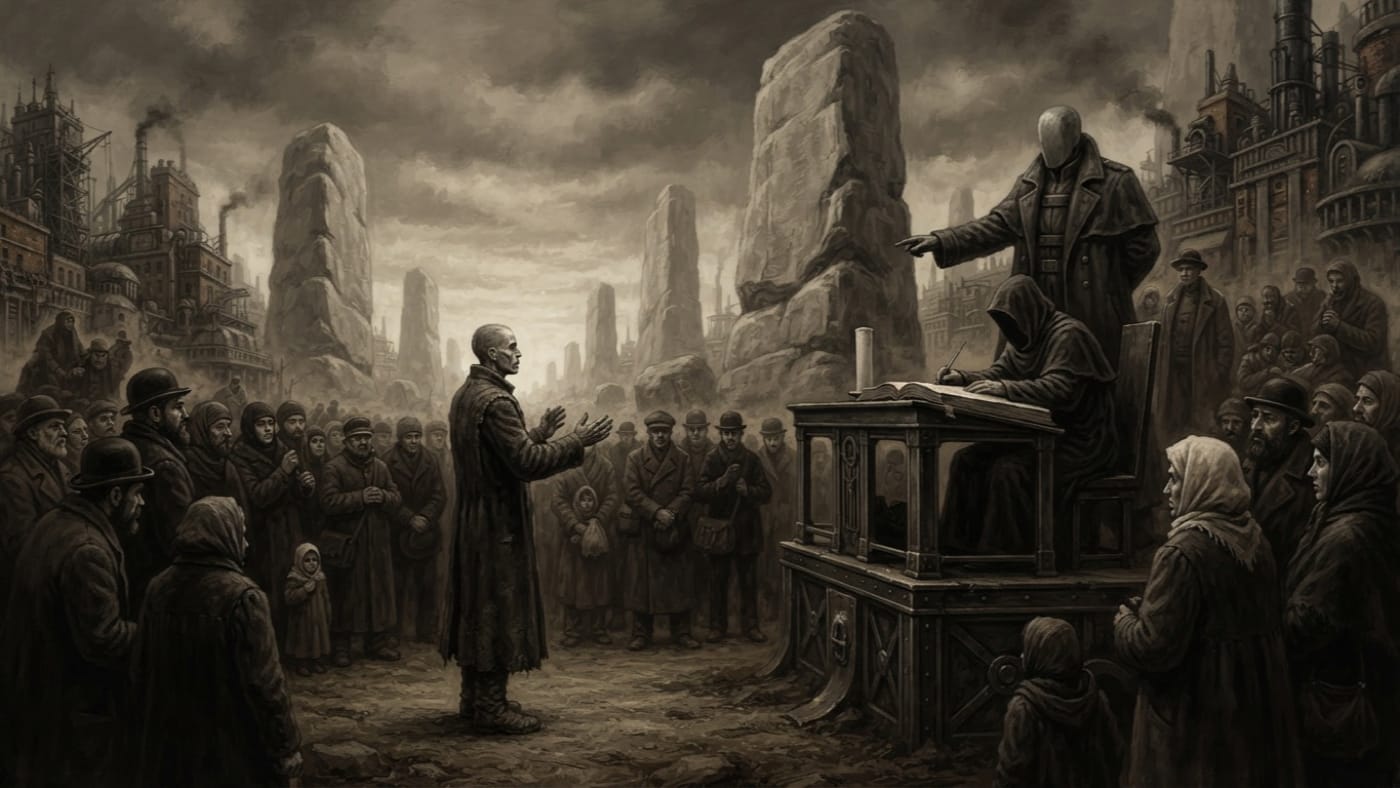
The whole difficulty fits on a single court form. The Caravan Court at the Steppe Gate hears claims aloud and weighs witnesses aloud, and it charges for both. Its intake sheet has a column for the petitioner's statement. The Stone-Mutes will not fill it. They are the strictest tendency inside the Null Tongue Brotherhood, the Gate's silent heresy, and they hold that every spoken contract is a meal for the treaty. So the clerk holds his pen over an empty column while the Bench behind him waits for a voice. The person in front of him has turned refusal into a rite.
The Stone-Mutes are a tendency within the Brotherhood. Nobody founded them as a separate order. No charter is on file for them, and no officer, roll, house or habit is known. The Bureau knows them only by their position. That is an odd way to know anyone, and a very poor way to arrest them.
Stone-Mutes: see entry under Null Tongue Brotherhood.
Corrected. The archived referral pointed to no page and no redirect. Clerks who followed it arrived nowhere, which the Stone-Mutes would call a fair summary of their doctrine. This survey replaces the pointer.
#On the Stones and the Wound
The Gate stands on the eastern edge of the steppe, near the Moldavian border according to some accounts. I have seen three maps of it and believe none of them. Its seven Treaty-Stones of wind-polished limestone were raised in A.S. 76 / 1786, and the Gate compact was registered in A.S. 78 / 1788. Around them lies the Treaty Ring and its open-air court. There the law is carved in stone, read by the wind, sold by translator-scribes and enforced on the throat. Speech is the Gate's currency. The Scribe Bazaar sells correct mouths, and the Seal-Houses sell the wax that makes a correct mouth lawful.
In A.S. 94 / 1804 the licensed Arbiter J. Sarn mispronounced a binding term at the Third Stone. About a thousand throats closed before dawn, and Doctrine corrected the registry's count by erratum in A.S. 95. This was the Red Pronunciation, which the Brotherhood claims as its origin wound. No Brotherhood charter survives, and no founder has been named.
The Stone-Mutes inherit that wound, but they have no birthday of their own. The file does not say whether the tendency hardened in the first winter after the Red Night or a century later in some cellar quarrel. Anyone who dates the Stone-Mutes to A.S. 94 has mistaken a parent's scar for a child's baptism.
#On Two Silences
The Brotherhood keeps silent in more than one way. The differences matter more to the Bench than to the Brothers, who deny with identical gestures that they are divided at all.
The Brotherhood's Quiet Hands teach practical silence near the Ring. They give no spoken answer by the stones and never repeat a clause they do not know. They use gesture with children, file written petitions where a petition will serve, and hire a paid translator when nothing else will. This is survival, and it can be negotiated, because a Quiet Hand will let someone else's tongue take the risk for a fee. They are not the Quiet Hands of the Ritual Bone-Stampers, who quiet corridors for the Ledger. The two groups share a name and a low tolerance for clerks, and nothing more.
The Stone-Mutes refuse that bargain. They teach that every spoken contract at the Gate strengthens the treaty's appetite, and that a paid translator only feeds it by proxy. They refuse to speak in court. They interrupt arbitration by sitting silently through hearings that cannot move forward without a voice. They teach null-walking in the gullies and wind shadows, the low ground where a gust breaks and a lesson gets a few minutes' cover. The appetite is their claim and no one else's. No office has measured it, and the stones have filed no reply.
Gesture has hard limits, and the Stone-Mutes cannot pray them away. The Brotherhood's cant was built for queues, market corners and patrol searches. A hand cannot always bind cargo or absolve a debt. Papers, witnesses, seals and the occasional bought tongue are still required at the Gate, whatever a person does with their fingers. Silence buys no passage and settles no debt. A Stone-Mute who will not speak in court still owes everything owed on arrival, plus whatever the Bench charges for the inconvenience.
High Arbiter Senn Vark has shown what that inconvenience costs. He required a mute petitioner to appoint a speaking proxy before the Bench would hear her claim. When the Brotherhood sent twenty-seven silent witnesses to the next session, he charged each of them a standing fee. The file does not say which tendency sent them, and I will not guess. The ruling is lesson enough: the court tolerates silence in the room and invoices it by the head.
#On the Price of Holding Still
The Brotherhood's own dead argue against easy faith. In A.S. 187 / 1897 an unnamed adherent attempted a null-walk past the Fourth Stone in daylight. He carried clean papers, made no sound and held his palms outward. At the Fourth Stone he fell, bleeding from both ears, and the examiner found ink in his trachea. Nobody has shown that he was a Stone-Mute. The method he died practising is one they teach.
The Brotherhood ruled that inward speech betrayed him: fear formed words inside his skull, and the stone heard them. That is a doctrinal judgment, and it saves the method by blaming the man. Purity found the case inconclusive. The cause of death is still open, and so is the question of whether the treaty has any jurisdiction over silence.
Gate glossary: null-walk — passing without speaking (illegal, effective).
Corrected for this survey. That it is illegal is established. That it works is not, and the Fourth Stone holds one body against the claim. Read: illegal; effect unresolved.
In A.S. 196 / 1906 a junior Lictor ordered nine suspected Nullists to answer together near the Third Stone. Seven answered, and all seven developed throat bruising in the shape of witness marks. Two stayed silent, and the Caravan Court released them for lack of an admissible statement. No record places a Stone-Mute among the nine. The episode shows what compelled speech does near the stones. The release was a ruling on evidence, and the stones granted no one immunity.
#On Appetite and Concealment
The first living addenda were classified in A.S. 194 / 1904, after an Archive shelf audit. Where they come from and how they form are unresolved questions. The Stone-Mutes do not treat them as questions. They folded the addenda into their teaching as proof that the treaty eats.
In A.S. 199 / 1909 the Third Stone rubbing went missing from the Burnless Archive. It has not been found, and its disappearance is unexplained. The theory that it was consumed belongs to the Archive's keepers, as their interpretation and nothing more.
The loss shifted the Brotherhood's teaching. The older hope was that silence could starve the stones. The newer counsel is that silence may hide the faithful from a treaty that adherents believe can amend itself. Starvation is a siege. Concealment is a vigil kept beneath the enemy's window. The Stone-Mutes now teach that the Archive feeds on enforced speech, on closed throats and on every ruling that becomes a death. No examiner has shown that the Archive digests anything, and this office will not grant the heresy a metabolism it has not proved.
The Court answered in its own idiom. In A.S. 201 Vark held that properly formed living addenda bind. His position concerns their form only. It says nothing about who writes them or how. The Stone-Mutes hear confirmation in it. The clerks hear procedure.
#On the Day That Has Not Happened
The Stone-Mutes propose a full silent day at the Gate, with no court, no market, no oath, no toll and no spoken name. It remains a plan. No attempt, date, outcome or shutdown is on record, and nobody has shown what one quiet day would do to the stones or to the Archive. I record the ambition and make no prophecy about it.
Meanwhile the Bureau of Purity watches the Brotherhood as a whole, through translator-scribe informants and controlled circulation of primers. It tolerates the Brotherhood because the Brotherhood is useful. It teaches letters and gesture and supports refugees. Through the Open Palms it moves debtors and failed witnesses through the Split Tongue cellar, the Oath Inns of the northern gullies and the queues of the Caravan Corrals. The scribes and Seal-Houses live off compulsory speech. A tendency that preaches the starvation of that trade gives commercial offence, in a town where offence is settled at the fee window.