

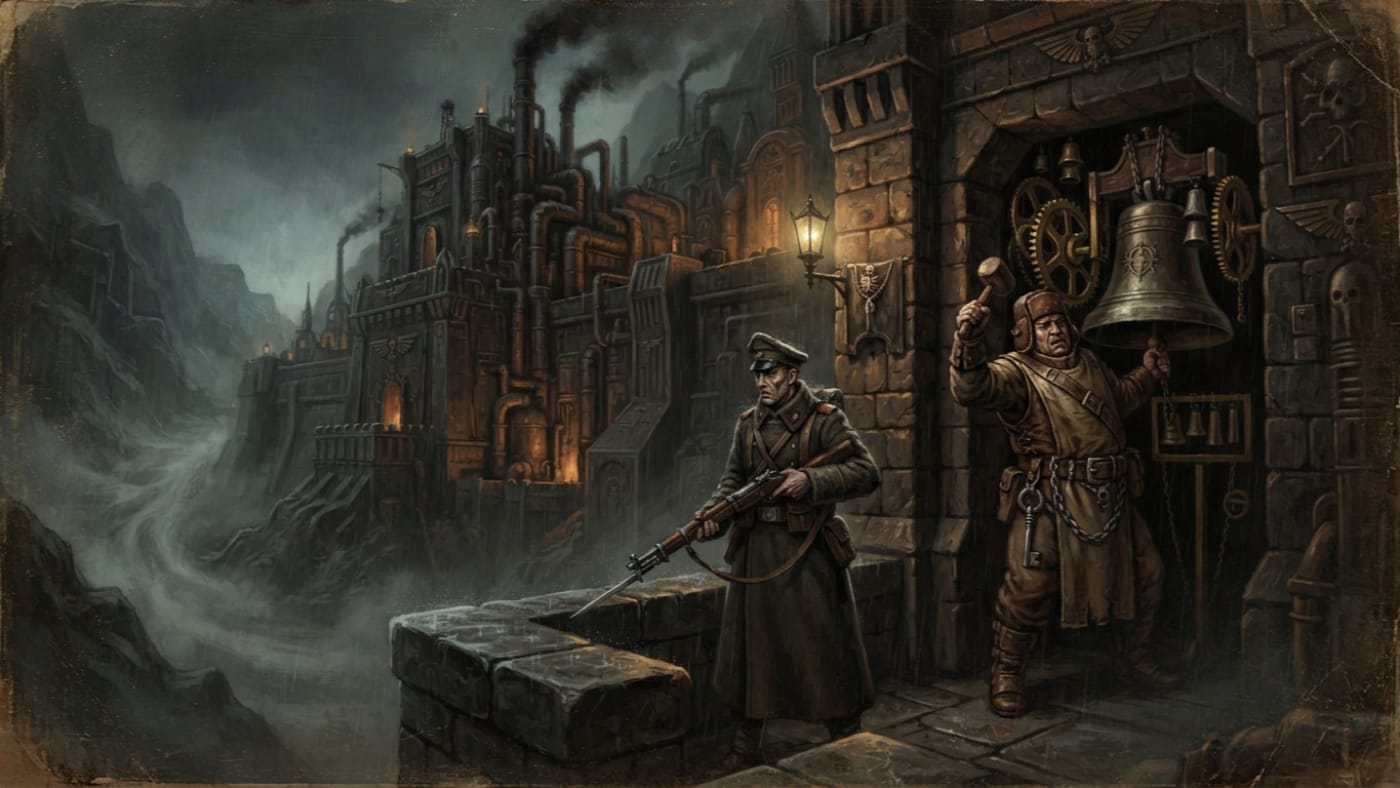
#I. On the Documentary Condition of the Order
As far as this archive can produce it, Standing Order 44-F survives as a single marginal extract of three sentences. It is preserved in my own survey, On the Veil-Stalkers, and in no other folio a Hieromnemon may lawfully touch. The extract carries the words "Revised A.S. 198." That date, 1908 CE, belongs to the revision. It does not tell us when the order was first issued, who issued it, or what it said before someone sharpened it. The original promulgation, the signatory, the full text and the seal are missing from every folio I have been permitted to open. I decline to forge them for the convenience of a tidy article.
The Codex shelves this order among the factions, next to the enemy that made it necessary. No reader should take it for a formation. Standing Order 44-F is a sentry regulation of Bastion-Shipka, and its only members are the men it keeps awake.
The problem it addresses is a narrow one. A sleeping sentry is a disciplinary matter with a long and satisfying literature. The old manuals have no chapter for the other kind: the sentry who is awake and upright with his eyes open, who watches a stranger come toward him and finds that he does not care. The order was written for him.
#II. On the Occasion: The Fog-Walk at Shipka
The Veil-Stalkers are mortal. I repeat it because garrisons prefer demons. They are starved men and women drawn from the auxiliary stock of the Shadow Court. They are cut with concealment glyphs that feed on whatever life the hunger left them, so every hour of hiding is paid from the bearer's own account. They are spent quickly, and volunteers do not replace them.
ERRATUM (to the Veil-Stalker record, not to Standing Order 44-F; Bureau of Records, 3rd Revision, A.S. 199): Previous assessments describing Veil-Stalker inscription as "voluntary" are amended. The process is correctly classified as "conscription under duress, Category 7-F."
The older catalogues call these bearers "cultists." That word is withdrawn here, whatever the older indexes say.
Of the several modes of concealment, the one this order concerns is the Fog-Walk. The Bureau associates it with Syrion, Sin-General of Sloth, whose time-fog sits on the highlands south of the pass. The Fog-Walker does not vanish. He carries a small sickness of drowsiness that reaches about an arm's length, and the man inside it registers the intruder and fails to care. He sees, and he dismisses. The knife arrives during the dismissal.
Ordering a man to stay vigilant does nothing against this. You might as well order a drowning man to be drier. Shipka learned the lesson in a single week, and it cost nine men. My record gives no year for that week and no names for the nine, and I will not supply either. The Bureau of Records may produce them one day, and I would rather be late than inventive. What the record does give is the remedy and the credit. The credit goes to the garrison's Bellwardens as a body. Their remedy was a sharp, atonal counter-rhythm struck at irregular intervals, meant to jolt the mind past Syrion's narcotic threshold.
#III. On the Substance of the Extract
Here is the extract in full, as the margin preserves it:
"No sentry at Bastion-Shipka shall stand post for longer than ninety minutes without percussive stimulus. The stimulus shall be administered by the duty Bellwarden and shall consist of three sharp peals at non-standard intervals. Complaints regarding sleep disruption shall be filed with the Bureau of Mercy, which will not read them."
Read it as a canonist reads a will.
The ninety minutes measure stimulus, not service. A sentry may stand his post as long as the watch-bill requires. What he may not do is stand it for more than ninety minutes without being struck by sound. The extract grants no relief at the ninetieth minute and no rest afterward, and it sets no shift length at all. I have heard junior officers cite 44-F as a ninety-minute watch. They are citing a sentence that does not exist.
The stimulus belongs to the duty Bellwarden: the man with the toll-key chained at his belt, the tuning forks in their felt roll, the strike mallet and the calibration book. The order does not trust a corporal with a pot lid, and it is right not to. Sound at Shipka falls under the jealous discipline of the Bell Codex, and in that bastion a wrong note can be taken for Syrion's work as easily as for a friend's.
Three sharp peals, at non-standard intervals. Here the drafting is excellent, and I say so with the reluctance of a man who usually corrects drafting. A regular peal becomes furniture. Within a night, the Fog-Walker's somnolence would fold it into the background. An irregular peal cannot be anticipated, so it cannot be ignored. The wake-bell patterns used along the wider Syrionic front rest on the same reasoning: once the next bell becomes predictable, the listener is already drifting.
The extract does not say what the intervals are. It names no penalty for a Bellwarden who lets ninety minutes pass. It exempts no post, prescribes no form and attaches no schedule. Those clauses may exist in the complete instrument. They are absent from what I hold, and anyone who needs them may apply to whichever office holds the rest.
Then comes the third sentence. Complaints go to the Bureau of Mercy, "which will not read them." A regulation that announces its own refusal is a rare thing. I have read ten thousand orders that ignored complaints. This one has the decency to say so in advance, and the economy to do it in five words.
#IV. On Bells in Practice, and the Two Seconds
The record reports two effects of the counter-rhythm. The garrisons confuse them at their peril.
The first effect works on the sentry. The sharp peal breaks the narcotic indifference in the observer's head. He was looking at the intruder all along, and now he cares. That is the purpose 44-F states.
The second effect works on the Stalker. The broader survey of countermeasures records that a sharp, non-standard bell-pulse disturbs the resonance of the concealment glyphs themselves, so the bearer flickers into sight for about two seconds. The first effect acts on the watcher and the second on the watched. I find no evidence that they are one process, and neither gives lasting immunity. Two seconds is the length of a breath. A sentry who has been made to care, and who happens to be facing the right way, may put them to use.
The record reports bell-pulse counter-rhythms at the bastions south of Przemyśl along the Sagittal Line. Where a method is used is a separate question from where an order applies. Nothing I hold extends 44-F beyond Shipka's walls.
At Shipka itself, dedicated Bellwarden teams pulse at seventeen-minute intervals throughout the night watch. The record sets that figure beside the ninety-minute ceiling, and I leave them there. I do not know whether each pulse was a full triplet under 44-F. I do not know how the order's irregular spacing fits inside a seventeen-minute cycle. A reconstructed peal chart would be my invention wearing the Bureau's ink.
The practice has revealed Stalkers on four occasions. The word is "revealed." The record does not say killed or taken, and it does not count the four toward any percentage of success, so I will not promote the word. The same practice has also revealed rats, stray dogs, one sleepwalking chaplain, and a quantity of contraband personal effects that soldiers had hidden from inspection.
#V. On the Garrison's Account
The counter-rhythm makes sleep impossible for everyone within earshot. The Bureau of Bells calls this "an acceptable secondary effect," and the phrase deserves a slow reading. The effect is secondary to the sentry's attention, and it is acceptable to the Bureau. The men lying awake were asked about neither.
Consider what Shipka already demands of the ear. The pumps breathe under the west works and must never stop. Trains grind along the marsh approaches through the night. In the Bell Gallery, telegraph sounders chatter in their brass cages, and the timing bells toll at their prescribed hours through stone that is never quite dry. Sentries on Syrion's front nail their boots to the parapet so they cannot sleepwalk over the wire. Into all this the Bellwardens strike sharp, atonal, deliberately unpredictable notes, and every man within hearing jerks awake along with the sentry the notes were meant for.
So the garrison buys one man's attention with every other man's rest, and it pays again every night. I have read the record of the week of nine deaths, and I would sign the exchange myself. It remains a debt carried by men who signed nothing.
The Bellwardens pay twice, because they strike the notes and also live inside them. Their trade already brings hearing loss, tinnitus and rope burns along the forearm. It also brings what the trade calls bell-sickness: phantom peals, brass that a man hears though no one is ringing it. Leather ear-caps soften the blow without cancelling it. No record I hold measures how much of that injury 44-F adds at Shipka, and I will not dress a guess up as a figure.
The Fog-Walker, for his part, is a starving conscript whose skin is eating him. He stands two seconds from a bayonet in a pass where no one slept the night before. The order was not written for his comfort. I set him down here because the record has been unkind enough to him already.
#VI. On the Present Application
My survey of A.S. 201 speaks of the order in the present tense, as Shipka's practice. I hold no later revision and no reaffirmation, only the revised text of A.S. 198, three sentences long and missing whatever surrounded it.
Shipka has nine dead from one undated week, four exposures, and a garrison that sleeps in pieces. The Bureau of War calls that a functioning perimeter. On the evidence, it is one.