

#On the Citation and Its Limits
The Codex knows Standing Order 44-R from a single line. That line sits inside a redaction in the Trench Court Field Manual, where the Bureau of War classifies Appendix C under the order's authority. Appendix C is titled Procedures for Continuity of Registry in Event of Total Clerk Casualty. Its cover description says only that it sets out a protocol for untrained personnel to take over recording duties using simplified rubric cards. Nothing more is public. The order's text, issue date, signatories, revision history and the meaning of its suffix are sealed. I will not embarrass the Bureau or myself by guessing at them in print.
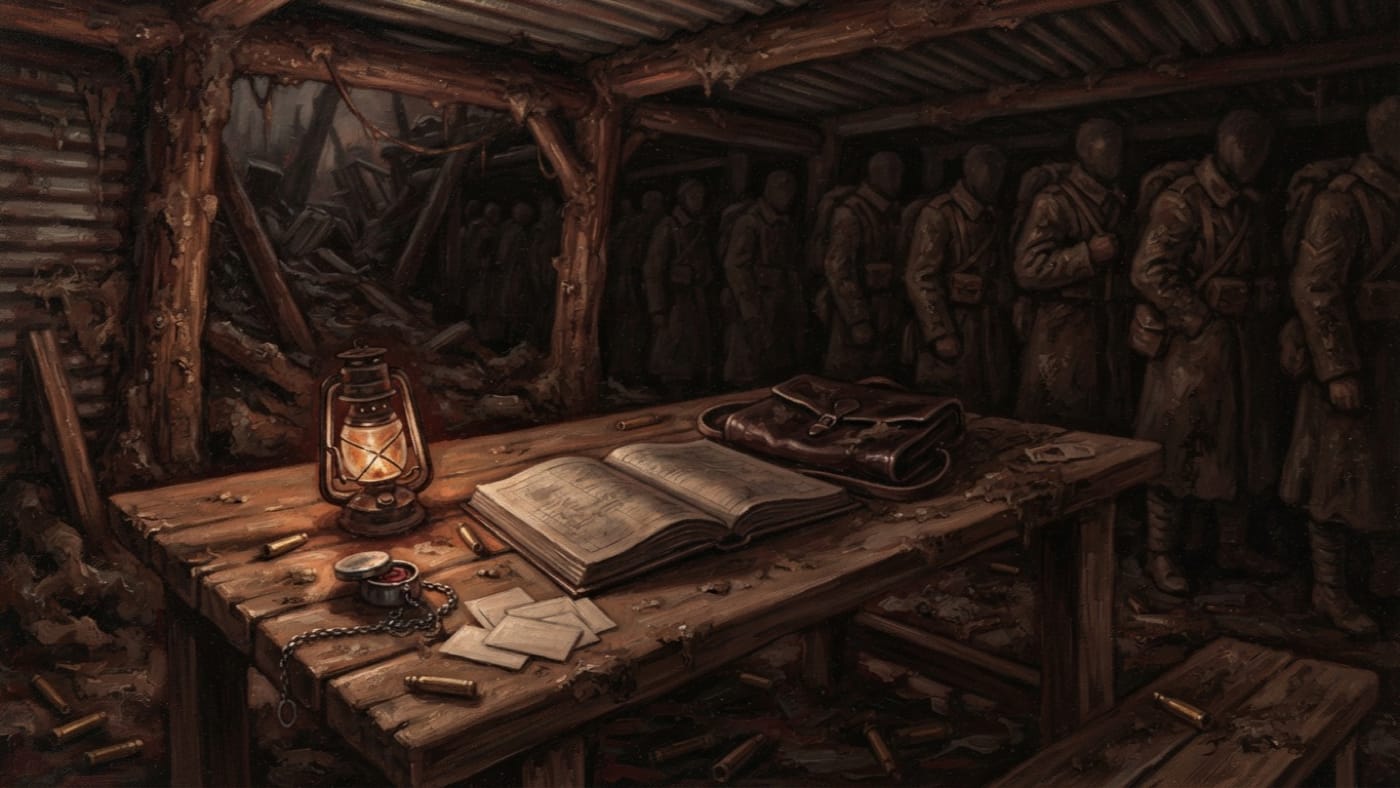
What the citation does show is narrower, and colder. At some point a person in the Synod's service considered the Trench-Court Clerk at his plank table, with his lantern, his brine cloth and his seal tin on its chain. That person then considered the table with nobody left who had been trained to sit at it. Appendix C is the written result. The Bureau of War has put it under lock, and Standing Order 44-R is the lock.
The forty-four is an instrument number, not a year. Any reader who has already turned it into a date can hand that arithmetic in at the nearest Bureau of Records window, where it will be stamped received and kept with similar efforts.
#On the Cost of a Silent Table
You have to understand what a registry dugout produces before the appendix makes any sense. A clerk on the Sagittal Line produces proof that men are dead.
That proof feeds everything behind him. A widow needs a death attestation before she can collect a benefit, remarry, or wear mourning with the Ledger's authority. An heir needs a bequest slip before the inheritance clerks will let a ring or a coin purse pass to him. Burial crews need a clearance before they can put a body in consecrated ground and stop counting it. Supervisors reconcile tags against bodies and attestations against casualty returns. A quartermaster who keeps drawing rations for a dead company is either a thief or the victim of an empty registry table, and the auditors seldom take the time to work out which.
The Synod has already learned what an empty table costs. In the Uncounted Winter, which the registers place somewhere between A.S. 87 and A.S. 91 and which I am in no hurry to pin down, a northern offensive overwhelmed field registration. About fifty thousand dead were left without attestation. Their families spent years trapped in the procedural gap between living and unrecorded, and the homefront responded about as patiently as you would expect. The Trench Courts grew out of that wreckage. The timeline dates their joint Records and War mandate to A.S. 91.
No register available to me dates Standing Order 44-R, and I decline to supply a date for it. Nothing in the record establishes that the Winter was its occasion. The Winter shows the problem the appendix is meant to address, and that is the full extent of the connection.
The problem is a simple one. The queue outside the flap does not stop when the clerk is killed. The men in it are still bleeding, and each of them still has a name, a unit, a doctrine line and a final bequest that someone has to write down before he goes cold. If nobody does, the Synod must either leave fifty thousand more families unable to prove a death or find a hand to hold the pen.
#On the Cards and the Satchel
Simplified rubric cards were not invented for an emergency. Short-codex rubric cards are standard issue, packed with the wax seals, the field stamp kit, the waterproof ledger sheets and the identity tags. In an ordinary surge a trained clerk already triages his queue: some men get a full transcript and others get a rubric summary. That depends on how many are waiting, how much shelling there is, and how long each man has left to talk. The card is the instrument a clerk reaches for when time runs short.
Appendix C, as its cover describes it, keeps the card and assumes there is no clerk. It is a reasonable piece of administration, which is exactly what is wrong with it.
I can list everything the Manual says will survive. The grab satchel is policy. When the shelling begins, the clerk has about twelve seconds to sweep the current ledger, the seal tin and the active tags into waxed leather, then press himself against the timber. The satchel is saved before the clerk is. I do not credit that rule to Standing Order 44-R. It stands in the Manual on its own authority, and it is the plainest statement of priorities the Synod has ever put in writing. The records are worth more than the registrar. The appendix only takes that position to its conclusion: suppose the satchel survives and the registrar does not.
After that, the record goes quiet. Who picks up the cards, who authorizes them to do it, and how the next man in the queue is identified without the hand trained to identify him are all sealed matters. So is what the cards actually say. I am certain they are sealed, and that certainty is the only certainty this article will give you.
██████████████████████████████████████████████████████████████████████████████ ██ [WITHHELD — Standing Order 44-R, text not released. Trench Court Field ██ ██ Manual, Appendix C, contents not released. Card wording not released. ██ ██ No recovered copy held by the Codex.] ██ ██████████████████████████████████████████████████████████████████████████████
The physical setting needs no imagination. A Zone 4 dugout after a direct hit has swollen timber and mud everywhere, wax smoke from a lantern knocked onto its side, and a tin of seals that is cold to the touch. The ledger sheets are treated with the Bureau of Engineering's laminate and resist ink, so they take a heavy, practised hand. A rifleman pressing his first entry onto that paper will find the nib skidding, and the next man in the queue is already asking whether his name has been written down.
#On Compression and the Furnace
The profession splits along a line that the appendix crosses, whether or not anyone intended it to.
The Record-true clerks hold that the Ledger's authority depends on completeness and that every word a dying man says belongs in it. The Rubric clerks hold that the front runs on usable outcomes, meaning an attestation, a clearance and a category, and that a dying man's family is better served by a clean classification than by a faithful transcript of his last confusion. I have not heard either faction say anything about Appendix C. I do know their positions, and the conclusion follows without help. If replacement recording runs on simplified cards, then by its cover description it is compression carried to its limit. Nobody in the dugout is left to argue for the full transcript.
That matters because the categories matter. Faithful, drift, contrition and contagious doubt each lead somewhere different. One leads to the honoured rolls and a pension. One brings reduced benefits and an annotation. One produces a triplicate packet for cross-referencing. The last produces a standard notification of death and a sealed pouch. A careless mark on a card can decide whether a widow gets a pension or a visit from the Bureau of Purity. The citation says nothing about whether the appendix keeps all four categories or reduces them, and I will not invent an answer.
Its limits deserve the same care. The fifth category, cadence anomaly, was added after Wound-Site 14 and belongs to specialist judgment and the Cadence Examiners. Nothing in the known citation gives that office to a man holding a card. Nor does the citation give him the furnace. Contradiction pouches, countersigned burn orders and the squat iron field furnace all exist. Burn Directive 7-C carries its standing instruction to cauterize on receipt. The Contradiction Doctrine governs what gets separated out and why. These instruments have their own authorities and their own signatures. A continuity appendix that keeps a registry working is a different thing from a licence to destroy testimony, and the Codex will not merge the two because the smoke smells the same.
A preliminary draft of this entry described Standing Order 44-R as the instrument that established emergency replacement recording on the Line.
The surviving citation establishes only that the Bureau of War classifies Appendix C under Standing Order 44-R. Whatever authority first drew up the procedure is not shown by the record available to this Codex.
#On the Present Position
As of this survey, A.S. 201, the classification stands, and that is the only date this entry gives Standing Order 44-R. Appendix C is still restricted, its cards are still unpublished, and its procedure is still described by its title and nothing else.
The institution's priorities can be read without the sealed text. The Manual saves the ledger before the clerk. It keeps the tags, which stay legible when the faces no longer are. It keeps the seal tin, because wax is how the Synod turns breath into fact. Appendix C reaches further than any of these, to the case where the trained people are all gone and the recording has to go on. Standing Order 44-R keeps that case from the eyes of anyone not cleared to plan for it. Clerks who might find themselves in it are, I presume, informed at the time, by whoever is still standing.
The Creator keeps a complete register of the dead. The Synod keeps a satchel, a set of cards and a classified appendix, and it has arranged for the queue to be served whatever happens.