

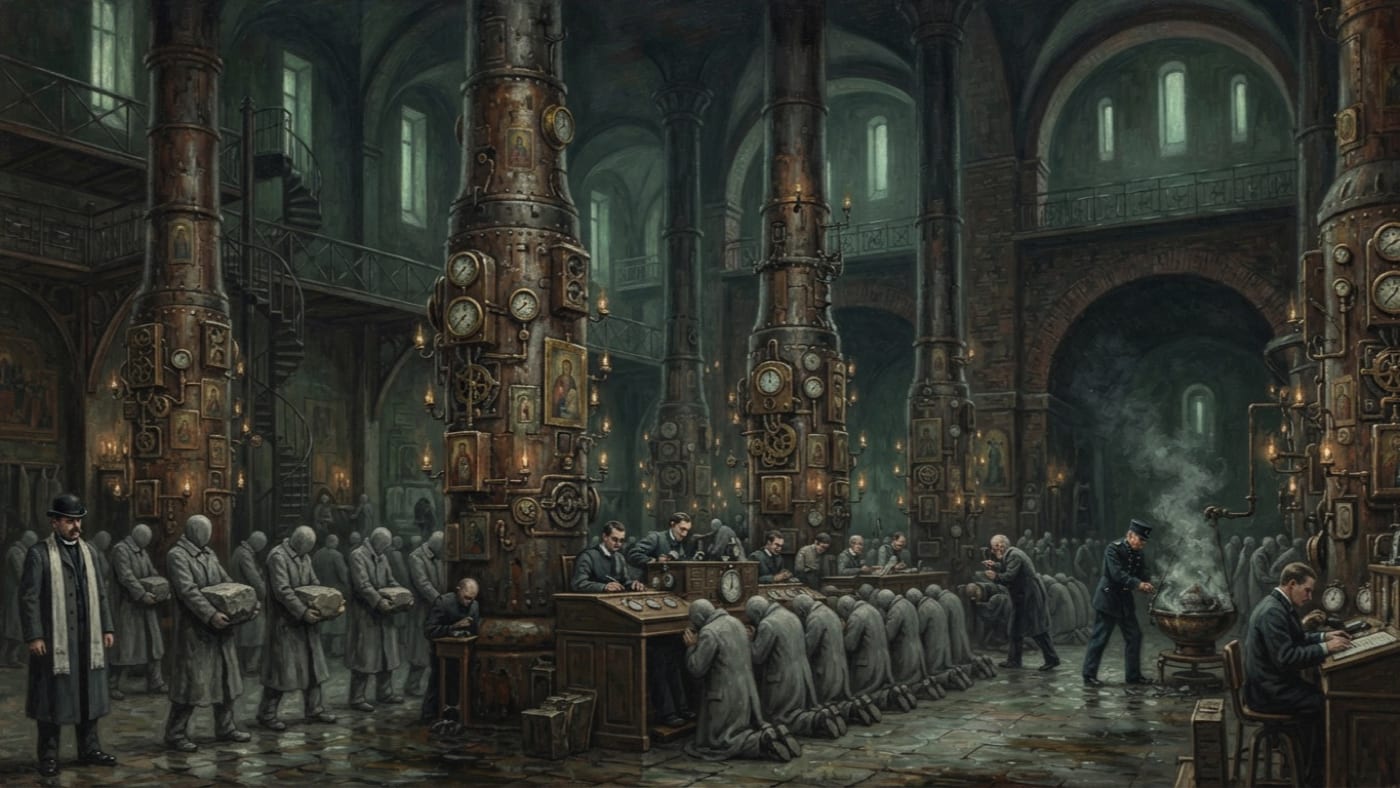
#On the Sevenfold Jurisdiction
"Form is Function, Function is Form." — Inscription above the Archive of Prescribed Gesture, Strasbourg Cloister
The Bureau of Rites divides all observance into seven jurisdictions and calls them the Seven Pillars of Prescribed Form. Visitors to Strasbourg sometimes ask to see the Pillars. There is nothing to see. The Pillars are a filing system. Like any filing system worth fearing, they decide in advance which drawer will receive the worshipper when the inspectors arrive.
The reader must keep three things separate, because the Bureau keeps them separate and will notice if the reader does not. The first is the Charter of Prescribed Observance: six hundred and fourteen articles, ratified in A.S. 58 under the seal of Augustinus and countersigned by Kratz. It dates from the years when the Church's offices were still multiplying after the Common Allegiance, three decades before the Concordat gathered them into a Synod. The second is the Codex Liturgiae, in eleven volumes and thirty-seven annexes, which is the working reference. The third is the sevenfold taxonomy, the method by which the Charter is enforced through the Codex. The Bureau has not told me when the Pillars were first numbered, or which annex answers to which Pillar. I have asked in the correct format.
All seven rest on one proposition, which the Bureau states without ornament: the prescribed performance is the worship. Belief may attend it or stay at home. A rite performed correctly by a doubter stands. A rite performed incorrectly by a saint is what the Bureau calls a breach, and Rites maintains that the Great Deceiver enters through breaches the width of a syllable.
#The First Pillar: The Sacramental Calendar
Rites sets every feast, fast, vigil and ember day in the Dominion. The Bureau of Festivals stages them, with banners, processions and bread. The calendar must agree with the peal schedules of the Bureau of Bells, the collection rounds of the Bureau of Tithes and the campaign tables of the Bureau of War. In practice the agreement runs one way: the others agree with the calendar.
In A.S. 167 the Liturgist-Primus moved the Feast of Saint Verena forward by two days. The ruling was liturgically sound. Tithes lost eight thousand Crowns in levies assessed against the wrong week of the harvest. A spring offensive reached Bastion-Przemyśl forty-eight hours before its supplies and found nothing waiting. No clerk of Rites was disciplined, because no clerk of Rites had erred. The feast fell where the Creator required it. The quartermaster's opinion is not a Pillar.
#The Second Pillar: The Codex of Gesture
The Codex of Gesture regulates the worshipper's body. It prescribes the position of the hands at absolution, the sign of the cross, the handling of the censer and the genuflection. A genuflection must last at least four seconds and no more than nine. An infirm worshipper may receive a dispensation for eleven, recorded in triplicate. An old man whose knees give way at the ninth second must first obtain three sheets of paper and a clerk's signature. Only then may his knees give way lawfully.
The most famous case under this Pillar is the dispute over fingers. The Dyarchists made the cross-sign with two fingers. They held that two fingers declared the Creator's mercy in its two aspects, given and withheld. The Tridentines answered with a theology of three. The argument consumed three years of Bureau deliberation and produced a schism that outlived most of the people who argued it. The settlement allowed three fingers in cathedral rites and two in field worship. The resulting manual of exceptions runs to three hundred pages.
Rites will tell any visitor that it has never compromised. I have carried that manual across the Cloister in both arms. It weighs about as much as a compromise.
An earlier plate in this Codex recorded two rural congregants "logged at nine seconds," and its caption treated this as an offence.
Nine seconds is within the prescribed range. The offence begins at the tenth second when no dispensation has been filed. The two congregants were compliant, and the shortage of dispensation forms was irrelevant to their case. This office regrets the alarm caused to their parish and to the Sub-Prior who counted them.
#The Third Pillar: The Canonical Texts
Every prayer, hymn, litany and responsorial exists in one authorized wording, and every word in it is held to be structural. In A.S. 119 a parish priest in Saxony substituted mercy for justice in the Vespers antiphon. He was reported, tried and sent to the Paper Mines of Ulm. His congregation received the corrected antiphon.
That was one word. He chose the gentler one, and by most standards kept outside this Bureau he chose the better one. The Bureau keeps no standards outside itself. The man's name does not appear in the records I was shown. The substitution does, underlined in red ink.
#The Fourth Pillar: The Fasting Protocols
Rites determines who fasts, when, for how long and how severely. Severity is measured in seven grades:
- Partial: bread and water after noon.
- Solemn: bread and confession after vespers.
- Severe: water and prayer only.
- Penitential: nothing, with hourly confession of appetite.
- Expiatory: nothing, with physical labour added.
- Immolative: nothing, while the penitent carries a stone representing their sin through the streets.
- Terminal: imposed on the condemned. It ends when they do.
A reader who counts will notice that the Bureau has placed a second sevenfold scheme inside the fourth of its first one. Rites considers this elegant. The grades form a ladder down which a body is walked, one rung at a time. The upper rungs take bread. The middle rungs take sleep, through the hourly confession of appetite, and then strength, through the labour. The lower rungs take dignity in public, with a stone carried past the bakeries. The bottom rung takes the rest. Every rung is set out in the Bureau's clean hand, and every rung has been revised seven times without any change to the bottom one.
#The Fifth Pillar: Penance
The Fifth Pillar sets the penance for each sin, and the penance scales with the offender's rank, station and nearness to relics when the sin was committed. A labourer who lies owes the prescribed prayers and a day of Partial Fast. A Bureau clerk who tells the same lie owes a week of Severe Fast, public confession and a fine paid to Tithes. The logic is defensible: more is expected of those who hold the pen.
The table then continues upward and stops. It contains no entry for falsehood by a Hierarch. I have read the table four times. It ends at the rank where my own superiors begin. I have the career I have because I have never offered to write the missing line.
#The Sixth Pillar: Consecration Protocols
The Sixth Pillar governs the rites that make places, objects and persons sacred. Under it fall the bastions, the reliquaries, every stretch of the Sagittal Line, and every bell before it is rung under the Bell Codex. A wall that has been consecrated incorrectly counts, for liturgical purposes, as a pile of stones.
The Bureau's own account of the consecration of Thessaloniki's harbour-chain on the Aegean records nine days of continuous ritual. It also records four divers who drowned while inscribing psalm-script on the submerged links. Their deaths were entered as "liturgical expenditure," in the same ledger that records tallow and incense. The account notes that the ceremony was performed correctly. That is the only adjective in the file.
#The Seventh Pillar: Supernatural Classification
Rites claims the authority to classify anomalous events theologically: to name what has happened and to decide which Bureau owns the name. The leading case is the Famine Pits of Kargath's territory. These were mass graves of the Sundering's starved, and their hunger did not die with them. Anyone who stands near a Pit feels cramps in the stomach, however recently they have eaten. Anyone who stays too long begins to eat their own hands.
In A.S. 134 the Bureau of Medicine classified the phenomenon as Residual Consumptive Emanation, Category Three. Rites objected. It argued that the hunger was theological in kind and proposed Post-Mortem Appetitive Disturbance, Liturgical Origin. Medicine replied that hunger is a bodily event whatever its cause. Rites replied that the body falls under theology and always has. In A.S. 148 a compromise was imposed. Medicine kept its classification, and every report it files must carry the words "pending liturgical review." The words are still added. The review is still pending.
Neither label has fed anyone or kept anyone away from the rim. The garrison's instruction is shorter than either Bureau's: do not linger. Which explanation is true remains undecided at the level of paperwork. What happens to the men who linger has been settled without any paperwork at all.
#On the Present Application
The Pillars work, and that is what makes them difficult to sneer at with a clear conscience. On the frontier a soldier reaches for the prescribed prayer, in the prescribed cadence, before reaching for a weapon. The Bureau's records credit that habit with holding walls. Under the Pillars a peasant in Saxony and a canon in Strasbourg keep the same feast on the same day with the same number of fingers, give or take three hundred pages of exceptions. The Church holds together largely because Rites has standardized how it worships.
That conformity has a cost, and the Bureau records it. Devotional debt is not an eighth Pillar. It is the price of the seven, and the Bureau keeps it in a separate ledger. Its symptoms are catalogued. Bread tastes of nothing. Bells sound at night when none are rung. Laughter cracks in the throat before it is finished. Whole parishes walk about grey-faced, worn out by grace. No published rate converts so many correct rites into so much lost taste. The Bureau measures both columns and does not compare them.
My verdict is the one the Bureau gave my own draft of its parent entry: adequate, narrowly. The Pillars stand. Everyone who lives under them is required to hold their genuflection for between four and nine seconds.