

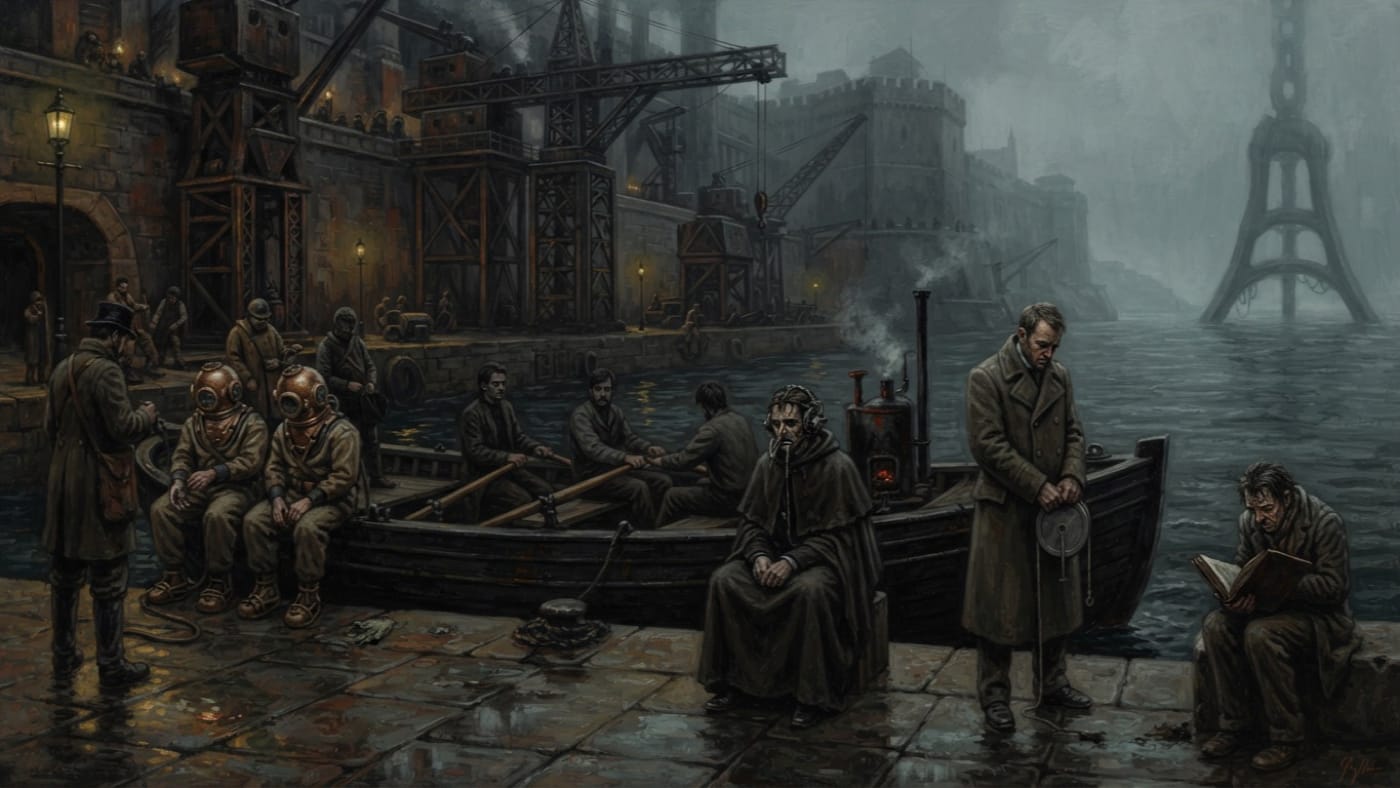
#On the Commission
Survey Team Phaleron-12 is the name under which the Bureau of Engineering sent nine persons onto the water off Phaleron Bay in A.S. 189 / 1899 CE. This dossier indexes that year as the survey milestone. It is the year of the work. It is not the founding year of a standing company. The file shows no such company before the survey, and none after it. The day and month go unstated. The water is stated. The team worked the Bosphorus inner approach, seven miles off the Pilgrim's Coast, in waters belonging to the auxiliary ward of the Harbor of Chains. That ward lies south of Bastion-Constantinople, the southern anchor of the Sagittal Line.
Three entries in this Codex share the name or the address, and the clerks who confuse them should be given a larger desk and a smaller stipend. The team is the subject here. The sealed statement taken from one of its divers is a document, filed as Diver Testimony Phaleron-12. The thing on the seabed is the Iron Idol, which the fishermen call the Sleeper. The team came back. The document was sealed. The object has not moved, so far as anyone with a writ has been allowed to check.
That water had been suspect since the Black Sea Armada of A.S. 162. Forty-seven hostile vessels came against the strait. Forty-three were destroyed against the Chain of Saint Anakletos, three withdrew into fog, and one was never accounted for. Some people propose that the Idol is that forty-seventh hull. It remains a proposal. Engineering was sent twenty-seven years after the Armada to examine a reported obstruction. Nothing it filed settles the arithmetic.
The survey began with a petition, as Constantinople's catastrophes generally do. In A.S. 189 the Phaleron fishermen submitted, through the Harbor Registry, forty-three signatures, six thumb marks and a child's drawing of a ship with knees. They had grievances behind them: cut nets, a husband lost over the flat water the year before, and an anchor hauled up hot. Those losses belonged to the bay. None was suffered by the team. In my earlier entry on the Idol I recorded that the petition came with smoked mackerel of suspicious generosity. I stand by the fish. Harbormaster Joram Clee entered the petition as weather-adjacent.
Two catalogues of the Bureau of Records index Phaleron-12 under the Afric "Iron Idol," a buried desert machine.
Corrected. The Afric Idol is an unexcavated legend with no survey attached. Phaleron-12 was a maritime party working off the Pilgrim's Coast in A.S. 189. They share a name and once shared a drawer. The drawer has been reassigned.
#On the Nine Assigned
The Bureau's complement is the one part of this file that adds up:

- two divers;
- one sounding officer;
- one alchemical corrosion specialist;
- one Bell-listener, borrowed from the Bureau of Bells;
- three oarsmen;
- one clerk with waterproof ink.
That makes nine. The roster has no commander. It lists no ranks or full names, and it says nothing of how any of the nine were chosen. A party of nine in a small boat must have had someone in charge, if only the man holding the tiller. The file does not tell me who that was, and I will not appoint one. Appointment is a power of my office, and I do not spend it on the dead or the unrecorded.
Each office on the list has an ordinary purpose, and that purpose shows what Engineering expected to bring home. Divers go down on weighted lines to look, touch and return. A sounding officer lets down lead and records depth and bottom, mark after mark, until the seabed becomes a column of figures. A corrosion specialist reads what salt has done to metal, and how long it took. He takes scrapings and enters them in a register so that the arithmetic of rust can be checked by someone who stayed dry. Engineering does not borrow a Bell-listener for company. It borrows one to hear what a struck line returns, and to write the interval in the notation of his Bureau. The oarsmen hold the boat over a mark against the current, and on the Bosphorus that current runs two ways at once. The clerk writes everything down in ink that will survive spray.
Those are the duties as the Bureaus define them. What these nine actually did under them, on that day, sits behind a seal. This dossier keeps the two apart. It describes the professions and makes no claim about the performances.
The roster shows a careful party. Engineering sent depth, metal, sound and a written record into the same boat. It equipped the boat to measure the obstruction four ways and to keep the results in waterproof ink. A Bureau that expected a rock would have sent a sounding officer and a boy.
#On the Hours Between
The team put out before Prime and came back after None.

Those are liturgical offices, and they are the only times the file gives. I will not convert them into a modern hour, and I will not work out the length of the day between them as if the boat had kept a chronometer. The day ran from one office of the Church to another. Somewhere in it nine people did their work and the sea did whatever it did.
The remit was to survey a reported obstruction on the seabed. Any sounding log, dive sequence, list of marks or record of lines let down and brought up would sit in the appendices. The appendices are absent. I can't say whether the divers went down once or a dozen times, or in what order the lead and the bell were used. I can't say what the oarsmen saw over the gunwale while the others worked.
Pamphleteers have supplied all of it. I own three illustrated accounts of the descent and one sermon on it. Each describes, in confident present tense, things no surviving page records. The authors had no warrant, no writ and no access, and that last lack is the one they share with me. I have the advantage of saying so.
#On What Returned
The return was recorded item by item, as if the clerk at the quay meant to account for each person and object separately. I set the items down the same way.
Both divers were alive.
The oarsmen were silent. One account says they did not speak. Another says they would not. The second implies refusal, and with it a will. I report both and judge neither.
The Bell-listener had bitten through his reed stylus. Reed is soft, and biting through it takes neither great strength nor long effort. It does take a jaw that stays clenched on the stylus until the reed gives. The file says nothing of when this happened or why.
The clerk's notebook came back swollen with water, and every page in it was dry.
Elsewhere in this Codex, in the Bosphorus account, two further items are recorded. One diver came back with barnacles inside his glove and no cut in the leather. The team did not return its sounding weights.
I hold to those last two particulars because they are the plainest in the file. Barnacles settle on surfaces that stay under water long enough to be colonised, and they need an opening to get in. The leather had none. I offer no mechanism. Medicine has not supplied one and Engineering has not asked. Weights, for their part, are lost on every survey. Lines part on old iron, catch in wreck gravel and are cut loose when the boat must move. A lost weight is ordinary. The empty place where the sounding record should be is what makes the loss a subject for this dossier.
"Alive" is the last word the record gives on any of their bodies. It describes the divers at the quay after None. It does not cover the following week, year or decade. I have seen these nine given, in harbor talk and in one regrettable broadsheet, fevers, early graves, confinement, sudden piety and dark trades. None of it comes from a filed page. The Bureau of Rites provides deaths on demand for its sermons. The Ledger does not.
One more piece of harbor talk must be handled, since otherwise someone will handle it badly. In the bay a story is told that a sounding weight came back wrapped in black thread nobody had tied. The same story has a man burning his gloves and a clerk writing dates backward. None of it is ratified. It also contradicts the firmer Bosphorus account, which says the weights did not return. I prefer the missing equipment. I will not make the two accounts agree by inventing a second weight, a later dredging, or an appendix lost and found. A rumour that contradicts the record has to be labelled as one. It does not entitle anyone to rewrite the record around it.
#On the Completed Survey
The filed report reads, in full: The survey is complete.
The sentence says the work was done. It does not say the site was safe, the object identified, the measurements adequate or the danger past. The Bureau of Engineering lets no load go uncalculated and no hinge undrawn, yet it closed this survey with a sentence that a sacristan might use about sweeping a nave. The sentence reports that the work is finished. Readers who take it as a report that the water is harmless have added the second meaning themselves.
Each line of that status describes a different act by a different hand.
Raw soundings: not appended tells us about the appendix. It does not show that the lead never went down. A sounding officer who took no soundings would have left an awkward gap in his own column. The more likely gap is in the file, and I cannot get past the file.
Diver testimony: sealed tells us that a statement was taken and closed. The original's custodian goes unnamed, and so does the day of sealing. Some other entries carry footer stamps from later years. Those stamps date the entries and say nothing about this seal.
Corrosion samples: none entered describes a register. A specialist can scrape metal, carry jars ashore and still leave the register blank. He might be told to, or he might find nothing worth entering. Then again, he might have had good reason to keep the jars out of a public room.
Bell-listener notation: transferred to Bureau of Shadows shows that one document went to the Bureau of Shadows. It does not show that every document went with it. Nothing I can cite makes Shadows the keeper of the sealed testimony, however tidy that would make the story.
Public hazard notice: no action required is the one line written for the public. It still stands.
The clerk's notebook is not on the list. It came back with the boat as a physical object, swollen and dry. It may have fed the sealed testimony, become a source for one of the dispositions, or gone into a stove. The file does not say. Its relation to the testimony is unknown, and I keep it filed separately.
#On the Unauthorised Fragment
Everything the wider Church knows of the sealed testimony comes from one page it was never meant to see. It is a fragment of an unauthorised copy, recovered from the estate of a retired Engineering clerk. The clerk is unnamed. The estate's location, the date of recovery and the hands the page passed through are not recorded anywhere I can cite. The estate inventory notes salt damage, though the papers were stored inland.
The full fragment, with the argument over its provenance, belongs to its own entry. I summarise only what bears on the team. The witness speaks as we and does not name himself. He says the plate near the forward rise was warm. He says the rivets moved under his glove, and he likens them to teeth beneath a lip. He says a Brother Kalem struck the bell-line once, and that something struck back from inside, knowing the interval and answering before the interval was finished. He also says that the hull was not lying on the bottom, and that the bottom was holding it down.
These are a witness's observations. Warm is not a temperature, a simile is not an anatomy, and an answering stroke heard through a line in deep water is not an acoustic measurement. The remark about the bottom holding the hull is one diver's description of the seabed. It is no finding about the Chain, or about any power that might keep a hull in place.
Brother Kalem appears once in that fragment, as the man who struck the line. The roster lists offices and gives no names. I cannot make him the borrowed Bell-listener, either diver, the witness or a tenth person in a boat Engineering filled with nine. The fragment does not tell me where he sat or what became of him. On both points this dossier makes no assignment.
How faithful the copy is to the original cannot be checked. I have seen stolen copies improve on their originals, as heirs do with family history.
#On the Subsequent Record
The later record falls into three periods, each with its own date and evidence.
In A.S. 193 / 1903 CE the Bureau of Bells proposed a descending peal test over the Phaleron water. Nobody rejected the proposal. Its docket was given a black pin, and after that it went nowhere. Bells now says no such proposal was ever active. The test was never carried out, and no one has repeated the stroke on Brother Kalem's line, if it was ever struck at all.
In A.S. 199 / 1909 CE I asked for the raw survey data. My pretext was the correction of a geographic table in the Constantinople supplement, which needed correcting less than I claimed. Shadows sent back my request unsigned and unstamped, with one word written across it: No. That request and refusal belong to my years. They do not make me a witness to A.S. 189, and they did not get me into any sealed room. I have read what a Hieromnemon may read. That turns out to be a list of what has been withheld from him.
At the documentary horizon of this dossier, A.S. 201 / 1911 CE, the record stands as follows. The testimony remains sealed. Its custodian and seal date are undisclosed. The appendices remain absent and the sample register empty. The Bell notation remains wherever Shadows put it. No repeat bell-line test is recorded. The public notice still says no action is required. Practice has gone further than the notice. Diving over the Idol's water now needs a writ signed by three Bureaus, the Bureau of Doctrine discourages public mention of the object, and captains out of the Harbor of Chains keep their distance and blame the currents. The record gives no date on which that practice became binding, so I give none.
The record also says nothing more about the nine after None. Two divers came back alive, three oarsmen kept silent, a Bell-listener bit through a stylus, and a clerk brought back a dry book swollen with water. The sounding officer and the corrosion specialist have left no trace beyond their offices on the roster. They do not appear in the file again.