
#On the Bay That Looks Back
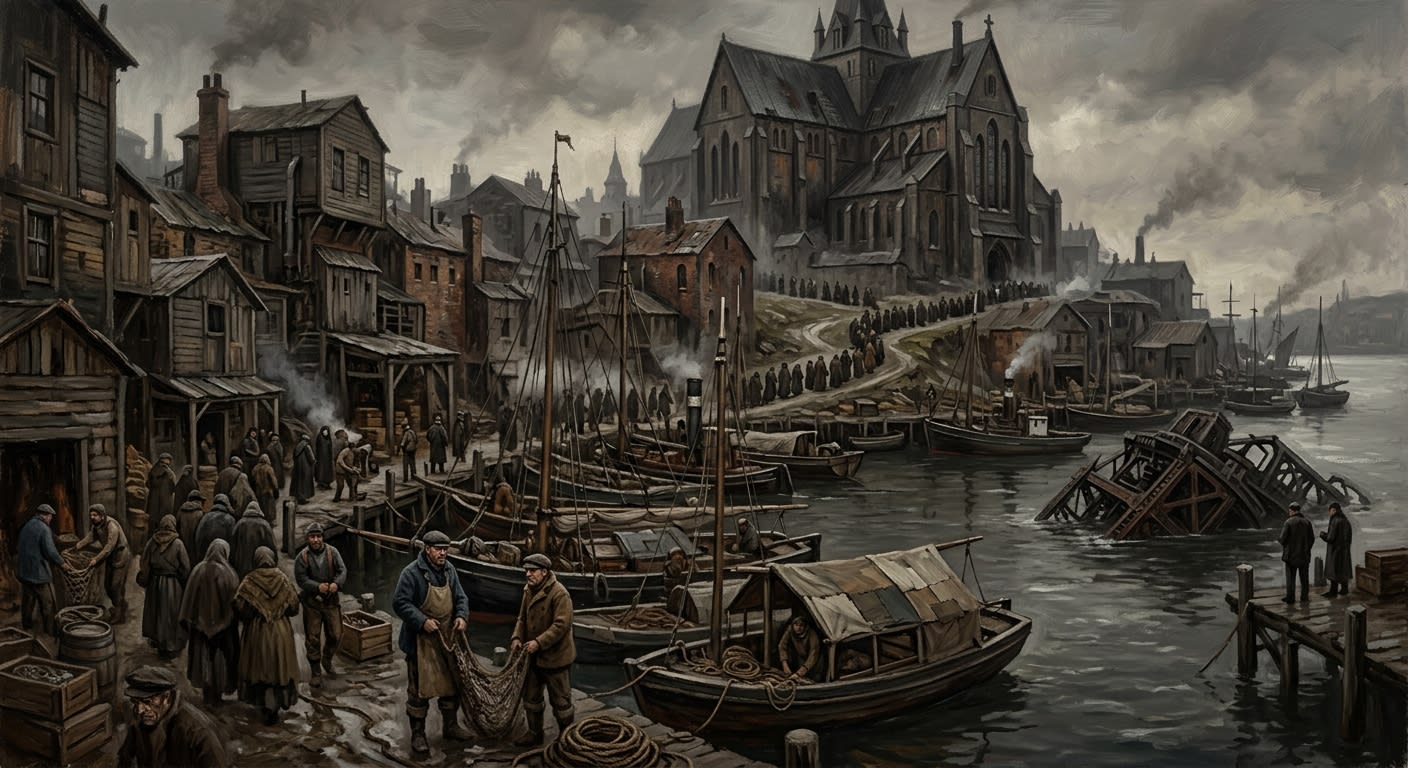
Phaleron Bay lies south of the sanctuary harbor of Bastion-Constantinople, near enough to hear the chain winches groan at dusk, far enough for fishermen to pretend the fortress belongs to someone else's nightmares. It is a working bay: nets, tar, crab-pots, smoke sheds, small boats, salt scales, prayer niches, customs posts, children with rope burns, widows with perfect hearing, and old men who can tell three kinds of danger by the colour of morning water. The Bureau maps it as a minor coastal settlement in the Bosphorus inner approach. The map is accurate in the way a death certificate is accurate. It gives the name and misses the body.
The bay is famous for three things: fish, silence, and the thing beneath it. The first feeds Constantinople poorly but persistently. The second protects the locals from officials, theologians, tourists, Purity inspectors, and their own more talkative children. The third is filed under several names, most of them evasions. The fishermen call it the Sleeper. Engineering calls it a submerged obstruction. Doctrine prefers the Iron Idol, because a dreadful noun is easier to guard than a dreadful fact.
The bay curves under low cliffs of grey stone and wartime brick. The houses cling to the shore as if they arrived in bad weather and never received permission to leave. Nets hang from balcony rails. Fish bones whiten in gutters. Every door has a small saint disk nailed above the lintel, and every saint disk faces inland rather than seaward. Local prudence explains the angle. Saints, like tax collectors, are safer when their attention is directed elsewhere.
Phaleron belongs to the Bosphorus system and to the great southern hinge of the Sagittal Line, though no one in the bay speaks with such expensive nouns unless a clerk is present. The locals speak of north water, chain water, deep hush, gull wrongness, the white patch, the no-net line, the feast eyes, and the place where oars slow. Their vocabulary is vulgar, precise, and disliked by bureaus whose terminology costs more and catches less.
#On the Old Water and the First Requisition
Before the Synod, Phaleron was a fishing fold under older walls, older debts, older empires, and older superstitions. Its people hauled mullet, mackerel, crab, lampfish, and the occasional drowned soldier from waters that changed masters more often than recipes. Byzantines taxed it. Rationalist quartermasters measured it. Local priests blessed boats from a chapel so small the bell-rope hung outside. The sea accepted all administrations with the same wet indifference.
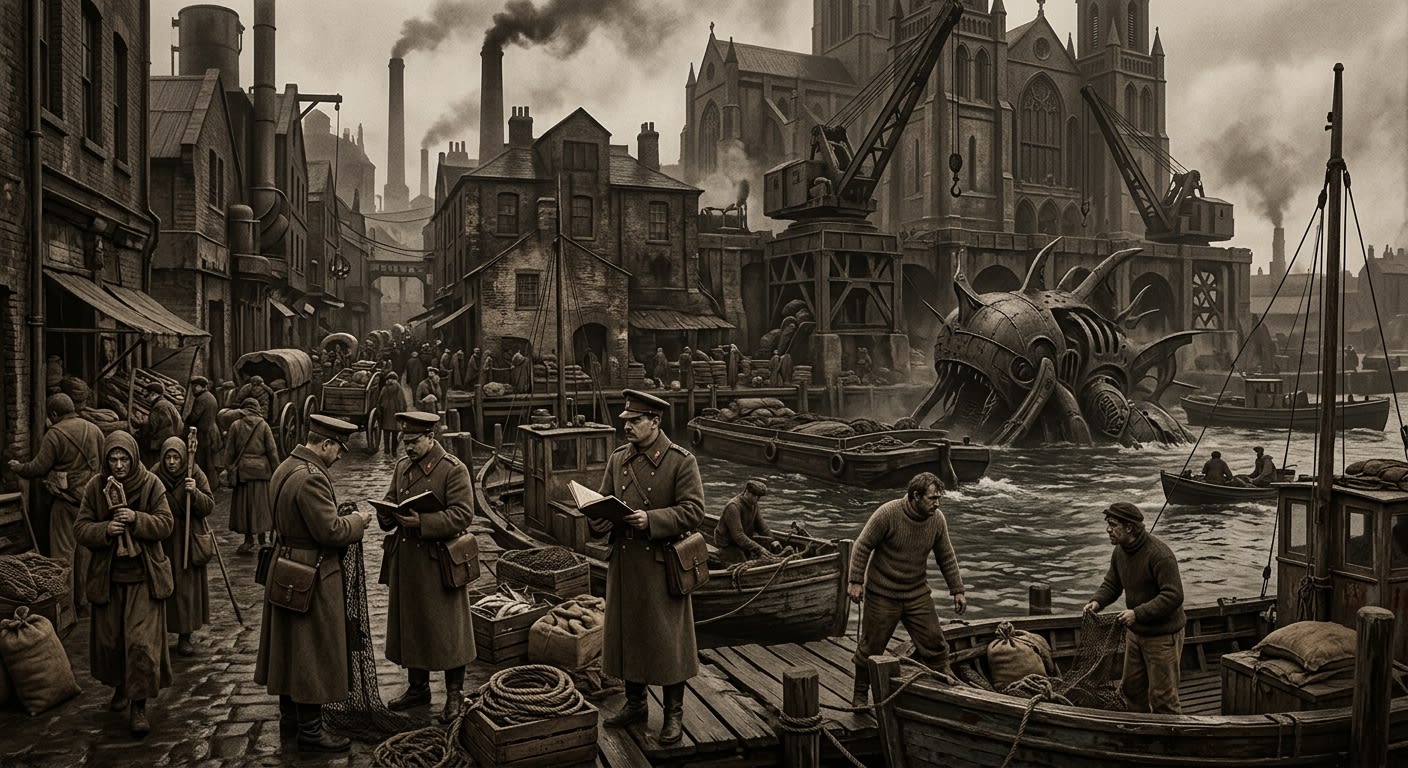
The Sundering changed the bay by giving its ordinary fear a name. Refugees arrived along the coast in A.S. 47 and A.S. 48, carrying icons, fever, half-true maps, sealed reliquaries, dead children, and stories no sane harbor wanted to hear twice. When the first holding works of Constantinople hardened and the southern hinge became a military fact, Phaleron was requisitioned into usefulness. Usefulness is the Synod's most persuasive form of annexation.
By A.S. 68, when the Harbor of Chains and the Chain of Saint Anakletos were formally strung across the Bosphorus, Phaleron had acquired a dock ledger, a rope store, a watch shed, a chapel with two bells, and four official explanations for why its original parish records had disappeared. The first explanation blamed water. The second blamed Rationalist fire. The third blamed enemy action. The fourth classified the matter as resolved. I prefer the first; water at least has the decency to be visible.
Earlier harbor abstracts listed Phaleron Bay as founded in A.S. 68 by the Shield-Prefecture.
Corrected. The Shield-Prefecture (Unregistered) requisitioned the bay in A.S. 68. It did not found it. Bureaucracies enjoy claiming birth where they merely arrived with boots, seals, and hungry men.
The first requisition turned fishermen into auxiliary pilots. The second turned their sons into oarsmen for patrol boats. The third turned their daughters into net-menders for military catch quotas. The fourth wore a softer name: devotional contribution, which means no receipt was required. Phaleron learned early that patriotism smells of tar, old fish, and unpaid labour.
The bay's chapel, Saint Ion of the Wet Palm (Unregistered), became an official coastal shrine by administrative accident. A clerk wrote “pilgrim-adjacent” on a routing table meant for the main harbor. Within a year, three minor processions had been redirected through the village to ease congestion at the sanctuary quays. Pilgrims arrived expecting relic splendour and found gutted fish drying beside a chapel door. Some complained. The villagers sold them candles at twice the ordinary price. Phaleron's approved devotional economy began there, pious whenever profitable and sincerely devout whenever frightened.
#On Fishermen, Pilots, and Sensible Cowards
The people of Phaleron are not romantic. The Bureau of Festivals once tried to commission a harbor hymn calling them “keepers of the silver gate.” The village refused to sing it because the tune misplaced a tide mark in the second verse. This is the correct response to art that threatens survival. A bad song can kill men if it teaches them the wrong hour for water.
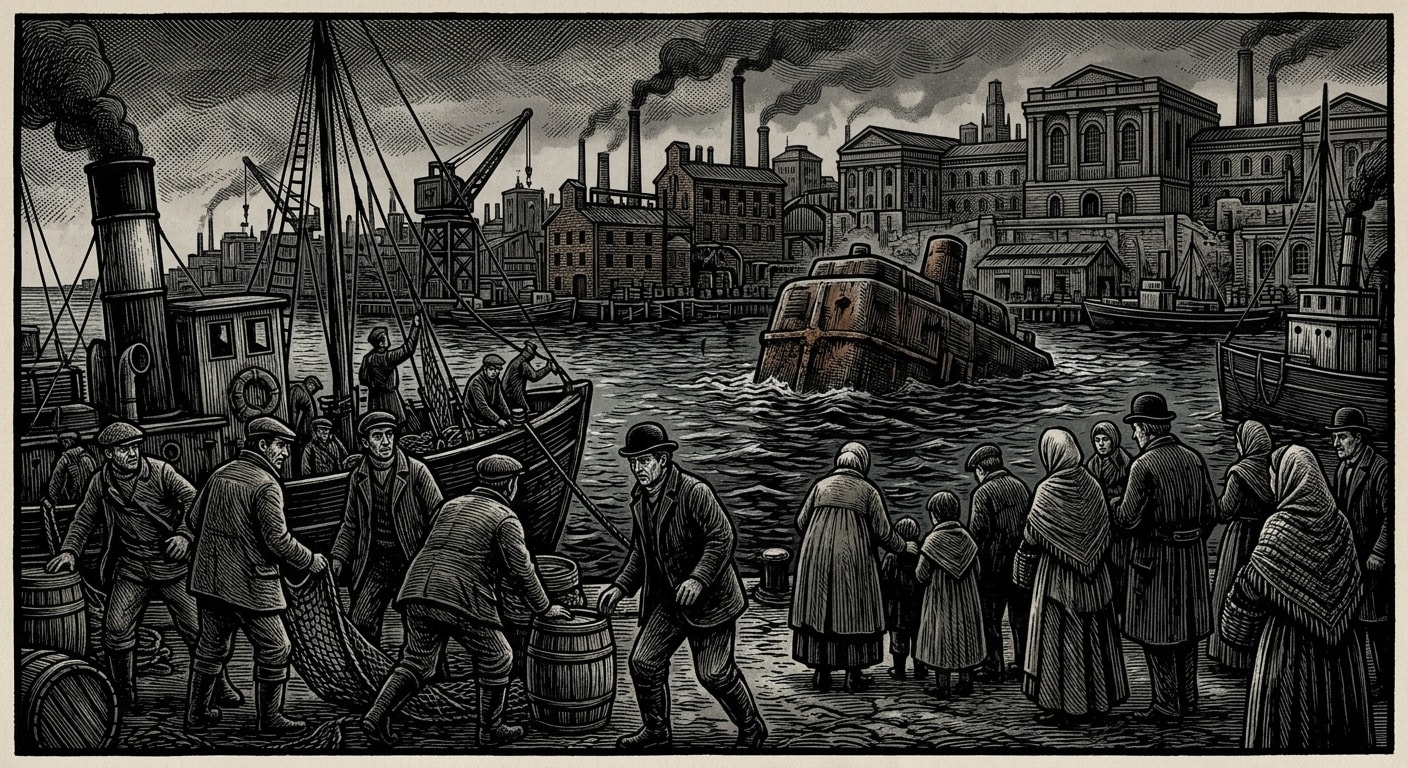
Phaleron fishermen know the bay by texture. They read oil sheen, foam shape, gull height, anchor drag, rope twist, plank tremor, bucket slosh, bell echo, and the tiny change in a sleeping dog's ear when the current turns below the hull. A Strasbourg navigator requires chart, compass, sounding line, wind table, correction sheet, and a candle before admitting uncertainty. A Phaleron boy with one sandal and a nosebleed will point to the water and say, “not there.” The boy is usually right.
Pilotage gives the village its power. Big harbor vessels cannot always read the inner approaches where Chain wake, southern shoal, old wreck metal, and Idol avoidance lines confuse the ordinary passage. The local pilots know which ripple belongs to rock, which belongs to chain-drag, which belongs to a hidden patrol anchor, and which belongs to something below remembering it has mass. They hire themselves through licensed guild channels and through unlicensed cousins, which is the same channel with cleaner sleeves.
Their cowardice is disciplined. No boat crosses the no-net line at dawn after a red moon. No child whistles over deep hush. No crew curses a broken net until the boat has returned inside chapel bell range. No one drops iron over the Idol coordinates. No one says the forty-seventh ship aloud on water. The younger men mock these rules when drunk and obey them when sober. The old men do not mock. They have seen nets come back cut in straight lines and crews come back older by an hour.
Purity calls these rules superstition. Harbor Command (Unregistered) calls them unauthorized maritime practice. Engineering calls them unverified observational protocol. The fishermen call them Tuesday. Government often mistakes survival habits for doctrine because government has few survival habits of its own beyond taxation and denial.
Women govern the bay more effectively than its listed wardens. Men go out, return, boast, understate, drink, and die. Women count boats, mend nets, remember debts, correct tide songs, slap fools, hide contraband, receive widows, track children, and informally decide which official will be lied to in which order. Aunties at Phaleron have broken more investigations than smugglers with knives ever could. Their method is tea, grief, and collective vagueness.
#On the Sleeper Beneath the Bay
The Iron Idol is the bay's unwanted patron. Its shadow lies on the seabed seven miles off the Pilgrim's Coast, within the inner approach where ordinary charts become decorative. Some days it cannot be seen. Some days the water above it flattens in a long black plate, and the youngest children grow quiet without being told. Under hard western sun, from the right angle and too small a boat, it resembles a ship that has been pressed into the sea floor by a hand too large for doctrine.
The approved history links it to the Black Sea Armada of A.S. 162. Forty-seven hostile vessels entered the Bosphorus. The Chain of Saint Anakletos burned white for seven hours. Forty-three were destroyed. Three retreated. One remained unaccounted. Arithmetic, the most pious of cowards, wants the missing vessel turned into a number. Phaleron gives it a shape.
The oldest bay accounts do not say the forty-seventh ship sank. They say it stopped being above. This distinction has troubled three Bureau committees and delighted me, because peasant phrasing occasionally slices where official steel merely taps. Stopped being above: a phrase with mud on its boots and metaphysics in its pocket. The fishermen maintain that the ship descended without splash, fire, wreckage, or permission, and that the water closed over it as a clerk closes a folio he intends never to reopen.
Instructional plates for school use mark the forty-seventh Armada vessel “destroyed, evidence submerged.”
Corrected for internal use. Destroyed is a comfort word. Submerged is a location. Evidence is what remains when comfort fails to persuade the tide.
Phaleron children learn the Sleeper before they learn the formal Creed. This alarms Doctrine until one hears the lesson. It is simple: do not point at still water, do not lean over when it shines white, do not answer if a voice below says your name, do not count eyes on Submission Day, and if your father rows toward the flat patch while sleeping, cut his oar rope. The lesson has saved more lives than several approved catechisms I could mention, and with better metre.
The Feast of Doctrinal Submission is the bay's black Sabbath of obedience. Officially, the village observes a fasting discipline in honour of the Chain's victory and the Synod's command over water. In practice, no one fishes. Nets remain folded. Boats are drawn high. Children are kept inland. Dogs are tied under tables. The chapel bell rings nine times before dawn and once after dusk. Between those bells, no one looks long at the bay.
Those who have looked give incompatible accounts. Two eyes below the forward rise. Eleven along the hull. A hundred tiny pale openings like reliquary niches. One whole bay becoming an eye and blinking around the boats. All agree on the colour: the drowned white of the Chain's miracle, stripped of heat, stripped of victory, stripped of every sermon imposed afterward. Holy light, if holiness had spent forty years under water learning patience.
DEPOSITION OF MAREN KELL, PHALERON NET-WIDOW, A.S. 188 “My husband said the flat water had opened. I told him not to say opened. He said it had looked at him. I told him not to say looked. Then he went back at dusk because men are made of rope and stupidity. His boat returned with both oars tied neatly inside. His boots were under the bow bench. There was salt in the boots. There was no water in the boat.” Final line sealed under Harbor Registry Black Thread: █████████████████████.
#On the Survey That Said Nothing
The Bureau tolerated Phaleron's fear while it remained poor, local, and useful. This is the normal mercy shown to rural knowledge: ignore it until it asks for funding. In A.S. 189, after three net losses, one vanished husband, one returned anchor still hot to the touch, and a child's drawing of a ship with knees passed through five offices, the village submitted a formal petition for survey. Forty-three signatures and six thumb marks accompanied it. The number forty-three should have warned the clerks. Clerks are rarely warned by poetry unless it has a routing stamp.
Harbormaster Joram Clee logged the petition as weather-adjacent. This phrase is perfect. It neither accepts nor dismisses, neither acts nor refuses, neither trembles nor laughs. The man has a gift for words the way a locked gate has a gift for welcome.
Survey Team Phaleron-12 (Unregistered) left before Prime: two divers, a sounding officer, an alchemical corrosion specialist, a borrowed Bell-listener, three oarsmen, and a clerk with waterproof ink. They returned after None. The divers were alive. The oarsmen did not speak. The Bell-listener had bitten through his reed stylus. The clerk's notebook had swollen with water though its pages were dry. The official report read: The survey is complete.
Engineering loves appendices. Engineering appends rivet diagrams to chair repairs, load tables to chapel steps, atmospheric notes to latrine vents, and five-page disclaimers to pulley squeaks. For Engineering to submit one sentence means hemorrhage under a clean bandage.
I requested the underlying survey once. Shadows returned the request unstamped, unsigned, and folded inside my own outer envelope. The page contained one word: No. I admired the economy. I despised the presumption. Both responses were appropriate, which is why I have not repeated the request on paper.
Rumours escaped anyway, because rumours are the sewage of sealed offices and every city has drains. A diver touched warm metal. A rivet moved under a glove like a tooth under skin. A bell-line was struck once and answered before the interval finished. A sounding weight returned wrapped in black thread no one had tied. The corrosion specialist burned his gloves. The clerk later developed the habit of writing dates backward whenever someone said “Phaleron.” None of this is ratified. Much of it is true.
#On Smugglers, Pilgrims, and the Useful Lie of Control
Phaleron sits below the official harbor like a pocket beneath a cassock. Things fall into it. Coins, crates, messages, hungry men, false saints, real relics, demon-glass, widows' requests, Purity traps, private absolutions, and all the minor treasons by which a great fortress remains supplied while pretending to remain pure.
The Strait-Rats use the bay because it is small enough to watch and crowded enough to hide in. Demon-glass travels in reliquary crates, stitched icon panels, hollow prayer boards, false fish barrels, and once inside a child's toy ark whose little animals reflected skeletons when turned toward lamplight. The smugglers claim they serve necessity. Sometimes they do. Necessity and profit are twins who dress differently for court.
Phaleron crews know which patrol lamps fail naturally and which fail because a lamp-man has been paid. They know when chain bells mask oars. They know which customs clerk worries over spelling, which one worries over wife, and which one can be bribed with smoked eel because money leaves accounts and eel leaves only bones. They stage minor seizures to protect major crossings. They deliver scapegoats to Purity with faces mournful enough for public theatre. They sell “possible salvations” to pilgrims who have discovered that holy war makes even official miracles feel insufficient.
The bay's relationship with Purity is intimate and hostile, like a bad marriage conducted through search warrants. Purity raids the rope sheds twice a season, smashes one crate, arrests three men, burns five shards, announces vigilance, and leaves behind two informants everyone recognizes by supper. The village mourns, pays fines, hides better cargo, and waits for the next instructional outrage. The arrangement is old. The music is ugly. Everyone knows the procedure.
Pilgrims complicate matters. They arrive with stamped permits, soft hands, fear of Hell, hunger for visible holiness, and purses containing more coin than judgment. Some want passage to the main harbor. Some want saint dust. Some want to stand near Sleeper water because grief has made them stupid. Some believe looking into the bay will show them dead sons. Sometimes it does. The village charges extra for discouraging them.
Pilgrimage pamphlets describe Phaleron Bay as a “quiet auxiliary landing blessed by the Chain's reflected sanctity.”
Clarified. It is quiet because speaking attracts attention. It is auxiliary because the main harbor dislikes its smell. Its sanctity is reflected only when the water chooses to return light, which is not a blessing I would recommend handling without gloves.
The chapel of Saint Ion keeps three ledgers: public offerings, fishing dead, and unnamed water incidents. The first is audited. The second is tolerated. The third does not exist and has better handwriting than the first two. A wise priest understands that nonexistent ledgers must be kept especially neat.
#On Feast Days, Bad Weather, and Civic Instruction
Phaleron teaches its children by prohibition. Do not sit with your heels over the quay after second bell. Do not sleep in a boat drawn above the high mark. Do not wear polished metal near the bay on Submission Eve. Do not bring a stranger to the white-water stairs unless he has paid first and sinned honestly. Do not repeat a drowned man's last sentence unless his widow has corrected the grammar. These rules would improve several seminaries.
The village calendar has the official feasts printed in black and the local feasts remembered in fish blood. The Feast of Doctrinal Submission is the great absence, observed by fasting, shuttering, and the careful non-use of boats. The Day of Saint Ion's Wet Palm receives three candles, a pot of eel broth, and a procession so short that pilgrims frequently miss it while adjusting shoes. The Chain Remembrance is celebrated with approved hymns in the morning and unapproved silence after dusk. The children prefer the silence. It has better discipline.
Widows' Tide (Unregistered) is the most dangerous observance because it is not listed. Once a year, on the first windless evening after the autumn salt accounts close, the net-widows gather at the low quay with bowls of lamp oil, bread ends, torn rope fibres, and names spoken only once. They do not pray for return. Maritime women are not fools. They pray that the dead remain dead, that boats come home empty rather than altered, that voices below water lose interest in children, and that the bay remember which households have paid enough.
Purity attempted to suppress Widows' Tide in A.S. 173. The officers arrived with public-order writs and left with soup on their boots, three missing batons, and a signed statement that no religious assembly had occurred because every woman present claimed to be cleaning fish. The fish were never produced. The writ was later found wrapped around a crab pot.
Bad weather changes Phaleron's politics. In ordinary weather, village and harbor play their old game of warrants, bribes, warnings, minor seizures, and mutual contempt. In fog, rank collapses. Pilots command officers. Boys with good ears outrank clerks. Old women decide whether bells mean recall or lie. A captain from the main harbor may wave a seal until his wrist aches; if Phaleron says no launch, his boat stays on land. The first time this happens, he threatens prosecution. The second time, he brings bread.
The fog from Sleeper water is thinner than natural fog and leaves salt on the inside of closed shutters. Lamps seen through it do not blur. They look nearer, sharper, almost engraved. Sound carries badly except for names, which carry too well. The village response is immediate: shutters latched, dogs inside, bells untouched, children counted by hand, no one answers from another room unless the speaker is visible. The rule seems excessive until it saves a household. After that it becomes tradition, and tradition is merely terror with grandchildren.
PHALERON FOG INCIDENT — WARDEN'S PRIVATE TALLY, A.S. 196 Households reporting name-call from outside: 19. Households answering: 3. Persons absent at dawn: 4. Persons returned by noon: 1. Returned person rejected by mother after hand-count discrepancy: █████████████. Official weather report: harmless sea mist, low duration.
The Bureau of Doctrine has considered producing a formal Phaleron instruction pamphlet. I opposed it. Printing a rule invites argument. Spoken rules acquire obedience by being attached to faces, scars, and the old woman who will strike you for violating them. Besides, a pamphlet explaining not to answer one's name in fog would inevitably include a footnote defining name, fog, answer, and culpable audibility. By the time the definitions were approved, half the village would be gone and the other half would be fined for improper disappearance.
#On the Present Watch
As of A.S. 201, Phaleron Bay remains under auxiliary Harbor of Chains jurisdiction, watched by Harbor Command, visited by Purity, used by smugglers, courted by pilgrims, and quietly obeyed by everyone who has spent enough nights near the water to stop being theatrical about courage. Its official population fluctuates with fishing season, military requisition, smuggling arrests, widow classifications, and whether Records has decided that drowned men still count until bodies are produced. The villagers count boats instead. Boats lie less often than clerks and more usefully than men.
The Iron Idol remains below. No public hazard order has been issued. No quarantine line has been posted. No dredging has been approved. No second survey has been scheduled. This abundance of negation is how government builds a fence around terror while insisting the pasture is open.
At dawn the bay smells of salt, fish guts, woodsmoke, cold iron, and the sour bread sold to pilots before first launch. Women chalk boat names on a slate beside the chapel. Boys carry nets past the saint disk without looking seaward. Old men spit into buckets rather than over the rail. A Purity clerk at the customs shed tries to make fishermen say “submerged obstruction” and receives, after three hours, only shrugs.
The daily count governs everything. Boat out, boat in. Net whole, net cut. Child present, child missing, child found asleep under the wrong bench speaking in a voice copied from his grandfather. Phaleron does not count bravery. Bravery has no stable unit. It counts returns. The chapel slate is wiped only after the last hull is pulled above the wet mark; until then even a boat seen burning in open water remains pending, because the bay has learned that absence and arrival have a complicated relationship near the Sleeper.
Harbor Command despises the slate because it contradicts manifests. A boat listed as under repair may leave at noon. A boat logged as seized may return at dusk. A dead pilot may appear on three separate tide tallies before his death certificate is corrected, and correcting the certificate makes his widow ineligible for rope allowance, which makes the widow angry, which makes the harbor office suddenly discover clerical humility. Bureaucracy pretends to command the bay. The slate edits command with chalk.
At dusk, the Chain rises in the north. Its winches groan across the water. The bay answers with smaller sounds: knots tightened, oars stowed, dogs called indoors, shutters latched, the chapel bell touched once by a hand that does not pull. Far out beyond the no-net line, the water lies flatter than weather permits.
A child asks whether the Sleeper is a ship.
His grandmother says no.
She says it is waiting.