
#On the Shape Beneath the Water
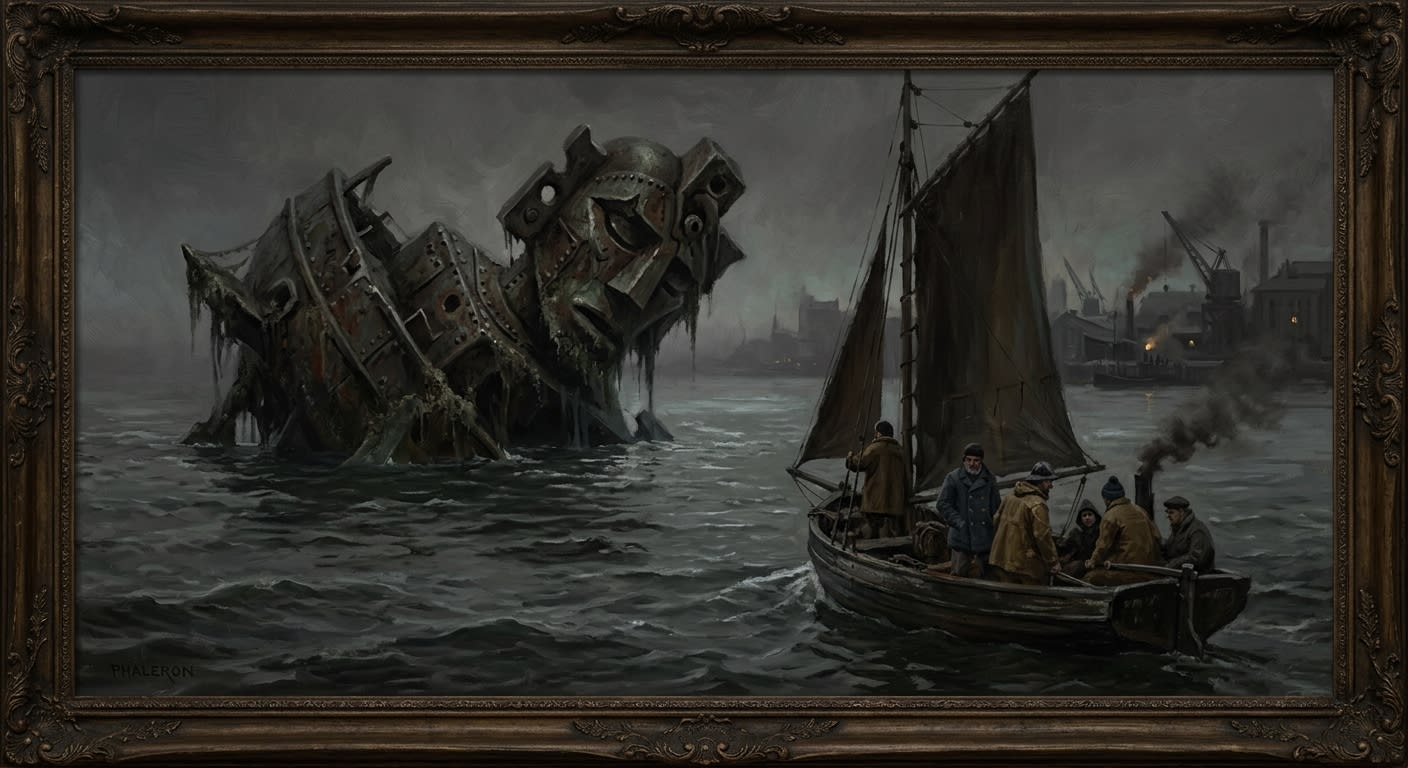
The object called the Iron Idol rests, if rest is the word, on the bed of the Bosphorus inner approach, seven miles off the Pilgrim's Coast near Phaleron Bay. Fishermen call it the Sleeper. The Bureau of Engineering calls it a reported submerged obstruction. The Bureau of Rites calls it superstition. The Bureau of War calls it outside current operational priority, which is how War describes anything it fears and cannot shell.
It is visible only under certain conditions: clear water, low wind, sun angled hard from the western walls, and the observer positioned far enough from the sanctuary harbor to have made several poor life choices already. The shadow is mile-long by the fishermen's reckoning, much shorter by official denial, and approximately ship-shaped if one defines a ship as a hull that has begun to reconsider anatomy. It has a prow. It has ribs. It has a stern. It has a raised portion amidships that resembles either a tower, a spine, or a kneeling figure with its head bowed toward Constantinople.
The Idol's surface, when described by divers, is neither corroded nor clean. It is iron with skin habits. Barnacles do not adhere to it. Weed avoids it. Fish pass over it and then, several boat-lengths later, change direction together, as if remembering an appointment elsewhere. Nets dragged across its flank return cut in straight lines too neat for rock, too dry for rope, and smelling faintly of heated chain.
The Bureau of Doctrine's present classification is Submerged Maritime Anomaly, Unresolved; doctrinal position pending; public reference discouraged. I wrote the discouragement clause. I discourage many things. Heresy, untaxed rhetoric, amateur poetry, and looking down from small boats on fasting days. Discouragement is not disbelief.
#On the Forty-Seventh Absence
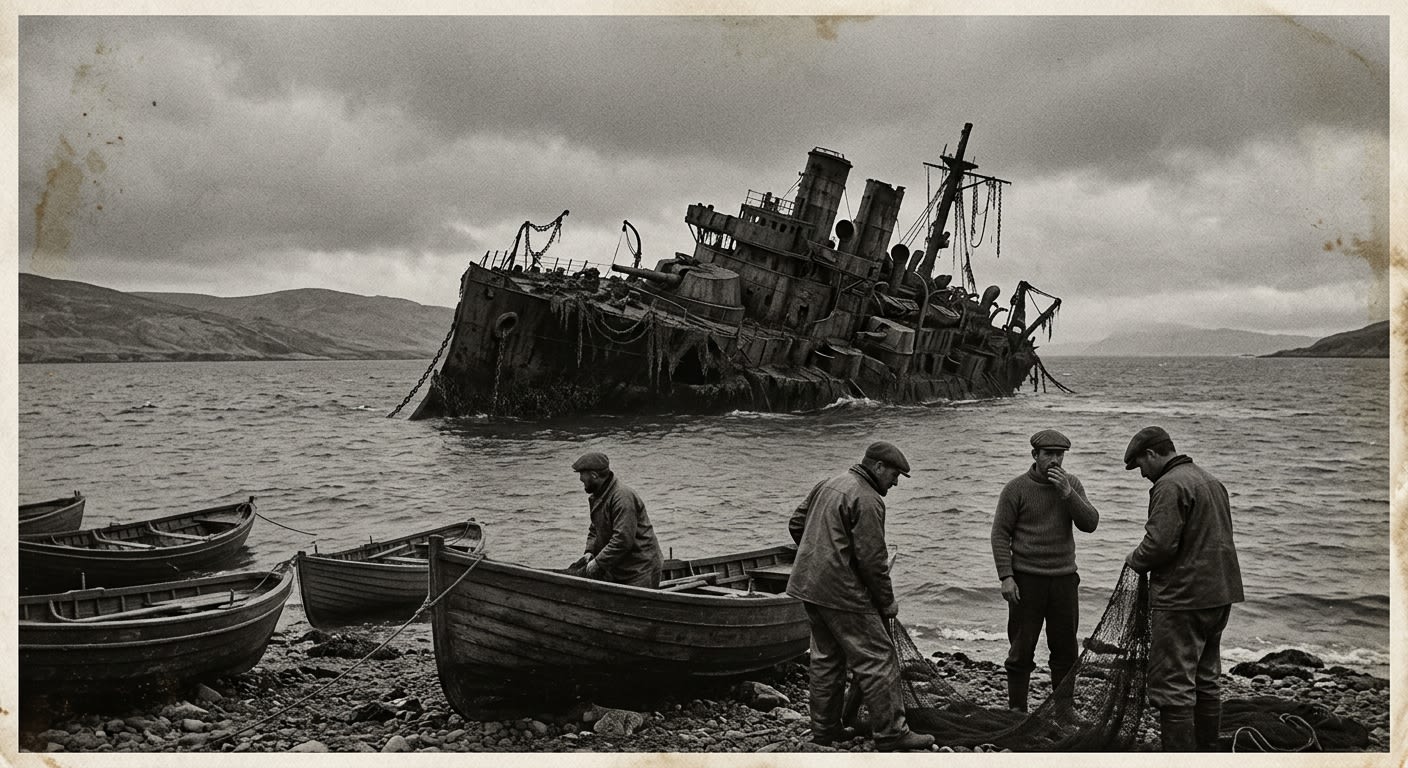
The Iron Idol enters history through arithmetic. The Black Sea Armada of A.S. 162 consisted of forty-seven demon-crewed ships. The Chain of Saint Anakletos burned white for seven hours. Forty-three ships melted against it, their prows running like wax and their crews visible in the glare long enough for several witnesses to regret possessing eyes. Three retreated toward the Black Sea and ceased to be present at a point no patrol has since charted. One remained unaccounted.
Forty-three. Three. One. The Bureau counted victory by addition and called the matter closed.
The forty-seventh ship was present in the second-hour engagement logs and absent by the fifth. No cannon claimed it. No chain crew saw it strike. No gun emplacement logged a sinking. No survivor from the supply vessels reported a retreating hull matching its outline. The Bureau of Rites, with the splendour of institutional reflex, marked it as "destroyed, evidence submerged." That phrase is a marble lid placed over a living pit.
Earlier Constantinople summaries listed the forty-seventh vessel as destroyed during the A.S. 162 engagement.
The administrative classification remains useful for school plates, feast hymns, and officers who sleep better when arithmetic has no loose ends. The physical question remains under water. It has eyes.
The armada's metal was recovered, melted, and reissued as fortification stock through A.S. 165. Some of that metal screamed when reheated. Doctor Haas, Bureau of War Chief Metallurgist, killed himself after eighteen months of salvage work and left a note reading, "The metal remembers." The Bureau of Medicine called this occupational fatigue. Medicine is a magnificent art when applied to boils and fractures. In metaphysics it should be muzzled. The Screaming Coin, first recovered after the Three-Night Bombard, has taught Purity the same lesson in smaller, noisier metal.
The forty-seventh vessel supplied no scrap. No rivets. No hinge-iron. No bell-cannon throat. Its absence produced no useful metal and no compensation claims. It became, in that perfect bureaucratic alchemy by which the State turns danger into a drawer, an open case with a closed label.
#On Phaleron Bay and Its Sensible Cowards
Phaleron Bay is a fishermen's settlement south of the main sanctuary harbor, old enough to remember Byzantine stones, Synod requisition, and every tax authority that has discovered fish after discovering hunger. Its people are practical, irreverent, superstitious in the ordinary maritime fashion, and alive in sufficient numbers to make their superstitions worth filing. Dead fishermen teach poorly. Living fishermen, when frightened, are almost a science.
They know the water by colour. They read currents by floating straw, anchor-drag, oil-sheen, gull behaviour, rope-twist, and the little tremor in a boat's plank when something large has moved below without surfacing. They avoid three patches of water: the old mine shelf, the Pilgrim-wreck gravel, and the Idol's length. The first contains iron spikes. The second contains bones and etiquette. The third contains whatever happened to the forty-seventh ship. The avoidance line bends the small-boat routes away from Bastion-Constantinople's southern anchorage and toward the safer teeth of the customs piers.
The fishermen do fish near it on ordinary days. Poverty corrects reverence. They mark the boundaries with nonsense songs so children will remember without asking too much, and they mend their nets facing away from the open water after a drag. They do not throw refuse over its coordinates. They do not curse there. They do not whistle. They will spit at a tax-boat, cheat a harbor scale, bribe a Pier Six clerk, and swear falsely before a customs saint; yet they lower their voices over the Idol as though the sea itself had become a confessional screen.
On the Feast of Doctrinal Submission, the 3rd of Ferrum, they do not fish the inner strait. No net leaves harbor before dawn. No hook is baited. No boy is sent to check crab-pots. The official explanation is fasting discipline. This explanation is pious, convenient, and false in the way a polished boot is false: useful at inspections, filthy underneath.
The true explanation is given only after wine or grief. On the 3rd of Ferrum, the Idol opens its eyes.
No witness agrees on number. Some say two, set low along the forward hull. Some say eleven. One old woman, whose husband vanished over the Idol's water in A.S. 188, says the whole thing becomes an eye and the sea blinks around it. The descriptions agree on colour: the pale white of chain-light seen through deep water, stripped of furnace-red, swamp-green, and the hellish gold beloved by bad illustrators. The colour of a miracle after drowning.
#On the A.S. 189 Survey
The fishermen petitioned in A.S. 189. Forty-three signatures, six thumb marks, and one child's drawing of a ship with knees were submitted through the Harbor Registry, accompanied by an excellent bribe disguised as smoked mackerel. Harbormaster Clee logged the petition as "weather-adjacent." One must admire the man's economy. A lesser administrator would have wasted nouns.
The Bureau of Engineering dispatched Survey Team Phaleron-12 (Unregistered): two divers, one sounding officer, one alchemical corrosion specialist, one bell-listener borrowed from the Bureau of Bells, three oarsmen, and a clerk with waterproof ink. They left before Prime. They returned after None. The divers were alive. The oarsmen were silent. The bell-listener had bitten through his own reed stylus. The clerk's notebook had swollen with water, although every page was dry.
The filed report reads, in full: The survey is complete.
The absence of appendices is the loudest part of the file. Engineering appends everything. Engineering appends footnotes to footnotes, rivet diagrams to privy repairs, cross-sectional sketches of hinge fatigue in doors that no one has opened since A.S. 104. For Engineering to file a one-sentence report is an event equivalent to a cathedral choosing to bark.
I requested the raw data in A.S. 199, on the pettier pretext of correcting a geographic table in the Constantinople supplement. Shadows returned my request inside a sealed envelope, unstamped, unsigned, with a single word written across it in ink no approved registry admits: No. This was rude, efficient, and almost certainly justified. I preserve the envelope in my private cabinet beneath three harmless sermons and one pamphlet on grain mildew. Hiding things under sermons has defeated better men than Shadows.
Fragment from an unauthorised copy of Diver Testimony Phaleron-12, recovered from the estate of a retired Engineering clerk: "The hull is not lying on the bottom. The bottom is holding it down. We touched the plate near the forward rise. It was warm. The rivets moved under my glove like teeth beneath a lip. Brother Kalem struck the bell-line once. Something struck back from inside. It knew the interval. It answered before he finished." Remaining lines excised under Seal ███████. Clerk's estate catalogued with salt damage despite inland storage.
#On the Eyes and the Feast
The Feast of Doctrinal Submission is a major observance in the Sanctioned Register of the Bureau of Festivals: attendance mandatory, enthusiasm measured, insufficient enthusiasm reported under Passive Ingratitude. The 3rd of Ferrum commemorates obedience as a virtue, subordination as hygiene, and the civic beauty of kneeling before instructions one privately despises. It falls, with the Bureau's usual appetite for accidental symbolism, on the anniversary of the Armada's approach.
That day the sea clears over the Idol.
The weather records confirm this more often than they deny it. Clee has logged the 3rd of Ferrum at the harbor as clear or "operationally clear" in thirty-four of thirty-nine years since A.S. 162. Current patterns do not explain it. Prayer pamphlets do. I trust neither. The fishermen say the sea wants witnesses. The Bureau says atmospheric conditions. The fish say nothing and are wiser than both.
Witnesses describe the eyes opening at third bell after dawn, remaining visible until the Feast procession's first public genuflection, then closing as the bells begin the Submission Antiphon (Unregistered). The timing is too vulgar to be accidental. The Idol watches obedience and shuts itself when obedience becomes song. This is my private inference. The Bureau of Doctrine does not endorse it because endorsement would require a committee, and committees are where inference goes to be strangled with ribbon.
No attack has followed the eye-opening. No boat has been seized on that day, because no boat goes near enough to be seized. No flare of chain-light has answered from the harbor. No liturgical instrument registers hostile motion. The absence of violence has been used by Rites to declare the matter harmless. By that standard, a judge asleep beside a scaffold is an ornament.
#On Possible Natures
Four theories circulate in sealed rooms, dockside wine-shops, and the part of my mind that the Bureau has not yet managed to requisition.
The first theory: the Iron Idol is the forty-seventh ship, intact, trapped below by chain-light, slowly becoming a shrine to whatever commanded it. This is the fishermen's theory. It explains the eyes, the shape, the Feast, and the reluctance of nets. It does not explain why the chain has remained dark since A.S. 162, unless the chain did not defeat the vessel so much as bind itself to it. The thought makes the Chain of Saint Anakletos less weapon than leash. I dislike this theory because it has the appalling courtesy to fit.
The second theory: the Idol is a decoy grown from Armada metal, planted to occupy Synod fear while the true forty-seventh ship escaped south-southwest with the three fog-carriers. This is the Bureau of War's theory, stripped of its uniforms and footnotes. It explains War's refusal to spend shells on the seabed. It also explains nothing useful about the eyes. War dislikes phenomena that cannot be bombarded; it calls them decoys until they develop gun emplacements.
The third theory: the Idol predates the Armada, and the missing ship found it, joined it, woke it, fed it, or knelt to it. This theory belongs to Shadows, although Shadows has not said so aloud. The clue is the A.S. 189 survey's suppression pattern: total enough for danger, selective enough for ignorance. Shadows seals facts it knows. It buries facts it does not. Phaleron-12 was buried.
A marginal tradition in older Afric port files identifies an unrelated "Iron Idol" as a buried desert machine.
That file concerns Afric and has no confirmed excavation. The Phaleron object is maritime, post-Armada in public record, and inconvenient in a local fashion. The Bureau of Records has confused the labels twice. Both clerks are now employed in catalogue humility.
The fourth theory is mine, and is consequently the best dressed: the Idol is an idol because someone is worshipping it, and the question concerns the hand that continues the rite. Objects do not become idols through shape. They become idols through attention, fear, offering, repetition, taboo. The fishermen avoid it. Rites denies it. Shadows seals it. The Feast reveals it. Every year, Constantinople kneels on the shore while a thing under the water opens its eyes. If that is liturgy, I have wasted my life among amateurs.
#On Countermeasures and the Merit of Distance
The approved countermeasure is distance. This is the most honest doctrine ever produced by four Bureaus working in mutual suspicion. Do not dive. Do not sound. Do not drag nets across the Idol's length. Do not lower bells into its water. Do not bring Armada scrap within sight of Phaleron Bay. Do not conduct Feast processions on boats, no matter how many scenic pamphlets the Bureau of Pilgrimage prints. Do not ask Harbormaster Clee why he logs the day as weather. He will answer. You will have gained nothing except brevity.
The Bureau of Bells proposed a descending peal test in A.S. 193. The proposal died without rejection. Its docket simply acquired a black pin and stopped moving. Bells now maintains that no such proposal was ever active. I have seen the pin. It is iron. It sweats in summer.
The Bureau of War proposed depth charges. The Bureau of Engineering objected that detonations might damage harbor substrates, submerged chain anchors, pilgrim wrecks, mine shelves, and the Idol itself. War replied that damaging the target was the purpose. Engineering asked whether War knew what the target was. War withdrew the proposal, proving that even War occasionally recognises a trap when it has already put both boots in it.
The Black Sea Reliquary Flotilla maintains a wider berth than its charts admit. Patrol sloops do the same. Pilgrim captains joke about unlucky currents and then alter course by half a mile. The sea-lane bends around the Idol the way a sentence bends around a forbidden name. We have not closed the water. We have taught the water to lie.
In A.S. 201 the Idol remains in place. The chain remains dark. The Feast remains mandatory. The fishermen remain ashore on the 3rd of Ferrum, mending nets that need no mending, drinking wine too early, and refusing to look at water clear enough to shame glass.
I recommend continued distance, continued silence, and a private readiness to burn every map that marks Phaleron Bay as safe.