

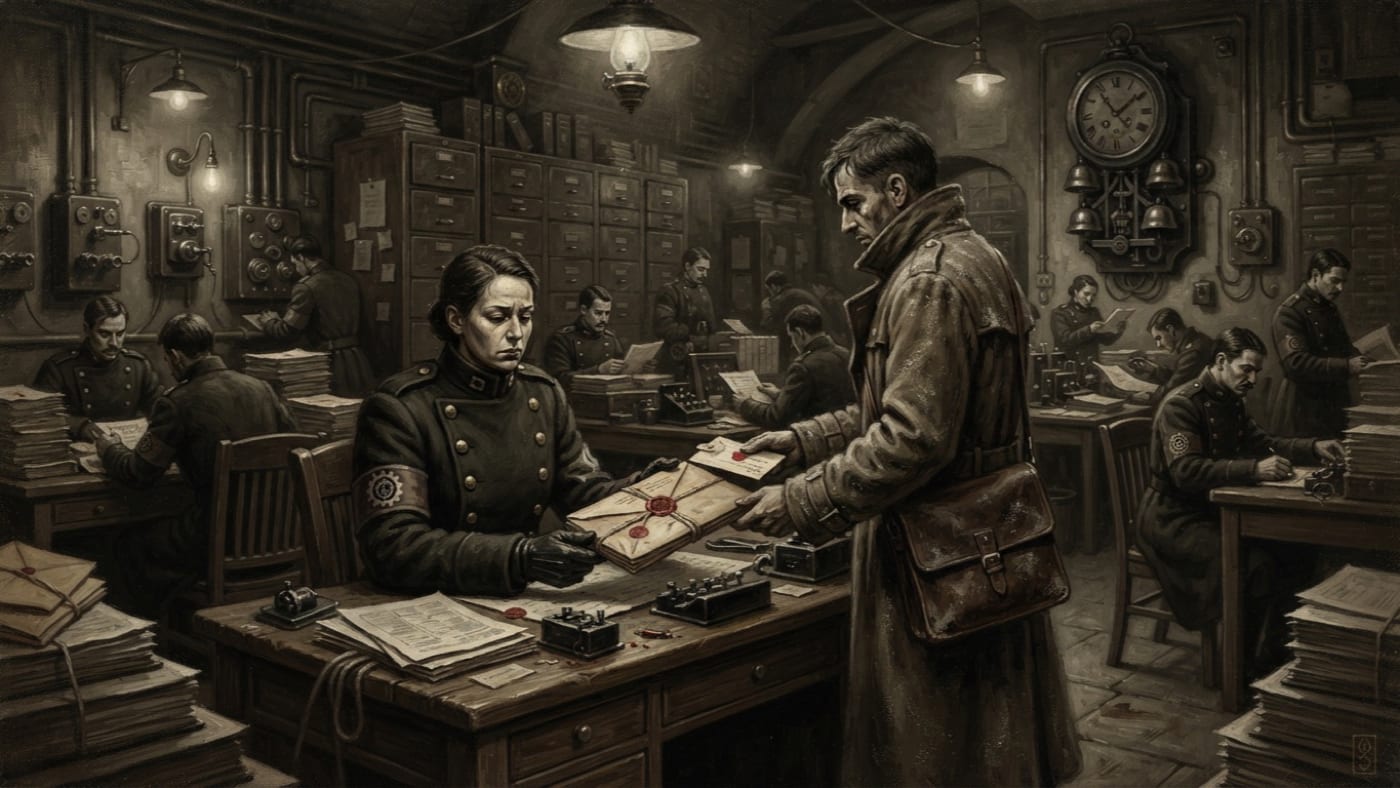
Writing the Transit Division prose now from the continuity file, style guides and source articles.
#On the Division's Charge
"Late is the same as false." — Transit Division maxim, older than any of the papers that repeat it
This is an institutional documentary survey compiled in A.S. 201 (1911 CE). It describes the Bureau of Purity's Transit Division as that office appears in the papers it leaves behind: training copies, transit cautions, disciplinary abstracts and receipts. It is not a founding record. I was shown no paper that dates the Division's birth, names a founder or reproduces a charter. I have therefore written none. Readers who want an origin should buy a hymnal.
The Bureau of Purity keeps the Index Damnatus in Strasbourg. Its second register, the Register of Names, holds condemned identities with their aliases, lineage flags and legal consequences. When an entry goes into the master it has full force, but nothing happens in the provinces. Between the master and the gate clerk who refuses a stranger passage lies distance, and the Transit Division administers that distance. The Index Damnatus Runner Corps carries the amendments. Receiving offices apply them. The Division issues the route orders, keeps the custody record and checks what comes back. It writes primers and cautions, and it compiles discipline against those who betray the route. It sentences nobody. The Bureau of Doctrine advises on what truth is prohibited. The Bureau of Records keeps and reconciles identity records. Purity owns the Index. The Division answers for the road.
#On the Earlier Failures
In A.S. 80 the Church's government had no Synod to speak of. The formal Synod is a creation of A.S. 90, and clerks who give the earlier machinery Synodal seals are dressing it retrospectively. Under that government the condemnations went out to the provinces in quarterly updates. Veyrel was condemned in Strasbourg and stayed lawful wherever the quarter had not yet reached. He crossed three ferries and changed his documents twice. Through a household alliance he became respectable in Cologne, and for eleven weeks the local ledgers counted him a faithful man. The Bureau of Shadows took him in the end. His capture did nothing to fix distribution. A crate arrives no faster because the man it names has been caught.
Then came the Night of Six Names, when six condemned persons crossed separate checkpoints on papers no gate had yet been taught to doubt. This made the problem general, and the shoemakers grew rich on it. Later Bureau teaching ties the crisis to Procurator Maxentius della Torre, who is said to have funded twelve dedicated Runners, reportedly by the following morning. The teaching compresses events, as teaching does, and I report it as it is taught. Emergency transit reform followed.
The surviving papers do not say where the Division's own beginning falls in this sequence. I looked. The papers did not thank me for it.
#On Custody and Acknowledgment
An amendment leaves under seal with a route order keyed to bell-hours. The procedure treats it as valid between stated bells, and the Division's papers record that procedure without explaining it. I follow the papers. A man who explains a mechanism he has not been shown is writing a novel.
At the relay house the keeper checks the seal against the current cipher. Five objects pass between hands at this point, and the Division forbids anyone to confuse them. The packet carries the amendment. The current strip carries the day's cipher and is worthless the next day. The route token authorises the path. The throat-tag marks the licensed carrier. The receipt proves that something was done. A clerk who mixes them up has given the condemned a holiday.
The packet travels from relay house to receiving node, and at each node a local correction or invalidation is made in front of a witness. The published Runner tract gives the standard order: gates first, orphanage registries second, ferries third, shrines fourth, print-quarters fifth. Ration, service and permit desks come after these where they apply. Hot-sealed emergencies and the way of a particular street may change the order. Each office acts on its own share of the amendment. Gate and ferry offices correct passage. Orphanage registries take the identity and lineage amendments, so that a child's ledger agrees with its father's damnation. Shrine offices restrict sanctuary. Print-quarters strike the prohibited name from circulating text. The municipal desks stop the bread, the wage or the permit.
Only one question concerns the Division here: did the amendment take effect at that node, and does the acknowledgment prove it did? Receipts come back and are checked against the route. A receipt naming an office that stands off the route is a lie. So is a bell-hour that no pair of legs could have managed. A packet with a sound seal can still have a fraudulent delivery history. An unopened packet can still betray its contents through its wax, its cord and its place in the route. Wax prevents tampering. It does not keep a secret.
#On the Primers
The Division teaches on paper, and its paper is defeated in the field. The Veyrel file keeps a marginal note from a Transit Division training copy: "A ban that arrives after the heretic has settled is an invitation, not a sentence." It was later attributed to me. The attribution has improved with keeping.
Transit Division primers direct that Veyrel's name be omitted from oral instruction.
Corrected by practice. The printed primers leave the name out. Oral instruction uses it all the time. The primers hold the policy, and the instructors hold the memory.
Field memory beats the printed page because the field punishes forgetting faster than Doctrine can reprint. The maxim survives because it fits in a mouth. Primers can teach seal-checking, node order and the five objects of custody. They cannot teach a frightened clerk to stop accepting a familiar face in place of a stamp.
The Name-Merchant file preserves a second contradiction.
Transit Division instructional sheets state that packet integrity prevents Name-Merchant activity.
Clarified. Packet integrity prevents packet theft. Name-Merchant activity often requires no theft. The sheet remains in circulation.
#On Contaminated Routes
In A.S. 134 counterfeit blacklist bundles bearing forged Purity authority passed through three Rhineland cities within one week. They led to four hundred wrongful arrests. Resistance turned into riots, and the riots produced genuine condemnations, which then travelled in genuine packets. This was the False Packet Panic. The master Index was never touched. Its integrity protected the book and did nothing for the routes, because the forgers had no need to touch the master. They needed clerks who trusted the look of authority more than its proof.
Published accounts link the response to triple-witness handoffs, tamper-evident seals, daily cipher rotation, the witnessed destruction of expired strips and closer scrutiny of receipts. The sources disagree about when strips are destroyed, and I give no hour. The lasting change was a new burden. The Division now had to authenticate every delivery without slowing it, and every added witness costs time on a route measured in bells.
The Shadow Relay shows the change in its pure form. A licensed Runner hands the packet to an unlicensed carrier and then files a false record of the carriage. Before the Panic, Division papers called this unauthorised outsourcing, which reads like a complaint about laundry. After it, they classified the same act as route contamination. A node that accepts an unverifiable carrier today has been trained to accept false authority tomorrow. The name misleads, so I will be plain. A Shadow Relay has nothing to do with the Bureau of Shadows, and an unlicensed carrier is not on that account a member of the Bureau of Shadows or of the Black Ledger.
The Name-Merchant deals in something more refined. He sells advance knowledge: a name, a timing, a route, or an omission paid for in advance. An intact seal does not hinder him at all. Smaller failures fill out the record. A Soft Drop leaves the packet somewhere it will be found late. A bought acknowledgment certifies an action that no one took. The Black Ledger buys and exploits route knowledge wherever it is offered. The record does not show that it invented every practice it profits from, and I decline to flatter it with authorship.
#On the Present Administration
In A.S. 201 the Runner tract estimates about 1,140 active Corps personnel and about 800 relay houses across Zones 1–5. These figures count the Corps and its network. They are not a census of Division staff or a count of its offices, and no such census has been shown to me. The same tract gives jurisdiction as Zones 1–5 standard, with counter-signature required for Zones 4–7. I cite that formula as published and claim no more for it. No Division headquarters has been established. The Bureau's seat in Strasbourg does not prove that any particular room belongs to the Division. The route maps reach me as references to maps, which is the Division's idea of a joke.
The papers show an office that does its work in custody: seal against cipher, route against receipt, and an acknowledgment held up against the act it claims. The office is beaten, regularly, by legs it never licensed and by mouths no seal can close. It goes on checking. It keeps a hearing for the Creator and a ledger for the Great Deceiver, and it trusts the ledger more.