
#On the Purists of the Cut
The True Knot faction is the purist obedience within the Gate-Carver trade: those grim lintel theologians who insist that every authorised cut requires the full ceremony — tri-cord measure, breath-count, consecration chalk, wax-tag, registry entry, witness mark, tool count, and no deviation even when the queue is starving, the rain has entered the cord, and the widow behind you is begging to bury her husband before the smell acquires parish rights.
Their rivals, the Fast Hands, call them Grave-Whittlers. The insult has teeth. True Knot men do treat doors like coffin-lids, which is one reason their doors tend to remain shut and their coffin-lids tend to avoid civic embarrassment.
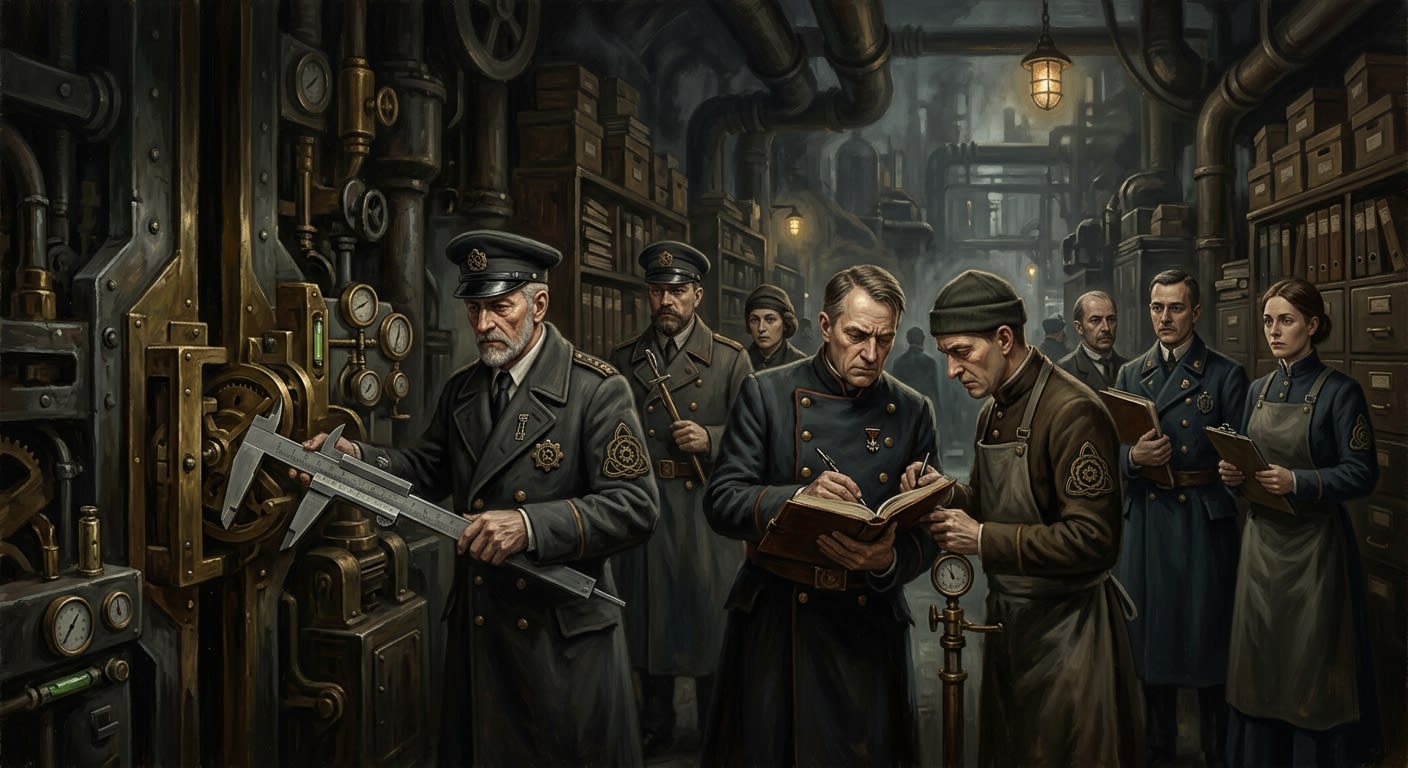
The faction claims no formal charter. The Bureau of Heraldry wisely calls them “strict-compliance carvers” in public memoranda, since admitting that a faction exists inside a licensed trade invites questions about why the Bureau licenses factions at all. The shops know better. A True Knot workshop is recognisable before the door opens: cords hung to dry above the stove, stencil cases aligned by serial, sand trays for practice cuts, bell slivers sewn square into apron seams, and apprentices whose wrists show chalk knots scrubbed raw from correction.
#On the Doctrine of Full Ceremony
The True Knot creed is a simple tyranny: a threshold exists only after the whole sequence has been completed. Paper verified. Sponsor named. Local ledger checked. Knot class selected. Tri-cord set dry and straight. Stencil frame seated. Cut made to the authorised depth. Chalk line drawn. Three breaths counted. Wax-tag fixed. Punch applied. Registry entry signed. Witness marked. Tools counted back into custody.
A missing step leaves a mouth in the wall.
This phrase is not metaphor to them. A door without a proper Knot is already speaking to whatever waits outside the inventory of the Creator. A grave-slab cut too quickly becomes an invitation. A warehouse arch accepted on a verbal promise becomes a future tribunal with hinges. True Knot carvers do not think the Bureau's procedure decorates reality. They think it fastens reality down.
Their manuals quote Saint Edrin of the Three Nails more often than Scripture. Edrin measured before he barred the plague-house. Edrin wrote the household names outside in chalk. Edrin cut once, true, before the plague could turn a street into an argument. Fast Hands claim Edrin because he acted quickly. True Knot claims him because he acted in order. The saint, being dead, has been assigned agreement by both factions.
A.S. 134 shop broadsheets described the True Knot as “anti-quota obstructionists.”
Corrected after the Ossuary Breach Winter proved that obstructive men with dry cords can be preferable to efficient men with shallow cuts. The approved phrase is “ceremonial sufficiency advocates,” uglier and likelier to be official.
#On the Lintel Pogroms and the Registry Temper
The True Knot did not begin in A.S. 112, but A.S. 112 gave it a spine. During the Lintel Pogroms in Cologne, fourteen houses sheltering unregistered persons were found under geometrically correct false Knots. The stencils were stolen. The registry punches were counterfeit. Every door on the affected streets was stripped to bare wood, every resident re-documented, every licensed carver hauled before a Sigil Inspector and ordered to reproduce his assigned geometry freehand.
Three failed. Two had sold stencil access to a Black Ledger cell. One trembled. All three were immured, because the Bureau does not always distinguish treason from nerves and, on that occasion, nobody present had a profitable reason to teach it.
The True Knot shops made a sacrament from the lesson. Cords dried overnight, never in use. Stencil custodians began sleeping in the case-room. Apprentices practised freehand geometry until their fingers cramped into little claws around invisible chisels. Registry entries were copied twice, then read aloud backward to catch transposed serials. A soft line became a sin. A wet cord became perjury.
KNOTWRIGHT REGISTRY TRAINING EXTRACT — POST-LINTEL POGROMS Exercise: freehand reproduction under witness pressure Failure allowance: █ degrees Observed failures: ███ Disciplinary demonstrations: █ Instructor note: “A trembling hand is indistinguishable from a lying hand until after the wall is opened.”
#On Enemies Within the Trade
The Fast Hands accuse the True Knot of loving procedure more than people. The charge is correct in the useless way most charges are correct. Procedure is the only form of love the state can verify.
In housing blocks, the quarrel becomes practical and ugly. A Fast Hand can mark forty doors before sundown. A True Knot master may finish twelve and leave thirty families unregistered until morning. The Fast Hand keeps a district quiet through speed. The True Knot keeps a district defensible through exactness. The Housing Canon praises whichever one prevents the riot that day, then fines both for different failures when the monthly tables arrive.
Grave-Sealers tend toward the True Knot. The dead are patient and vindictive, an ideal constituency for procedural men. House-Knotters tend toward the Fast Hands. The living shout, bargain, faint, threaten, and obstruct placement with furniture. A grave does not ask whether the Knot might look better slightly higher.
The True Knot reserves its sharpest hatred for shadow knotters. A shadow knotter carving an outlaw charm for a refugee family may save a child from a winter street. He may also leave a wrong loop above the door, a false line in the registry, a weak place in the block, and a future excuse for Purity to strip every threshold to bare wood. Mercy, in the hands of amateurs, often arrives with a chisel and leaves with a warrant.
#On the Beast-Scraping Years
The Beast Proscription gave the True Knot an altar made of other people's doors. Under the Sigil Reform of A.S. 158, animal crests were to be removed from every lintel, shutter, warehouse arch, grave-slab, and family crest-stone. Six months. No deference to lineage. No mercy for the old boar, the wolf, the serpent, the eagle, the stag worn smooth by three generations of hands.
Fast Hands saw quota. True Knot saw purification by replacement: scrape beast, measure surface, set cord, cut Knot, register corrected threshold. A conquered surface pretending to have always been clean. They worked slowly, which enraged inspectors. They worked exactly, which made inspectors dependent on them. In Cologne, after the hammer attack on a Knotwright removing a grandfather's stag, True Knot masters demanded two witnesses per animal removal and a pre-scrape rubbing filed under Visual Compliance. Heraldry called this excessive. Purity adopted the form within six weeks.
A Heraldry circulation sheet once praised the True Knot for “preserving local affection during crest removal.”
Withdrawn. The True Knot preserved evidence. Local affection was gouged, bagged, stamped, and entered under prohibited animal memory.
By A.S. 199, when authorised Knot variants dropped from forty-seven to forty-three and four former patterns were reclassified as insufficiently angular, the True Knot was ready before the order dried. Lists emerged from shop drawers within the hour. Doors bearing the four tainted variants had been quietly logged for years by purists who trusted geometry more than Chancellery optimism. I dislike many things about zealots. Their filing habits are not among them.
#On Present Use and Private Terror
As of A.S. 201, the True Knot remains tolerated, mocked, fined, consulted, and summoned after disasters by the same officials who curse its delays during ordinary weeks. Every Bureau wants the quick cut until the quick cut fails. Then everyone remembers the purist with the dry cord.
True Knot shops train apprentices through humiliation refined into liturgy. A boy learns the tri-cord on practice planks, then on cellar doors, then on grave-stone, then on a real threshold while the owner weeps behind him. If the line wanders, the master scrapes it out and makes him cut again. If the hand shakes, the master ties a nail token to the wrist. If the apprentice asks whether the family can wait, the master answers: the family can wait longer than the Enemy.
Their private terror is the same terror every Gate-Carver carries, sharpened to a doctrinal point: the perfect Knot that fails. The inspected cut. The dry cord. The matched punch. The witness mark. The wax unbroken. The door still breathing cold at midnight.
True Knot doctrine has no graceful answer for that. Installation error comforts Fast Hands, since they can blame haste. True Knot men have no such pillow. When a perfect threshold opens to something that should have remained outside, the purist is left with a smaller and more terrible possibility: Order was followed and Order was insufficient.
They do not write that sentence down.