
#On the Office That Counts Chisels
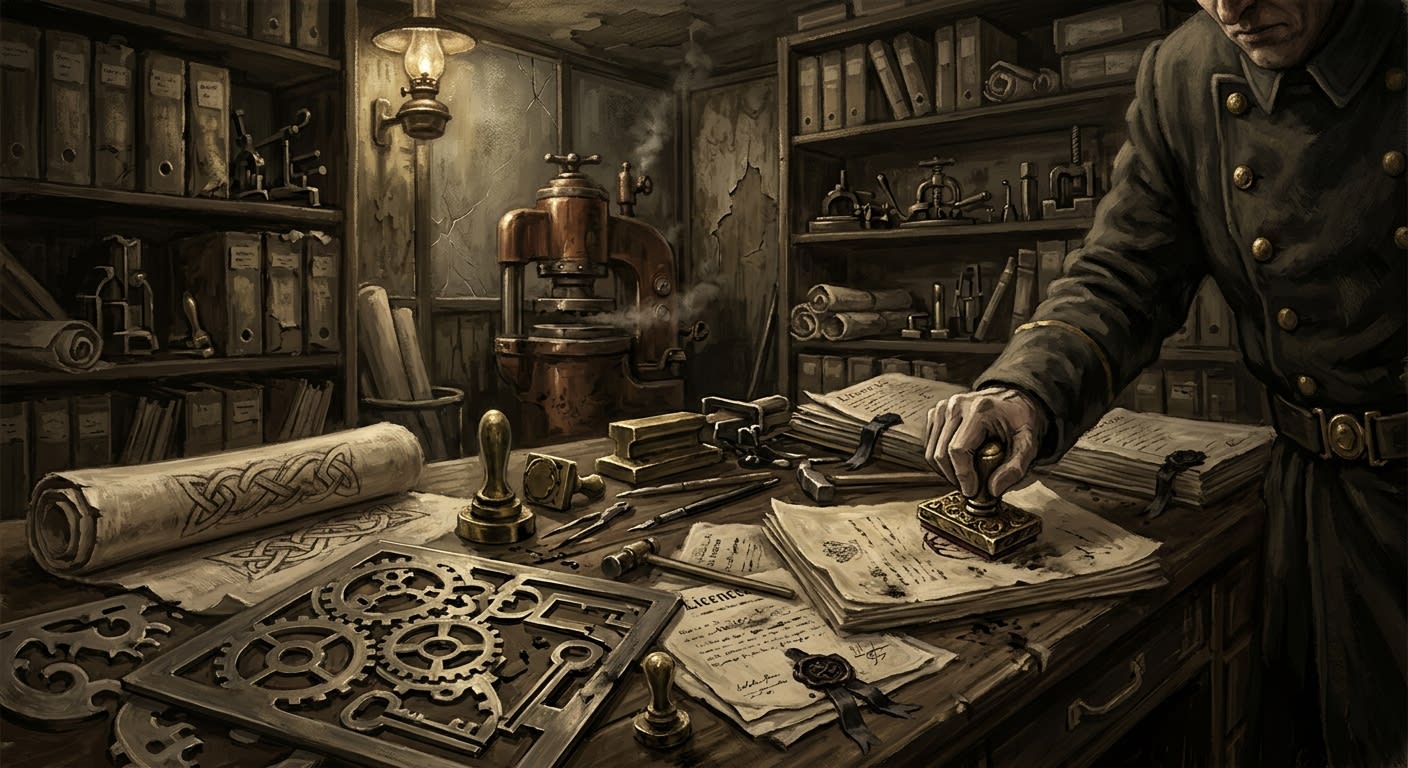
The Knotwright Registry is the central roll of every licensed Gate-Carver, issued stencil, serial punch, shop mark, retired frame, confiscated frame, disputed frame, and frame whose owner's widow insists it was never used for anything except lawful lintels and the occasional coffin-lid done at cousin's rates. It sits in Strasbourg under the Bureau of Heraldry, three floors below the Armorial copying rooms and one floor above the vault where rejected animal crests are kept until the Bureau finds a finer word than shame.
The Registry does not carve doors. That would be manual labour, and Heraldry observes such things through glass. The Registry makes carving legible. It gives each tool a number, each number a custodian, each custodian a liability, each liability a file, and each file enough ribbon to strangle a parish if pulled from the cabinet with conviction.
Its public motto is carved above the intake desk: Three Loops, One Law. The private motto, spoken by examiners after wine, is shorter: Where is the punch?
#On the Pogroms That Founded It
The Registry was born from a door that lied correctly.
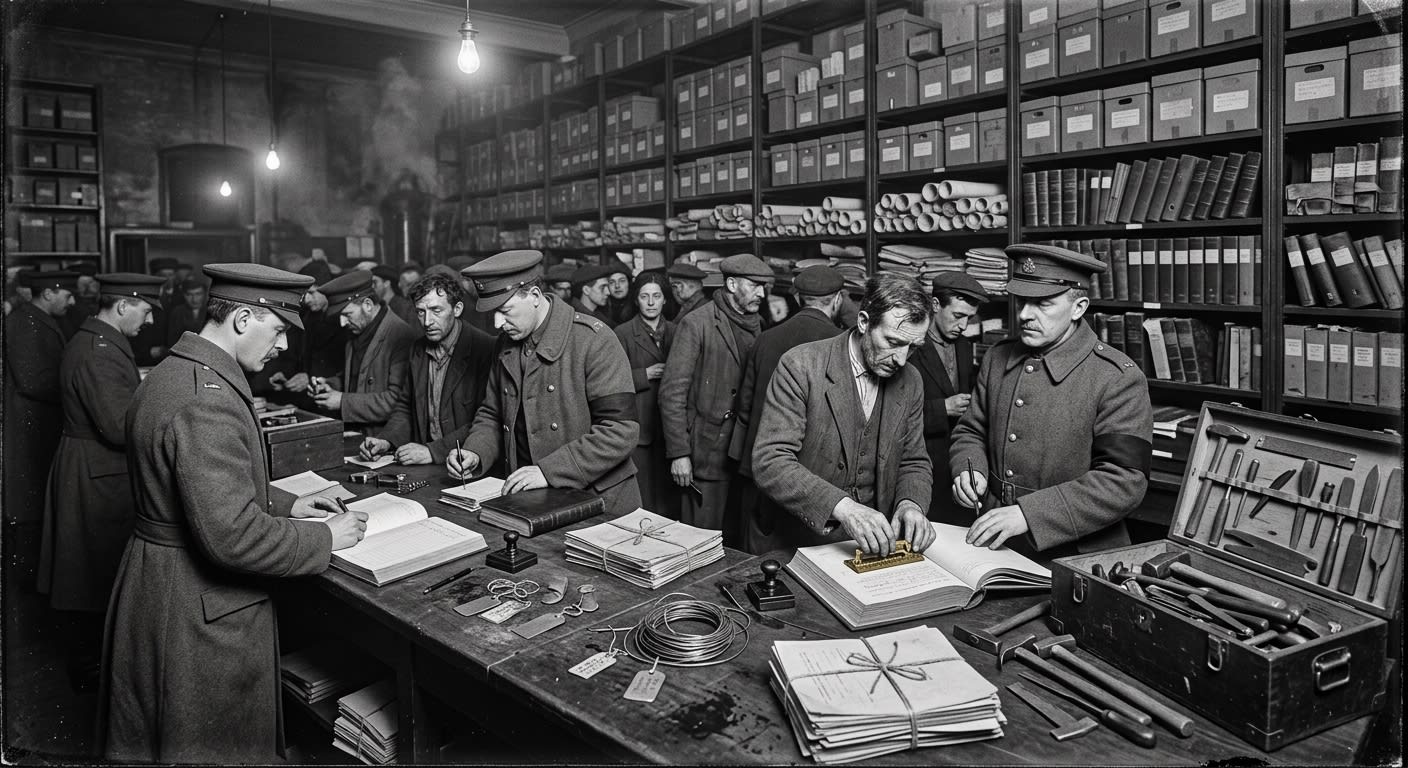
In A.S. 112, the same dreadful year that gave the Rhineland the Quiet Purges, Purity operatives entered the Cologne river quarter and found fourteen houses bearing geometrically correct Triune Knots. The loops were clean. The depth met table. The chalk had been laid with tolerable discipline. The houses sheltered unregistered persons, which by itself would have produced arrests, tears, and a useful sermon. The true offence lay in the marks. They had been carved by unlicensed hands using stolen stencils and counterfeit punches.
A false Knot badly cut is vandalism. A false Knot well cut is insurrection.
Purity stripped every door on the affected streets to bare wood. Residents were re-documented. Neighbours were questioned until memory became a hazard. Every Knotwright in the district was hauled before a Sigil Inspector and ordered to reproduce his assigned geometry freehand while Purity men watched fingers for tremor. Three carvers failed. Two had sold stencil access to a Black Ledger cell. One trembled.
All three were immured.
Heraldry founded the Registry before the lime on the stripped lintels had dried. A centralised roll would hold every licensed carver, every issued stencil, every serial punch, every authorised shop, every apprentice transfer, every revoked geometry. Quarterly audit by Masks and Seals would prove that no tool wandered, no frame multiplied, no chisel learned politics. A stencil found unregistered became a weapon. A carver found without his serial punch became a deserter from proof itself.
Early Heraldry abstracts described the Lintel Pogroms as “the Registry Chartering Review.”
Corrected for internal tables. A review includes chairs, minutes, and an orderly grievance period. The Lintel Pogroms included stripped doors, trembling hands, and three sealed niches. The Registry may have been chartered afterward; it was conceived while the plaster was still falling.
#On What the Registry Holds
The Registry's main hall is a stone room of offensive cleanliness. Punch cases sit in numbered lockers with brass lips. Stencil frames hang in nested racks according to geometry class, material tolerance, and district issue. Cord gauges rest in locked drawers lined with green felt, a softness that has misled many an apprentice into forgetting that felt can be accusatory. Ledger volumes lie on slanted desks under bell-glass shades. Each entry carries the carver's name, licence grade, shop affiliation, approved Knot classes, tool assignments, inspection history, correction history, disciplinary remarks, known apprentices, and a column headed Other, which is where institutions place their most interesting sins.
The Registry holds rubbings from doors, grave-slabs, ossuary niches, ration presses, warehouse arches, ferry tags, quarantine boards, and coffin lids. A rubbing arrives folded between boards, sealed by district wax. The intake clerk checks the impression against the issued geometry plate. The plate is checked against the stencil record. The stencil record is checked against the punch custody sheet. The custody sheet is checked against the carver's oath. The oath is checked against the last confession receipt when Purity is in a bad mood.
The small vault contains failed tools. Crooked punches. Worn plates. Frames swollen by damp. Stencils seized from shadow knotters in trench-lines and back rooms. The Registry does not destroy these instruments quickly. It studies them, catalogues them, compares them to legitimate cuts, then destroys them after enough memoranda have been produced to make the destruction look reluctant. The vault's deadliest object is a lawful frame retired one revision late.
The A.S. 199 correction reduced authorised Knot variants from forty-seven to forty-three after four geometries were reclassified as insufficiently angular. The Registry produced affected-door lists within an hour. This was praised as administrative readiness. It was, in plain ink, years of private suspicion made profitable by decree.
Registry tool custody law is recited like a shop prayer: stencil counted at Matins, punch witnessed at Sext, frame sealed at Ninth, rubbing filed before supper. A missing tool speaks until its keeper is silenced.
#On Examiners, Freehand Tests, and the Theology of Tremor
The Registry's examiners are failed artists, successful clerks, and retired carvers whose wrists still twitch toward invisible lintels when anyone says depth. They administer the freehand geometry test, the terror of apprentices and the favourite entertainment of Purity observers who have forgotten how to enjoy theatre without ruining it.
A candidate stands before a bare plank. No stencil. No guide. A cord may be held, then removed. The examiner names the class: household gate, ward-house shutter, ossuary niche, grave-slab, warehouse arch, quarantine board. The candidate cuts the Knot from memory. The line is measured. The depth is gauged. The loops are compared to the authorised plate. The punch hand is observed. The breath-count is heard.
A perfect pass earns licence. A slight error earns correction. A repeated error earns probation. A beautiful error earns suspicion, because beauty outside specification is the oldest costume of disobedience.
FREEHAND EXAMINATION EXTRACT — COLOGNE POST-LINTEL REVIEW Candidate: █████████████ Assigned geometry: Household Class III Deviation: █ degrees, lower return Observed condition: hand tremor Confession result: no admission Disposition: immurement executed under Purity supervision Marginal note, later hand: “He was afraid.” Marginal note struck: █████████████████
True Knot masters adore the test. True Knot doctrine treats freehand reproduction as the naked soul of the trade: if the line lives in the hand, the stencil merely assists. Fast Hands regard the test as a useful cruelty, like winter or municipal soup. They pass it, curse it, and return to marking forty doors before dusk because hunger has never waited for a plank to be morally satisfying.
#On Saint Edrin in the Filing Room
The Registry claims Saint Edrin of the Three Nails as patron with the enthusiasm of an office that has discovered a saint can be made to endorse tool custody. His three nails—Measure, Witness, Refusal—hang above the senior examiner's desk in silvered replicas. The originals, naturally, are elsewhere, or nowhere, or in six reliquaries whose owners have receipts and no shame.
Measure governs the plates. Witness governs the signatures. Refusal governs the locked case. The saint who barred a plague-house during the Lull of Names has become the saint of not lending your stencil to your cousin. This is less degrading than it sounds. Most heresies begin as favours.
On Edrin's shop observance, the Registry opens no public counter before Third Bell. Examiners clean the plates, oil the punches, and strike three nails into a practice plank while reciting the threshold oath: Mark the threshold; name the living; bind the dead. Apprentices watch from the rear benches and try not to breathe at the wrong moment. The wrong moment is any moment at which an examiner notices them.
A devotional guide once stated that the Knotwright Registry descends directly from Saint Edrin's plague-house ledger.
Pious rubbish. Edrin supplied the image; A.S. 112 supplied the terror; Heraldry supplied the furniture. The Registry descends from fear, like many reliable institutions.
#On Discrepancy, Audit, and Useful Confusion
As of A.S. 201, the Registry holds 6,411 active serial entries. The Bureau of Heraldry reports approximately 6,400 licensed Gate-Carvers operating across Zones 1 through 5. The Bureau of Settlement reports a different number because it counts housing registrations. The Bureau of Tithes reports a different number because it counts taxable tradesmen. These figures have been under review since A.S. 147, which means no one important has yet found the confusion expensive.
The discrepancy falls short of scandal and remains large enough to be useful. Eleven entries can hide retired hands, field dispensations, dead men whose punches still appear on rubbings, clerks whose names should never have been copied, or licensed carvers working in places the Synod prefers to describe as temporarily inaccessible. A clean table is a boast. A dirty table is an instrument.
Quarterly audit brings Masks and Seals into the hall. They count lockers, compare ribbons, lift plates, weigh punch cases, inspect wax impressions, and ask the same question in twelve tones: who touched this? Heraldry resents them. Heraldry requires them. The Registry without audit would become a guild cupboard with better stonework, and guild cupboards, as history teaches with the patience of a torturer, become markets.
The Registry fines Fast Hands more often than it expels them. It summons True Knot masters more often than it thanks them. It hunts shadow knotters with the sour possessiveness of an office watching amateurs steal its sins. It tolerates emergency field deviations after battles, fires, plague closures, and roof collapses, then punishes the handwriting afterward. Mercy may be permitted. Sloppy filing cannot.
#On the Registry's Present Use
A citizen meets the Registry only when something has gone wrong. The lawful door is invisible. The disputed door acquires clerks. A widow presents a rubbing whose serial punch does not match the shop record. A landlord claims an old Knot predates the latest revision. A grave-seal hums. A warehouse arch bears a softened variant withdrawn in A.S. 199. A parish insists its coffin lids were cut by Master Arven (Unregistered); Master Arven has been dead for eight years, which complicates the matter only slightly, since death has never prevented paperwork from moving under a man's name.
The Registry answers through letters heavy with stamps. It orders inspection, correction, confiscation, re-cutting, restitution, suspension, or, in the merrier cases, referral to Purity. It can make a house unmoored with three lines. It can restore a block to ration eligibility with one seal. It can render a grave suspect, a shop bankrupt, an apprentice unmarriageable, a doorway real.
The old question remains beneath every entry: does the Knot work because the geometry binds the threshold, because the citizen believes the geometry binds the threshold, or because the Synod punishes anyone who behaves as if it does not? The Registry's answer is perfect. It files all three under Valid.