
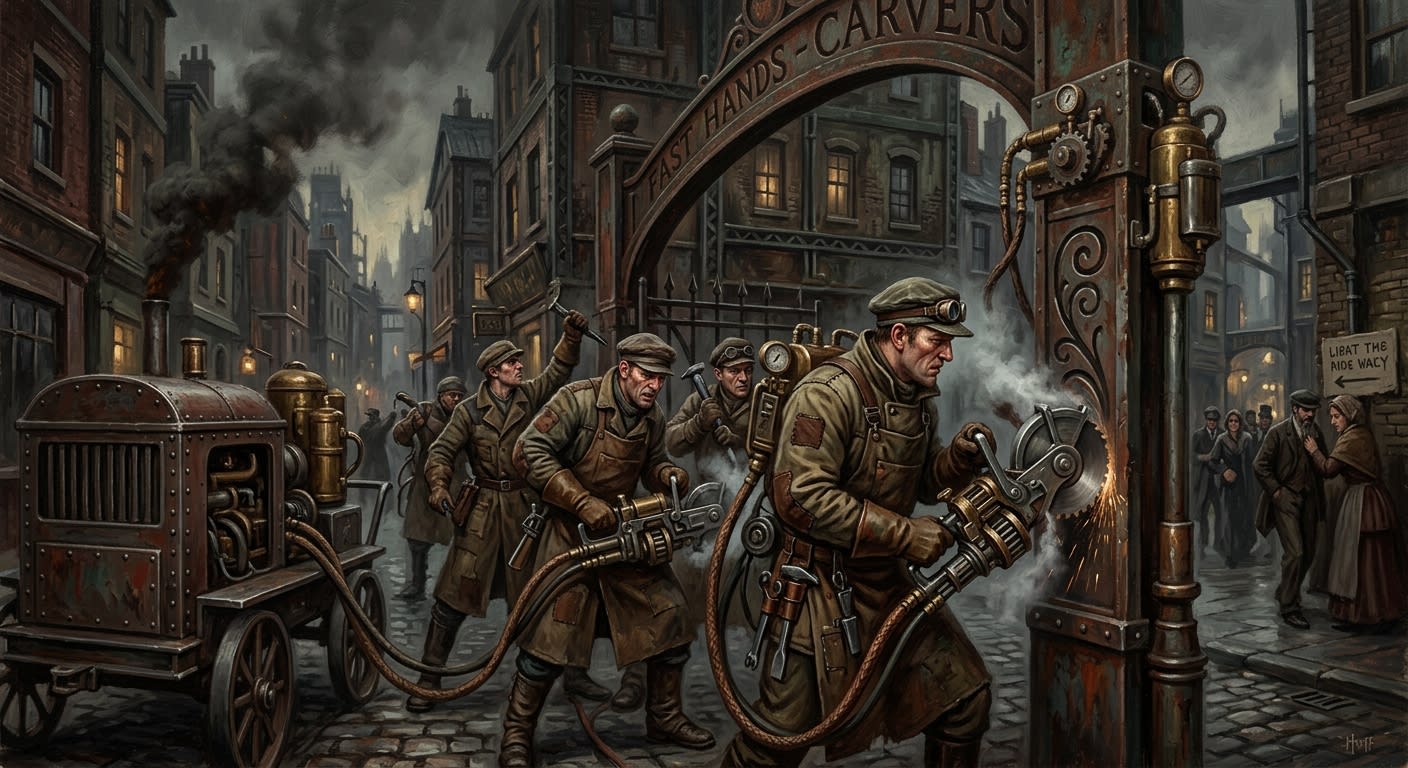
#On the Men Who Finish the Street
The Fast Hands are the quota faction of the Gate-Carver trade, the lintel sprinters, ward-block cutters, muster-shed sealers, and housing-office survivors who hold that a door left unmarked by sunset is a worse sin than a door marked with sweat still in the groove. They call the True Knot purists Grave-Whittlers, because purists treat a threshold as a coffin-lid and spend half the afternoon listening for theological noises in the plank.
The Fast Hand treats a door like a door. He measures enough. He cuts true enough. He chalks, breathes, tags, punches, and moves. Forty doors before sundown, if the wood is soft and the clerk stops asking questions.
The Bureau of Heraldry dislikes admitting that the faction exists, since the existence of Fast Hands proves that the Bureau's own quotas cannot be met by the Bureau's own ceremony. Official memoranda call them “accelerated compliance teams.” The street calls them blessed when the ration door opens, cursed when the Knot fails, and available if paid in wax, bread, or a promise from a Housing Canon who will deny the conversation by Matins.
#On Speed as Doctrine's Embarrassing Cousin
Every Bureau praises exactness until the line forms. Then the slow man becomes a saboteur with good handwriting.
Fast Hands rose wherever people had to be made legal faster than ceremony permitted: Brest barrack expansions, Cologne rebuild blocks after the Lintel Pogroms, Irongate living quarters during the Ossuary Breach Winter, Sigil Reform streets where six months of animal-scraping produced six years of work. Their argument is vulgar and hard to refute. An unmarked family cannot claim rations. An unmarked warehouse cannot pass inspection. An unmarked grave invites panic. If the full rite can mark twelve doors and the district requires fifty, the missing thirty-eight become mouths.
The Fast Hand's sequence is recognisably legal: paper glance, sponsor name, knot class, cord snap, frame clamp, cut, chalk, breath, wax, punch. The difference lies in compression. One breath where the purist counts three. A damp cord dried across the sleeve. Witness mark taken from the nearest literate person, or the nearest person convincingly pretending literacy. Registry entry filed at day's end in a batch, with addresses recovered from memory, chalk marks, and divine mercy.
Earlier Heraldry summaries described Fast Hand procedure as “informal knotting.”
Corrected. Informality implies absence of procedure. Fast Hand work is procedure under famine conditions, which is to say it is formal enough to punish and useful enough to deny punishing too often.
#On the Rivalry with the Grave-Whittlers
The quarrel between Fast Hands and True Knot purists is not philosophical in the shops, whatever pretty rot the guild lecturers write later. It is a fight over time, blame, and who stands nearest the widow when the inspector finds a shallow groove.
True Knot masters accuse Fast Hands of making weak thresholds. Fast Hands accuse True Knot masters of making homeless citizens. The purist points to failed Knots, unsealed niches, and cold lintels humming after Ninth Peal. The Fast Hand points to barrack children sleeping under registered roofs because someone cut the last twenty doors by lantern-light while the purist was still drying his cord. Both have evidence. Evidence is the favourite food of quarrels.
SHOP INQUIRY RECORD — STRASBOURG OUTER HOUSING OFFICE, A.S. 199 Dispute: Fast Hand team marked ███ doors in one watch Purist objection: breath-count abbreviated; wet-cord risk Inspection result: █ failures; ███ accepted; two later cold-lintel complaints Disposition: commendation issued, reprimand sealed, stipend withheld, quota maintained
Their insults form a little catechism. Grave-Whittler. Quota monkey. Splinter priest. Door butcher. Coffin-boy. Chalk liar. Fast Hands laugh louder because they finish earlier and drink before the purists arrive. The laughter stops in ossuaries.
#On the Years That Made Them Useful
A.S. 112 gave the trade fear. The Lintel Pogroms stripped Cologne doors to bare wood and forced every carver to prove geometry under Purity eyes. Fast Hands survived because, after the stripping, someone had to put the Knots back before the district starved under administrative suspension. Purity can unmake a street in one morning. Heraldry needs wrists to make it readable again.
A.S. 134 gave them martyrdom of a practical kind. During the Ossuary Breach Winter at Irongate, quotas tripled; niches, slabs, bone-alcoves, and living-quarter doors all demanded fresh or corrected marks. True Knot men took the grave corridors. Fast Hands took the housing blocks and the repair lanes where soldiers slept beside walls that had begun making noises. Nine months of double shifts produced stone-dust cough, bad proportions, forged meal breaks, and several thousand doors that were legal by sunrise. The Bureau recorded attrition. The families recorded roofs.
The Sigil Reform of A.S. 158 made them indispensable and hated. Animal crests came off every lintel; new Knots went on. A purist could scrape a serpent as if conducting a funeral. A Fast Hand could scrape fifty, bag the chips, cut forty replacement marks, and leave the remaining ten under chalk promise. Heraldry called this disorderly. Heraldry extended the deadline nowhere.
#On Bad Knots and Worse Alternatives
Fast Hands produce failures. Let the Ledger record that plainly before some pale inspector accuses me of indulgence. Their lines drift under rain. Their registry batches contain swapped addresses. Their wax-tags fall from wet lintels. A hurried breath-count can miss the little change in air that tells a trained carver something is leaning from the far side of the threshold.
They also prevent riots. The Synod, in its more honest sealed reports, knows this. A district waiting three days for proper ceremony begins tearing planks from empty houses and carving its own charms. Refugees copy Knots from memory. Gangs sell silenced doors. Shadow knotters arrive with outlaw frames and tender voices. By the fourth day, Heraldry has lost the street. By the fifth, Purity arrives to save it, which is the worst possible version of rescue.
A Bureau of Purity briefing classified Fast Hands as “primary contributors to threshold unreliability.”
Amended after review of three housing riots, two barrack fires, and one ward-block hunger incident. Current classification: “secondary contributors to threshold unreliability; primary contributors to threshold availability.” One hears the teeth grinding behind the wax.
The faction's private rule is brutal: a legal door tonight can be corrected tomorrow; an illegal door tonight may have no tomorrow. This is doctrine in a workman's apron, without incense and with splinters.
#On Present Standing
As of A.S. 201, Fast Hands work in every zone where the Knot must travel faster than dignity. They dominate new housing blocks, levy-cart shelters, warehouse repairs, refugee intake streets, fire-gutted parishes, and temporary barracks whose temporary designation has lasted thirty years. The Knotwright Registry fines them more often than it expels them. The Bureau of Tithes complains about their batch ledgers and pays their stipends because taxable doors must first exist. Settlement curses their handwriting and sends them more forms.
They invoke Saint Edrin with a smirk the purists find obscene. Edrin acted while committees dithered; that is their gospel. Measure, Witness, Refusal — yes, yes, yes — and also the blessed fact that he did not wait for a subcommittee on plague-house plank condition. He barred the door. He wrote the names. He moved before the fever acquired a lawyer.
The Fast Hand's terror is not the perfect Knot that fails. That belongs to the purist. The Fast Hand fears the imperfect Knot that holds, because it teaches the forbidden lesson that some portions of ceremony may be theatre. A shallow cut survives the winter. A rushed tag remains sealed. A one-breath door keeps out what three-breath doors have failed to restrain. The state can endure failed shortcuts. Successful shortcuts are much more dangerous.