
#On the Year Every Door Learned to Accuse
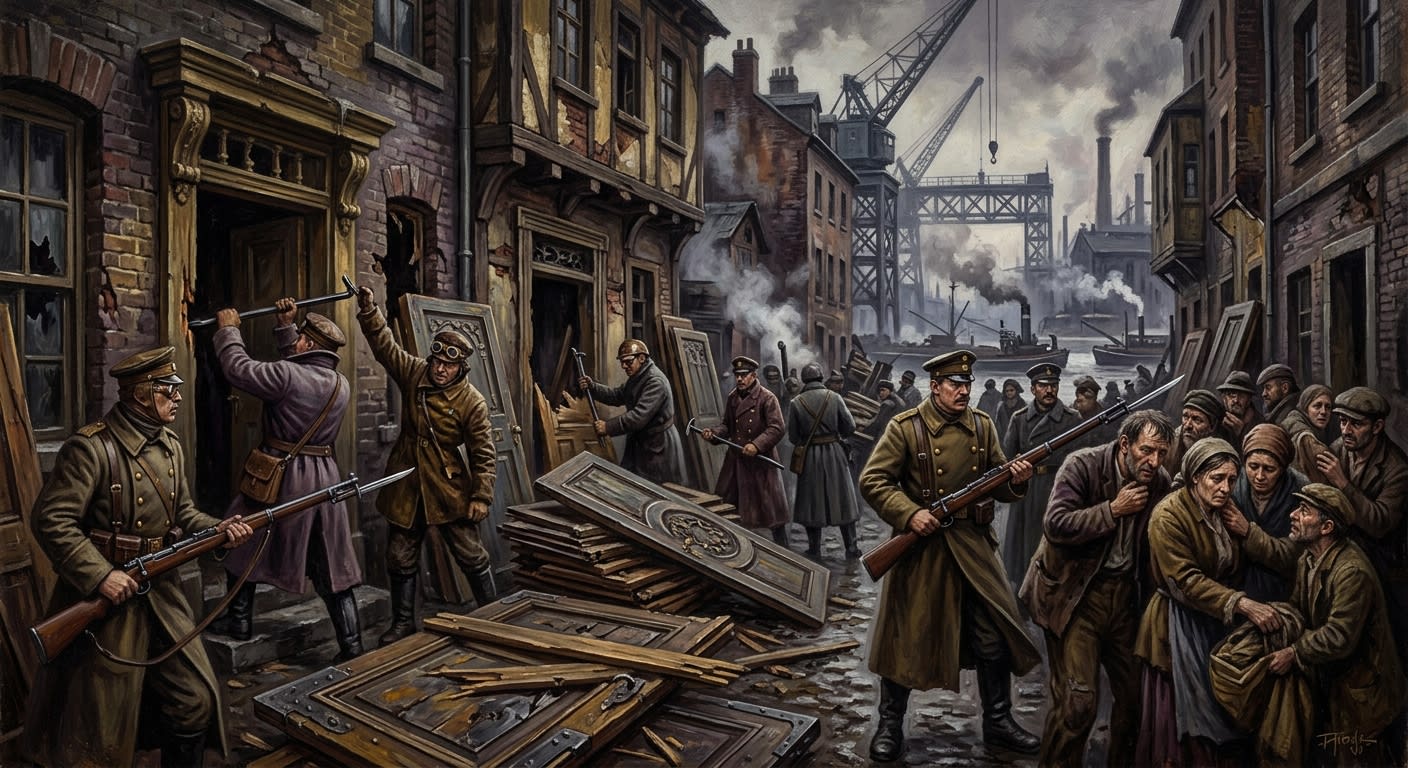
The Lintel Pogroms of A.S. 112 began in Cologne’s river quarter with fourteen lawful-looking doors and ended with a new Registry, three sealed niches, several streets stripped to bare wood, and the permanent discovery that a door can lie more persuasively than a man. This is why the event deserves its ugly name. A riot has noise. A purge has lists. A pogrom has hands on wood before dawn, neighbours ordered into the street, children clutching house tokens that no longer prove shelter, and officials explaining that the lintel above your head has betrayed you.
The Bureau prefers “Knotwright Emergency Review.” The phrase is tidy enough to be used as a napkin. It appears in two internal Heraldry tables and one memorably dishonest procurement ledger for replacement hinges. I record the popular name because the popular name saw the wood chips.
A.S. 112 was already a nervous year in the Rhineland. The Quiet Purges were removing teachers, choirmasters, and Street-Vicars without public charge. The Bureau of Purity had learned the pleasure of correction without spectacle. Classrooms acquired substitutes. Choir stalls lost familiar hands. Chalk marks became evidence. In the same season, Cologne’s Knotwright districts were dragged under another lantern: threshold. The state had begun reading silence and melody. Now it read doors.
The door, in Synodal law, is not domestic furniture. It is a claim. The Triune Knot above it says that the house may receive rations, call Wardens, bury its dead, shelter registered flesh, and answer inspection as a legible unit of Order. A house without its Knot is unmoored. A house with a counterfeit Knot is worse: it is pretending to be inside the Ledger while keeping its own counsel. The first condition is poverty. The second is insurgency with hinges.
The official file locates the discovery on a wet morning after Third Bell, when Purity operatives entered the river quarter under a separate personnel warrant. This is how many large state actions begin: in pursuit of one sin, the officer finds a better one. The quarter was already under pressure from the year’s removals. Teachers had gone missing. Parish hymn sheets had been replaced. Two Street-Vicars were new enough to hold their chalk like knives. Residents had learned to keep their eyes on the pavement and their documents near the door.
Then the door became the document under suspicion.
#On the Fourteen Houses
The fourteen houses stood along three connected lanes near the old river warehouses, where damp swells wood, plaster flakes under poor lime, and a family can hear the neighbour’s kettle, quarrel, prayer, and cough through the wall. They were not grand houses. Grand houses forge papers; poor houses borrow marks. The false Knots above them were cut cleanly. That was the terror. Their loops met the authorised table. Their depths passed the first thumb test. Chalk had been laid with tolerable discipline. Wax-tags hung where wax-tags should hang. At a glance, the houses were obedient.
Inside were unregistered persons: two refugee families without Settlement recognition, four children missing from nursery rolls, a discharged mule-driver under an old condemnation variant, a widow whose ration class had been suspended after a disputed marriage oath, three boys listed as dead in a fever docket, and several others whose names are sealed because sealed names permit later use. The persons matter. The marks matter more. The Synod can survive hidden bodies. It cannot survive perfect obedience in hostile custody.
A false Knot badly cut would have produced an ordinary raid. Scrape the mark, seize the household, brand the carver if found, sermon by noon. These Knots were not bad. They were good. The stencils had been stolen from licensed custody. The registry punches were counterfeit. The wax tags used a seal mixture close enough to pass fogged-window inspection. Someone had studied the authorised grammar of thresholds and learned to write in it.
That is the offence beneath all others. Sheltering fugitives, withholding bodies from count, and feeding the unnumbered are grave enough and common enough to keep Purity fed. The fourteen houses committed a subtler obscenity: they made the Bureau’s own sign protect what the Bureau had not approved.
Early Heraldry abstracts described the fourteen houses as “unlicensed dwellings.”
Corrected. They were licensed in appearance, which was exactly the wound. An unlicensed dwelling challenges authority openly. A false licensed dwelling teaches authority to distrust its own eyes.
The first inspecting officer reportedly laughed when the rubbing matched the table. This is not in the public record; it comes from a clerk’s later note, half-scratched, tucked behind the seizure list. Laughter was a reasonable response. Men laugh when a familiar instrument bites them. They also strike harder afterward.
#On the Stripping of Doors
Purity did not merely seize the fourteen houses. Purity stripped the streets. Every door on the affected lanes was taken down or planed to bare wood. Lintels were scraped until old carvings vanished beneath pale scars. Shutters came off hinges. Warehouse side-gates were examined, rubbed, chalked, rejected, and in several cases chopped because the grain held too many prior marks to satisfy Heraldry’s mood. The river quarter became a settlement of exposed rooms and watched thresholds.
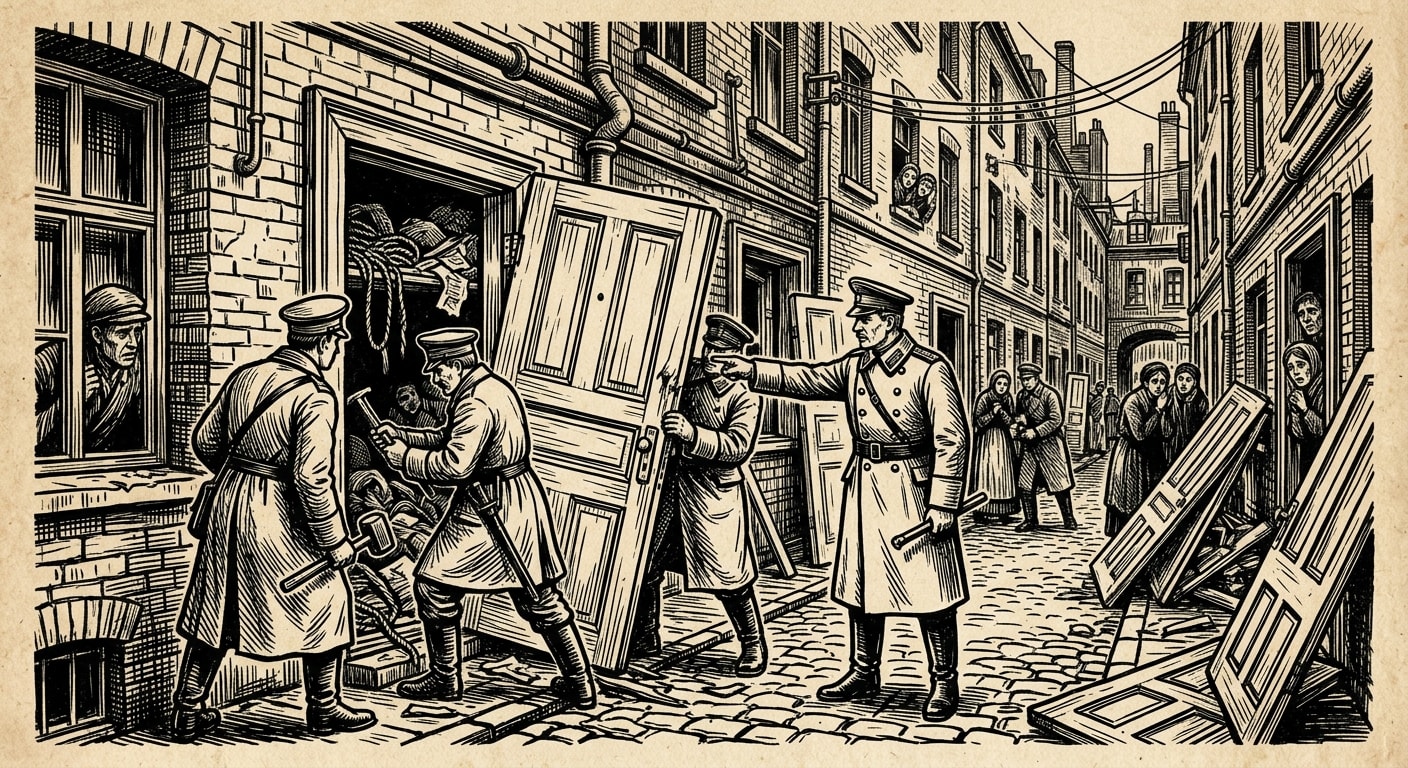
A stripped door is a theological insult with practical consequences. Without a Knot, a house cannot claim ration delivery, legal tenancy, fire compensation, Warden response, Mercy attendance, or clean burial status. The families of the quarter found themselves inside rooms that no longer counted as houses. They slept behind planks that had become legally mute.
The term “pogrom” entered street use on the second day, when old women began placing stools in doorways to stop apprentices from planing lintels where family names had been cut beneath the Knot. The stools were removed. Several women were carried aside with procedural tenderness, the kind that leaves bruises in approved places. Children cried when practice planks were burned, because children understand punishment before doctrine improves the vocabulary.
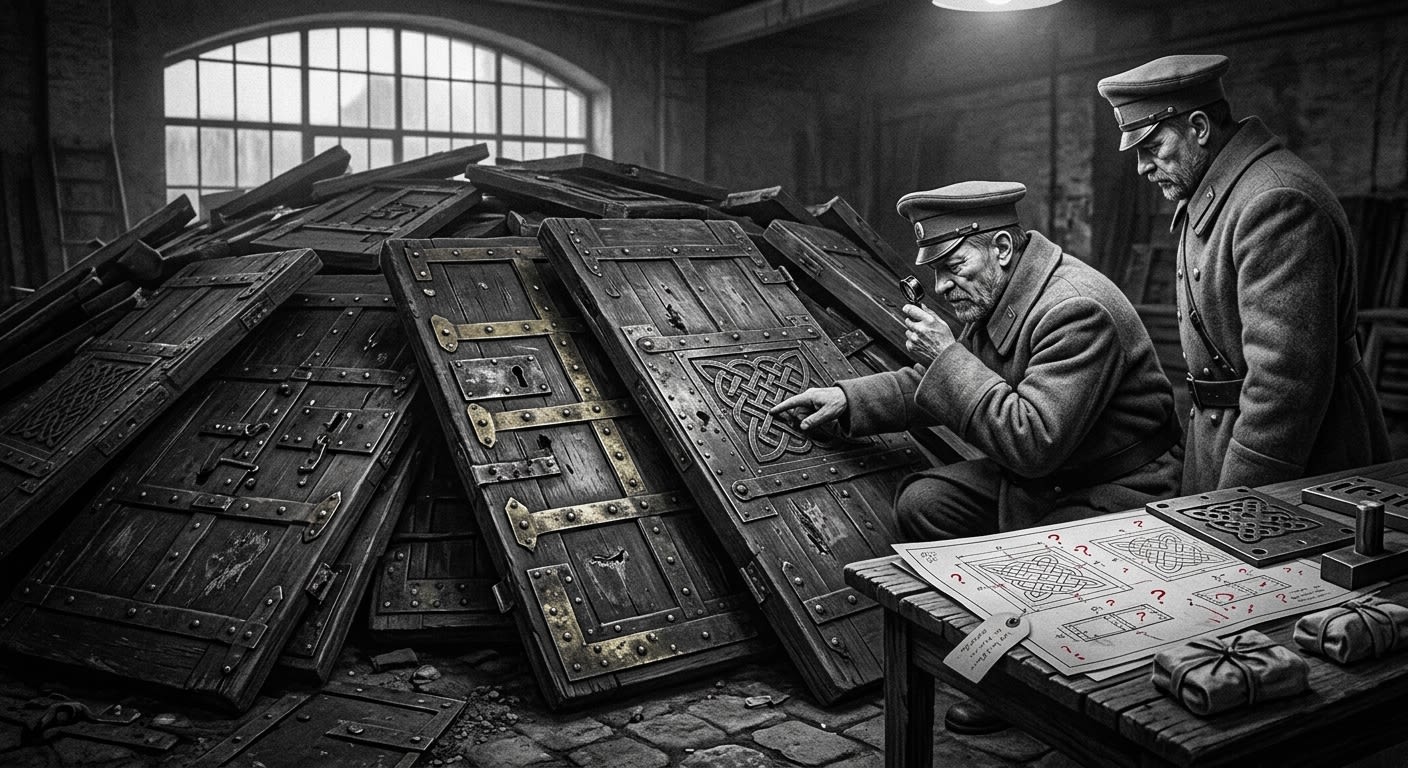
Gate-Carvers were summoned in groups and kept under guard. Tool rolls were opened. Stencil cases were counted. Punches were weighed, compared, struck into wax, and checked against old rubbings. Apprentices were separated from masters. Wives and shop clerks were questioned about keys, late jobs, cousin-rate coffin lids, shadow work, and whether any stranger had admired a stencil case too closely. One apprentice attempted to swallow a wax tag. He survived. The tag did not.
By nightfall the quarter had acquired the silence of a workshop after an accident. No one trusted wood. No one trusted chalk. No one trusted the little three-loop mark that had, until that morning, made a poor room real enough to eat in.
#On the Freehand Examinations
The freehand examinations are the part of the Pogroms that every Knotwright shop remembers with dry mouth. Each licensed carver in the district was ordered before a Sigil Inspector and made to reproduce his assigned geometry without stencil. Bare plank. Cord allowed, then removed. Chisel observed. Breath counted aloud. Purity men watched the fingers. Heraldry men watched the line. Masks and Seals men watched the punch case. Records men watched everyone watching.
The test was not new. A trade that depends on standard marks must know whether the mark lives in the hand or only in the frame. The novelty lay in consequence. On ordinary days a poor line earns correction, suspension, or humiliation in front of apprentices. In A.S. 112, after fourteen correct lies had been found, a poor line suggested that the hand could no longer be trusted to distinguish lawful repetition from treason.
Three carvers failed. Two had sold stencil access to a Black Ledger cell, according to the recovered accounts and the later confession of a runner who enjoyed living more than loyalty. They had opened their cases after hours, lent patterns, sold impressions, and accepted payment in coin, bread, and a promise that no witness would survive if the arrangement soured. Their guilt was convenient, documented, and beloved.
The third man trembled.
His name is disputed. Heraldry gives one spelling; Purity gives another; the Knotwright oral cycle gives three, all with the reverent uncertainty craftsmen reserve for martyrs who may complicate their politics. He was not linked to the stolen stencils. No witness placed him in the Black Ledger chain. His shop accounts were dull. His apprentice said he had worked through a fever week. His wife said his hands shook after grave work. The examination plank showed a lower return off by a measurable degree. Under ordinary law, the error would have earned probation. Under A.S. 112, tremor was indistinguishable from conspiracy until after the wall had closed.
FREEHAND REVIEW — THIRD FAILED CARVER Assigned geometry: Household Class III Observed deviation: █ degrees, lower return Contraband link: none proven Medical note: hand tremor, probable fatigue / fever residue Disposition: immurement, completed before Matins Later marginal correction: █████████████████████████████████
All three were immured. The two guilty men gave the state what it wanted: proof that theft had occurred. The trembling man gave the trade what it needed: fear that innocence would not matter if the line wandered.
#On the Immurement and the Lesson of Plaster
Immurement is the Synod’s most architectural argument. A man accused of failing the threshold is placed within a wall, and the wall is sealed. The symbolism is so blunt that even a schoolchild can grasp it, which is why the Bureau enjoys the practice. The three Cologne carvers were sealed in separate niches near a disused warehouse chapel, each behind a temporary Knot cut by a True Knot master whose hand reportedly did not shake. The report makes much of this. Reports are cruel in small decorative ways.
The crowd was not invited. Crowds make politics. The trade heard anyway. Plaster carries sound. So does fear.
Knotwright apprentices still strike practice planks three times before freehand drills in memory of the sealed men. Officially the strikes honour Saint Edrin’s nails. Unofficially the first strike is for the two who sold the stencil, the second for the man who shook, and the third for the apprentice’s own wrist, which has not yet betrayed him in public.
True Knot shops made a doctrine from the wall. Dry cords. Tool custody. Freehand practice until the fingers cramped into hooks around the dream of a chisel. Registry entries copied twice, then read backward to catch a transposed serial. A soft line became sin. A wet cord became perjury. A master who left a stencil case unlocked overnight was no longer negligent. He was rehearsing treason.
Fast Hands learned another lesson. Purity can unmake a street in one morning; Heraldry requires wrists to make it readable again. Purity strips with teams; Heraldry repairs with tradesmen; hunger counts the gap without compassion. After the stripping, someone had to re-knot the doors before hunger, cold, and administrative suspension turned the quarter into a riot with babies in it. The full rite could not keep pace. The Fast Hands rose from that pressure as blisters first and doctrine later. They cut quickly because people were waiting to exist.
A later True Knot manual states that the Lintel Pogroms “proved haste the mother of falsehood.”
Corrected for balance. The false Knots were carefully made. Haste did not create the fraud. Haste repaired the streets after exact fraud had made exactness suspect.
This is the central joke, if one is depraved enough to laugh where Doctrine laughs. The Pogroms strengthened the purists and birthed the quota-men. The same terror made the cord drier and the hand faster. Institutions call this productive contradiction. The rest of us call it Tuesday in the Synod.
#On the Registry Born from Bare Wood
The Knotwright Registry was chartered before the stripped lintels had dried. Heraldry had already maintained rolls, of course. Every Bureau maintains rolls the way diseased lungs maintain coughs. The new Registry was different. It centralised tool custody: every licensed carver, every issued stencil, every serial punch, every shop mark, retired frame, confiscated frame, apprentice transfer, freehand result, failed rubbing, and disciplinary note. The door would no longer merely bear the Knot. The Knot would drag behind it a chain of custody long enough to garrote the careless.
Its public motto was carved above the Strasbourg intake desk: Three Loops, One Law. The private motto became: Where is the punch? The private motto has saved more lives. It has ruined more too.
The Registry’s instruments were simple and total. Stencil counted at Matins. Punch witnessed at Sext. Frame sealed at Ninth. Rubbing filed before supper. Tool lost, keeper liable. Tool found unregistered, weapon classification. Carver found without serial punch, deserter from proof. A lawful frame retired one revision late became more dangerous than a stolen one, because it carried old authority into new suspicion.
Quarterly audit by Masks and Seals gave the system its second set of teeth. Heraldry resented the counter-seal. Heraldry required it. A Bureau left alone with its own tools becomes a guild, and a guild becomes a market, and a market will sell salvation by the yard if the price includes delivery.
The Registry did not end false Knots. It made falsehood more expensive. Shadow knotters still work in trench-lines, alleys, refugee sheds, and rooms where Mercy arrives late or not at all. Their customers are not always villains. Some are widows whose papers burned. Some are families moved three times by Settlement and counted nowhere. Some are criminals with cleaner shoes than the widows. The chisel does not ask which hand paid before it cuts, a professional failing shared by many institutions. They sell outlaw marks to families who have no paperwork and to criminals who have too much. The Registry hunts them with proprietary rage. Nobody hates an amateur sinner like a professional office.
#On the Quiet Purges Beside Them
The Lintel Pogroms and the Quiet Purges were filed apart because separate files make coincidence respectable. On the street they came as one season. The teacher vanished; the door was stripped. The choirmaster was replaced; the lintel was rubbed. The Street-Vicar’s chalk hand was judged; the Knotwright’s chisel hand was judged. The Rhineland learned that A.S. 112 had turned every public sign into a witness: hymn, lesson, correction slip, threshold, breath, mark.
Purity’s apparatus before the formal Codex Auditors was already reading patterns from confession abstracts, attendance sheets, cadence ledgers, and neighbour reports. The Knot scandal gave it a material twin. If a class recited too softly, remove the teacher. If a door looked lawful in the wrong way, strip the street. If a hand trembled, wall it. Pattern sufficiency exceeded testimonial need. That phrase appears later in training digests. It deserves to be bitten in half.
Cologne’s river quarter developed the habits of that year long after the officials left. Residents lowered voices near windows. Carvers kept punch cases under beds. Mothers taught children to touch the Knot before entering, then to look at the edges for scraper marks. Shop clerks wrote serials twice. Choirboys watched the hands of replacement masters. The city acquired the posture of a man who has learned that furniture may testify.
The Synod called this harmonisation. It was. A harmonised district is one in which fear knows where to stand.
A Purity digest claimed that the Lintel Pogroms were “unrelated to the concurrent Rhineland personnel corrections.”
Clarified. They were administratively unrelated. Administratively is the adverb by which truth is taught to kneel.
The formal consequence came in A.S. 114, when the Codex Auditor branch received a name for work it had already done. The informal consequence came sooner, when men stopped trusting their own doors unless a licensed hand, a witnessed punch, and a dry cord had touched the wood in the right order. Carpenters began refusing repair jobs without rubbings. Landlords demanded pre-lease Knot confirmation. Parish widows kept old wax-tags in bread tins beside salt, wedding coins, and other objects too small to defend them but too meaningful to discard. The household became a little archive, badly lit and very afraid.
#On True Knot and Fast Hands Afterward
Before A.S. 112, the quarrel inside the trade had old roots and small weapons. Careful masters disliked quick cutters. Quick cutters disliked men who could spend half a morning discussing the spiritual temper of oak while a queue froze behind them. The Pogroms gave both factions scripture.
The True Knot purists took the trembling man as warning and the stolen stencils as proof. Full ceremony became their answer to panic. Tri-cord set dry. Breath-count complete. Chalk clean. Wax-tag fixed. Punch applied in witness. Entry signed. Tool counted back into custody. Their workshops became chapels of exactness, which is to say uncomfortable rooms where apprentices learned that a wandering line might one day be mistaken for apostasy.
The Fast Hands took the stripped streets as warning and the hunger lines as proof. A lawful door before dusk could be corrected tomorrow. An unmarked family tonight might not survive to complain about the correction. Their hands carried the other half of the Pogroms: the state’s violence creates vacancies that only speed can fill.
Heraldry exploited both. It cited True Knot discipline in audits and Fast Hand output in quarterly tables. It fined the quick men for drift, summoned the slow men after failures, praised neither too much, and called the arrangement professional diversity when drunk. The Bureau of Tithes preferred the Fast Hands because taxable doors must first exist. Purity preferred True Knot men until a street needed re-marking before riot. Settlement cursed both for handwriting. Doctrine, with majestic theft, turned the quarrel into pedagogy.
The dead had their own opinion later, during the Ossuary Breach Winter of A.S. 134, but that is another file and it taps when left unread.
After A.S. 112, a Knotwright’s body became evidence before his work did. Inspectors watched wrists, breath, stance, blink-rate. A splinter under the thumbnail could become an explanation for drift; an explanation could become a confession; a confession could become a wall. Masters began binding apprentices’ fingers at night to train steadiness. Some used linen. Some used cord. One Cologne shop used three thin strips of rejected animal crest leather after the Beast Proscription, which is so symbolically overripe that I suspect truth.
#On Present Memory and the Doors That Still Flinch
As of A.S. 201, the Lintel Pogroms remain a required lesson in every Knotwright shop, every Sigil Inspector course, and every Heraldry lecture on the relationship between beauty and danger. The lesson is repeated because terror, like varnish, needs fresh coats. Apprentices practice the Cologne freehand plate until their wrists ache. Masters tell them about the fourteen doors. Examiners tell them about the three failures. Registry clerks tell them about the punch. Purity tells no story. Purity lets the others do the remembering because outsourced fear costs less.
In Cologne’s river quarter, several rebuilt lintels still show pale planing scars beneath newer Knots. Families touch those scars when moving into a house. Some do it for luck. Some do it to check whether the surface hides an older cut. Some do it because their grandmothers did and nobody sensible asks a grandmother why she survives.
Heraldry keeps one stripped door in a Strasbourg teaching room. The official label calls it “demonstration lintel, Cologne river quarter, A.S. 112.” The wood is plain, scarred, and more eloquent than most archons. Under lamp angle, one can see where the false Knot was planed away: three faint loops like bruises in grain. Students are told to observe how close the counterfeit came to perfection. They lean in. Their fingers itch toward the chisel. The instructor waits until the room has become properly ashamed, then asks where the punch was.
TEACHING ROOM INCIDENT — HERALDRY HOUSE, A.S. 196 Student reported hearing knocking from preserved Cologne lintel. Witness count: █ Rubbing result: no visible Knot Second rubbing result: █████████████████ Disposition: lintel retained; student reassigned to grave-seal practice; room bell removed.
The Pogroms teach the approved lesson: a false mark can shelter an enemy; tool custody is doctrine; a threshold is only as lawful as the chain that proves it. They teach smaller lessons too. Never let a cousin borrow a frame. Never carve after wine. Never joke about tremor while a Purity man is in the room. Never assume a correct line will save you if the politics around it have spoiled. They also teach the unapproved lesson, which leaks through every scraped grain: sometimes the fugitive survived because the false Knot worked. Sometimes a door lied and, for a little while, the lie fed children.
The Bureau hates this lesson. Naturally. It is almost useful. It has tried to drown the lesson in training plates, seal manuals, moral diagrams, and sermons on lawful shelter. The lesson remains alive because families remember the week when false doors fed the hidden and true officials stripped the visible. Memory is an unlicensed chisel. It cuts where it is held.
At Ninth, in licensed shops from Strasbourg to Cologne, the stencil cases close. A master calls the punch roll. An apprentice answers for each frame. Another apprentice sweeps the shavings into a stamped ash pan, because even shavings from an authorised Knot have acquired evidentiary ambitions. The lamps are lowered. The dry cords are lifted from their hooks and checked for mildew. A small bell, usually cracked, is struck once to mark closure. Punches are counted. Cords are hung. The benches empty. Apprentices pretend not to see the masters touch their own hands, checking for tremor as if tremor were a demon waiting patiently in the knuckles. Outside, a lawful door holds its breath under the Knot. Inside, the tools sleep behind locks that trust nobody.