
#On the Winter the Dead Became a Housing Problem
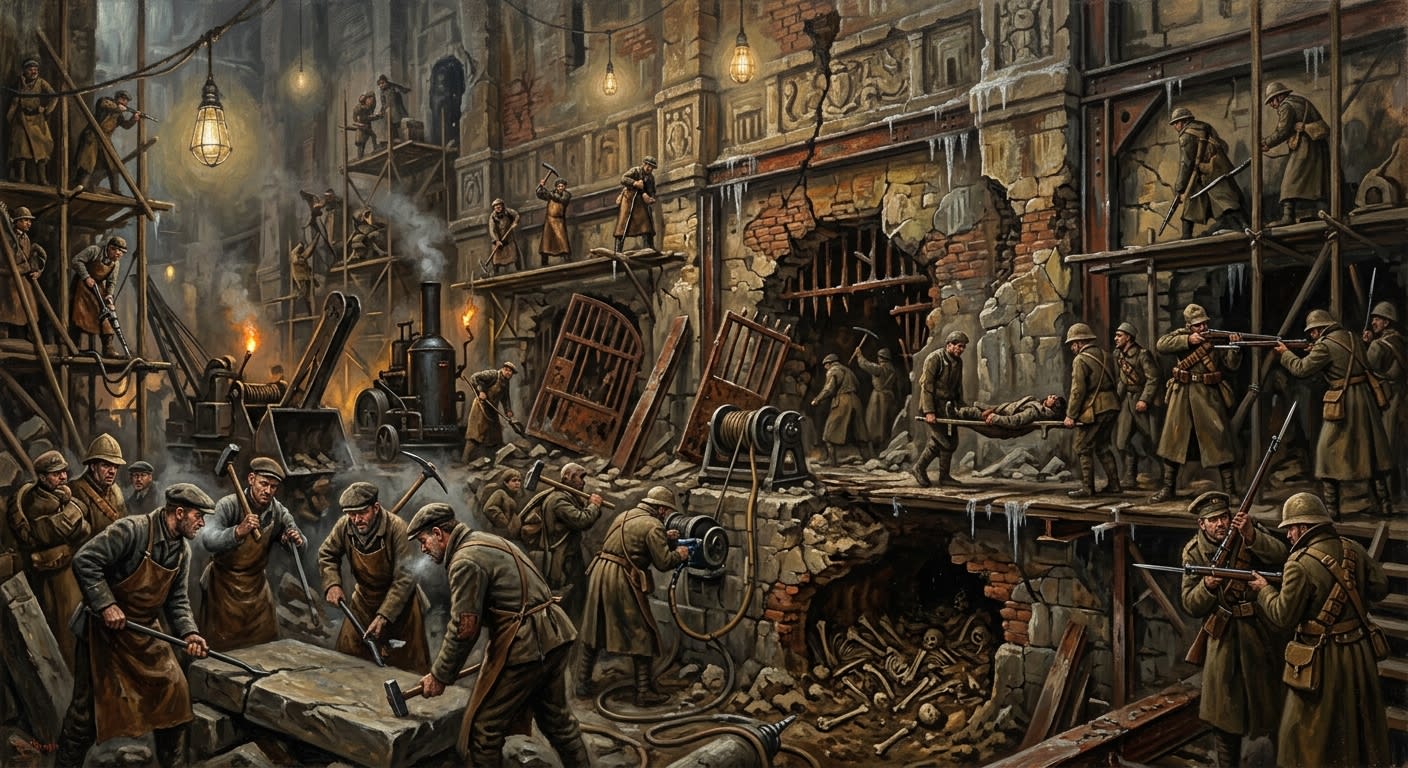
The Ossuary Breach Winter of A.S. 134 began in the eastern catacombs of Bastion-Irongate, where the mountain holds its dead in bone-alcoves, sealed niches, slab-stacks, military drawers, unclaimed family shelves, and those admirable little municipal cupboards into which a poor man may be folded once the state has finished using him upright. The first report described scratching behind a niche wall. The second described three skulls found outside their assigned alcove, arranged jaw-down toward the corridor as if listening. The third described a corpse standing in a passage it should not have been able to enter, because the door was barred, the slab sealed, the registry correct, and the dead, at least in theory, obedient.
The phrase rising scare appears in the public abstract. It is a cowardly phrase. It gives the citizen a shawl and asks him not to notice the blood on the hem. A scare is when a child mistakes a coat for a man. A breach is when the coat answers to a baptismal name.
Irongate had warning. Its catacombs were cut into damp basalt beneath the living quarters, close enough to the Gasket Choir's lower channels that a hymn sung at Third Watch could tremble dust from a niche seal. The Gate-Carvers had complained for years that ossuary stone sweated, cords warped, chalk softened, and registry punches struck unevenly where the wall rang hollow. The Bureau of Engineering called this structural. The Bureau of Heraldry called it tolerable. The Bureau of Doctrine, more usefully and more dangerously, called it spiritually instructive.
By Frostwane of A.S. 134, the instruction had begun moving.
#On the Eastern Catacombs
Bastion-Irongate is a fortress carved inside a gorge that thinks in echoes. Every corridor repeats what it hears. Every seal receives some portion of the mountain's breath. The living sleep above the dead, the dead rest beside pressure channels, and the Gasket Choir sings through both because the mountain requires sound the way a chest requires lungs.
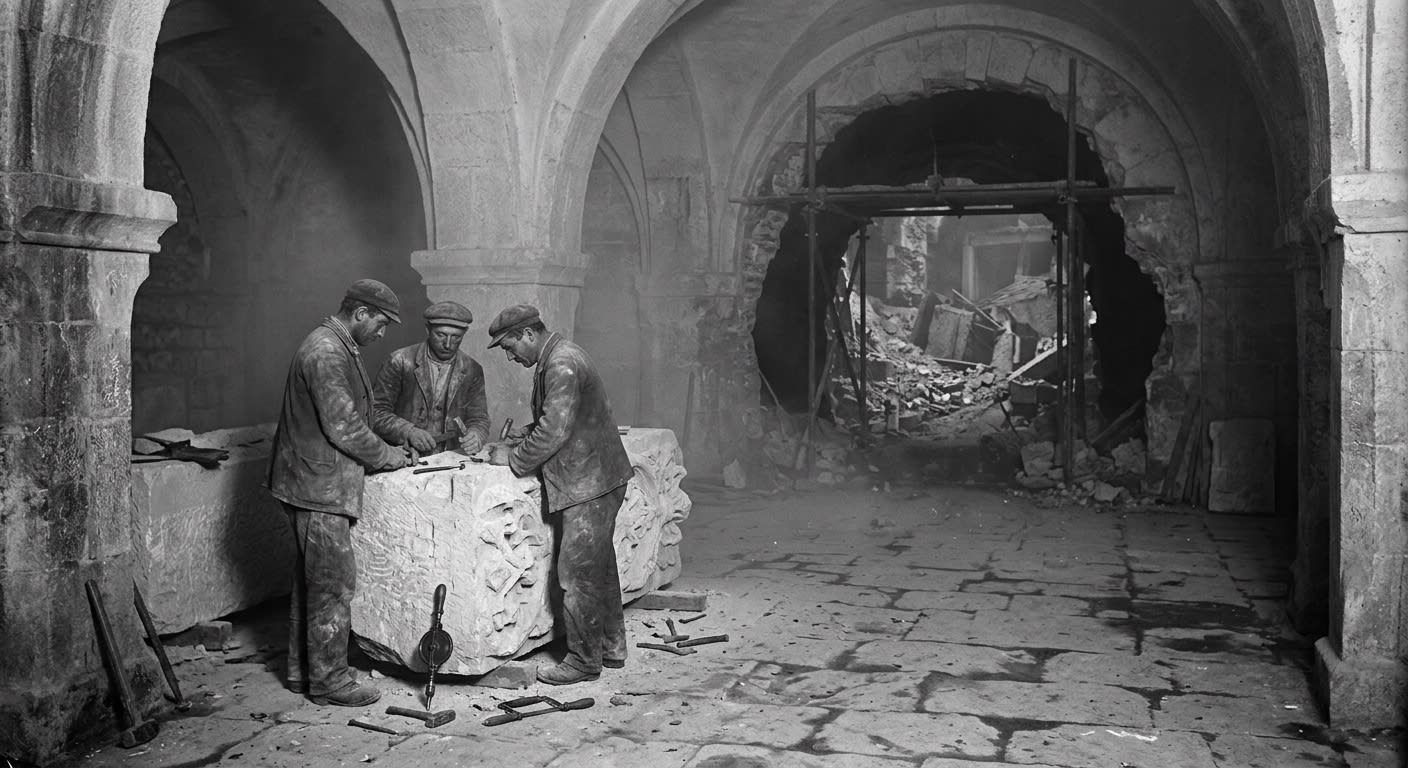
The eastern catacombs were never meant to hold so many. This sentence appears in Engineering memoranda, Burial Office minutes, Gate-Carver shop complaints, and one anonymous chalk inscription behind Alcove Row 7: STOP STACKING THE FAITHFUL LIKE KINDLING. It was removed by limewash, returned in smaller script, removed again, and then scratched into the stone with a nail. Persistence is the poor man's heraldry.
The catacombs held garrison dead from Sibiu convoys, river casualties, tunnel collapses, chant crews whose lungs failed in service, unclaimed refugees who died between permit desks, and ossuary transfers from older burial shelves surrendered to new barrack expansion. Each niche bore a Triune Knot cut to authorised depth, chalked, waxed, punched, entered, and—where time, cord, and wrist permitted—witnessed. That is the official claim. The wall itself offers a less tidy archive.
There were shallow cuts. There were damp-cord seals. There were wax-tags softened by breath channels. There were registry entries batched at day's end, then copied after lamps guttered, then corrected in a hand that may have belonged to the original carver or to a clerk who admired confidence more than truth. The True Knot masters blamed Fast Hands. Fast Hands blamed quotas. Heraldry blamed stone. Engineering blamed vibration. The dead, with admirable economy, blamed everyone at once.
Early Irongate burial abstracts stated that “no properly sealed niche was compromised.”
Corrected after the third inspection. Several compromised niches bore valid marks, unbroken wax, and matched registry punches. The revised phrase is “no properly understood seal failed,” which is theology wearing a clerk's hat and hoping no mason asks for measurements.
#On the First Three Incidents
The first incident occurred in Corridor E-17, a low passage where the ceiling ribs bend close enough that a tall man must choose between humility and concussion. Watchman Joric Pell heard three taps from behind a sealed wall. He answered once, because soldiers are trained to answer signals and because training often survives intelligence by several fatal seconds. The wall answered with the same three taps, then with his name.
Pell reported the sound. His sergeant accused him of drinking. The sergeant heard the sound. The sergeant accused the wall of settling. The wall said the sergeant's childhood nickname, which had been entered nowhere in military files because even the Bureau has not yet mastered every mother's cruelty. Corridor E-17 was closed by second bell.
The second incident occurred in Row of Saint Veyra Minor, where skulls placed in west-facing ranks were found facing east. Reorientation of bone is common after tremor, says Engineering. Three skulls had also acquired fresh chalk marks across the brow, each forming the first loop of a Knot. Engineering had no appetite for chalk.
The third incident gave the winter its name. A corpse assigned to Niche 44-K stood upright in the inventory passage outside its sealed slab, hands folded, head lowered, feet bare on stone dust. The Niche 44-K seal remained intact. The body inside the niche also remained present. The standing corpse and the filed corpse matched in age, wound, missing finger, and burial tag. The duplicate opened its eyes when the Gate-Carver approached and exhaled stone dust into his face.
WITNESS EXTRACT — EASTERN CATACOMBS, NICHE 44-K Question: Did the subject speak? Answer: Yes. Question: What words were used? Answer: “The cut is shallow.” Question: Was the niche mark measured afterward? Answer: ███████████████ Question: Disposition of measuring cord? Answer: Burned. Question: Disposition of Gate-Carver H. Voss? Answer: Lung seized; transferred to Breatheries; no further interview recommended.
The Bureau of Purity wished to burn the row. The Bureau of Rites wished to reseal it under vigil. The Bureau of Engineering wished to shore the wall. The Bureau of Heraldry wished to inspect the cuts before anyone spoiled the evidence. The four Bureaus debated for six hours while the corridor temperature fell by seventeen degrees and two sealed niches began tapping in counterpoint to the Choir Nave.
#On Quotas Tripled by Fear
The order reached the shops before dawn. Every ossuary niche in the eastern catacombs was to be inspected, remeasured, recut where needed, rechalked, rewaxed, re-punched, cross-entered, and witnessed. Every living-quarter door adjoining a burial channel was to receive a fresh Knot. Every slab in the old military corridors was to be tested for hollow ring. Every bone-alcove without a visible authorised mark was to be treated as open until sealed. Zones 3 and 4 sent Gate-Carvers by convoy. Irongate received them the way a wound receives salt: with pain and gratitude indistinguishable.
For nine months the profession worked double shifts. Dawn to Ninth in living quarters: barrack doors, family thresholds, infirmary shutters, ration arches, sleeping cell partitions. Ninth to Third in the ossuaries: slab, niche, shelf, drawer, alcove, corridor gate. Stone dust entered lungs, hair, food, prayer books, wax seals, and the little creases around the eyes by which old tradesmen identify one another across a tavern. The cough began in the third week.
The Bureau called it occupational attrition.
Fast Hands became indispensable. Their crews took housing blocks, repair lanes, soldier dormitories, soup doors, temporary family quarters, and every threshold that needed legality before panic took a bite from the street. True Knot masters took the grave corridors, where haste could be blamed for each tap and each tap could become a sermon against haste. The old rivalry hardened into something more useful than hatred. Fast Hands kept the living registered. True Knot men taught the dead to stay filed.
Neither side forgave the other for being necessary.
#On Stone-Dust Cough
The dead killed fewer carvers than the stone did. The ledger says so.
The eastern catacomb walls shed grey powder when cut, a fine mineral ash mixed with lime, bone dust, old chalk, wax soot, and whatever nameless residue gathers in a corridor where generations have placed their dead and then lied about ventilation. Cloth masks blackened within an hour. Wet masks clogged. Dry masks failed. Carvers spat grey into rags and kept working because a half-cut seal was worse than an uncut seal: an uncut seal invited suspicion; a half-cut seal invited confidence.
By Thawmonth the Breatheries were full. Men slept upright to keep from choking. Women tied cord around their ribs to feel when a coughing fit began, because a chisel stroke made during a fit could ruin a cut and a ruined cut could condemn an entire row. Apprentices learned to read seal depth through tears. Masters learned to count breaths around blood.
The initial casualty ledger attributed Gate-Carver deaths to “winter respiratory weakness.”
Amended after shop petitions, Breatheries memoranda, and the inconvenient habit of dead men carrying stone dust in their lungs. Current classification: occupational atmospheric exposure, non-compensable. The Bureau can name a thing and still refuse to pay for it. This is one of civilisation's cheaper miracles.
Bone-Lung entered Gate-Carver slang that winter, borrowed from ossuary stampers and made nastier by pride. A stamper breathes dust in service to seals. A Gate-Carver, being vain in the small way tradesmen are vain, breathes dust in service to geometry. Both cough the same colour. Both receive the same supplement: none.
The Bureau of Heraldry did increase the stencil stipend by a quarter-Crown per annum. This fact is included so the reader may appreciate the tenderness of institutions.
#On What Was Found Behind the Seals
Most opened niches contained what they were meant to contain: bones, tags, rosary fragments, folded cloth, cracked teeth, buttons, prayer cards, officer tokens, clay pipes, and the small stubborn debris by which a human life continues insulting neat categories after death. Some contained too much. Some contained too little. Nine contained no body at all, though the ledgers listed full interment. Four contained extra hands. One contained a sealed ration chit dated three days after burial. One contained a child's shoe in an adult cavalryman's niche, still damp.
The worst corridor was Saint Orla Spur, where twenty-seven niches bore proper Knots and hollow backs. Behind the backs ran a maintenance crawl never entered on the ossuary plans. The crawl was cold, dry, and worn smooth along the floor by passage. The Gate-Carvers found wax scrapings there. Also finger bones. Also a bell sliver tied with black thread to a registry punch that had been missing since A.S. 128.
Engineering reclaimed the crawl as pre-Hush infrastructure. Heraldry reclaimed the punch as stolen tool evidence. Purity reclaimed the finger bones as contamination. Doctrine reclaimed the whole incident as proof that the dead require stronger instruction.
The Saint Orla Spur crawlspace was placed under interdepartmental hold: pre-Hush infrastructure disputed, registry punch recovered, partial human remains sealed, increased seal depth recommended for ossuary interfaces, public disclosure unnecessary. There are whole cathedrals less doctrinally crowded than that sentence.
The standing duplicate from Niche 44-K was never explained. The official disposition says cremated. The ash weight does not match. The niche corpse remained in place for three inspections, then was transferred to a sealed drawer under Purity custody. The drawer appears in no current inventory. I record this because I enjoy the Bureau of Purity's discomfort when its cupboards are counted by someone with better prose.
#On the Breach Closing
The winter ended bureaucratically before it ended physically. That is common. Snow remained in the gorge. Coughs remained in the shops. The eastern catacombs remained cold enough to sting the teeth. Heraldry declared the breach contained after the last priority corridor received its double mark and the last living-quarter interface passed inspection under revised cord protocol. Rites held a sealing vigil with three choirs, two censers, one portable reliquary, and seventeen men with hammers hidden under their robes in case the dead disliked ceremony.
The final night produced no tapping.
Nobody trusted this.
The Gate-Carvers walked the corridors anyway, palm on wall, bell sliver against apron seam, listening for the hum that means stone is only stone and the hum that means stone is thinking. True Knot masters signed their inspection pages with hands cracked white from chalk. Fast Hands filed batch ledgers thick with corrections, stains, and the little shorthand marks used by men who know no one in Strasbourg will read line seventeen if line one has a proper seal.
The Bureau's public lesson was exactness. The trade's private lesson was lung capacity. A perfect seal cut by a dying man remains perfect until he coughs blood into the groove. A fast seal cut by lantern may hold long enough to feed a family. A grave cut under full ceremony may still speak if the wall behind it belongs to older masonry with its own opinions.
The Ossuary Breach Winter did not settle the argument between True Knot and Fast Hands. It gave both factions relics to throw at one another.
#On the Present Memory
As of A.S. 201, the eastern catacombs of Irongate carry more Knots than any burial complex of comparable size in the Synod's files, a sentence that conceals its horror behind administrative neatness. Some niches bear three marks: original, emergency correction, later authorised overlay. Some slabs are so crowded with geometry that a mourner must search for the name between loops. Children of Gate-Carver families call those rows the Lace Walls. Their parents tell them not to touch.
The Breatheries still receive old carvers from A.S. 134. Their lungs have spent sixty-seven years making a document of that winter. They cough during damp weather, during low chant, during arguments about stipend arrears, during funerals of younger men who thought cloth masks were enough. The Bureau of Heraldry sends a wreath when one dies if the shop files Form 19-F within fourteen days. Late wreaths are not issued retroactively.
Apprentices learn the winter in three versions. The True Knot version: shallow cuts invite the dead. The Fast Hand version: impossible quotas create shallow cuts. The Bureau version: emergency measures restored confidence in the grave-seal system. The wall version: tap, tap, tap.
The old apprentice rhyme still moves through Irongate shops: cut it deep, cut it dry, count three breaths, do not lie; if it taps, tap no more; if it speaks, unmake the door. The shopmasters deny teaching it. The apprentices deny learning it. The tune persists, which is the usual fate of forbidden instruction.
The Ossuary Breach Winter remains the Gate-Carver trade's favourite accusation and least favourite memory. It proves speed kills, except where delay would have killed faster. It proves ceremony matters, except where ceremony arrived too late. It proves the dead respect authorised geometry, except for the occasions when they do not.