

#On the Reported Cell
Compiled for the Cologne Sub-Registry in A.S. 201, which is 1911 in the common reckoning. That is the year of this survey. It does not date any event described in it.
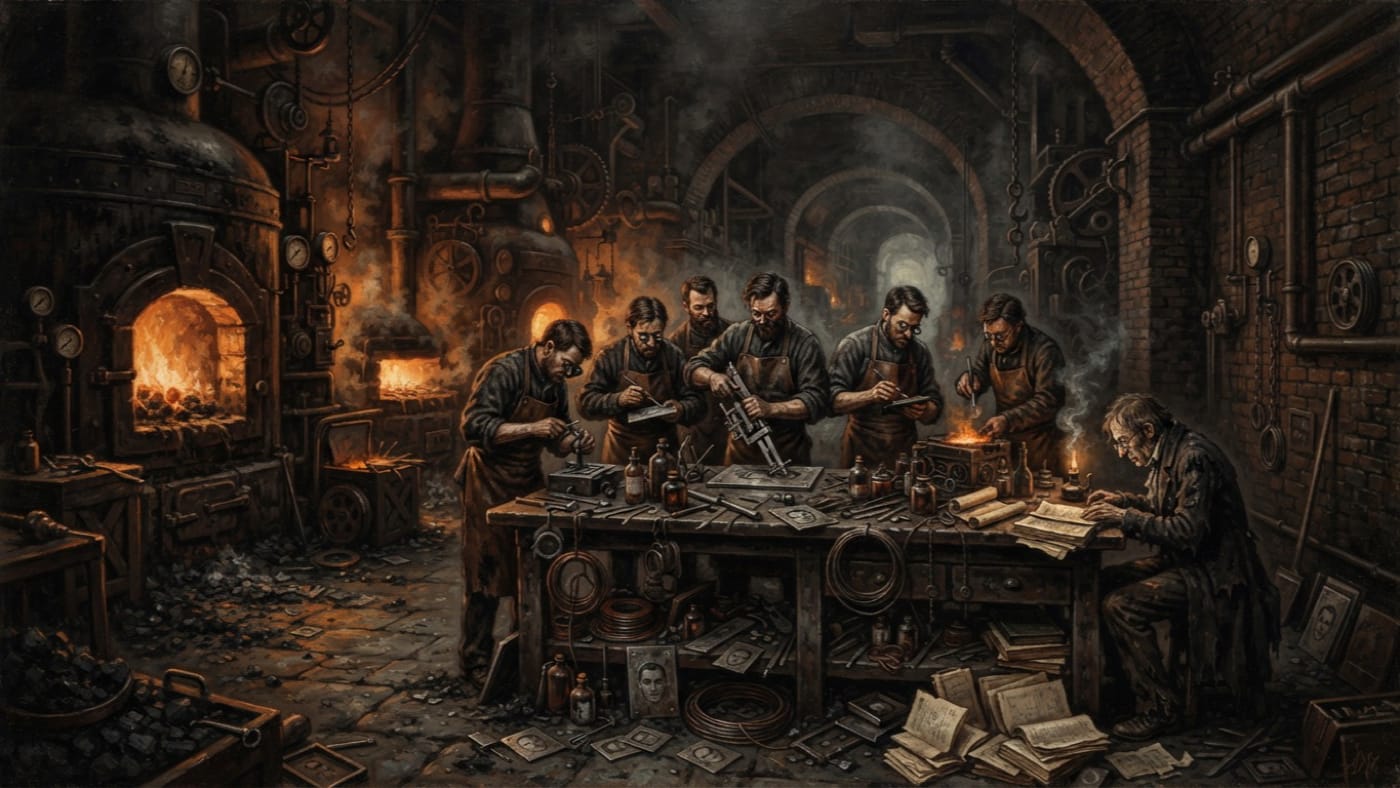
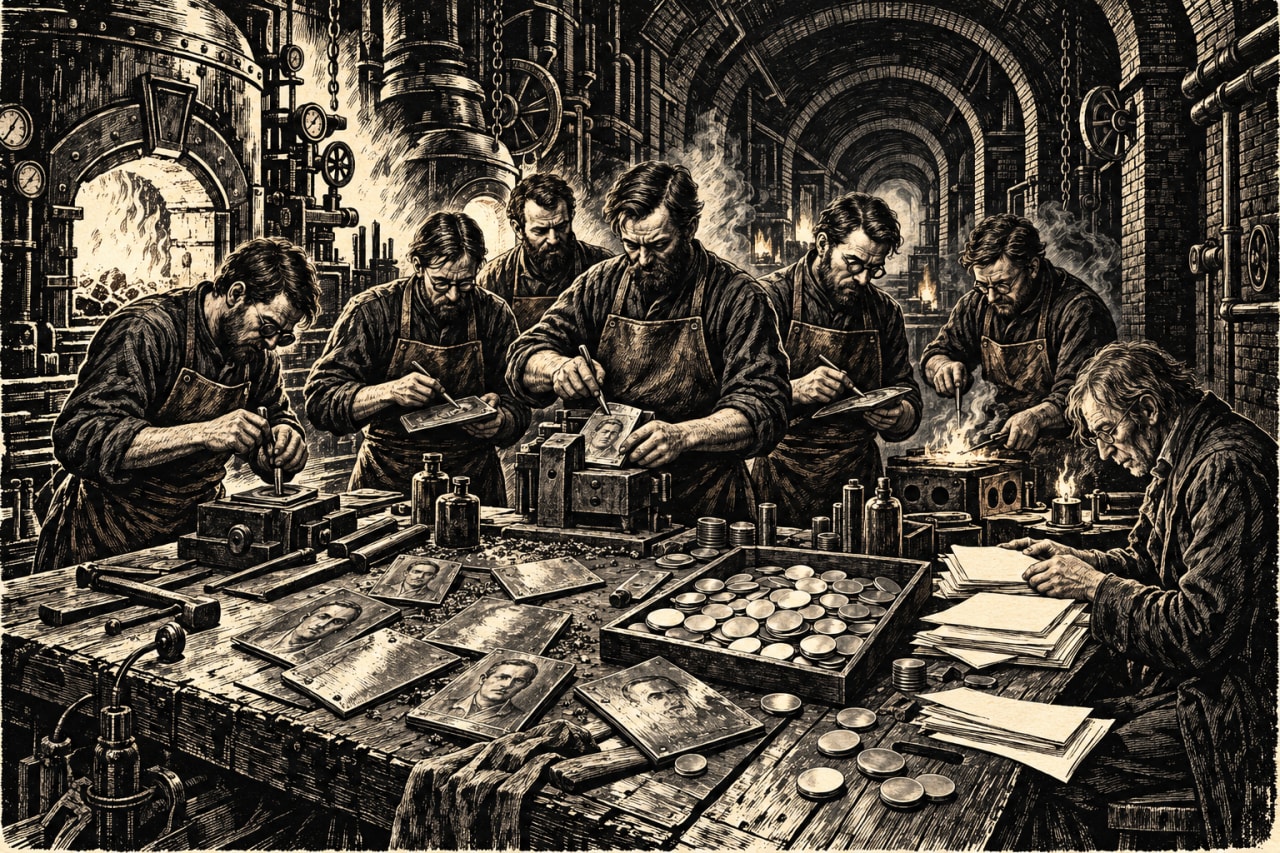
According to the files of A.S. 201, the Unface Society is seven people in a hot hole. The published reports describe six engravers and one disgraced archive scribe working out of the furnace tunnels beneath the Anneal Courts of Sable Court, the walled mint quarter in Cologne's south. I have that count from reports. I do not have a membership roll. Nobody has sent me names, the benches the engravers came from, or any account of what the scribe did to earn the disgrace. Heresies usually leave these things lying about for their prosecutors. This one has not. Nothing on file says when the cell first met, who brought in whom, or which tunnel they use.
The Society has declared two things. It wants the Face Registry abolished, and it claims responsibility for the Face Theft.
The Bureau of Purity accepts the first declaration as a fair statement of what the Society wants. It doubts the second. Purity does not believe six engravers and a scribe could have produced a contamination this sophisticated and this widespread. This dossier is built around that doubt, and I will not settle it by temperament in either direction.
#On the Registry They Would Destroy
The thing the Society wants to destroy was built in A.S. 94, four years after the Concordat of Strasbourg. That year Mint-Prelate Albrecht Sable bound the old Crownwright Guild to Synodal authority and founded the Mint-Chapter. Crownwright hands cut the dies, and the Chapter licensed the strike. Records tied each face to its number in the Great Ledger. Tithes taxed what came out. Doctrine then found, as it always finds, that the Creator had wanted all of this from the start. In A.S. 102 the Face Archive was put under triple lock. From then on, every face struck into coin had a master plate there, filed against its Ledger number.
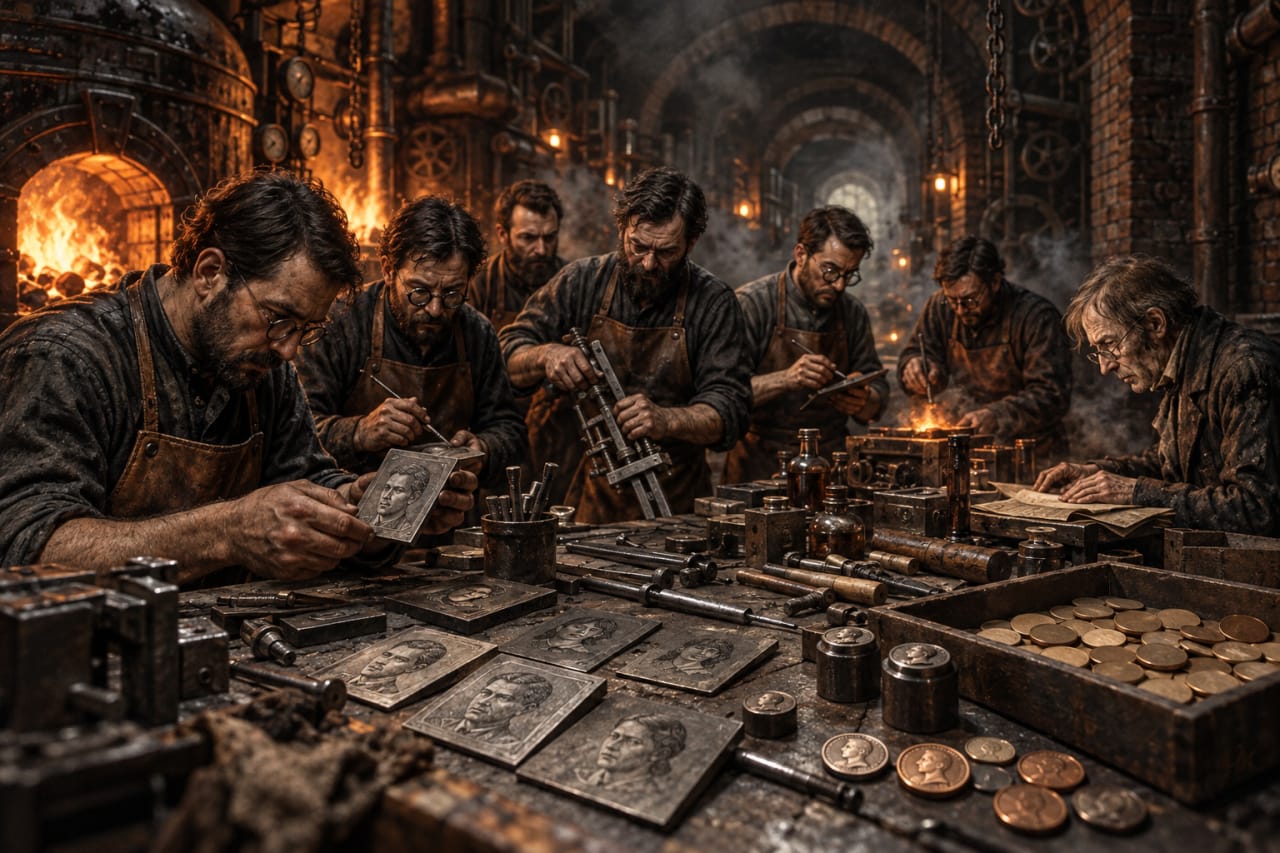
The plate is the reference. The die copies the plate, and the coin carries the copy out into the world: the wage purse, the poor-box, the bread seller's tray, the offering plate at Mass. People learn faces by handling the coins. Because they have held a face in copper, a merchant knows his customer, a landlord his tenant, a magistrate his witness, and a child its father. Recognition makes a face usable. It draws wages, holds a lease, buys bread, carries a debt, and gives testimony that a court will accept.
Losing a coin costs you nothing, because coins are struck in batches. The danger lies in the standing of the face itself. A facehold freezes all exchange under that face while it is reviewed. A recall takes a disputed face out of circulation. Unfacing removes its plate authority altogether. The Crownwrights call the person left behind an unface. The Society's name is built from the same word. Whether they meant it as a boast, a lament or a joke, they have not written in to say.
People who have been unfaced do not disappear. They stand in their own doorways while the household argues, with growing fear and shrinking certainty, about whether they ever lived there. Merchants stop halfway through a sale, unable to remember who sold them the salt. Witnesses lose the faces of suspects. Doctrine classified this in A.S. 194 as a Category Two Localized Identity-Scribal Anomaly. It described the ordinary bond between coin and memory as "theologically adjacent to the reliquary effect." That phrase is Doctrine's reading of the bond. It does not explain how the bond works, and nobody else has explained it either.
#On Identity Released from Metal
As the Chapter's files record it, the programme has three parts. Every plate in the Archive is to be destroyed. The Theocracy is to be flooded with faceless coin. Identity is to be released from metal. Doctrine has classified the aim as "theologically terminal." That classification at least describes accurately what the Society wants to end.
I set out the promise fairly because it is attractive, and attractive heresies are the ones that fill tunnels. If there are no plates, there can be no recall. A face that was never filed cannot be put under facehold. A widow whose husband's face has been suspended could buy bread on her own merits, and no clerk could unmake a man with a signature and a red slip. Anyone who has stood in a recall queue outside the Gate of Assay will find something here to love. That includes a good many people with no taste for heresy.
Then think of the bread seller. Today she reads the face on the coin, checks the assay slip and hands over the loaf. Under the Society's plan she has nothing to read. She will have to judge the customer some other way: by his accent, his parish, his neighbour's word, or a Warden's list. When the plates melt, the need to recognise people does not melt with them. It goes looking for some other instrument, and the Synod owns a great many instruments. A city that takes its faces off its money will still identify people. It will do it by other means, and those means are cruder, slower and more personal.
Then there is memory. The reported effect of unfacing is that people stop recognising each other. The Society says that coin with no face at all would set recognition free. It has not shown this, and there is no faceless district anywhere for me to inspect. Nobody has demonstrated that a city full of blank metal would remember its neighbours better than a city whose faces were taken away one at a time. Possibly it would. Possibly the whole of Cologne would forget its brothers in a single season. The emancipation the Society offers is a claim. It is the same kind of paper as its claim of authorship, and I file the two together.
#On the Claim of Authorship
The Face Theft began in A.S. 199. Citizens in Cologne's outer districts found that the faces on their own coins had gone wrong. In the reported cases, a wife's coin carried her husband's jaw under a stranger's eyes, and a merchant's coin carried a face he had never seen and could not stop remembering. The Mint Tribunal's record shows more than four hundred complaints in three months. Within six months the complaints stopped, because the people complaining could no longer remember what their faces had looked like before.
The Chapter recalled seventeen denominations. Die Row went to triple shifts and the presses ran all night. The hymn-timing slipped twice, and two batches came out bearing faces that neither the shift choir nor the Assay Cloisters could name. Under the Amber measures now in force, every gate has doubt inspections and the Warden circuits are doubled. The Archive is closed to everyone below Mint-Prelate clearance. Blind clerks in the Cloisters compare the hymn-frequency of each struck coin with its archived plate, without ever seeing the face. Purity has sent an Inquisitor-Assayer to work under File 1104-SC.
These measures respond to the crisis as a whole. None of them has been reported to have caught, traced or stopped any particular act of the Society, and I do not count them as evidence against it.
The claim itself is another matter. The papers I have seen do not say when it was made, how it reached the Chapter, or what its exact words were. They say only that it exists. Heresies claim catastrophes the way minor nobles claim descent from saints. They do it often and hopefully, and the claim is sometimes true. A claim of authorship shows that the claimant wants the deed. It does not show that the claimant did it.
Purity's doubt also has limits, and I will state them so that nobody stretches it. Purity says seven people are too few to account for what happened. It does not say the seven are innocent. It does not say there is a larger organisation, and it has named no other operator, no network and no patron. The Mint-Chapter's own account blames the Clipped Choir for part of the damage. That only shows the crisis had more than one pair of hands in it. It does not show that the Society had any.
The file can be read three ways. The Society did some of the damage and claims all of it. The Society did none of it and claims all of it. Or the Society is the visible corner of something nobody has found. The record supports none of these over the others, and I decline to pick one because it suits the reader.
The Codex assessment of the Crownwright Diehouses of Sable Court, countersigned by this office, states that the Society's method is not technically impossible because "there exists" a master die, cut before the Compact, able to overwrite the Archive's concordance.
Corrected. The existence of the master die is not established. The Mint-Chapter has denied it in four depositions, and those denials prove only that the Chapter denies it. A few paragraphs later the same assessment asks whether the die is myth or hardware. That question is the one this office endorses. No record places any such die with the Unface Society.
#On the Furnace Tunnels
The Anneal Courts lie south of Die Row. Their yards of black brick heat each batch of metal twice. The first heat softens raw blanks so they will take a die without splitting. The second tempers the struck coin so that its face survives a lifetime of thumbs. Underneath lie the furnace tunnels: flues, ash-pits, coal ways and older brick passages that nobody has properly mapped. I have no plan of them and I will not draw one. Neither the location of the Society's chamber, its entrance nor its escape route has been reported.
Every blank that goes into the first heat is faceless metal, and lawfully so. Blanks crack, scale and warp in the fire. By law each ruined blank is logged, weighed, sealed and sent back to the melt in front of a witness. The gap between trays counted in and trays counted out is entered as furnace loss, and that is the richest line in Sable Court's accounts. Under the Amber orders of A.S. 201, any faceless blank found outside the process must be surrendered within one bell. Every shift ends with a clean-hand inspection: palms up to the mirrored glass, nails scraped over felt, mouths opened.
Being able to take metal is not the same as having taken it. Furnace tenders, tray-bearers, acid runners and penitents serving out debt warrants handle faceless metal for eleven hours a day. That makes them labourers, and it makes none of them Unface. A missing tray points to a thief. It does not point to any particular thief.
The Clipped Choir is a separate creature. By A.S. 187 it held the mouths of the furnace tunnels, where stolen trays of ruined blanks cool in the dark. It also works the canal basements and the shadow stalls of Clipper's Market. The Choir makes its living from the Registry: a face-swap is worthless in a city where faces mean nothing, and every clipped edge depends on a lawful one. The Society wants the Registry destroyed. Both work in the same tunnels, but the record shows no alliance, shared command or common membership. The Choir's presence in A.S. 187 dates the Choir. It does not date the Society.
#On Purity's Doubt and the Master Die
Here is the mismatch stated plainly. On one side are seven reported people. On the other is a contamination spread across Cologne's outer districts, with hundreds of complaints, seventeen recalled denominations, faces that changed in their owners' pockets, and memory failing in whole households. Somebody has to explain how the first produced the second. The Society has explained it with a declaration, and Purity has rejected the declaration.
Two objects have to be kept apart here, because Sable Court's clerks blur them whenever blurring helps. A master plate is the Archive's reference for a single lawful face. There is one for each registered person, kept under triple lock. The master die is something else. By report it is a steel cylinder cut before the Compact, bearing no face and every face, and able to overwrite the Archive's concordance simply by circulating. The accounts say a coin struck from it carries no stable identity. They say that whoever handles such a coin feels their own face loosen: it drifts on the ordinary coins in their pocket, shifts on its plate, and stutters in the Ledger. All of this is attributed. The Chapter denies the die exists. Its security measures prove that it is frightened. They do not prove the die is real.
Supposing the die existed, the Society would want it more than anyone. An instrument that dissolves the Registry coin by coin matches the programme almost word for word. But nothing in the record shows the Society holding it, making it, testing it, finding it or using it. Wanting a weapon does not put it in your hands.
The mechanism remains unknown. Doctrine's phrase about the reliquary effect covers the lawful bond between face and memory and nothing beyond it. No report explains how a coin could move a plate locked in another building. In the audit of A.S. 187, three Archive plates were found altered overnight. That was twelve years before the Face Theft. Nobody has connected the alteration to the Society, and I will not connect it either.
I have written elsewhere that Purity is right. I hold to that. Purity is right about how big the suspect is. How big the crime is remains an open question.
#On the Present Compilation
As of this compilation, A.S. 201 or 1911 CE, the position is as follows. The Unface Society is a cell reported to consist of six engravers and a disgraced archive scribe, working from the furnace tunnels beneath the Anneal Courts. Its programme is the destruction of the Archive plates, the circulation of faceless coin, and the release of identity from metal. It claims responsibility for the Face Theft. Purity doubts the claim. The investigation under File 1104-SC continues. The Archive remains sealed and the quarter remains at Amber.
No arrest is recorded here, and no raid. No member has been named in any paper sent to this office, and no tunnel has been mapped. No faceless district exists to show whether the Society's promise would free anyone or only teach Cologne a new way to forget. When the Society was founded and when it made its claim are not recorded. I leave both blank, because a blank on the page is more honest than a date I made up.
Doctrine once called the Society's method technically impossible. This office has withdrawn that finding and put nothing in its place. Doctrine still calls the aim theologically terminal, and that classification stands.