

#On the Southern Commission
In A.S. 191 the Bureau of War authorised a third Vigil Ark for the Constantinople theatre. I have read the authorisation twice and found nothing in it to correct. War's correspondence rarely gives me that experience, so I record it here for the benefit of future auditors.
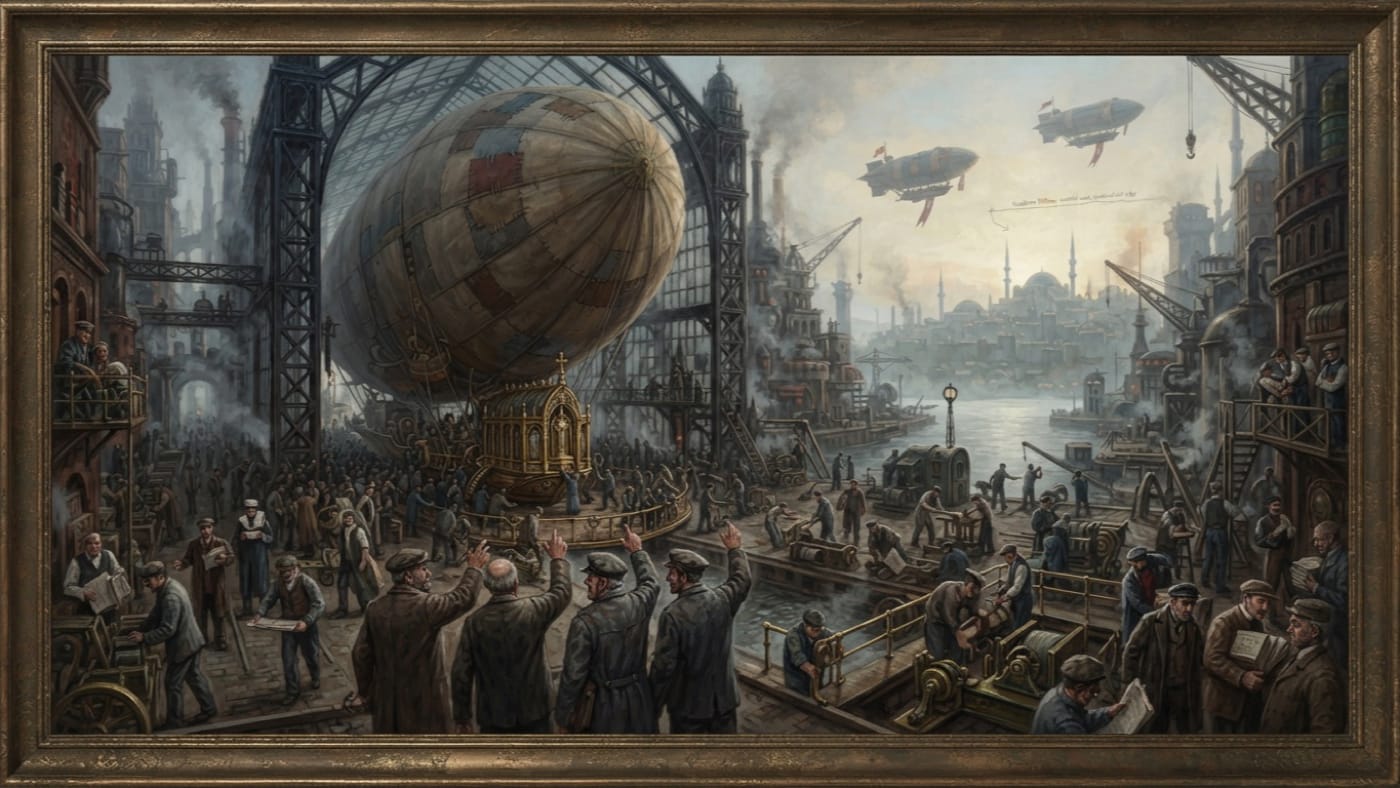
Bastion-Constantinople is the southern anchor of the Line, the last lock at the Bosphorus. By A.S. 191 two Arks already kept its sky. The Saint Barachiel had held the central corridor above the strait since A.S. 168. The Saint Gabriel had flown the northern Black Sea approach since A.S. 182. Both faced the enemy. Neither faced the city's supply. Shell-cases in straw, flour in tarred sacks, lamp-oil and drafts of young men come up from the Aegean by coastal lane and harbour road, and the air above them had no assigned sermon.
The Southern Bellway was drawn over that traffic, running from the Bosphorus mouth toward the Aegean approaches. The new vessel was to be its guardian. The register entered it as the Vigil Ark of Saint Uriel, third of three, and the Constantinople fleet took on the strength of three hulls on paper. In the air it still had two.
#On the Tooth and Its Certificates
An Ark is a cathedral given lift. Gas fills the envelope, and the Compound 7 issued for the Saint Uriel met specification at every attempt, a point the gas-clerks raise whenever anyone looks at them. Gas alone does not make an Ark operational. The relic in the gondola chapel carries the vessel's ascent and its sermon. An envelope without a saint is a balloon, and the Synod does not commission balloons.
The relic chosen for the southern commission was a tooth attributed to Saint Uriel. It was bought at considerable expense from a dealer in the relic quarter of Marseille. The receipt describes it as an upper molar, with angelic class uncertain and saintly attribution probable. I hold these qualifiers in some esteem. They are the most honest words in the file, and they were written by the vendor.
The Bureau of Relics authenticated the tooth before installation. It was carried to the Carrier Yard in the Foundry Quarter, set in the chapel reliquary and sealed. The Ark was assembled and consecrated in the Yard. Each office then certified the part of the vessel within its competence. The Bureau of Engineering certified the hull and its apparatus as sound. The Bureau of Rites certified the consecration as valid. The Bureau of Relics had already certified the relic as genuine.
Each certificate is correct. I have examined all of them and would sign any one under oath. Taken together, they amount to a declaration that the Saint Uriel was ready to fly.
#On the Four Attempts
The Ark was launched four times in A.S. 191. On some attempts it rose a few feet off its cradle, stayed there a short while and settled back. On one it did not rise at all. On none did it hold the air long enough to be entered on a patrol return. Dockyard men who say the Saint Uriel never left its cradle are wrong, and the artificers correct them sharply because the trim tables are theirs to defend. Dockyard men who say it never flew its patrol are right, and nobody corrects them.
Every office treated each failure as an error in its own department. The vessel record gives the sequence. After the first attempt, Engineering found fault with the envelope trim and corrected it. After the second, the Bureau of Bells retuned the Sermon-horns. The third attempt produced no lift whatever, though the envelope held pressure, the gas was in order and the chapel lamps burned steadily. Rites then re-consecrated the chapel. Each correction was followed by a new certificate, so the file grew thicker after every attempt that failed.
After the third attempt the Bureau of Relics issued a memorandum. Its conclusion reads, in full: "The relic is genuine. The relic's behaviour is the relic's concern." I have heard this called evasion. It is jurisdiction. Relics certifies what a relic is. No form in any Bureau certifies what a relic will do, and Relics declined to invent one in the middle of a launch review.
The fourth attempt was made later in A.S. 191 under restricted attendance. The public record says the Ark did not achieve sustained flight. Any further observations of that attempt are held under seal, and my office does not paraphrase sealed material for the convenience of readers.
Dockyard summaries attributed the grounding to a counterfeit tooth and to a Marseille transaction compromised by Velmoran agents.
Withdrawn. The Bureau of Purity examined the relic and found no Velmoran signature. The tooth stands authenticated. The Bureau has named no culprit to replace the withdrawn one, and this entry names none either.
#On the Uncovered Bellway
The Bureau of War does not concede that the south has a gap. It funds measures to fill one. These two positions are budgeted separately.
Ground guns on the southern harbour defences cover the near water and the fog as far as a gunlayer can see into it. Naval patrols work the coastal lanes. When the wind permits, the Bureau of Bells extends the Saint Barachiel's sermons southward, stretching the strait-guardian's voice over water it was never assigned to bless. When the wind sits wrong, the extension is struck from the schedule and the convoys have only their harbour bells.
The south is therefore defended. What it lacks is the scheduled pass of its own Ark along its own corridor, made whether or not anything has yet come out of the fog to justify the trip. A gun answers what it sees and a cutter answers what it meets. A borrowed sermon arrives when the wind allows and leaves when the wind changes.
The convoy captains noticed first. Some now ask for northern routing even when the northern water is worse, and a captain who chooses the worse sea has given the most candid assessment of the Southern Bellway on file. The boom-wardens noticed next, hauling chain across the harbour mouth under a strip of sky that is charted, scheduled and assigned to nothing that flies.
#On the Pending Finding
Ten years on, in the A.S. 201 survey, the Saint Uriel sits at the eastern end of the Carrier Yard. Its drydock was built for harbour patrol vessels and adapted for an envelope. The Ark is complete, consecrated and maintained on a quarterly schedule. Artificers polish brass that has never been out in weather, oil winches that have lifted nothing and test the Sermon-horns against harbour smoke and gulls. The tooth is in the chapel under Relics seal. The register still lists the vessel against the Southern Bellway.
The dockyard has made its own arrangements, which belong to later years than the crisis. Petitions began to collect under the cradle struts. In A.S. 194 the Bureau of Purity classified the practice as low-risk dockyard sentiment, and in A.S. 197 it upgraded the classification to monitored. The workers speak of the tooth's refusal. So, on occasion, do I. That is our interpretation. It is not a Bureau finding, and no office has explained why a sound hull with valid rites and a genuine relic will not hold the air.
Every office has ruled within its jurisdiction. The Saint Uriel remains assigned, the corridor remains without its Ark, and the classification entered in A.S. 191 has not been revised.