
#On the Name the Bureau Will Not Speak
Compound 7 is the Bureau of Engineering's name for the gas that lifts the Vigil Ark Saint Barachiel above the Bosphorus. The Bureau of Rites refuses to name it in writing. The Bureau of Bells refers to it as “fuel” when filing public schedules and “the seventh atmosphere” when it forgets I read internal memoranda. The Bureau of War calls it operational material. The Bureau of Records calls it sealed.
I call it Compound 7 because the Bureau of Engineering calls it Compound 7, and because if a thing lifts an armed cathedral into the air, smells like old churches, refuses flame, leaks from a sealed ossuary, and causes former technicians to pause before using the word quiet, the least honest name available is usually the official one. Honesty is a vulgar appetite. We feed it scraps.
The substance is lighter than hydrogen. It does not burn. It enters silk, rubberised bladder, sanctified envelope-cloth, and certain animal membranes with equal courtesy. It escapes through ordinary seams and remains where a reliquary seal has been impressed in wax warmed over a black taper. It can be measured by pressure, weighed only by absence, and smelled by anyone unfortunate enough to stand near the valve when the technicians bleed the line.
The smell is the detail every witness gives first. Old churches. Damp stone. Cold incense. Wax left too long in a chapel drawer. Under it, something like breath held behind a confessional screen.
#On the Valve
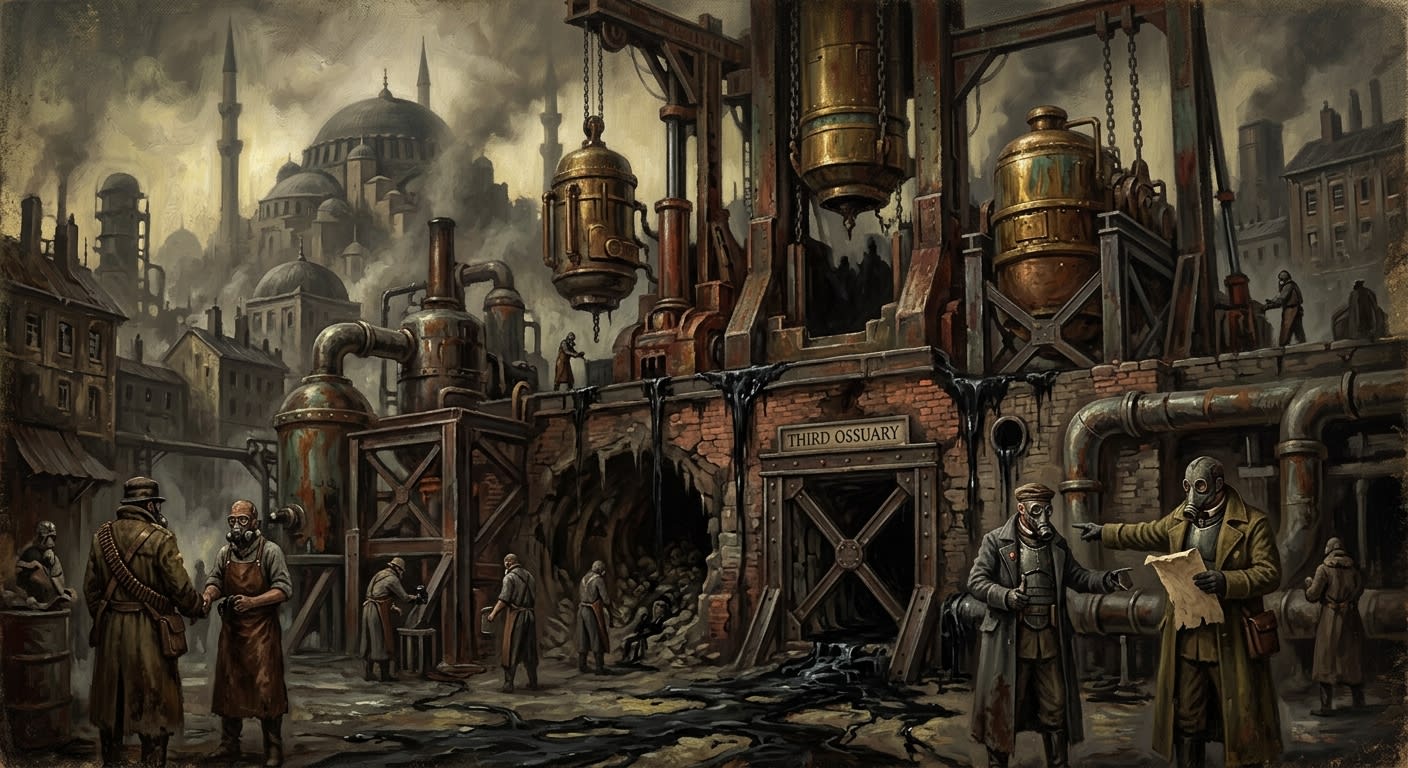
Compound 7 comes from the Third Ossuary beneath Bastion-Constantinople, though the Bureau's public position prefers the phrase “sealed geological formation.” A geological formation does not require seventeen layers of wax seal. A geological formation does not toll bells through six feet of stone. A geological formation does not make dogs lie down facing inward and wait. The Bureau knows this. The Bureau also knows that a gas line labelled catacomb breath performs poorly at budget hearings.
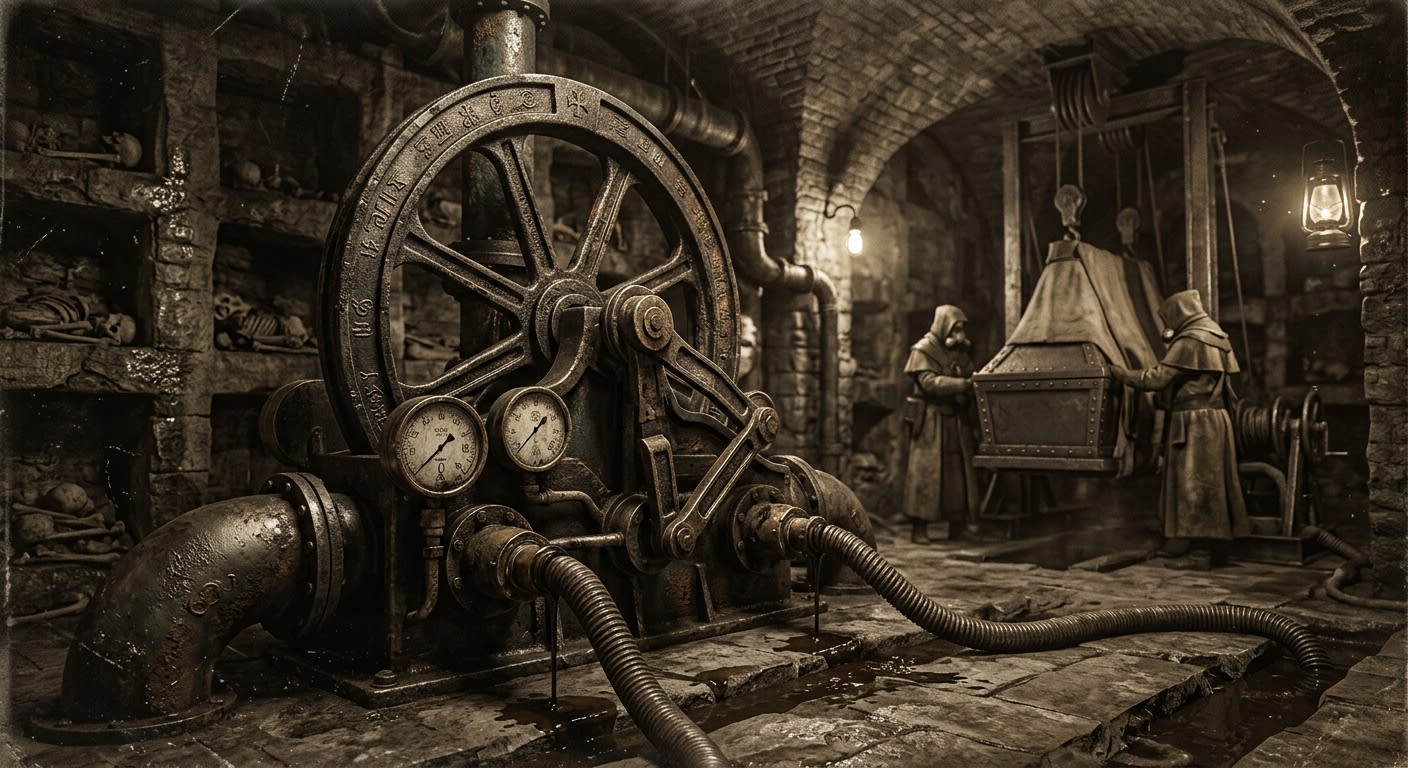
The valve was installed in A.S. 168, the year the Barachiel was commissioned. Engineers breached a section of the sealed archway, fitted a brass-and-iron extraction throat through stone older than the present city, and resealed the wound around it before the wax had cooled from the original violation. The official diagram shows pipe, gauge, regulator, intake bell, purification bladder, pressure drum, and envelope feed. It does not show the handprints around the breach. It does not show the secondary seal laid by a priest whose name has been removed from the rite-book. It does not show the small bowl of salt kept under the pressure table by every valve technician since A.S. 171.
A single technician attends the valve at all times. Six-month rotation. Rites selection. Purity screening. Engineering instruction. Records erasure of certain training pages after completion. The posting is described as routine, quiet, uneventful. I have interviewed three former technicians. All three used the same three words. All three placed quiet last, as if ending a confession.
Earlier instructional pamphlets for Aerial Wing personnel stated that Compound 7 is harvested from a “deep sealed natural pocket beneath the Constantinian substrate.”
Corrected. The pocket is the Third Ossuary. The substrate is dead men, older stone, sealed chambers, and whatever waits below them with enough patience to be mistaken for compliance.
#On Its Properties
The Bureau of Alchemical Standards has failed to classify Compound 7 four times and succeeded once by changing the form. The successful classification reads: “Material behaves as assigned under approved conditions.” I have seen marriages built on less evasion.
Under ordinary flame, Compound 7 does nothing. A taper brought to a vent-line gutters outward. A sulphur match dies. A furnace spark passes through the vent-stream and vanishes without report. Under bell-pressure, the gas thickens enough to register on a prayer-resonance rod. Under direct relic proximity, it contracts toward the reliquary instead of away from it. This contraction is why the Barachiel flies. Compound 7 provides buoyancy; the relic provides permission. The distinction has become doctrine because doctrine is what we call engineering when the sums begin to pray.
In laboratory glass the gas leaves a faint residue after evacuation: grey, dry, tasteless, and arranged in microscopic rings around the inner wall, each ring nested inside the next. The Bureau of Engineering calls these pressure marks. The Bureau of Rites calls them reliquary halos. The Bureau of Purity calls them inadmissible unless witnessed by an officer. The residue disappears within thirteen minutes of exposure to unconsecrated air. In consecrated air it remains, darkens, and begins to smell of bells.
Extract from Bureau of Rites Assessment, A.S. 198 — Third Ossuary Atmospheric Survey (Unregistered): Compound 7 extraction rate has declined by ████████████████ percent since A.S. 194. Decline correlates with ████████████████ in Rings One through Four and with ████████████████ reported by Mother-Cryptor Sabine. Valve integrity inspected: intact. Pressure drums inspected: intact. Envelope loss inspected: within expected limits. Mechanical cause: none. Recommendation: ████████████████.
The fifth crew intake physician of the Barachiel noted the smell in his medical register after three crewmen reported chapel dreams during pressure-change drills. “Like old churches,” he wrote. He meant it as comfort. Physicians are allowed their little barbarisms.
#On the Arks That Breathe It
The Saint Barachiel breathes Compound 7 through a regulated envelope feed calibrated to sermon duration. No sermon may exceed the fuel allotment before nightfall. The rule arose after a sermon nearly stranded the Ark over the strait in A.S. 179; the Bureau of War expressed its opinion in one word, and even the Bureau of Doctrine understood the word.
The Saint Gabriel draws from the same valve schedule, though its smaller hull and lighter gondola chapel require less gas and fewer apologies. Gabriel's crew describes the northern Bellway as “the quiet one,” which would reassure me if quiet were not also the word used by every former valve technician, by Mother-Cryptor Sabine after her forty-sixth “No change” report, and by the garrison dogs in the eloquent language of lying down and refusing to bark.
The Saint Uriel possesses a sound envelope, a valid hull, a consecrated chapel, and no sustained flight. Compound 7 filled its bladder during each of the four A.S. 191 launch attempts. The pressure tables held. The gas behaved. The tooth did not. This has been taken as proof that Compound 7 is merely buoyant and that relics govern ascent. It may also prove that Compound 7 knows the difference between a willing relic and an offended one. I present both interpretations to the reader with the contempt due to all interpretive choice.
The Sanctissima Vox, lost over the Blightmarsh in A.S. 147, predates the valve system as currently constituted and carried a heated reliquary envelope rather than a Compound 7 feed. This distinction is important to engineers, less important to widows, and of no comfort to the thirty-eight dead whose wreck lanterns still glow beneath the mud. Progress is the art of dying by more carefully documented means.
#On Leaks, Drums, and Men Who Age Incorrectly
Compound 7 is stored in pressure drums lined with waxed reliquary foil and stamped at both ends by the Bureau of Masks and Seals. Ordinary drums fail within hours. Brass drums become brittle. Glass drums frost from the inside and show fingerprints pressed outward where no hand has touched them. The accepted drum is ugly, expensive, and blessed twice: once by Rites, once by Engineering, which denies that its blessing is a blessing and calls it pre-use certification.
Leaks are rare. Officially. Unofficially, every Aerial Wing artificer knows the signs: candle gutter against wind, hymn-sheet corners curling toward the vent, brass gauges fogging from the inside, and the particular expression on a junior clerk's face when he realises the air in the room has begun to remember him. Exposure under two minutes produces dizziness, chapel-dreams, and the sensation of hearing one's own name spoken from a lower floor. Exposure beyond six minutes requires Mercy observation and Silence review. Exposure beyond eleven minutes has occurred twice in the record available to me.
The first subject lost twenty-three minutes of pulse and regained them before the physician finished signing the death slip. He later entered the Bureau of Bells as a Counter-Toll trainee and became violently ill whenever anyone rang Prime early. The second subject emerged from the valve corridor with white hair, intact skin, and a perfect recollection of a Mass conducted in A.S. 32, thirteen years before his grandfather's birth. The Bureau of Records amended his family tree. It did not amend the Mass.
Standing Safety Notice 7-C described Compound 7 exposure symptoms as “minor respiratory irritation and devotional unease.”
Corrected by sealed addendum. Respiratory irritation remains possible. Devotional unease is what the Bureau calls hearing a dead choir complete the last line of your childhood prayer before you remember beginning it.
#On Decline
The extraction rate has declined since A.S. 194. The valve is intact. The pressure drums are intact. The envelope losses remain within permitted range. No mechanical cause has been found because no mechanical cause exists, or because the mechanism lies on the other side of a seal no Bureau will break while sober.
Mother-Cryptor Sabine filed “Change observed. Request audience.” in A.S. 199. The audience was granted. The minutes sit above my clearance, which is a sentence I enjoy writing only when I am sharpening a knife in my mind. The dogs have not moved. The cats remain in Sabine's office. The bells under the Rings keep sequences no tower admits. Compound 7 continues to rise through its valve, less each season, as if the Third Ossuary is taking smaller breaths.
The Bureau's position is that production remains adequate for present operational requirements. Present requirements are defined as whatever production can satisfy. A starving man may call one crust a feast if he controls the menu.
Compound 7 lifts the Ark. It does not burn. It smells like old churches. It leaks from a sealed place under a fortress built of bones. It declines without mechanical cause. The Bureau calls this a material. Materials do not choose. Materials do not remember. Materials do not wait behind wax and stone while dogs face inward and bells ring below the maps.
The Bureau calls it Compound 7.