

#On the Circular's Prescription
"Seal room, douse thresholds in lime, recite Vigil of Saint Ephrath, and do not inhale visible particulate." — Eastern Chaplaincy Circular, A.S. 200
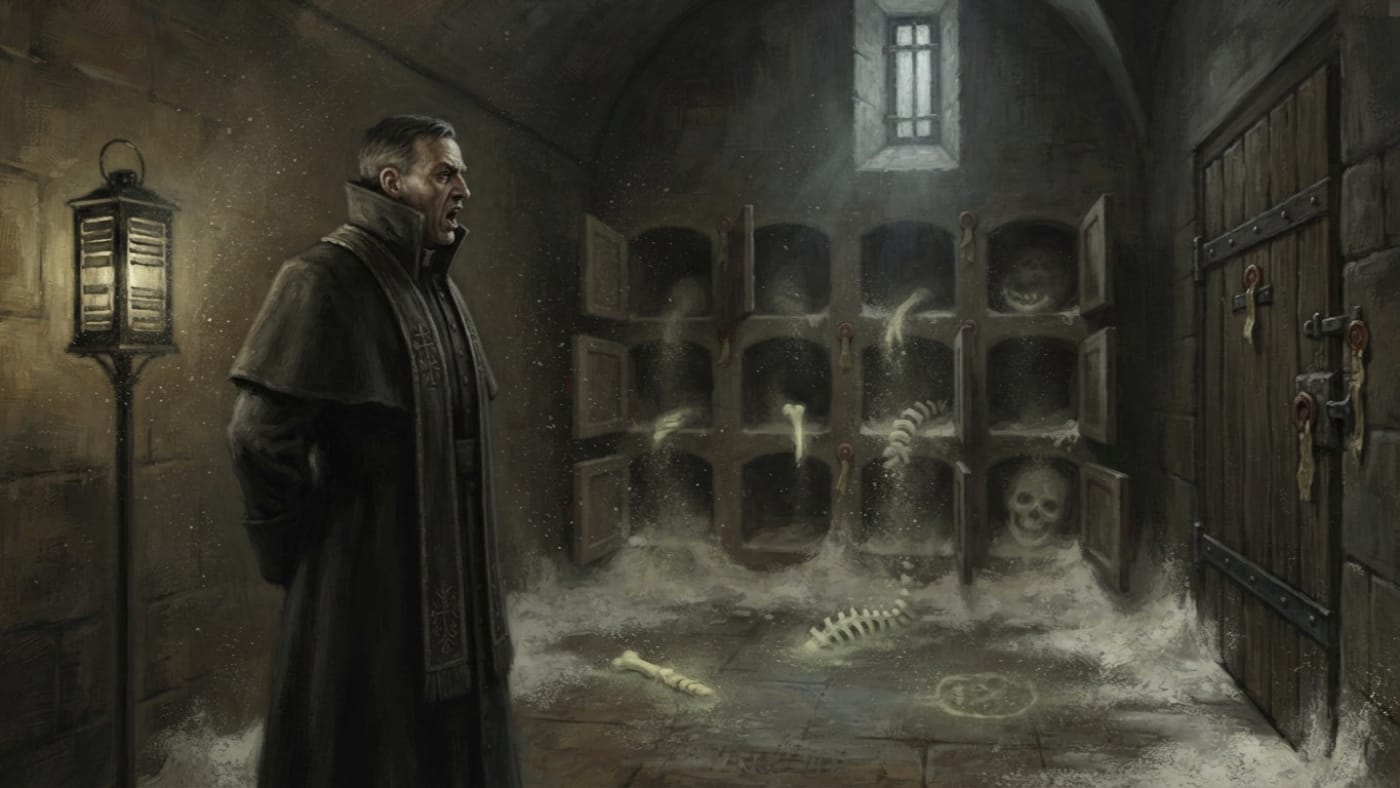
The Vigil of Saint Ephrath is a named recitation, and the Ledger holds exactly one order to perform it. That order appears in a field advisory of the Eastern Chaplaincy, circulated in A.S. 200 (1910 CE). It applies to one circumstance only. A certified batch of saint-dust from the Saint-Dust Cooperage of Mournwater has caused the secondary reduction of remains, so that a body already dead and decently buried has gone to powder. The circular tells the chaplain present to do four things. The third is to recite.
I reproduce the advisory as I first filed it under Crumble-Wrong. It names the Vigil. It does not print it. The text did not come to my desk with the circular, and I have found it nowhere else in the folios I consulted. The record gives no words, no composer and no date of adoption. It gives no length either, and no rubric telling the reader whether to kneel, stand, or keep one hand pressed against the door. The circular assumes its readers already have the text. The Warden of the Sacred Ledger does not have it, and he will not compose a prayer to fill a gap in another office's paperwork.
A.S. 200 anchors this entry because it anchors the only document. It is the year a clerk set the name in type. It does not date the Vigil's composition, and nothing in the circular says the recitation was new.
#On Remains Reduced Twice
The hazard has a file of its own. Mournwater's graders call it Crumble-Wrong, and the Bureaus call it the Irregular Settling Pattern, classified Category Two at Mournwater in A.S. 194 (1904 CE). Note what the category describes. It ranks the anomaly. It does not rank the Vigil, which has never been graded at all.
Sound dust settles into rosary strata under the Grading Hall prayer. Suspect dust hangs. It drifts sideways and gathers into bone shapes: a finger, a jaw, a run of vertebrae. Once a batch has turned it answers to humidity, and the record lists breath, river fog and chapel steam. Applied to the dead, whether to preserve them, sanctify them or seal them in, it can bring the corpse down into a pale and mobile powder.
The southern corridor shipment of A.S. 199 is the case the file returns to. Three casks certified pure reached a garrison chapel that the account does not name. Within hours of application, twelve recently buried soldiers crumbled inside their lime-sealed vaults. Before dawn the sentries found powder gathered at the infirmary door, laid out as four complete rosaries and one further shape that the chaplain refused to describe in writing. The report was filed. The Synod denied receipt, and Mournwater blamed the handling.
Nobody in that report recites anything. The account records casks, vaults, powder, a door and a refusal to write. It does not say whether the garrison chaplain knew the Vigil, said it, or had ever heard the name. The circular follows the shipment by a year. I record both dates and draw no line between them.
The account leaves the motion of the powder in dispute. Chaplains write that the dust seeks breath. The Bureau of Medicine writes that air currents explain it. I enter both claims and certify neither.
#On Lime, Breath, and Recitation
The prescription has four parts, and three of them are material. Seal the room. Lime the threshold. Keep visible particulate out of the lungs. The fourth part is spoken, and it sits between the lime and the breath like a clerk wedged between two quartermasters.
The material measures have a record, and it is not flattering. Lime slows mobile powder without reliably stopping it. Salt breaks some clumps and feeds others. Pitch burned at a threshold drives the powder up into the rafters, where it waits with a patience I would welcome in my own copyists. Sealed-sleep masks hold until the wearer scratches a cheek in a dream and wakes with grit on the tongue. The circular chose lime for the threshold, and the file on lime says slows.
A recitation is made of breath. By every account in the Crumble-Wrong file the dust answers to humidity, and breath is humidity with a vocabulary. The circular does not take up the juxtaposition, so I record it here. I have no finding on whether the Vigil helps, hinders, or merely occupies a mouth that would otherwise be screaming.
The addendum is the finest thing the Eastern Chaplaincy has issued. In eight words it concedes that the instruction above it cannot be obeyed by the eyes alone. A chaplain who avoids every mote he can see has met the letter of the order. He has met nothing else, and the order now says so in print.
A.S. 197 contamination memoranda attributed irregular settling to "improper storage humidity and dockside handling negligence."
Struck as an explanation and kept as an observation. The dust does answer to damp. It does not answer to dockhands, and a crate left out in the rain does not make it lay itself out as a jawbone.
The circular reports no successful performance of the Vigil. It reports no failed one either. In the clerical sense an order is complete once it is issued. Its outcome belongs to another department, and that department has never been formed. The Bureau of Rites co-sealed the joint review of A.S. 200 alongside the Bureau of Alchemical Standards. Neither seal certifies that the recitation does anything at all.
#On the Name of Ephrath
The name on the Vigil has served other trades, and the reader should keep them apart.
The approved Life of Saint Ephrath makes him a deacon of Bohemia, set in Prague during the late Rationalist occupation. Brought before a tribunal of philosophers, he answered their mockery by reciting the Creed and kept reciting until his mouth filled with blood. They nailed a pamphlet to his tongue and he went on. The Life says the pamphlet burned and was not consumed. The Bureau of Doctrine ratified that miracle in the approved form. Birth, tribunal, death, canonisation and feast day carry no dates in the consulted folios.
The Order of Saint Ephrath took his name after his death. It works at public correction. The Ledger first enters its Prague chapterhouse under A.S. 92, and the Order held procession authority by A.S. 94. Neither date bears on the Vigil. The Saint-Dust Salvage crews have a second use for the name. On the Sagittal Line they sing the Receipts of Saint Ephrath to steady their hands in the slurry. The Receipts have their own stanza count, and it stays with them.
The Vigil makes a third use. No source I hold gives the three a common wording, a common author or a common owner, and none says one may stand in for another. The Order does not claim the Vigil. The Chaplaincy that prescribes the Vigil is not named as its author. Nothing in the record has the saint writing any of it.
A deacon who kept on reciting with paper nailed through his tongue makes an obvious patron for words said in a room where the air cannot be trusted. That association is mine. The circular gives no reason for the dedication, and an obvious reason is still not a documented one.
#On Certification and Continuing Hazard
The circular exists because certificates outlive their promises. The southern corridor casks came stamped pure from the White Steps. Their seals were intact and their manifests balanced. Every paper did what paper is meant to do, and twelve dead men went to powder anyway.
Mournwater's defence is the dish. In the Grading Hall, samples rest in shallow glass under the Settling Bell while the hall keeps silent and the graders watch for rosary strata. Second settling, and third settling under Purity witness, are trials of the dust before it ships. They are not stages of the Vigil, and the reader who folds them together has confused a test with a remedy. The settling test is silent and comes before shipment. The Vigil is spoken afterwards, in a room the dust has already entered.
That last clause carries the whole economy. Second settling catches the obvious taint and misses the batches that turn in transit. Supply priority can override it. Casks still go downriver to bastion chapels, field hospitals and trench shrines, because the Line spends sanctity faster than anyone can doubt it. The raw matter still comes down from the Ossuary Shoals, and what lies upstream is a question the joint review has not closed. The living who breathe the dust go to the Crumble Ward with cracked lips, gritty teeth and voices drying to paper. Nothing in the record proves that their end matches what the dead suffered in the vaults, and I leave their files open.
The circular remains the order of record. Seal the room and lime the threshold. Recite the Vigil in whatever words the chaplain was taught, and do not breathe what you can see.
What you cannot see is covered by the addendum, and the addendum names no remedy.