

I've read the continuity reference, the voice guides, the dedicated Steppe Gate lore and the published Gate, Patrol Command and Balesh articles. I'm now writing the prose.
#On the Survey and Its Limits
This survey of the Windwatch Towers was compiled in A.S. 201, which is 1911 CE. That year belongs to the compilation, the paper in your hand. It is not the year the towers were built, inspected or first manned. Nothing I have read gives such a year, and I decline to make one up. The seven stones of the Treaty Ring were raised in A.S. 76, and Records registered the settlement in A.S. 78. Both dates belong to the stones and the town. The towers stand above them without a birthday.
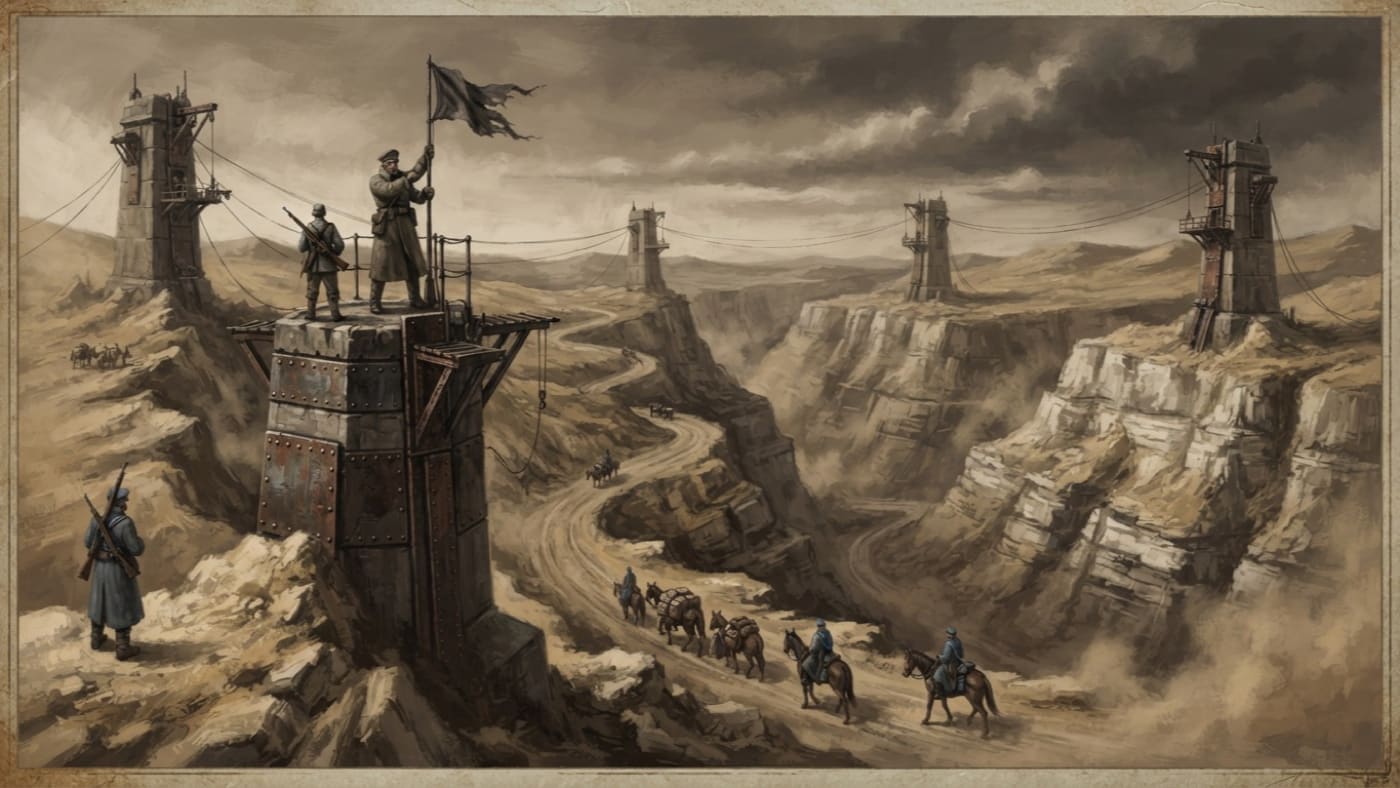
What the files do record is short. There are four stone pylons on the higher cutbanks at the Steppe Gate, looking down on the gap between two ridged walls of limestone. That gap carries every caravan, refugee column and smuggler's mule string trying to cross the Moldavian border steppe. Patrol marksmen and signal-flag operators man the pylons. Patrol Command holds them under Captain Rho Balesh, together with the approach roads below. That is the entire inventory.
The towers are a network, and a network is what I describe here. No source numbers them or gives one pylon a name, a garrison roll or a quarrel of its own. A surveyor with less discipline would issue them as First Tower, Second Tower and so on, each with a sergeant and a superstition. I have seen that done in other provinces. Every such invention costs the reader something later.
#On the Cutbanks and the Wind
The wind in the gap does not stop. Below, it strikes the carvings on the stones and reads the treaty aloud. Up on the cutbanks there is nothing to read, so it just blows. Dust comes off the flats in white ribbons. The exposed limestone is polished as smooth as a bench under a judge. The flags snap loud enough for a man below to hear them over his own mules. The district list gives the towers a smell: oil and dust. The oil is for guns. The dust is everything else.
Lightning is the towers' recorded hazard. The steppe storms strike metal seals first, and a stone post holding iron fittings, oiled barrels and a man with a flagstaff on a cutbank stands about as close to the weather as anything can. The file gives no count of the men killed this way and no account of how the posts shelter from storms. I record the danger and leave its arithmetic blank.
The towers' job is to see. The town's defensive arrangement, as written, rests on three practices: tower sightlines, gully sweeps and Seal-House lockdowns. The marksmen watch the gap and the approaches. The riders sweep the ravines the towers cannot see into. If those fail, the Seal-Houses on Seal-House Row shut their doors under Seal-Mistress Ylena Korr, and the Gate's last line of defence turns out to be wax. The towers come first in that order, and they can do the least on their own. A tower can see a column coming. Stopping it takes a rider, and making the stop lawful takes the Caravan Court.
The documents do not say which pylon sees which stretch of road, where their fields of view overlap, or whether all four can see one another. I have read enough tower-plans from the Sagittal Line to draw a convincing one. That is exactly why I will not.
#On the Two Languages of Flags
The flag operators speak two languages. The first is ordinary military semaphore: approach, halt, column sighted, riders needed in the gullies. Any garrison anywhere uses its equivalent, and nobody would find it remarkable.
According to my published plate on the Gate, the second language carries illicit reroute instructions, bribe schedules and the coordinates for intercepting caravans. On the same authority, the Bureau of War knows about this second language, uses it and denies that it exists. I stand by the plate. I have not re-examined its sources in compiling this survey, and the reader should know where each claim comes from.
Consider what the second language does. A caravan comes onto the approach road with its writs freshly stamped and its pronunciation certificate paid for at a cost greater than all its other papers together. Above it a flag snaps once. The drover takes it for ordinary watch-keeping. In fact his column has been priced. The flag may send him toward the Caravan Corrals by the lane where escort priority is sold. It may hold him on the road until a rider with a blue cord gets there first. The flag never touches him. It only arranges his costs before he reaches them.
"A flag can be read from four cutbanks by any marksman who has learned the secondary language, which is half the garrison." — the compiler's dossier on Captain Rho Balesh.
Withdrawn on two counts. The four pylons stand on the higher cutbanks of a gap formed by two ridged cutbanks. "Four cutbanks" counted the towers and called them ground. "Half the garrison" has no source. It was the compiler's estimate, wrongly presented as a count. How many in the garrison can read the second language is not recorded.
I leave the error in the record, struck through, where any clerk can see it. A survey that hides its corrections ends up in the Gully Market.
#On What Crosses Without a Flag
Three of my own published entries record the same practice, those on the Null Tongue Brotherhood, the captain and the Treaty Office. When a bribe schedule has to cross the Windwatch Towers without signal flags, Balesh's Blue Cords use silent runners. The Treaty Office knows this. The Treaty Office files weather reports.
The reason is obvious once you think about flags. Anyone on a cutbank who knows the code can read one, along with anyone below who has paid to learn it. A schedule meant for one post and hidden from the others cannot go by flag. It goes on foot, through the gullies, and it is passed on with the hands. The captain's dossier says the runners use hand-cant. It is the kind refugees learn in the cellars of the Oath Inns, with signs for toll, patrol, safe, unsafe and running without papers. A bribe needs few more words than those.
No file names a single runner. The cant was born among the Brotherhood after the Red Pronunciation of A.S. 94, and it is taught as discipline: lessons in refusing to speak, cards hidden in hymn books, children trained to answer with their hands before their mouths. The patrol's silence is something else. It is a delivery method. No record makes the runners Brotherhood adherents. No record makes Balesh a member, a patron or a pupil. I have no account of any particular runner carrying any particular schedule along any particular route between the posts. The gullies keep their own counsel.
Nobody should take the method for proof that it is safe. Nothing in the record shows that a silent runner cannot be seen, that his crossing leaves no witnesses, or that silence falls outside the jurisdiction of the stones. In A.S. 187 a Brotherhood null-walker crossed the Ring without making a sound and fell dead at the Fourth Stone. The autopsy found ink in his windpipe, and its verdict was inconclusive. Whether the treaty can hear silence is still an open question. The runners are betting that it cannot, at wages that do not cover the stake.
As for the Office's weather reports, I have not seen them. I do not know what they say. Meteorology is a dignified science. Here it is plainly also the place where things the Office does not want to file get filed. The Office registers protection and records rulings, and it sits in the Gate's governing compact beside the arbiters and the captains. It does not command the towers, and no paper I have read says it does. It watches them the way the Creator watches a sparrow: with full knowledge and no visible intervention.
#On the Present Condition
Patrol sweeps at the Gate have run without pause since A.S. 199. That year a rubbing of the Third Stone vanished from the Burnless Archive, and Balesh answered by changing the sweeps from twice a day to continuous. The rubbing is still missing, and nobody has explained how it went. Whatever the captain hopes to catch on the roads, the towers have not yet spotted it.
The sweeps add work at the posts. Riders in the gullies at every hour must be watched over and must be signalled. The flags have more to say than they did before, and so, by the same reasoning, do the runners. The file gives no figures for this. I offer it as a deduction from the way the arrangement is built, and the reader may weigh it as such.
The rest of the Gate's troubles reach the cutbanks second-hand. The Living Addenda have been coming up from beneath the eastern cutbank since A.S. 194. In A.S. 201 High Arbiter Senn Vark ruled that any Addendum in valid procedural form is binding. I have found no record that an Addendum has altered a tower order or an escort signal. I note the danger and make no claim beyond it.
The towers' real pressure comes up from the road. Caravans feed the town and pay the patrols. Every flag that sets a price, and every runner carrying a schedule, puts something on a drover's bill, and the drovers can count. If the fees climb too high, columns will take the long way round the steppe. The town's own doctrine admits that the Gate needs no siege to fall, because rerouted caravans would starve it on paper. In that case the four pylons would stand above an empty gap, watching wind cross limestone with nobody left to charge.
This A.S. 201 compilation leaves the towers as they stand: four posts, manned, flagged and watching. They are profitable for as long as somebody keeps coming up the road.