
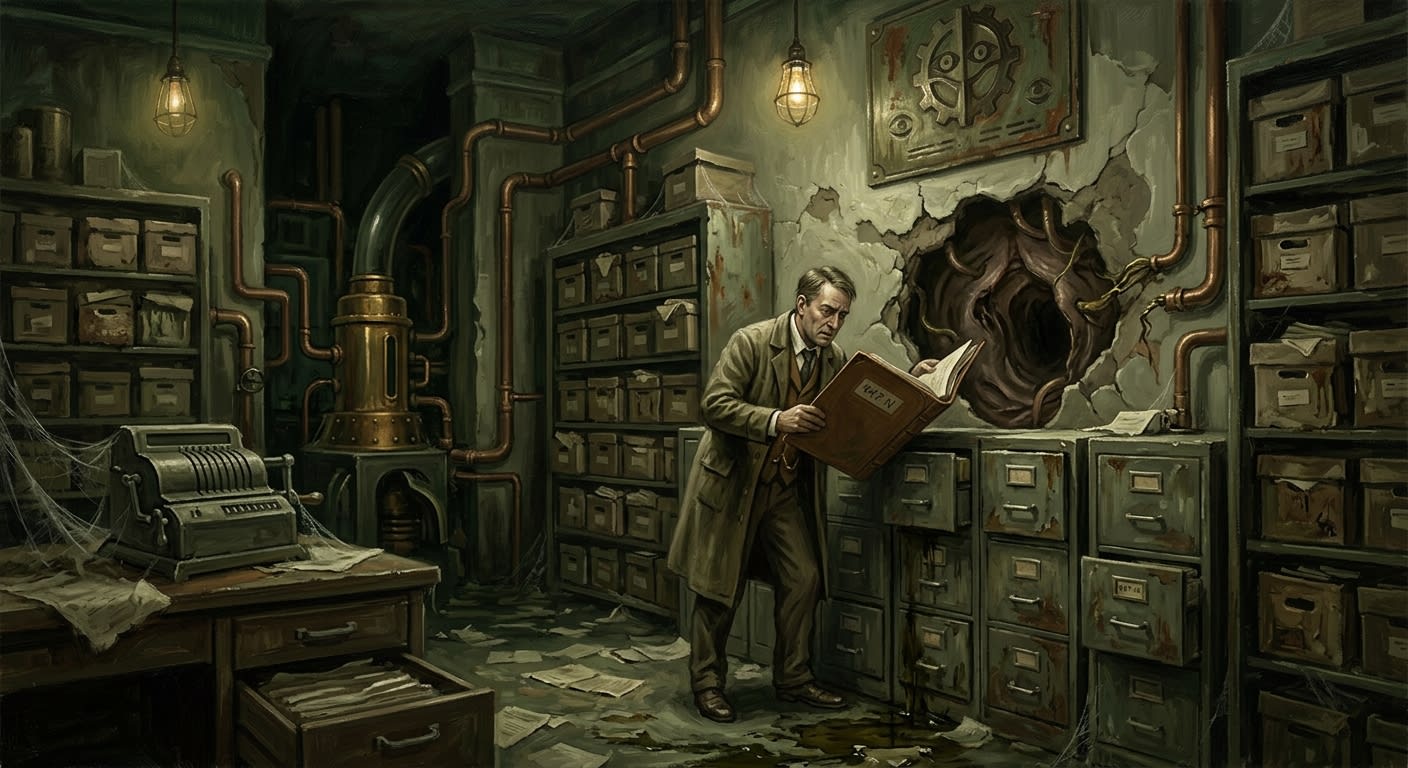
#On the Investigation That Learned to Pend
Investigation 447-N is the Bureau of Bells' northern inquiry into the Fractured North bell noncompliance, acoustic distortion, visual displacement, low-frequency ground vibration, and the humiliating fact that old fjord bells can hold back what Strasbourg's standard tunings cannot persuade to notice them. It began as a harmonisation audit. It became a threat file. It ended, as wise files sometimes do, by refusing to end.
The number has become a superstition in the Northern Office. Clerks lower their voices around it, which is sensible, since the file concerns things that answer sound. 447-N lies between routine correspondence and suppression drawer, between Bells embarrassment and Doctrine paralysis, between the official desire to correct the North and the private fear that the North may be correct already. The Bureau calls it pending. The North calls it southern curiosity that survived long enough to frighten itself.
The investigation was dispatched in A.S. 199 after decades of complaints about pre-Concordat bell sequences, unsanctioned intervals, hand-signal timekeeping, cliff-post silence rules, and Shrine Chapter reports whose margins smelled of seal-oil and defeat. Fourteen northern settlements were selected. Seven produced ordinary noncompliance: wrong peals, wrong hours, wrong feast cadence, wrong obedience. Seven produced records that the auditors sealed before the ink dried.
#On the Cause of Dispatch
Strasbourg does not tolerate an unmeasured bell unless the bell belongs to a powerful ally, a profitable relic, or a jurisdiction far enough north to kill inspectors. The Scandinavian bells enjoyed all three protections in varying proportion for over a century. They rang at their own hours. They used intervals older than the Concordat. They answered clan moots before Priors. They quieted fjords without submitting notation. The Bureau endured this in the same spirit by which a man endures tooth rot during a siege: with irritation, prayer, and avoidance.
A.S. 193 altered the taste of the rot. During the northern sea demonstration, elders from three fjord settlements refused to surrender old tunings and instead rang them against det grå vattnet, the grey water. The water stopped. Bureau observers stopped speaking. Shadows acquired the file with a speed that proves either excellent preparation or prior guilt. Bells demanded another demonstration. The elders declined with the courtesy of men refusing to hand a child a loaded pistol.
The formal trigger came from Hrafnvik and six sister settlements. Priors reported responsive fog, path-prayers returned with altered words, low hums beneath stone, bell intervals that southern gauges failed to capture, and Watch Captains using silence rules without authorisation. The Bureau of Rites wanted liturgical review. The Bureau of Bells wanted harmonisation. Engineering wanted instruments. Doctrine wanted language that made none of this sound like panic.
Initial dispatch memorandum: “Investigation 447-N is a routine review of regional bell-schedule irregularities.”
Corrected under sealed annex after field return. The irregularities reviewed included non-meteorological fog response, ground-borne vibration, anticipatory echo, route displacement, and one instrument needle bending before any audible tone. Routine is a charming word. It should be kept away from cliffs.
So the auditors went north with tuning forks, pitch boxes, portable gauges, harmonisation tablets, vellum forms, warm gloves procured too late, and the little southern conviction that reality owes obedience to categories printed in Strasbourg. The North received them, fed them cod, assigned guides, and told them nothing useful until the weather decided otherwise.
#On the Fourteen Settlements
The fourteen settlements selected for Investigation 447-N were chosen to embarrass nobody and explain everything. This is the first sign of a doomed audit.

The list included Danish harbour chapels where Synod authority still possessed furniture, Swedish timber shrines where bell schedules bent around labour tides, Norwegian fjord posts where the Winter Watch outranked Priors by custom, and upland path settlements whose bells were less bells than iron plates, antler frames, and one stone that rang when struck with a fishbone hammer. The Bureau chose breadth. The North supplied depth.
Seven settlements yielded manageable offences. Two used local saint days to replace sanctioned peals during storm weeks. One counted Matins by aurora. One recorded feast openings through hand-signals because winter wind swallowed bronze. Three altered fast-day bells to correspond with lamp-oil rationing. The auditors wrote disapproving notes. The elders accepted correction slips and used them to wrap fish.
The other seven settlements produced the sealed portion: Hrafnvik outer paths, Bergen cliff-post (Unregistered), Voss (Unregistered) cliff-chapel, an inland Swedish pass whose name appears differently in three copies, a Danish island chain where fog answered from a well, one Lofoten shrine whose bells rang before being struck, and an upland cairn route associated with den stilla hungern. The auditors stopped writing in full sentences by the fifth site.
At Hrafnvik, they documented a bell peal that held fog at the narrows without scattering it. At Voss, morning Creed returned from below the cliff with two words omitted and one name inserted. At the Swedish pass, the path between cairns doubled during observation while both ends remained in sight. At the Danish well, a child's voice repeated a bell order issued three settlements away. Engineering instruments recorded a low vibration at a frequency inconsistent with known atmospheric or geological source. The needles leaned before the sound began.
#On What the Auditors Heard
The first sound was absence. The auditors wrote this badly because southerners distrust silence until it has injured a superior officer. Birds ceased. Dogs lay down. Lamps leaned away from water or toward stone. Watchers stopped speaking before the instruments moved. Bureau personnel, trained to observe event after cause, encountered northerners who obeyed signs before event troubled itself to arrive.
At the Bergen cliff-post, a standard Strasbourg interval was sounded for comparison against the local three-bell sequence. The southern bell produced clean decay. The local bell produced decay, return, and what the senior auditor called “a held courtesy,” borrowing the northern word because his own vocabulary had gone to pieces. Fog at the waterline did not advance. The note sat between cliff and narrows like a writ the water had agreed, grudgingly, to read.
At Voss, the auditors requested Creed cadence. The congregation chanted under predawn wind. The returned voice came from the fjord wall, then from behind the chapel, then from a sealed grain cellar whose door had been waxed shut since autumn. The words were exact until the line naming the living and the dead. There the return inserted a name not recorded in the settlement's present rolls. The oldest woman in the chapel spat seal-oil into the hearth and ordered every child counted by nickname. The disturbance ceased.
INVESTIGATION 447-N — SEALED FIELD NOTE, VOSS CLIFF-CHAPEL Returned Creed inserted name: █████████████. Records observer identified name as absent from A.S. 200 northern census. Elder identified name as “not born yet.” Follow-up: child delivered winter-dark, grey-eyed, alive; cried before breath; first sound resembled struck bronze. Disposition: sealed under Northern Phenomena annex; no baptismal harmonisation attempted.
At the Swedish pass, visual displacement ruined the map. The fourth cairn moved uphill in every sketch and remained fixed to local eyes. The Engineering assistant hammered a measuring peg into the snow beside it. By dusk the peg stood at the second cairn, still bearing his initials, while the assistant insisted he had never walked back. The Watch Captain closed the path, tied black cord to birch, and told the auditors to stop naming the distance. They objected. The ground hummed through their teeth. They stopped.
#On What the Auditors Did Not Understand
The auditors misunderstood the northern countermeasures because the countermeasures lacked institutional vanity. Salt under tongue. Iron nail in boot heel. Triple-wick lantern carried low. No singing on upper snow. Count only after running water. Do not answer a voice that asks whether you are cold. Do not share bread on the hungry path. Ring first, explain never. These instructions have no preface, no doctrinal gloss, no committee report, no Latin title. Naturally, the Bureau suspected superstition.
Superstition, in the administrative lexicon, means practice without southern paperwork. Investigation 447-N recorded six such practices and found all six correlated with survival. The report avoided saying effective. One must not expect heroism from ink.
The Watch Captains refused to explain mechanisms. Captain Rauk One-Eye at Hrafnvik answered the inquiry on old bell intervals with four words: “It hears rank wrong.” Elder Sigrun Half-Wick answered the question of whether the still hunger was creature, place, or condition with “Yes,” then resumed cutting wick. A Danish harbour woman told the auditors that the well repeated distant orders only when addressed politely, so the town had ceased politeness near wells. This, too, was filed as folklore.
Preliminary analytical note: “Local avoidance rites likely function by reducing panic in low-visibility conditions.”
Corrected by casualty comparison. Parties observing silence, salt, low lantern, and post-water name-counting returned at higher rates than parties using Bureau verbal reassurance procedures. Verbal reassurance has since been discouraged in two annexes and praised in public manuals. The Bureau dislikes admitting that silence saved what sermons endangered.
The worst failure concerned bells. Bells investigators believe bells exist to ring correctly. Northerners believe bells exist to make the thing outside decide against coming closer. Correctness, to the North, is measured by survival after dawn. When the Bureau asked whether the bells were tuned against the grey water or with it, three elders conferred and answered, “If you must choose one, leave.” The auditors wrote: response evasive. I write: response merciful.
#On the Suppression
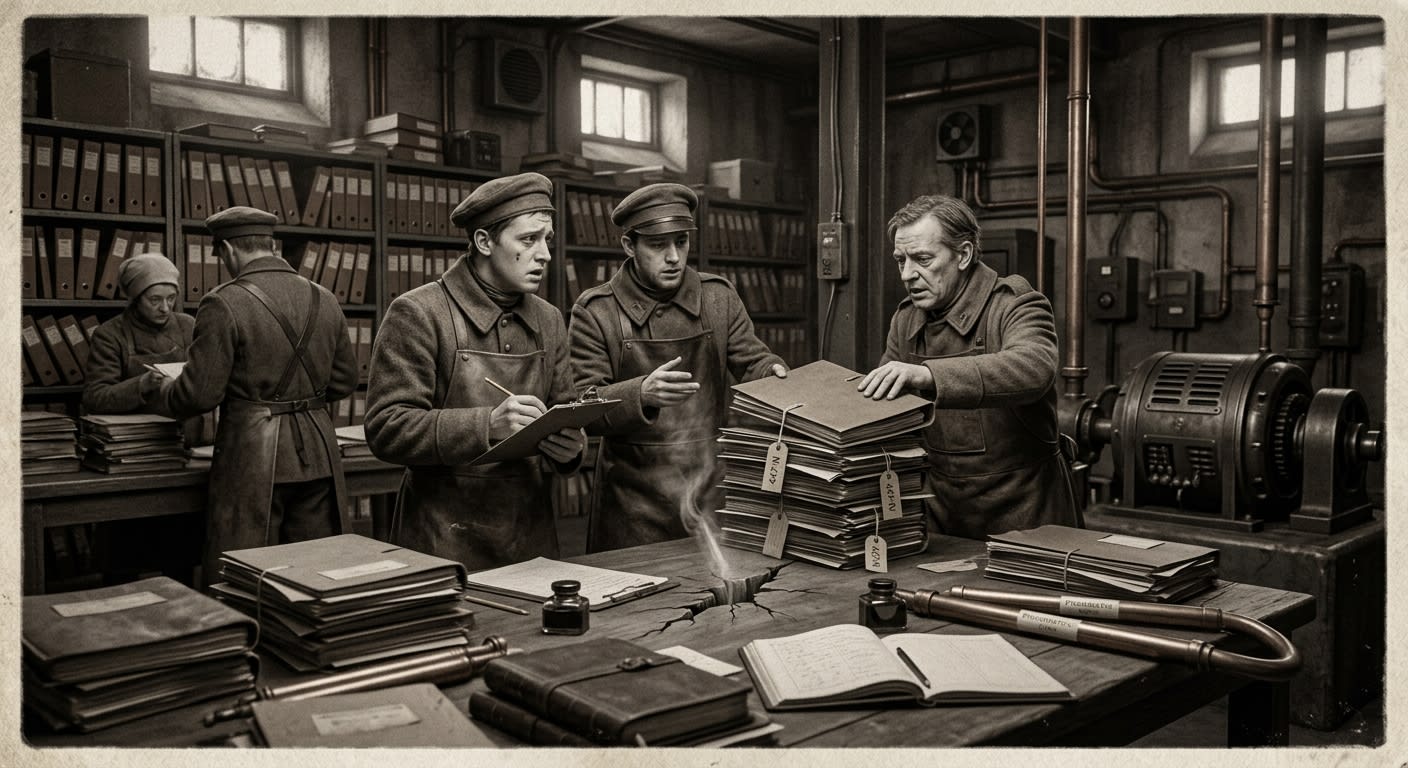
Investigation 447-N returned to Bastion-Königsberg with forty pages, three cracked gauges, one missing junior notary, a sealed packet from Voss, and a bell-metal sample that sweated brine in a dry room. The Northern Office divided the report into Public, Restricted, Sealed, and Mislaid. The public portion cited irregular peal intervals and logistical difficulty. The restricted portion recommended suspension of harmonisation. The sealed portion linked the Grey, det grå vattnet, and den stilla hungern through acoustic response and name instability. The mislaid portion is known to exist because three offices deny receiving it in identical language.
Bells wanted to re-run the investigation with better instruments. Engineering wanted to design those instruments from safer latitudes. Rites wanted to classify northern bell practice (Unregistered) as Concordat-Variant, Category B, and depart before winter. Doctrine wanted the word extradoctrinal removed, retained, or hidden where no sermon could trip over it. Shadows wanted the sea demonstration file kept away from men who ask questions loudly. War wanted fuel shipments uninterrupted.
War won, as War often does, by requiring no metaphysics.
The investigation was suspended. Not closed. Closure would imply resolution. Suspension allowed the Bureau to keep every posture at once: concerned, active, respectful, authoritative, cautious, and absent. The North received form letters. The Priors received instructions to avoid bell disputes during dark months. Watch Captains received nothing, which they took as improvement.
#On Its Present Use
As of A.S. 201, Investigation 447-N functions as a warning label pasted over a wound, with a report number for decency. Every Bureau reads the label differently. Bells reads it as unfinished work. Rites reads it as permission to tolerate local practice while pretending tolerance is temporary. Engineering reads it as a request for instruments it should never test in person. Records reads it as a census complication. War reads it as a fuel-security memorandum. Doctrine reads it at night and then denies insomnia.
The Fractured North continues to ring. Hrafnvik continues to hold its narrows. Voss counts children by nickname when the return-voice inserts new names. The Swedish pass remains closed under black cord except by Watch escort. The Danish well has been capped with iron, uncapped twice, and heard once humming a peal not due until Advent. Priors send quarterly reports phrased with diplomatic cowardice. Elders send fish. The fish are more useful.
The Bureau has not harmonised the bells. This restraint deserves praise, though praise delivered too loudly may attract the wrong listener. It is possible — write this in small letters, reader, and wash your hands — that the Synod has encountered a domain where obedience to Strasbourg would kill faithful people faster than disobedience. The Bureau's greatness lies in refusing to state this. The Bureau's survival may lie in continuing to act as if it knows.
Do not teach 447-N publicly. Do not cite it in sermons. Do not mock northern bells. Do not retune old bronze near grey water. Do not ask the Watch what it watches unless prepared to stand the watch. Do not bring a Strasbourg pitch gauge above the sixty-third parallel and expect the mountain to honour its little needle.
The file pends. The bells ring. The water listens.