
#On the Column That Received the Bones
The 7th Rearguard Column enters the sacred record because an unnamed military chaplain near Koblenz accepted three apostolic phalanges (Unregistered) from Ignatius Brenner in A.S. 45 and did not lose them before they reached Brother Tomislav. This is an achievement of such plain utility that the romantic reader will undervalue it at once. He wants flame, ridge, demon recoil, martyr-ash. He wants Kalnik. He does not want the middle custody where sanctity passes from one frightened hand to another and becomes, for a few miles of mud, a logistics problem.
The Bureau wants the middle custody. The Bureau has better taste when frightened.
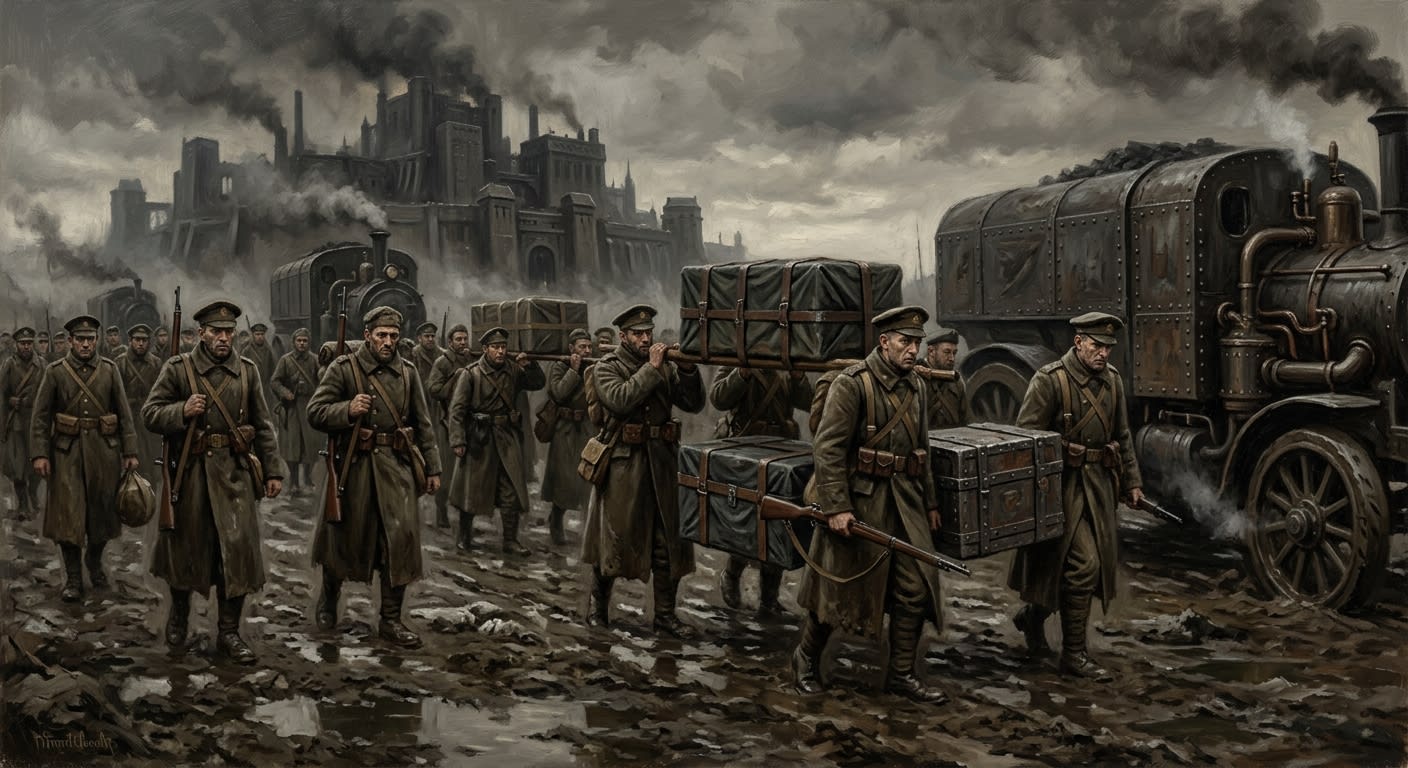
A rearguard column is the most honest military formation because it is named for what it is expected to do. It guards the rear. It watches the road already abandoned. It delays the pursuer, burns the bridge, empties the storehouse, counts the missing badly, and accepts that every order arrives with the smell of a grave already opened. The 7th did all these things while the world behind the Sundering cracked, smoked, screamed, and corrected the old Rationalist curriculum with fire.
#On Its Making During the First Flight
The 7th was not raised in the clean manner beloved by military historians: no parade ground, no newly stitched banner, no tidy roster blessed by a calm bishop under a dry sky. It congealed out of retreat. Broken Continental Levy detachments, faithful militia remnants, carts of refugees, two artillery teams without guns, three chaplains, a surgeon with one saw and no patience, and enough former Rationalist officers to make the prayers awkward were pressed into a moving hinge between the eastward horror and the westward crowd.
War later called this formation provisional. Records called it under-documented. Doctrine calls it providential because all three descriptions are true and only the third sounds fit for inscription.
A later regimental broadside described the 7th as “selected for relic custody by formal command.”
Corrected. The 7th received Relic 31-C because it was present, armed, moving eastward enough to matter and westward enough to survive. Formal command arrived after survival, carrying a pen and looking offended.
Its work was ugly. Rear sentries fired from ditches while refugee wagons passed. Axemen cut road timbers after the last cart crossed. Priests buried names faster than bodies. The surgeon’s cart took the wounded who could scream and left those who could not, because silence in a retreat is often triage wearing a hood. A column learns quickly that mercy must be weighed against pace. The scale is never clean.
#On the Koblenz Transfer
The sacred portion of the column’s file begins in a rear room behind the Sign of the Bent Oar (Unregistered), near the Rhine and Moselle confluence. Brenner arrived with the relic packet wrapped in oilcloth, coarse linen, and bread scent, having drawn three apostolic finger bones out of the long silence of Hartmann’s cellar. The receiving chaplain was attached to the 7th, feverish, under-authorised, and sufficiently awake to understand that the packet mattered more than his paperwork.
The transfer took less than six minutes. Public piety dislikes this number. It wants processional length, not custody speed. Six minutes is exactly the right size for a true handoff: long enough for doubt, short enough for survival.
The chaplain placed the packet beneath medical linen in a cart whose manifest listed cracked chalice stems and fever compresses. The choice was shrewd. Guards inspect gold. They quarrel over weapons. They avoid compresses. Sickness has always enjoyed a small jurisdictional privilege over curiosity.
From Koblenz the relics moved with the Column through roads already crowded with columns that had better names and worse luck. The 7th carried no proof that would satisfy a later auditor. Its authority consisted of possession, movement, and loss avoided. This is primitive law, and primitive law is the parent from which most Bureaus descend after shaving, perfuming, and denying their mother.
COLUMN CUSTODY NOTE — FRAGMENT, A.S. 45 “Packet warm at second watch. Men near cart report less hunger. Chaplain forbids touching. One former prefect asks whether bones require inventory. Sergeant answers with rifle butt.” Secondary line burned away. Records classification: useful if unauthenticated.
#On the Road Toward Tomislav
The 7th’s route from Koblenz toward the eastern retreat corridors cannot be reconstructed as a single clean line. Clean lines are luxuries of victorious map rooms. The Column moved by river track, military road, parish lane, cattle path, and one vineyard slope whose owner later petitioned for compensation because history had damaged his vines. His petition was denied with unusual grace: the Bureau sent him a prayer card and no money.
Relic custody passed under three disciplines. The chaplain kept the packet close. The sergeants kept men away from it. The desperate kept looking at it. This last category caused the most trouble. Sacred objects in retreat camps attract hope, theft, fever, bargaining, and the attention of men who believe holiness can be eaten if wrapped thinly enough. Two ration fights near the medical cart are recorded in later deposition. One man claimed the packet smelled of bread after the bread was gone. One said it smelled of his mother’s kitchen. Both were reassigned to ditch watch, where sentiment met rain and improved.
Near the Croatian approaches, the Column transferred the relics into Tomislav’s custody, though “transferred” is too smooth a word. The accounts agree only on essentials: a half-blind Franciscan with the Isidorean casket, a military chaplain too hoarse to finish the formula, a sergeant insisting that someone sign something, and Tomislav answering that the box had already signed by becoming warm. The sergeant, no fool, accepted this as sufficient.
Pilgrim catechisms sometimes teach that Ignatius Brenner handed the phalanges directly to Brother Tomislav.
Corrected. The 7th Rearguard Column was the middle custody. Devotion may prefer a single holy handshake; Doctrine requires the chain, because chains are what keep miracles from being claimed by the loudest parish.
#On Its Disappearance Into the Line
The 7th did not survive as a proud regiment with annual dinners, polished muskets, and grandsons lying about ancestral heroism. Rearguards rarely receive such ornaments. They spend themselves too early. By A.S. 48, its surviving men had been absorbed into rearguard fragments at Kalnik, refugee screens, field chaplain escorts, medical carts, and the nameless labour that later hardened into the Sagittal Line. Some died before the relics blazed. Some saw the blaze from below the ridge. Some carried wounded west after Maldrake’s vanguard flinched and learned, with the rest of mankind, that retreat had acquired a spine.
The Column’s formal roll remains partial. Records lists gaps. Relics lists custody. War lists losses. Doctrine lists usefulness. These are the four approved ways of saying that men existed long enough to matter and vanished before vanity could claim them.
As of A.S. 201, supply-runners on the Ignatian route (Unregistered) still scratch a small VII beneath bread-loaf chalk marks at Koblenz and Deutz. Pilgrimage discourages the practice because it complicates approved iconography. Porters preserve it because porters understand the middle hand. The first carrier rescues. The last bearer burns. Between them walks the column nobody paints.
Carry only until told.