
#On the Order That Forbids the Necessary
Standing Order 14-K is the Bureau of Purity's great furnace-cloak: a law thrown over black fuel, demon glass, scripture-smoke, unlicensed optics, pit-seep commerce, hidden pipes, mounted shards, and every other useful contamination by which the Synod keeps warm, sees farther, and lies with a cleaner collar. Its public instruction is simple enough to fit on a gallows placard. Seize. Shatter. Bless. Inter in lime. Immure the handlers. Salt the premises. Deny the category.
The actual instruction is longer, older, wetter, and written between departments in the ink of embarrassment.
Standing Order 14-K forbids the extraction, transport, distillation, polishing, mounting, sale, purchase, storage, ignition, viewing, reading, interpreting, invoicing, devotional use, tactical use, research use, and conversational defence of Category Sigma and Category One infernal materials. In practice it condemns black diesel in the morning, burns it by evening, smashes decoy demon glass before crowds at noon, and routes the useful panes through War channels before supper. The Order is hypocrisy, of course. The reader will kindly admire the scale before reaching for the obvious word.
Its jurisdiction runs from the Anatolian Pitlands east and south of Bastion-Constantinople to the Maskwright Lanes of Thessaloniki, from Wrath's fused slag-plains to Lust's mirrored courts, from a Wick-Kid's unmarked canister to a general's trench mask filed as Optical Supplies, Standard. The same clauses cover fuel that writes in smoke and glass that shows a soldier his death before the shell arrives. One might call that overreach. The Bureau calls it economy of condemnation.
A law that bans only what can be safely banned is a pamphlet. Standing Order 14-K bans what cannot be safely admitted. This is why it endures.
#On the Birth of 14-K
The Order was born from two panics that refused to remain separate.
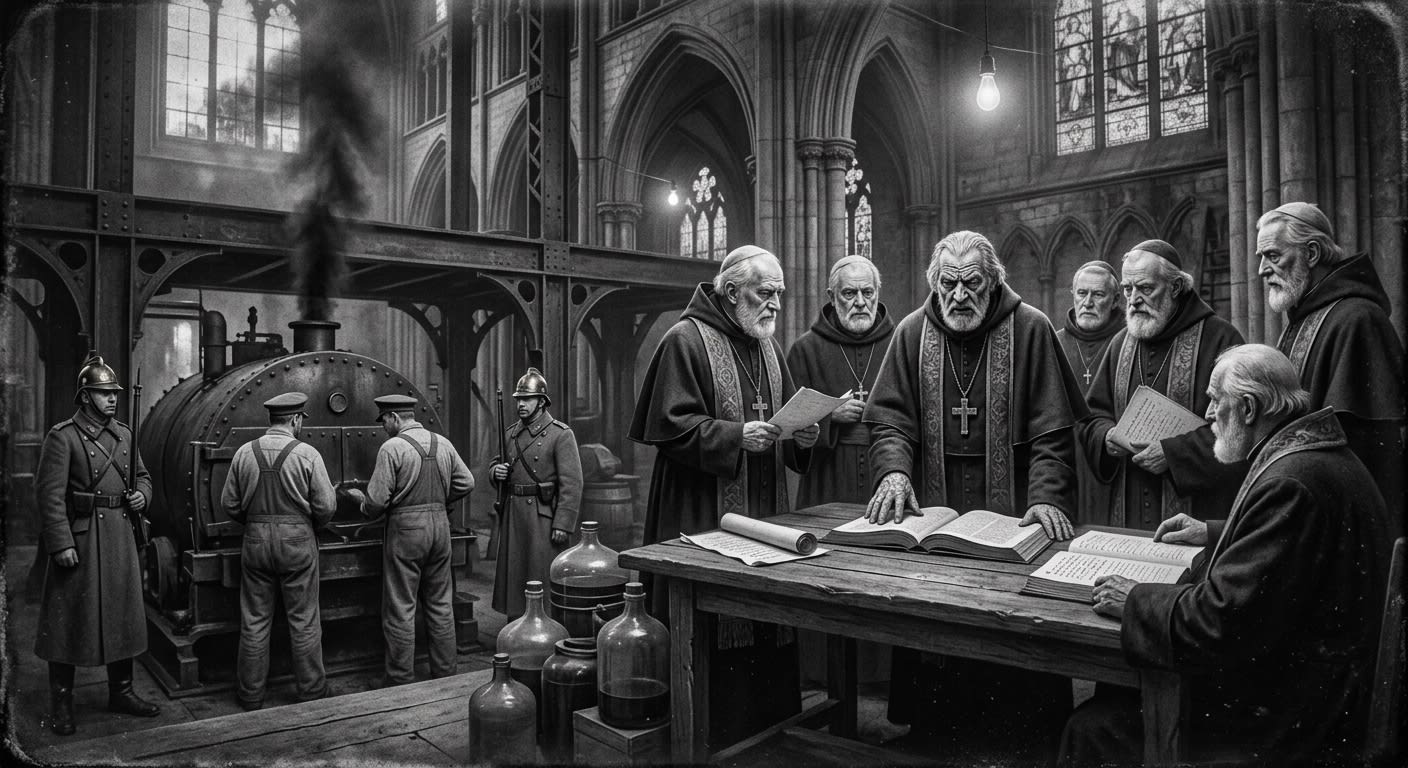
The first panic was fuel. By A.S. 134, unofficial Anatolian sludge had entered enough boilers, lamps, kitchens, ward-stoves, pump rooms, and engine sheds that denial required clerks with stronger wrists than honesty. The Chrismole Furnaces of Brast produced sanctified fuel with hymns, seals, filters, and admirable invoices; the Line required more heat than sanctity could provide. Black diesel filled the gap. It arrived in skin-bags, corpse carts, devotional crates, dented drums, false ash-wagons, and the pockets of children who learned silence before multiplication.
Then the smoke began to write.
The A.S. 136 scripture-smoke quarter in Constantinople turned inconvenience into doctrine. Furnaces burning Anatolian black produced smoke that arranged itself into Creed fragments, Index phrases, pre-Sundering Wallachian sentences, and one sequence that seventeen witnesses called a list of debts owed by the dead. Soldiers fired into the watching crowd. The smoke formed human shapes and consumed them. Purity named the event atmospheric combustion, anomalous. Doctrine named it voluntary interpretive risk. Records named nothing until the dead had cooled.
Early Purity summaries described 14-K as a narrow fuel-interdiction order directed against “unauthorised distillation cells.”
Corrected after A.S. 172 harmonisation. The Order was never narrow in spirit, merely underfed in vocabulary. It now possesses enough teeth to bite glass, smoke, oil, song, polish, and any clerk who asks which category came first.
The second panic was glass. Demon-glass recovery had been occurring since at least A.S. 68, when a quartermaster with more prudence than courage logged a shard as geological sample, anomalous. Scavengers kept harvesting. Smugglers kept moving. Polishers kept grinding. War kept buying. Purity kept discovering, smashing, sermonising, and requesting budget.
Varna supplied the public skeleton. In A.S. 151, raw shards sold in the harbour were smashed by Purity inspectors before a crowd. The fragments reflected the crowd as skeletons moving independently of their owners. Bodies followed bones into the water. Hundreds drowned. The report blamed mass hysteria aggravated by heretical optics, a phrase so insufficient that I preserve it as a specimen of clerical panic in decorative clothing.
Wormwood Hill supplied the iron sermon. In A.S. 163, a tank fed engine-grade black diesel burned its crew alive and advanced for three days while the hymn-vox spoke through melted fittings. Its wreck dripped self-igniting oil for eleven days. Engineering spoke of residual thermal signature. Pit-Masters spoke of fuel memory. The Bureau of Purity spoke louder, which is the usual substitute for speaking accurately.
By A.S. 172, fuel law and glass law were bound under the revised 14-K. The Order learned to treat infernal matter as a single administrative family: substances that answer pressure, flame, polish, sound, fear, or appetite with behaviour too useful to ignore and too dangerous to confess.
#On the Letter of the Ban
The letter of Standing Order 14-K is stern, clear, and largely fictional.
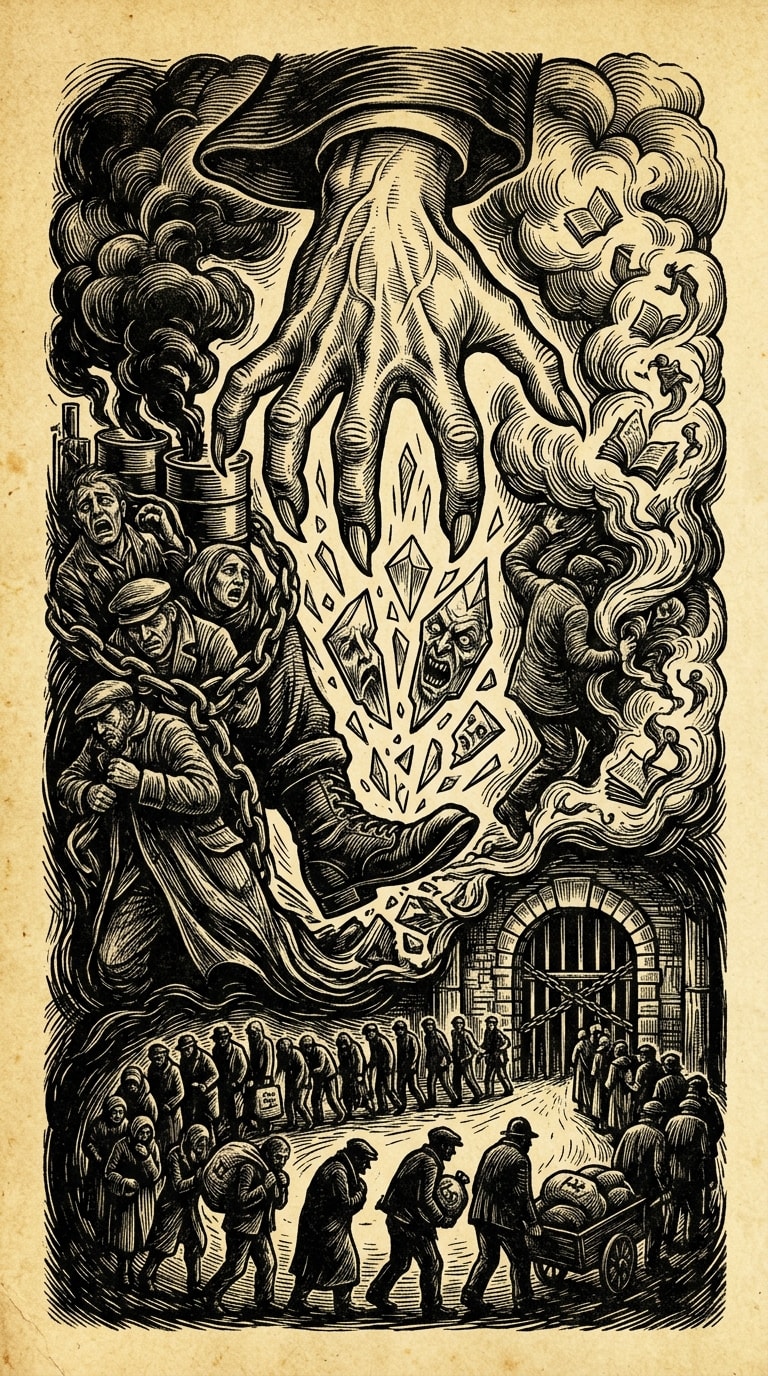
No civilian or military personnel may approach confirmed demon-glass deposit sites. No shard may be recovered for research, intelligence, devotional study, tactical assessment, private grief, optical fitting, or material theology. No black diesel may be distilled, cut, pumped, stored, burned, inhaled, read, interpreted, or used as auxiliary fuel under any name not already laundered by an authorised office. No scripture-smoke may be transcribed. No smoke-text may be read aloud. No mounted pane may be tested with a known name. No responsive fuel may be subjected to bell vibration, hymn-vox proximity, or unauthorised pressure chant. No quiet-box may be opened without Purity witness. No Purity witness may be named in any record likely to be subpoenaed by War.
There are clauses for tools. Coil-stills, wick-needles, bone-char sachets, grave-wax knockoff seals, ash-grit stones, quiet-boxes, lead came, closed-eye stamps, black-diesel wash basins, pipe-tap keys, hidden pressure valves, shard tongs, polish jigs, and mask sockets may be seized as infernal apparatus. There are clauses for persons. Wick-Kids, Coil-Hands, Pit-Masters, Pipe-Ghosts, Pickers, Pullers, Wrappers, Palace-Crawlers, Whisper-Brokers, Grit-Runners, Lappers, Mounters, Stainwrights, Mask-Lens Surgeons, Furnace-Hardliners, and any quartermaster who says auxiliary with unusual tenderness may be detained.
The Order's genius lies in its verbs. Approach. Recover. Mount. Burn. Read. Interpret. Store. Assist. Benefit. Conceal. A noun can hide in a crate. A verb follows the hand, the eye, the flame, the invoice. Purity did not write many elegant laws, but 14-K has the clean malice of an experienced lash.
The penalty language is severe enough to satisfy Purity and flexible enough to satisfy everyone else. Immurement remains the preferred public punishment because it is visible, architectural, and hard to appeal after the mortar sets. Field execution is permitted beyond the Line. Confiscation is mandatory. Destruction is mandatory. Reclassification is, by footnote, available where destruction would impede critical operations. In that footnote lives half the southern war.
#On Exceptions, Which Do Not Exist
No exception to Standing Order 14-K exists. The Order says so. War says so. Purity says so. Engineering says so while examining a pressure nozzle smelling strongly of illegal heat. The Maskwright Lanes say nothing because laughing during a raid is tactically unsound.
Exceptions are not exceptions when filed as another category.
A mounted demon-glass lens becomes Optical Supplies, Standard. A polished pane becomes fog-resistant observation glass. A black-diesel drum becomes emergency auxiliary fuel. A hidden pipe becomes abandoned drainage. A seized convoy becomes enforcement theatre. A confiscated cask becomes missing evidence. A Stainwright becomes a recurrent contraband-adjacent person; useful. A Furnace-Hardliner becomes erased-but-used. Glassman Dimo remains watched, unseized, and invoiced in everything but name.
War's exception is necessity. It wants mask lenses that can see through smoke, glamour, brine-fog, trench murk, and the ugly uncertainty of Thracian things wearing human outlines. It wants black diesel when shell-hoists, pumps, kitchens, ward generators, and gun engines cannot wait for blessed fuel. War does not enjoy impurity. War enjoys continued function, which is a more demanding altar.
Engineering's exception is curiosity disguised as maintenance. It knows black diesel fouls valves, heats harder, stains hymnal plates, and sometimes causes machinery to remember the wrong pressure. It also knows a dead pump drowns a sap faster than doctrine can arrive. It pretends to hate the Pipe-Ghost and studies his repairs by lantern.
Tithes' exception is revenue. Fines, staged confiscations, material recovery fees, illegal heat assessments, decoy-shard penalties, fuel irregularity surcharges, and the charming little category called Contextual Revenue Assessment (Unregistered) all pass through clean ledgers. Tithes has never met a damnation that could not improve a column.
Doctrine's exception is language. We condemn, clarify, distinguish, and seal. We do not purchase. We certify that War's purchase was not purchase, Purity's failure was selective enforcement, Engineering's curiosity was safety review, and Tithes' appetite was administrative accompaniment. Then I write the sentence handsomely enough that lesser men mistake it for truth.
#On Enforcement Theatre
Enforcement under 14-K is immediate where convenient, ceremonial where profitable, and absent where winter has sharpened its teeth.
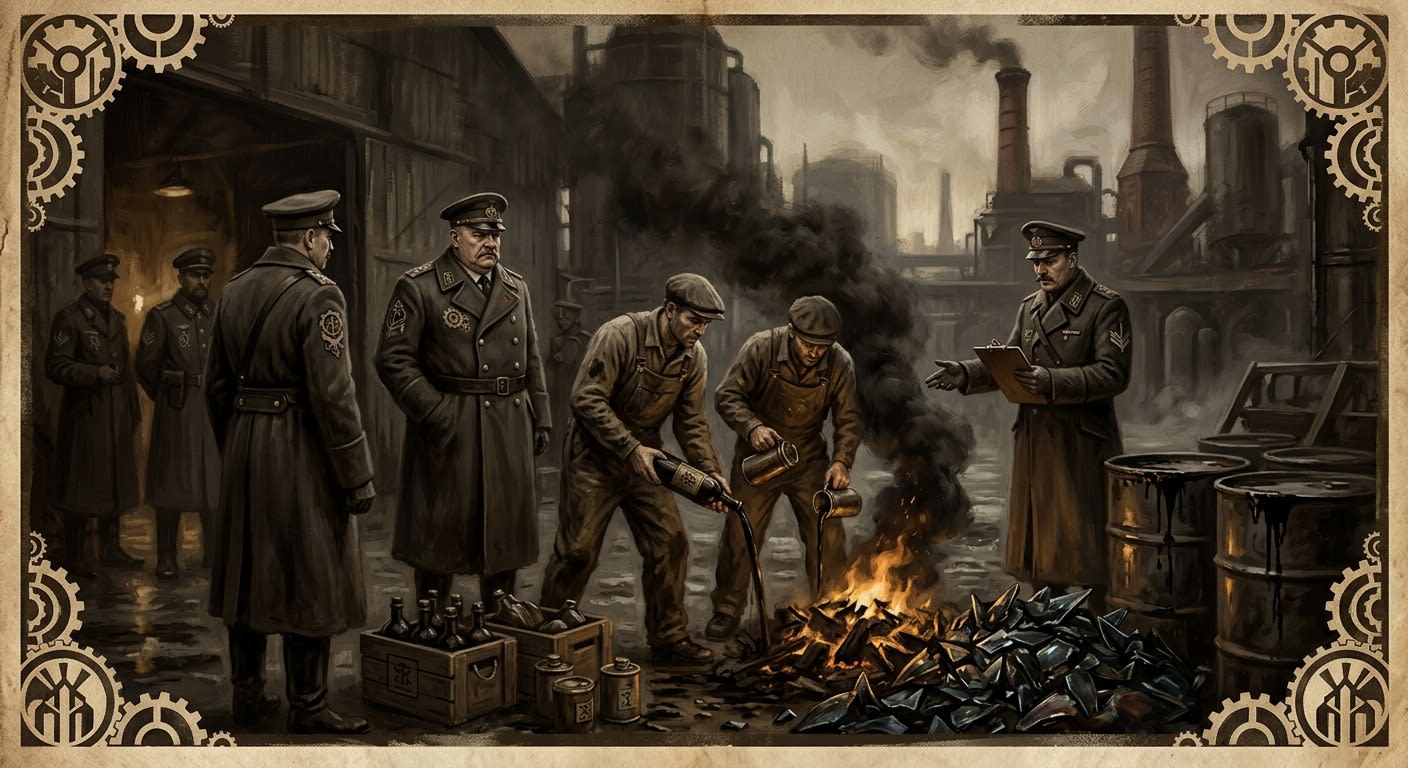
A proper seizure begins with warning. Not to the guilty, naturally; to the useful guilty. The real stock moves first. The decoy remains: one active shard wrapped in too much reliquary cloth, three blanks, six tins of lamp-grade black, a terrified Wick-Kid, one ageing Picker, a ledger written in pencil, and a crowd large enough to learn obedience. Purity arrives in white. The officer reads the Order. The glass is smashed behind shield cloth, unless the officer is new or vain, in which case nearby harbour water should be watched carefully. The casks are stacked. A sermon follows. The expendable are taken. The useful lanes reopen by dusk.
Theatre is not useless. A population that sees canisters taken will burn the remainder more quietly. A workshop that sees decoy glass smashed will pay its precinct runner promptly. A Furnace-Hardliner who watches a neighbour immured will remember the tithe cut. A Glass Polisher whose false crate is seized will make the next false crate more persuasive. Order is sometimes maintained by punishing the stage furniture.
Purity's A.S. 197 eastern-theatre assessment declared demon-glass scavenging eradicated.
Revised to residual opportunistic recovery by unaffiliated individuals. The unaffiliated individuals retained route hierarchies, annual yield, grading slang, broker discipline, and a reliable schedule, which shows what opportunity can achieve when properly unaffiliated.
There are real seizures. One must not make the comforting error of believing every immurement symbolic. Amateur distillers who sell engine-grade fuel to children, Seers who keep Hook-grade shards, Revelators who tune panes for widows until the dead learn to bargain, Bell-Tappers who let scripture-flame through public lines, and route fools who read smoke-text aloud are taken hard. Purity loves a sinner it can destroy without interrupting supply.
The Order survives because everyone fears the uncontrolled case. Varna was uncontrolled. Wormwood was uncontrolled. The scripture-smoke quarter was uncontrolled. A mounted War lens that shows a captain the enemy's approach is useful; a raw shard that makes a harbour walk into its skeletons is riot, drowning, inquiry, and worse, paperwork with witnesses.
#On the Trades Beneath the Order
14-K created no trade. It shaped them. A prohibition is a mould into which necessity pours itself.
The Demon-Glass Scavenger learned donation seizures, wrapper discipline, route separation, and the pleasant fiction that a Picker caught with furnace-grade shards had acted alone. The Demon-Glass Polisher learned quiet-box custody, cold wash, silence tests, decoy benches, false premises, and the closed-eye mark of Saint Varda of the Lead Hands. The Black Diesel Distiller learned tithe cuts, hidden pipe routes, staged confiscations, wick hierarchies, scripture-smoke taboos, and the art of boiling heresy in basements beneath officials who complain about cold floors.
The Order also gave the trades a common enemy and a common grammar. Category Sigma. Category One. Useful patron. Decoy crate. War number. Purity day. Lime sermon. Theatre cut. Grey burn. Hook grade. Furnace grade. Lamp clean. Closed eye. Black wash. A criminal vocabulary is a constitution with dirt under its nails.
Saint Varda flourished under 14-K because the Order's command to shatter raw glass was both right and stupid. Right, because raw glass kills. Stupid, because smashing it badly kills more. The Polisher cult answered with bench law: lead first, vision second. Purity calls Varda fabrication. The workshops call her practical. Doctrine records persistence. I prefer saints who can keep apprentices from staring into active shards. They save training costs.
Furnace-Hardliners flourished because the Order's fuel ban created allocation power. The Hardliner can say no with law behind him and yes with heat in his hand. Kitchens over homes. Pumps over chapels. Gun engines over private sickrooms unless riot probability rises past furnace value. Hardliner morality is ugly. It is also calibrated. I have seen prettier ethics freeze to death.
Glassman Dimo flourished because the Order made replacement capacity the true measure of guilt. He can be raided; he cannot be removed. His closed-eye panes reach coastal masks, and coastal soldiers live a little longer. Purity knows. War knows. Dimo knows that both know, which is why his cellar has more rooms than his floor plan and his apprentices sing softly enough to be deniable.
#On Smoke, Sight, and Voluntary Contamination
The heart of 14-K is a theological claim disguised as safety procedure: infernal matter contaminates more than the body. It asks to be interpreted.
Black diesel burns. That would be manageable. It also writes. Smoke coils into Creed fragments, old languages, names, debts, fears, ledgers, prayers, and sentences no department wishes to own. Reading the smoke is prohibited because reading completes the circuit. A word seen becomes a word stored. A word stored becomes testimony. Testimony becomes jurisdiction. Jurisdiction becomes a room full of officials asking why the fuel knew their private accounts.
Demon glass reflects. That would be manageable. It also selects. It shows skeletons, futures, desired faces, enemy souls, dead children, possible salvations, and that most corrosive commodity, evidence the viewer wants. Looking becomes negotiation. Negotiation becomes appetite. Appetite becomes purchase. Purchase becomes doctrine among the desperate and intelligence among officers, which is the same sin wearing different boots.
14-K INTERPRETIVE CONTAMINATION FILE — EXTRACT SEALED Subject read three smoke-words from black-diesel chimney. Words matched no published Creed variant. Subject then identified concealed shard crate in adjacent warehouse without prior entry. War requested transfer. Purity requested immurement. Doctrine response: ███████████████████████████. Disposition of subject: █████████████.
Voluntary contamination is the Order's favourite phrase. It implies the soul stepped forward with receipts. This is useful in trial and obscene in practice. A child points at smoke. A widow looks too long through a pane. A soldier glances into a cracked mask lens before battle because terror has made him obedient to any object promising knowledge. Voluntary, says the Order. Contaminated, says Purity. Useful, says War, if he survives.
#On the Three Ledgers of Contraband
Every 14-K case produces three ledgers. The public ledger records sin. The operational ledger records supply. The private ledger records who survived by pretending the first two never met.
The public ledger is Purity's property: names, charges, seized items, sermon text, crowd size, immurement cost, lime expenditure, and the satisfying phrase material destroyed in accordance with Standing Order. It is written for superiors, frightened citizens, and the little moral theatre by which an office proves it remains awake. The operational ledger belongs to War, Engineering, and the practical quartermasters whose boots are always dirtier than their consciences. It records how many lenses were diverted before the raid, how many drums reached the pump shed, which distiller can still cut lamp-clean fuel, which Stainwright lost apprentices, which Pipe-Ghost needs a fresh bribe, and which Purity captain can be trusted to arrive late with conviction.
The private ledger is never bound. It lives in sleeve notes, scar memory, pipe knocks, route songs, closed-eye chalk marks, and the small domestic knowledge that tells a mother which stove oil will make the baby cough black and which will merely stain the kettle. The state hates this ledger because it cannot seize a thing distributed among hands. The trades protect it because it is the only record that admits the living were there.
A 14-K inspector learns to read absences. A workshop with too much broken glass has staged its raid. A still room with no children's shoes has been warned. A fuel cellar with clean walls is either new or lethal. A mask bench without Varda's mark is hiding something worse than devotion. A pipe junction that sounds hollow after the fourth bell has been drained for inspection or fed to another district. The Order names contraband; the contraband names the Order back through the shape of what has moved aside.
This is why the best inspectors become either corrupt or dead. The incorruptible fool sees a crate and smashes it. The useful inspector asks why that crate was left where a fool could see it. The dead inspector opened the one under the fish pans.
#On Revision as Survival
Standing Order 14-K has been revised so many times that the revision slips require their own cord. A.S. 134 gave the first fuel clauses their teeth. A.S. 136 added smoke-text language after Constantinople proved that chimneys could become pulpits. A.S. 151 inserted raw-shard crowd controls after Varna. A.S. 163 created engine-memory cautions in the wake of Wormwood Hill, though the first draft called the event a mobile boiler persistence anomaly, because Engineering sometimes writes as if shame were punctuation. A.S. 172 bound the matter into the modern Order. Later addenda have dealt with quiet-boxes, black-diesel wash, closed-eye marks, War requisition laundering, Bell resonance near fuel stores, child runners, lime reuse, decoy-crate ratio, and the correct sermon length for public shattering in rain.
Each revision admits failure by forbidding a newer description. That is the sacred rhythm of law under pressure. The world produces a horror. The office gives the horror a form number. The horror changes clothes. The office adds a subsection. At no point does the Bureau concede pursuit. It calls the widening circle a net.
A Purity preface to the A.S. 172 revision states that previous editions of 14-K had “contained all known infernal-material abuses.”
Clarified. Previous editions contained all known infernal-material abuses that had already embarrassed the issuing office. Unknown abuses, useful abuses, and abuses wearing War labels remained free to mature into future clauses.
The revision history also records bureaucratic appetite in its purest little form. War demanded tactical exemptions and received labels. Engineering demanded test custody and received safety review. Tithes demanded fines and received assessment authority. Doctrine demanded interpretive jurisdiction and received every smoke-text no one else dared read. Purity demanded obedience and received ceremonial primacy, which pleased it until it noticed everyone else had taken the useful parts.
The Order's margins are crowded with dead language. Field Dispensation 7-C, annulled retroactively yet cited in three War invoices after annulment. Protocol 7-C, similar enough in number to confuse auditors and useful enough that the confusion was never repaired. Martial Code 22-A, voluntary contamination, involuntary contamination, interpretive contamination, aggravated transcription, beneficial possession, hostile custody, devotional proximity, scientific curiosity, and that favourite little coffin, rank-sensitive misclassification.
Rank-sensitive misclassification deserves reverence. It means a colonel looked into the wrong pane, a Purity officer warmed himself with the wrong oil, a bishop accepted a reliquary window that hummed during Lent, or a quartermaster signed a clean receipt beside a dirty drum. The lower ranks commit crimes. The upper ranks suffer classification events. This distinction is foundational to civilisation.
#On Children, Apprentices, and Other Disposable Wicks
The Order speaks of personnel with admirable flatness. It does not linger over Wick-Kids, Grit-Runners, vent children, ash boys, lead apprentices, shard watchers, pump nieces, cellar sweepers, fish-pan carriers, or the small hands by which every forbidden industry keeps its adult experts alive. A child can fit through an Anatolian vent. A child can run a folded paper between benches without seeming important. A child can hold a quiet-box steady while the Stainwright presses lead. A child can carry a canister under a cloak and, when arrested, produce a public lesson at low political cost.
This is tolerated design.
The trades use children because adults with names are expensive. Purity arrests children because adults with patrons are inconvenient. War receives the benefits because the child has vanished before the engine starts. Doctrine condemns the arrangement in terms sufficiently grave to make continuation feel supervised.
JUVENILE CONTAMINATION ANNEX — 14-K, SEALED Subjects: seven Wick-Kids, two Grit-Runners, one vent child from Pit route unsurveyed. Common symptom: black residue beneath nails; sleep speech in words matching no household language. Recommendation: separate, question, compare smoke exposure. War note in margin: retain two with lens tolerance. Final disposition: ███████████████████████████.
The workshops tell gentler stories. Varda protects apprentices. Pipe-Ghosts do not send quick children twice through hot vents. Hardliners feed the families of arrested Wick-Kids. Scavengers drop Hook-grade shards rather than let a child see them. Some of these stories are true. Truth does not absolve the machine; it merely oils one gear with pity.
I record the children because the Ledger must not pretend the Order is made only of clauses. A law touches paper first. Then it touches hands.
#On Present Force
As of A.S. 201, Standing Order 14-K remains in full force, which is to say full contradiction. The Anatolian Pitlands are officially unregistered and unofficially mapped. Black diesel remains anathema and operationally indispensable. Demon glass remains Category One contraband and mounted in useful masks. Purity continues public seizures. War continues requisition. Engineering continues safety review. Tithes continues arithmetic. Doctrine continues speaking with the serene authority of a man standing on a trapdoor he designed himself.
The Order is strongest along the southern and coastal theatres: Constantinople's Warrens, Thessaloniki's Maskwright Lanes, Varna's haunted harbour accounts, the disputed routes from the Pitlands, the fuel-hungry trenches, the glass-fed optics shops, the black routes where smugglers move saint-bones, shard crates, and oil canisters beneath labels pious enough to discourage inspection. It is present in Brest pump rooms, Przemyśl shell yards, Irongate pressure chapels, Shipka thaw sheds, Strasbourg rail depots, and every cold district whose manners improve when an illegal stove is lit.
No officer believes eradication possible. The honest ones say containment. The dishonest ones say progress. The clever ones ask which crate must be found this quarter.
The Order will not be repealed. Repeal would admit dependence. It will be revised, narrowed, expanded, harmonised, annotated, and contradicted until every illegal furnace has an approved denial and every useful shard has a cloth cover. This is governance. Not purity. Governance.
At dusk the confiscation square empties. The lime pit cools. The sermon paste dries on the wall. Somewhere below, a hidden pipe knocks once and begins to move heat toward a kitchen whose children will wake alive. Somewhere by the quay, Dimo sets a closed-eye pane into a soldier's mask while Purity raids the shop two alleys away. Somewhere east of Constantinople, a nameless man lowers a child into a crude seam because the passage is too narrow for shoulders.
Standing Order 14-K forbids all of it.