
#On the Name Withheld
The Rationalists wanted a signature. They got one in the only ink he had left to give.
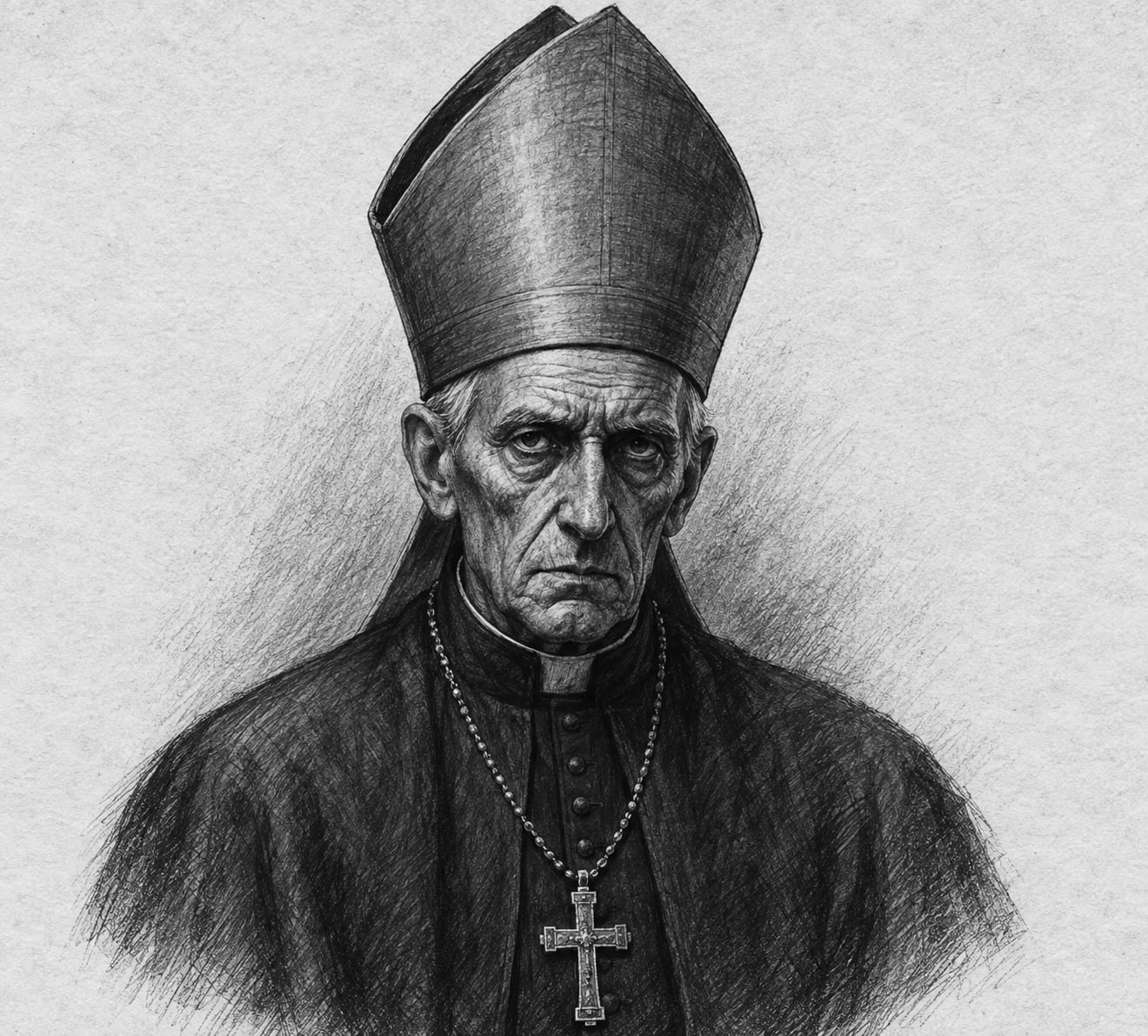
The Archbishop of Vienna is the style the Bureau of Doctrine permits for the prelate who signed away his own See at Regensburg in A.S. 30 (1740 CE). The style names a function. It does not name a man. The Codex prints no baptismal name, no birthplace, no age, no family and no date of death, because the Codex does not hold any of these with the confidence that print requires, and because printing a guess about a dead archbishop is how pilgrimage catechisms acquire saints.
The surviving accounts disagree about who he was. One makes him the successor of Rupert III. Another makes him a coadjutor raised in haste once the Viennese chancery had begun to smoke. A third makes him a rival prelate whom the Rationalists held in custody for this particular afternoon. The driest calls him the last man the Rationalists could force to hold the pen. That is the most honest description in the file and the least useful. I have filed four requests to unseal the conflicting folios. The fourth came back stamped with a date and a smudge that I have decided to read as contempt.
Doctrine files him as predecessor personnel. The term covers men who held real ecclesiastical authority before the formal Synod existed and served neither Reason nor Hell by intent. They failed where everyone could watch, and they are still needed as ancestors. The category keeps his dignity and denies him jurisdiction. The office itself is dead. So this dossier treats the title the way a surgeon's ledger treats a wound: by where the blade went in.
A pilgrimage catechism of A.S. 134 honoured the Regensburg signatory as "Saint Rupert the Last."
Corrected. No canonisation exists. No "Last" title has been ratified. His identity with Rupert III has not been established. The catechism's author was assigned to proofread feast calendars in the Rhineland, where he could confuse only the dates of the dead.
#On the Chair He Carried
Whoever he was, he inherited the Holy See of Vienna: seven centuries of continental precedence, the vaults beneath the Cathedral of Saint Stephen's, the relic chains of half of Europe, an appellate court that took years to decide anything, and a chancery whose Latin reached its verbs after the Alps had changed hands. The See had prestige, relics, archives and grammar. It had nothing like the later Bureau of Records, nothing like Purity and nothing like War. Its armour was inherited reverence. Reverence is excellent armour until the enemy stops kneeling.
The See had already learned to flinch. In the Year of Letters, A.S. −32 (1678 CE), Archbishop Rupert III answered the Amsterdam bone-counters by striking the Reliquary of Saint Aldebrand from the inventories and leaving the bone glowing in the vault. That was a separate Viennese failure, committed by a separate archbishop in a separate century. Readers who fold the two men together because both wore the same mitre should remember that mitres are cut to fit an office, not a man.
By A.S. 25 the chair had become a symbol everyone needed. When Guillaume sold Aachen in the Betrayal of Aachen and the northern faithful front caved in, the Rationalists needed Vienna humiliated. The faithful needed Vienna unbroken. The Archbishop of Vienna needed time and an army, and was given neither. Five years later the Atheist Wars ended at a table, and the Rationalists required him at it.
#On the Room at Regensburg
The evening before, during the Oaths of Regensburg, three priests taken at Rouen were drowned in vats of Rhenish red between the seventh and eighth toasts. The Bishop of Worms vanished between the ninth and tenth. The Archbishop of Vienna went to bed, if he was given a bed, knowing exactly what the Rationalists did to clergy who were no longer needed.
He was still needed.
The signing took place in the Reichssaal, the old Imperial Diet chamber. Its crucifixes had been stripped out and its walls hung with the Broken Cross. Through the high windows the ruins of three churches were visible, placed in view like exhibits for the court. The Council of Nine sat on one side of the long table. On the other sat what remained of the old order: three bishops, a baron of the Rhineland whose forces had collapsed at Aachen, the aide-de-camp of Lord-Protector Guillaume, and the Archbishop of Vienna.
Two of those men had come for their masters. Guillaume stayed in his Lowlands palace, already paid and unwilling to hear the price read aloud. He sent a proxy, and the proxy signed with a firm hand. The Archbishop could send nobody. Dissolving the Holy See required the Holy See's own signature, and the Rationalists, who otherwise despised the old forms, cared a great deal about this one. They meant to kill the Church with its own chancery practice.
The Rationalists explained his choice with their usual precision. He would sign, or they would find someone who could hold the pen with the correct number of fingers remaining. The threat was procedural and so was the man who delivered it. The See's law needed an archbishop's hand. The Council offered him his own hand intact, or a replacement.
He cut himself and signed in his own blood.
Rationalist witnesses called it theatre. Devotional accounts call it martyrdom, although he walked out of the room alive and the martyrologists find that awkward. Chancery copies record it as an irregularity of ink. I prefer the chancery phrase because it is the only one that puts the blood where it belongs: in the document, as a defect in the document.
REGENSBURG WITNESS SUPPLEMENT — recovered from a private clerk's packet, A.S. 92 After signing, the Archbishop pressed his thumb below the seal and whispered ██████████████████. Three Rationalist signatories requested translation. The interpreter refused. The interpreter's tongue was removed before dusk. Translation on file: ██████████
#On What His Blood Did Not Authorise
The Treaty ran to forty-seven articles, and the forty-eighth was struck out. The first articles did the killing. They dissolved every ecclesiastical institution on the continent, turned dioceses into Philosophical Prefectures, disbanded cathedral chapters, nationalised the Church's property and made the Rationalists' earlier thefts legal. Article Fourteen abolished sanctuary, so a church could no longer shelter anyone from the Republican Guards. The Rationalist Republic governed on the strength of these articles from A.S. 30 to A.S. 45, fifteen years in which Reason filed forty days of darkness as an eclipse and a boiling Danube as iron deposits.
The Archbishop's signature carried all of it. Doctrine's later judgment, made retrospectively once there was a Doctrine to make it, holds that the signature validated nothing. A seal extracted under threat of mutilation is evidence of the threat. The Bureau calls the blood signature a consecration by duress, which in theology is a different thing from a contract, and on that ground the Treaty was annulled in A.S. 92, retroactively to the moment he lifted the pen. The Rationalists used his blood to prove his consent. The Bureau now uses it to prove the coercion. The page has not changed. The prosecutor has.
Early homiletic tracts of the provisional period called the Regensburg signature "the Archbishop's surrender" and reproved him for want of fortitude.
Corrected. Doctrine does not charge the Archbishop with weakness or treason. A man who signs with a knife beside his hand has not surrendered anything. His fingers were taken hostage. The tracts have been withdrawn, and their authors' fortitude was tested in turn under suitable supervision.
With that signature the Holy See ceased to exist in law. It did not go underground. It ended. What went underground was faith, in the keeping of the Cellar Saints and the hidden clergy: hosts in tobacco tins, relics under loaves, parish registers kept on the backs of Rationalist census forms, and root cellars where the Mass went on without a chancery to authorise it. The Archbishop's title was left behind in the Reichssaal with the pen. Nobody carried it into the cellars, because nobody there had any use for it.
When the Sundering opened the east on 1 November A.S. 45, the chair in Vienna stood empty through the whole Great Retreat. Shrine pamphlets that give the Holy See credit for guiding the faithful west have been corrected elsewhere in this Codex, and I will not correct them twice. Where the Archbishop was during those years, and whether he was alive, sits in the same sealed folio as his name.
Clemens Stahlhand took Vienna back in A.S. 95 with three divisions and the Aldebrand reliquary strapped to a gun-carriage. The city was reconsecrated, and today it sits among the Shrine-Ruins with warm basalt columns and supervised pilgrim routes. The chair was not restored. The Synod kept the dissolution the Rationalists had forced, because a restored archbishop in Vienna would have brought precedents, appeals and memories older than Strasbourg. In A.S. 92 the Reichssaal itself was reconsecrated by fourteen exorcists. The Treaty copy, with its brown signature, is held in the Forbidden Stacks under triple seal. Purity instructors show novices the chancery copies so they understand what compromise looks like once it has learned calligraphy.
Pilgrim vendors on the road through the Gates of Regensburg still sell children toy pens that leak red syrup. Strasbourg schoolboys sign mock treaties with them and their sisters annul the treaties retroactively. Doctrine forbade the pens once, and the prohibition failed. I have stopped objecting. The children have understood the case better than the catechists did: the signature is the property of the prosecution, and the man who bled for it belongs to the sealed folio.