
#On the Tunnel That Hunger Built
"Material received: continuous. Material quality: consistent. Supply expected to exceed requirement." — Bureau of Engineering tunnelling return, Sixth Ring extension, fifth month of A.S. 143
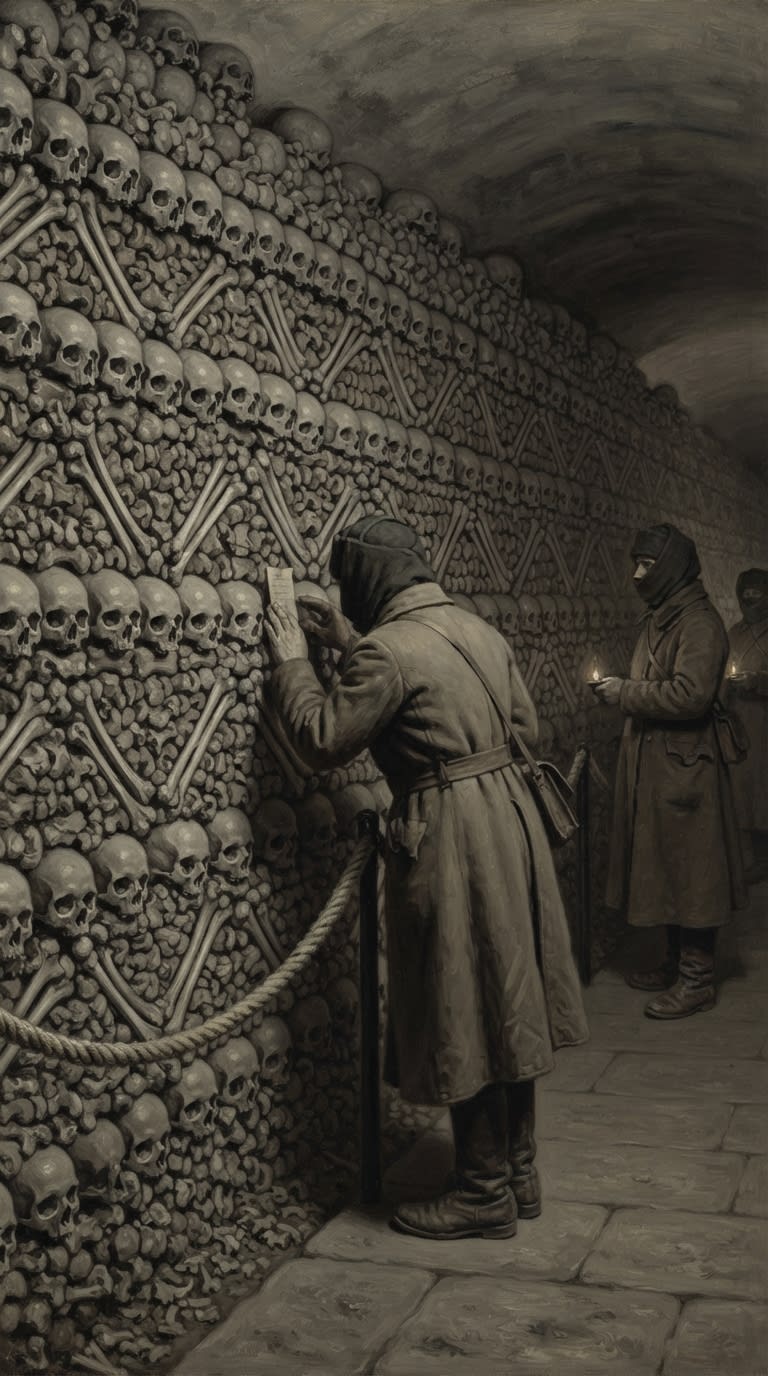
The Ash Gallery is a tunnel in the Sixth Ring of the Ossuary Rings beneath Bastion-Constantinople. The dead of the Ninth Bell Famine line it from floor to vault. It is a fortification and a grave. On the third day of the Constantinople commemorative circuit it is also a pilgrimage station. It has a rope rail, a lamp-seller at the mouth, and a clerk of the Bureau of Rites who counts heads, in case the dead should ask about attendance.
It was dug in A.S. 143, the Year of Ash Rain. That year Maldrake set fire to the Thracian forests under Campaign Record 143-M/WRATH, and the sky over the city became a grey lid for nine months. By the common reckoning the forests burned for three weeks. One Engineering model prefers twenty-four days, and I leave the extra three to whichever department wants custody of them. The crops failed. The cisterns clogged. The ninth bell tolled over ration doors with no bread behind them. The dead came down to the Ossuary faster than the stampers could stamp them. Between the fourth month of the famine and the ninth, the Sixth Ring advanced a quarter-mile to receive them.
The Bureau of Rites supplied the geometry: skulls outward, long bones in chevron courses, vertebrae packed into the gaps as mortar fill. The Bureau of Engineering supplied the proof that this geometry bears load. Both Bureaus claim the pattern. Both are right, which in Constantinople is the rarest form of agreement and the least comforting.
Many of the crews came from the Warrens, which swelled that year as the hungry pressed into the dry spaces between the Rings. By A.S. 201 the Warrens hold some forty thousand souls that the Bureau of Records has not registered. Some of their grandfathers set the courses of the Ash Gallery. Some of their grandmothers are in them.
#On the Grey Residue
Every skull in the Ash Gallery is grey. Ordinary ossuary bone yellows over the decades until it is the colour of old vellum. The Gallery's skulls are the colour of the sky their owners died under.
Engineering surveyors named the cause. Particulate from the Thracian fires, charcoal fine enough to pass through a breathing-rag, has fused with human calcium at a scale no loupe can resolve. The ash did not settle on the bone. It went into it. The seam is thickest along the skull sutures, where the plates of the head were knitted together in infancy. Pilgrim lamps catch it there as a dull line, like the solder on a reliquary closed by a nervous goldsmith.
The forests and the famine dead are now one wall. The Bureau of Records files them under separate headings. The wall does not.
Earlier editions of the Rites Pilgrim's Handbook to the Constantinople Circuit told visitors that the grey of the Ash Gallery was "settled famine ash, which the devout may brush from the brow of the dead as an act of mercy."
Withdrawn. The grey does not brush away, because it is in the bone. Generations of devout thumbs have polished the lower courses to a dull shine and removed nothing. The Bureau of Rites has since installed the rope rail and cites wear. Mercy has been reclassified as abrasion.
Engineering stopped once it had identified the fusion. That department measures what things do, and the residue did nothing Engineering could measure. It bore load as bone bears load, and it passed every structural test. The matter went to the Bureau of Alchemical Standards because it had to go somewhere, and the bottle-priests classified the substance as novel.
#On the Bureau's Sample
The file is designated AG-143/201. The first figure names the ash. So far as I can determine, the second names the review under which the survey copy I was shown was compiled. The copy gives no day of extraction. I note the absence. Absences in Alchemical Standards files are rarely clerical.
The procedure followed the manual as far as the manual went. An assessor took a flake from a skull-suture seam in the Gallery's middle courses, using silver tongs and a lead vial. A Rites witness stood at the assessor's shoulder, and a Records clerk read from the name-ledger so that the extraction could be logged against the adjacent dead. The famine ledger is the one part of A.S. 143 that the Bureau of Records got entirely right. Every name is there. It was this reading that made the file what it is.
ASH GALLERY SAMPLE AG-143/201 — SURVEY COPY: Grey residue removed from skull-suture seam under witness. Sample warmed upon naming the dead adjacent to extraction site. Reagent strip showed calcium, carbon, sanctified lime, and █████████████. When placed beside ordinary bone ash, both samples oriented toward the eastern wall. Junior Assessor █████ asked who was buried beyond it. No answer authorised. Sample returned to wall by order of Doctrine.
The warmth was in the sample and not in the tongs. The assessors confirmed this by the only method available to frightened people with silver instruments: they touched the tongs, then the vial, then each other's sleeves, and wrote down that nothing else had changed.
The ordinary bone ash is the detail that assessors do not discuss over supper. It was control material from a Strasbourg drawer, ash of the anonymous dead, certified inert. Placed beside the Gallery sample, it turned as well. Control material has no business agreeing with the specimen.
Doctrine ordered the flake returned, and the same assessor returned it with the same tongs. The Rites witness recited the committal over a piece of grey no larger than a fingernail paring and pressed it back into its seam. I am told the seam accepted it. I am not told what accepted means, and I have asked twice.
#On Pilgrims, Names, and the Eastern Wall
Pilgrims come on the third day of the circuit, after the ration-gate vigil and before the Ravelin walk. They carry lamps and name-slips copied from the Records ledger at a fee set by the Bureau of Tithes, which values grief by the line. The Gallery smells of lime and old stone. By midday it smells of breath as well, since a quarter-mile of tunnel holds a great deal of breathing and releases it slowly.
The custom is to read the names aloud. Rites permitted this from the first circuit. When the AG-143/201 file reached Strasbourg, Rites suspended the reading for one season and then quietly restored it, because a permanent ban would have needed a reason, and the reason was under seal.
Engineering attributes the warmth of the lower courses to lamps and crowds. It has never tested this, because a test would mean clearing the Gallery of paying pilgrims, and Tithes has objected on grounds of revenue.
Now the pilgrims ask the junior assessor's question about the eastern wall, since stories leak from laboratories faster than samples do. The guides point at the chevrons and talk about load. Some pilgrims have noticed that the Chain of Saint Anakletos first glowed during the seventh month of the famine, while this tunnel was being cut. They connect the two, and the chaplains of that year let them. The Chain fed nobody. It glowed again over the Black Sea Armada in A.S. 162, and nobody was fed then either. Other pilgrims whisper about the Third Ossuary, because in Constantinople every unanswered question is sooner or later redirected there.
I have not taken a bearing from the eastern wall. I have been asked not to, in writing, by an office that rarely puts its requests in writing.
#On Present Classification
As of A.S. 201, the Bureau of Alchemical Standards holds the Ash Gallery residue to be real, non-manual and provisional. It is not currently hostile. It is not currently inert. It is not currently transferable. It is not currently available for theological conclusion. The word currently was chosen by men who have held the sample, and it is doing more work in that sentence than the four adjectives it props up.
The Bureau of Rites classified the famine a Refining Tribulation in A.S. 143, before anyone had counted the dead. The Bureau of Records took its census in A.S. 145 and counted sixty-eight thousand, seven hundred and twelve. The pilgrims say sixty-eight thousand, because a round number fits more easily on a candle-ribbon. The name-ledger does not round. The Gallery holds a part of that count. Rites has refined the dead to completion, and the Gallery is where it keeps the completed ones.
Doctrine will review the file again when the file gives it cause. The residue has given no cause. It has only become warm when named, turned toward the east, and gone back into the wall when told to. Most clerks of my acquaintance could not match that record.