
#On the Timber That Became Weather
The Thracian forests were the last grand timber-body north and west of Bastion-Constantinople, a black-green province of oak, hornbeam, beech, pine, resinous underwood, shrine paths, charcoal pits, wolf gullies, fugitive tracks, military survey lanes, and old imperial roads that pretended straightness could civilise a hostile country. Before A.S. 143, the Bureau of Engineering classified them as strategic timber reserve. The Bureau of War classified them as flammable, regrettably. Maldrake settled the dispute in one night and proved that both offices had, for once, been right.
The phrase Thracian forests now appears in children’s primers as the cause of ash. This is almost true, and almost true is the Bureau’s preferred public diet: nourishing enough to quiet questions, thin enough to pass through Doctrine without blockage. The forests caused nothing. They were used. Timber became fuel. Fuel became ash. Ash became famine, ink-hunger, echo-heresy, lung disease, grey bread, black cisterns, warm snow, and every other small continental correction that followed the Year of Ash Rain.
The forests stood within fallen Thrace, in Zone 6 by substance and Zone 5 at their western scars, along the approaches where Maldrake’s furnace country faced the Bosphorus hinge and the southern Balkan roads. Old survey sheets place their western fingers nearer the fortified watch lines than any comfortable clerk now admits. The trees supplied pre-Sundering villages, military roads, charcoal burners, ship ribs, chapel beams, and enough shadow for smugglers, hermits, deserters, and saints of doubtful documentation to disappear with professional ease.
#On the Old Green Reserve
Old Thrace was never pastoral innocence, whatever sentimental map-makers and exile songs pretend. Its forests had fed armies since men first discovered that a tree becomes a spear when shaved by grievance. They hid border shrines, brigand graves, charcoal heaps, abandoned watchtowers, cut roads, altar stones, wolf dens, and little villages with wells deep enough to keep pagan habits cool beneath devotional plaster. The forest did not love men. It tolerated them in exchange for blood, smoke, and axes.
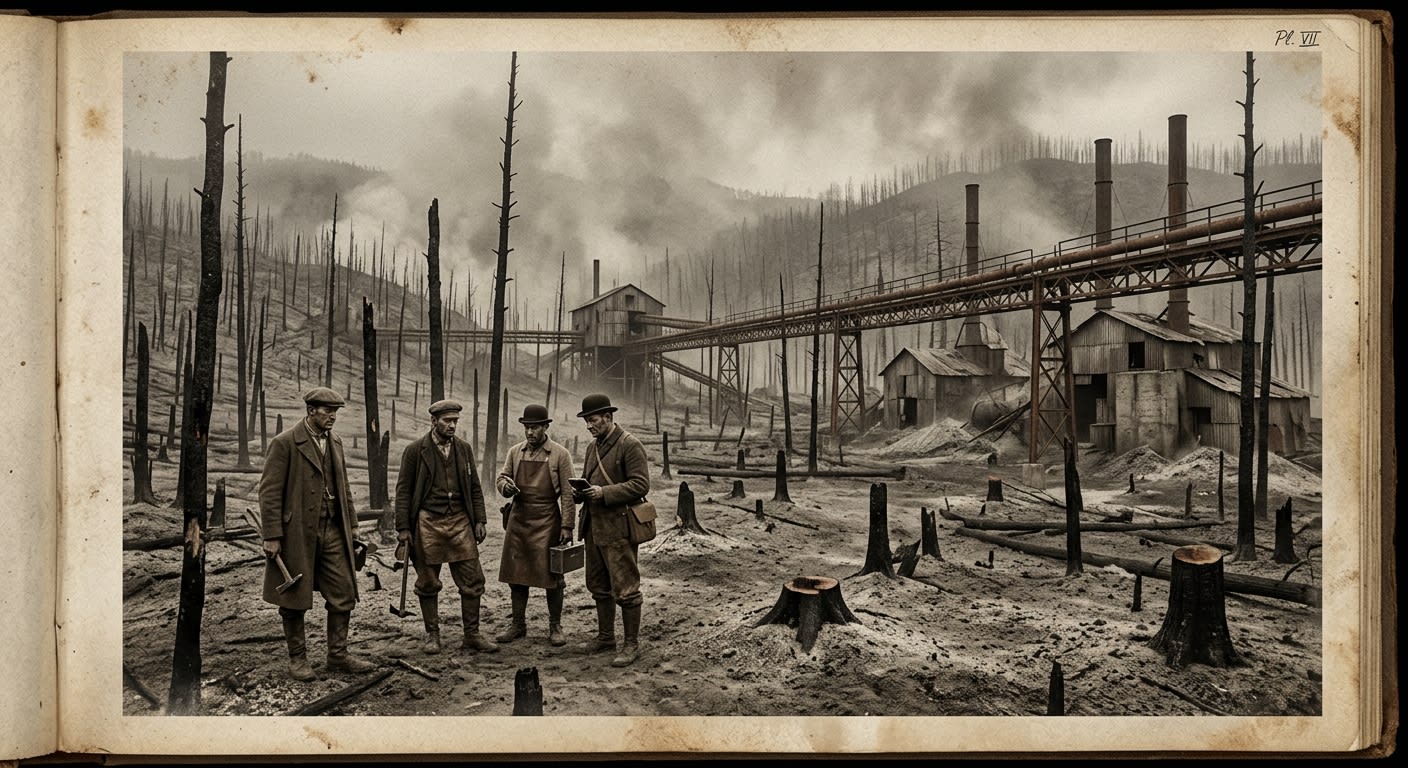
During the Rationalist decades before the Sundering, eastern administrators counted the woods with the bright idiocy of men who believe enumeration is mastery. Compartments were numbered. Timber quality was graded. Monastery holdings were seized and converted into civic reserve. Processional paths became extraction lanes. Bells in forest chapels were silenced under acoustic nuisance ordinances, because a scholar with a clean desk will forbid sound in a place where wolves listen better than magistrates.
The Sundering shattered that confidence. A.S. 45 cracked the Balkans and made the old forest a hiding screen, then a killing screen, then a resource too dangerous to harvest and too valuable to abandon. Refugees passed beneath its branches moving west. Soldiers fled through its gullies with buckles hot against skin. Priests buried reliquaries under roots. Rationalist survey posts vanished, leaving tripods, melted lenses, and record books whose last entries asked for corrected weather tables.
Pre-A.S. 143 Engineering inventories describe the Thracian forest complex as “inexhaustible strategic timber.”
Corrected. No timber is inexhaustible when Wrath owns the match. The old assessment remains in restricted training files so young engineers may learn the chief law of resource classification: the enemy receives a vote, and his handwriting is usually fire.
After the Sagittal Line hardened from retreat into refusal, the forests became an enemy-adjacent reserve. War wanted them denied to Hell. Engineering wanted them harvested before denial. Tithes wanted projected revenue from timber that no licensed cutter could reach. Doctrine wanted sermon examples. Local commanders wanted clear sightlines. Smugglers wanted every path left dark. The trees stood while offices argued, which is one of the few known cases in which wood has outperformed bureaucracy by doing nothing.
#On Maldrake’s Ignition
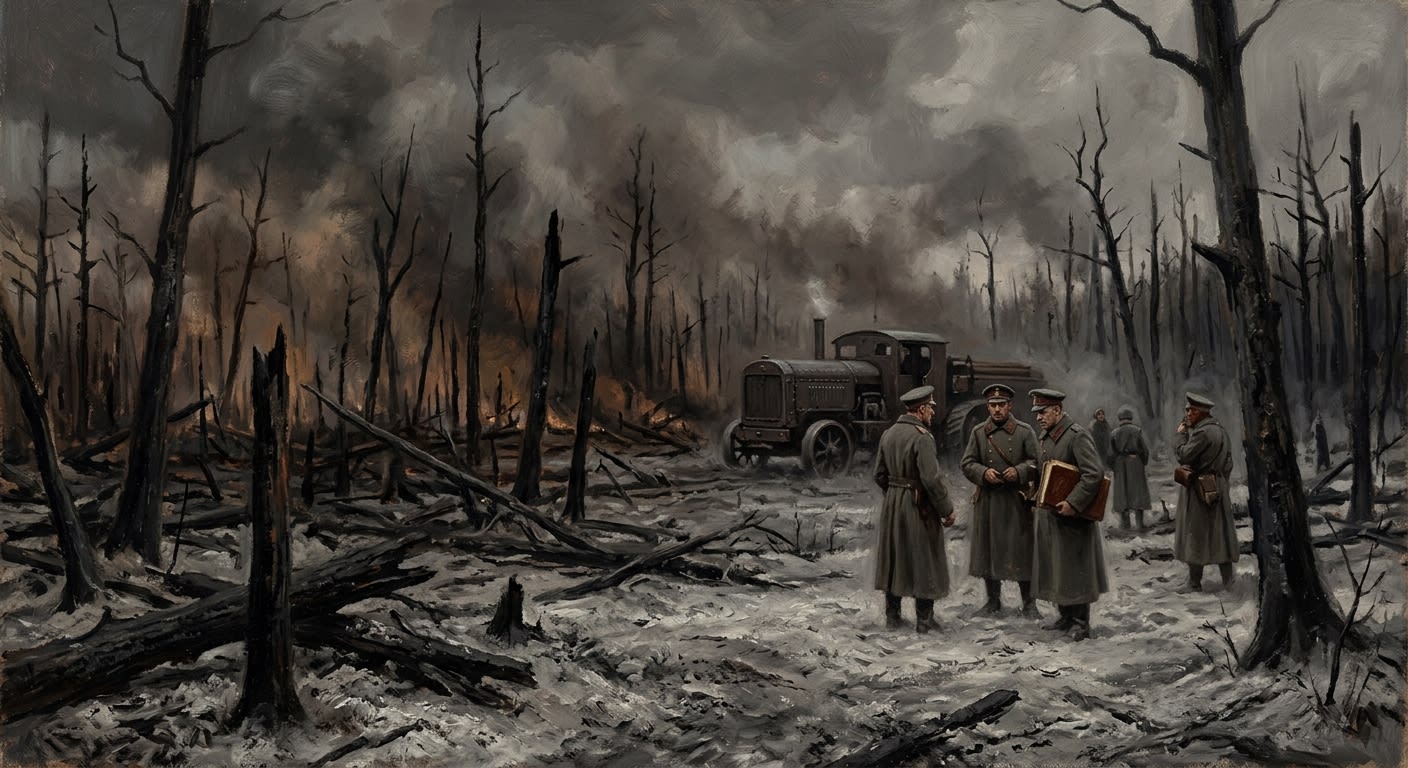
The A.S. 143 ignition began without thunder. Survivors reported a red stillness before the first crown-fire, a heat that did not move with wind, a pressure in the teeth, birds dropping from branches already dead though leaves still held their shape. Then the underwood lit in lines too straight for chance. Ravines glowed from below. Resin knots burst like musketry. The canopy did not catch so much as receive orders.
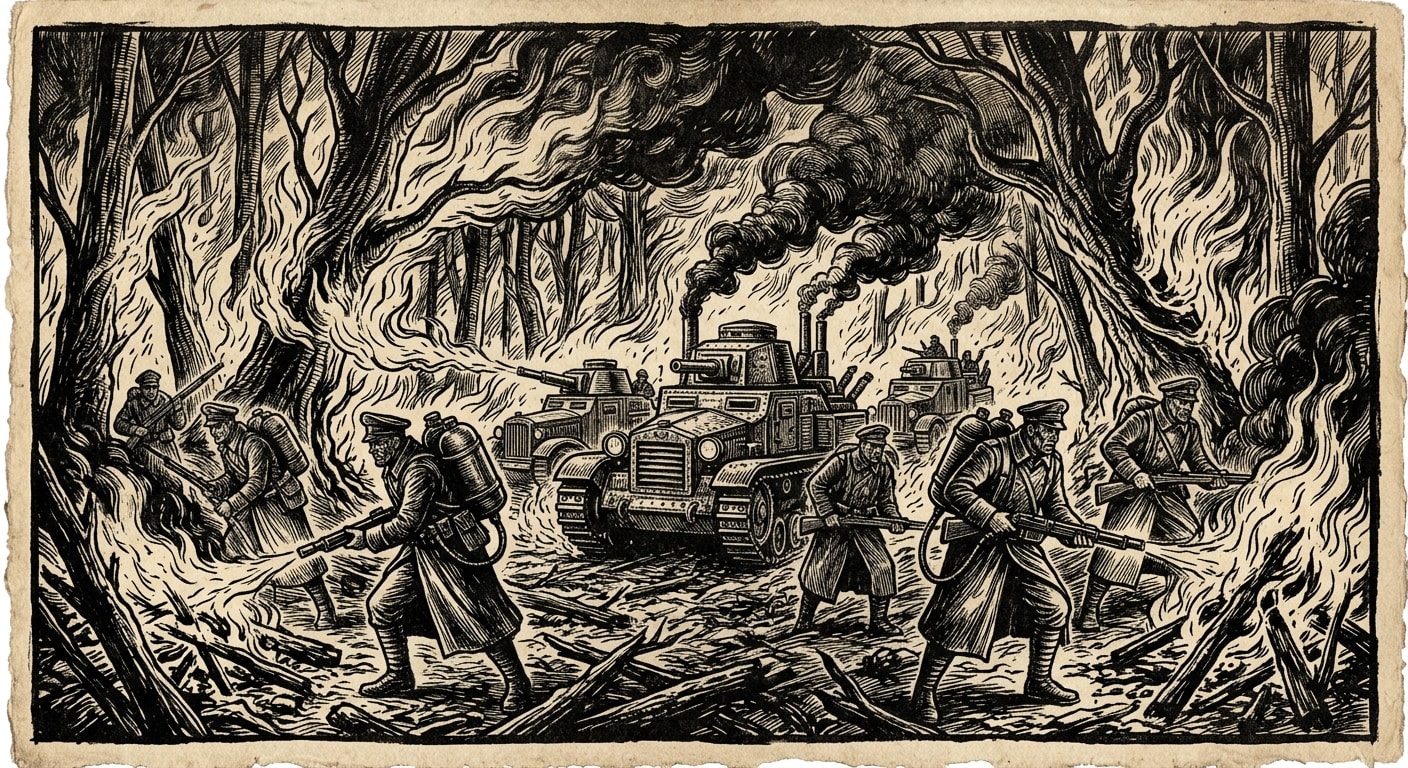
Maldrake’s campaign record calls the act tactical denial of terrain resources. That phrasing has the moral grandeur of a butcher calling slaughterhouse drainage “liquid adjustment.” The forests burned because Wrath found in them a weapon larger than any cannon: stored carbon, resin, deadfall, dry crowns, old roots, abandoned shrines, field chapels, charcoal seams, survey stakes, wagon roads, the accumulated patience of trees, all waiting for command.
The fires ran for three weeks by War count, twenty-four days by Engineering ash deposition models, and “until the sky forgot blue” by Constantinople testimony, which is the least precise and most useful record. Flame moved through valleys faster than horses. Firebreaks ignited before crews reached them. Iron tools softened in carts. Buckets boiled empty. Men sheltering in creek beds found the water warm and red with ash before the fire crossed overhead.
The first smoke rose black. The second was brown with soil. The third, witnesses insist, had a green seam over the southern ridges where old chapel groves burned. Doctrine rejects colour theology in ash reports except when useful. I preserve the green seam because several later anomalies kept its tint: the roofline smoke in the Rot-Week of Saint Vellum teaching annex, the moving ash in Constantinople jars, and certain Candlewick bottles that reflected hands writing from beneath the liquid. Coincidence is a fine servant and a poor master.
FORWARD SURVEY FRAGMENT — THRACIAN WESTERN SCAR, A.S. 143 Crew reached Compartment 17 after second burn. Trees standing, fully charred, leaves intact as grey sheets. When touched, leaves sounded like paper being signed. Under root mass: bell-metal object, warm, repeating █████████. Crew withdrew after Surveyor Malk struck Assistant Roe with transit rod. Object unrecovered.
Maldrake did more than burn wood. He turned forest into atmosphere. The distinction matters. A raiding fire destroys a district. This fire entered weather, liturgy, bureaucracy, appetite, ink, echo, and ration tables. Wrath became particulate.
#On Ash Over Constantinople
The ash reached Constantinople like a second siege. No breach. No ladder. No battering ram. No triumphant demon at the gate. A grey descent, patient and total, settling on ravelin, cistern, loaf, tongue, Host, rifle, cradle, warrant, soup pot, beard, bell rope, and the little eyelashes of children already learning to blink less because blinking wasted strength.
The Ninth Bell Famine was born from this descent. The forests burned for weeks; the ash fell for nine months. Crops failed across Constantinople and six eastern prefectures. Cisterns clogged. Granaries emptied. Ration doors opened at the ninth bell upon nothing. Sixty-eight thousand seven hundred twelve dead by later census, though death continues after counting stops with a vulgar lack of respect for office hours.
Ash is a sly enemy because it resembles aftermath. Men think the disaster has passed when it begins to fall. The Thracian ash entered flour bins and changed the colour of bread. It entered water filters and made Engineering invent new categories of clog. It entered lungs and produced ash-lung among trap cleaners. It lay on gun embrasures until metal patterned under it. It settled on the Host until chaplains could not tell grace from soot by taste, a confusion Doctrine classified as theologically imprecise and physically accurate.
The ration system, sanctified under the A.S. 92 catechism, assumed bread existed somewhere behind the door. The ash disproved this assumption with excellent manners. Clerks stamped empty distributions because the transaction required completion even when the bread had withdrawn from reality. The dead entered the Ossuary Rings as structure. The Bureau of Rites called the famine a refining tribulation before Records finished counting the refined.
Public famine plates state that the Thracian ash “temporarily impeded supply.”
Corrected for doctrinal adults. It killed crops, clogged water, poisoned lungs, weakened artillery accuracy, emptied granaries, fed black markets, expanded the Ossuary Rings by a quarter-mile, and taught the ninth bell to precede silence. Temporarily is the word a clerk uses when he intends to survive the paragraph.
The forests became walls. Their ash fused with bone in the Ash Gallery. Their particulate lodged in lime, mortar, cistern-brick, cloth, and flesh. A tree that once cast shade over a Thracian shrine now faces outward from Constantinople as calcium-grey residue in a skull course. The Bureau wastes nothing, least of all catastrophe.
#On Ash That Learned to Write and Answer
The Thracian forests did not stop at Constantinople. Ash travelled west in weaker bands, across roads, gutters, vats, bell throats, dye water, canyon mouths, canal surfaces, and the innumerable little cracks through which the world informs bureaucracy that forms are porous.
At Candlewick, ash lodged in mordant salts and dye-water. The vats accepted it. Official ink developed appetite. Hungry Ink eats sentence and leaves seal, signature, date, registry shade, and fee stamp intact. This is Wrath’s most insulting joke upon administration: authority preserved, meaning consumed. The first correlations appear in A.S. 143, the same year the forest became sky. Records objected to admitting weather had entered documents, because documents belong to Records and weather notoriously refuses custody.
Hungry Ink is ash after literacy. It blooms black at the margin, sloughs verbs, reverses destinations, and improves grammar with a malice that offends me aesthetically before it frightens me theologically. It never alters the seal. A vandal attacks authority. Hungry Ink genuflects to authority and changes the prayer underneath. That restraint smells of Thrace: not random ruin, but ruin taught office etiquette.
At Peregrine Row, the Echo Creed worsened after the Year of Ash Rain. The canyon had misheard before. After A.S. 143, it edited. Prayers returned with one vowel altered. Contracts shifted nouns overnight. A grief clause changed rate. A water chit became punishment. Stone learned a new catechism from airborne forest and began charging pilgrims for pronunciation sins they had not committed until the wall committed them on their behalf.
This is why the Thracian forests require their own plate. They are more than the fuel source of one famine. They are the dead vegetation through which Maldrake introduced himself to the Synod’s documents, roads, throats, and stones. The Bureau prefers causes isolated: fire there, famine here, ink anomaly elsewhere, canyon error under separate fee schedule. Isolation is administratively soothing and intellectually cowardly. The ash did not respect category. It entered everything available and taught each thing a local form of hunger.
#On the Burned Country Now
No reliable map of the post-burn forest exists. The phrase alone is an argument: post-burn forest. Some reports describe a dead charcoal plain where trunks stand as black columns and leaves hang as grey paper. Others describe regrowth too fast, shoots red at the vein, sap warm, bark patterned like filed teeth. A Shipka scout swore he saw a copse kneeling eastward. A Constantinople deserter claimed the stumps grow rings outward from A.S. 143 and inward from an unnamed future year. Engineering rejected both accounts, then requested samples, which is how disbelief dresses when it wants evidence.
The western scars are hardest to survey. Furnace heat from the Iron Wastes presses through old root channels. Syrionic fog drifts in certain hollows and keeps ash suspended in air long after wind should have carried it. Rain makes black paste underfoot. Metal objects warm when arguments begin. Charcoal pits appear in places where no burner worked. A crucifix recovered near Compartment 9 had tree roots grown through the corpus, though the tree above was entirely ash.
Human use persists at the margins. Smugglers cut through ash gullies when official roads overprice survival. Refugees hide in cold pockets around relic stones. Charcoal thieves, whom I regard as both criminal and admirably insane, collect blackwood that burns without flame and sells dearly to alchemists with poor wills. Wrath cultists mark living stumps with nail-script. Purity patrols erase the marks and sometimes find the same words under the bark.
The old forest shrines fare worst. Some burned clean. Some will not burn further. Some ring under ash when the ninth bell sounds in Constantinople, though distance should prohibit the hearing and common sense should prohibit the report. Common sense has had a poor century. The shrine of Saint Orvan-in-Leaves (Unregistered), once a cutter’s chapel, is recorded by three escaped workers as standing uncharred inside a circle of glassed soil. Its door is closed. Smoke leaves from beneath it in winter. No authorised expedition has reached it. Unauthorised expeditions are, by their nature, bad correspondents.
#On Present Doctrine and Future Caution
As of A.S. 201, the Thracian forests are classified as burned strategic reserve, hostile regrowth uncertain, salvage forbidden without War escort, ash sample custody shared by Engineering, Doctrine, Alchemical Standards, and Records, each of whom distrusts the others in a manner that may yet save us. No civilian timber claim is recognised. No pilgrimage is authorised. No relic recovery may proceed without cold lead, ash masks, double witness, and a clerk willing to write while afraid.
War studies the burn as enemy method. Engineering studies the ash as material event. Alchemical Standards studies the western correlations and sweats into its collars. Doctrine studies the sermons, because the public must be taught that Reason stripped the east, Sin occupied it, Wrath ignited it, and Order alone kept the ash from becoming Europe. This is true as filed. It omits the sharper truth.
The remaining truth is more useful and less comfortable: the forests burned because we left them legible to the enemy. We counted them, valued them, argued over them, delayed denial, delayed harvest, delayed decision, and watched a Sin-General turn our pending file into weather. The Bureau does not like this sentence. The Bureau will survive it. It has survived worse prose from lesser men.
A forest stores time upright. Maldrake felled that time into the sky and made Europe breathe it. The ninth bell still tolls over bones lined with ash. Candlewick still ships ink that watches its seals. Peregrine Row still fines pilgrims for the canyon’s bad vowels. Somewhere east of Constantinople, black trunks stand under red weather, and when the wind crosses them, the leaves that should not exist make a sound like pages turning.