
#On the Count
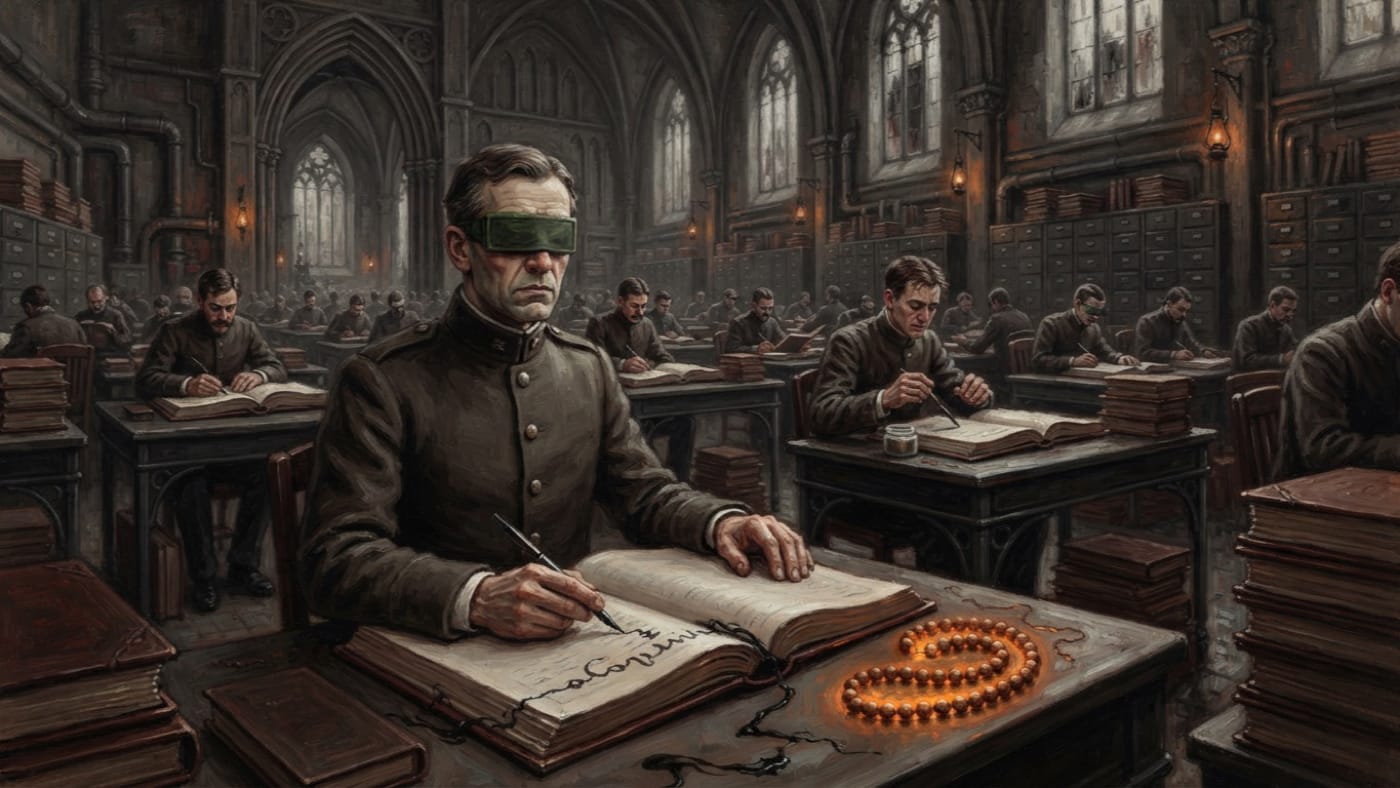
A pilgrim's string is a ledger worn at the wrist. Each bead stands for a station walked, a confession filed or a bell observed. The beads must agree with the book, and the book must agree with the road. When they disagree, the pilgrim is sent to the Cloister of Miscounted Beads on the outskirts of Strasbourg. There the Bureau of Records and the Bureau of Pilgrimage share one damp compound and one purpose, which is to make a life agree with itself.
This is called reconciliation. It proceeds by desk, filing, confession addendum and fee. Where coin fails, it proceeds by labour owed against clerical debt. The pilgrim with a wrong count enters through the Lost-Procession Yard, waits in the Dorm Rows, pleads at the Supplementary Entry Office and is weighed at the desks of the Counting Hall. If the account can be made whole, the Chapel of the Second String issues a lawful second string. The pilgrim walks out wearing corrected obedience at the wrist.
Every amendment in that sequence has an author: a clerk's hand, a sponsor's mark, a Prior's seal. The anomaly under review has none.
#On the Signs
The street calls it bead drift. Without the street's poetry, the phenomenon is this: counts and records at the Cloister amend themselves outside the sanctioned machinery of reconciliation.
It begins small. A bead grows warm in a detainee's pocket while the hand holding it stays cold. A string on an unattended desk clicks as though thumbed. A tally entered in the morning reads differently by evening. No clerk admits to the correction, and the paper shows no scraping. Dry ink bleeds into new letters. Old entries acquire new text in the old ink, the same brown and the same age, as if the page had always said so.
The graver signs concern the dead. Names recorded as cleared dead appear in intake lists. Evidence cases in the Bead Vault warm against the stone. Rosters are reported to crawl. A pilgrim who was cleared and went out through the gate reappears on the roll of Awaiting, and someone stands at the desk answering to that name.
The Cloister's first catastrophe, which Records has never dated to my satisfaction, took this last form at scale. Dozens of names entered as cleared dead returned to the ledgers at once. The Outer-Watch answered with panic arrests. The arrests fell on the living, the dead being unavailable for custody.
Those are the observations. What they prove belongs on a separate docket, and that docket remains open. No tribunal has ruled whether the drift restores a truth the clerks mislaid, fabricates identities, alters the memory of whoever reads the ledger, or reaches through the page into flesh. The street says the string "finds" the dead. The street also says the Clickery desks move at night.
The return of a dead name to the Cloister ledgers constitutes evidence that the named person has risen bodily.
Retracted. A name is ink. A resurrection requires an empty grave, and no grave has been entered into evidence. The earlier phrasing was drafted by a copyist with a gift for sermons. It has been corrected by one with a gift for filing.
#On the Prior's Writ
Prior-Scribe Erem Vale does not use the phrase bead drift. His term is "autonomous reconciliation irregularity," which has the merit of containing three words and no accusation. He holds the clearance seal, the suspension seal and the anomaly counterseal. Under his revision of Chapter procedure, no anomaly may be described before it is classified, and no classification may be revised without his hand.
Read that twice. The Cloister cannot say what it has seen until Vale has named it. Once he has named it, nothing that happens afterward can rename it except Vale.
Here lies the doctrinal embarrassment. At the Cloister, correction is both a sacrament of the office and a line of revenue. A life is amended when the fee is paid, the sponsor answers, the addendum is filed and the seal comes down. The drift amends without fee, sponsor, addendum or hand. It performs the Cloister's one power for nothing. An institution that sells correction by the paragraph cannot tolerate a competitor that gives it away.
Vale's remedies are administrative and exact. When cases warm, he orders silence. When rosters crawl, he orders them covered. When a cleared pilgrim returns to Awaiting, he seals the earlier clearance and holds the present claimant. He then routes the contradiction into a file thick enough that no single clerk sees both ends of it.
Now look at that last remedy from the cot. The claimant's clearance exists and cannot be consulted. The claimant's body exists and cannot leave. Neither document may be called false, because that would require a classification, and classification waits on the Prior. The detainee does not know the charge, because there is no charge. There is only a file, and it keeps growing.
#On Silence and Custody
The reported countermeasures are these:
- silence hours
- vinegar cleansing of desks and hands
- sealing suspect strings in salt-wax
- moving detainees to the undercroft
- locking the gates
- controlling the ink stores
- isolating the Vault
- burning strings judged beyond keeping
No one has shown that any of them cures anything. They are performed because they can be performed.
Silence has the strongest local following. The silence tests are held in rooms where, it is said, speech makes the ink crawl. The drift is also alleged to spike between the third and fourth bell, so clerks dim their lamps and swallow their coughs. I record the allegation. I do not ratify its timetable.
Archivist Keth keeps the Vault. Evidence goes in on her countersigned receipt and comes out the same way, and a warm case goes nowhere she has not permitted. The street files the rumour of the First String under her name. Nothing shows her to be more than its most discreet neighbour. She has told me nothing, which I respected more than I enjoyed.
Jossa Rill holds intake. A lockdown closes the gate, but the road stays open. Processions keep arriving and the Yard keeps filling. Rill must sort bodies into berths that anomaly week has already filled twice over. The Outer-Watch locks the chain gates, and the city grumbles on the far side.
For the detainee, each measure takes something more away. Silence takes the voice that might plead. Salt-wax takes the string that proved a road was walked. The undercroft moves the body out of reach of sponsors and daylight. The gate lock stops bread carts as readily as it stops fugitives. During the A.S. 199 anomaly week, food ran so thin that Vale called the condition "protective narrowness." The Dorm Rows repeated the phrase, because a hungry man will eat whatever he is given, words included.
#On the Buyers of a Past
Wherever the Church opens a delay, someone rents a chair beside it. The Sponsor-Seal Brokers profit from every suspended clearance, since a suspended soul can still pay. The Grave-Name Market trades dead identities and compliant pasts in the rubble taverns outside the wall. To them, a drift that returns dead names to the rolls is an unlicensed competitor flooding the market with stock.
One rule holds, or is said to. Once an anomaly is declared active, no one can buy its cancellation. Beside that rule I place the exception from the sealed week of A.S. 199. One noble pilgrim was cleared by dawn under an authority that is still blacked out in the Chapter minute. An unexplained clearance is not a cancelled anomaly. It is only an unexplained clearance, and the Bureau of Doctrine has been told nothing more.
The Quiet Thread wants the drift for itself. The cell works with stolen strings, silence tests and rites of its own. It teaches that the drift can be directed, whether to restore names or to ruin them. It also teaches of an original count and a First String beneath the Vault. That is the cell's doctrine. No tribunal has seen it succeed.
#On the Present Condition
As of A.S. 201, the Cloister is overfull from the intake pressure that followed A.S. 198. Evidence in the Vault runs warmer than stone should allow. Clearance moves at the speed of Vale's seal, which is the speed of his caution. The Chapter's present assessment projects five anomaly weeks. They are projected. None of the five has yet been lived, and I will thank the copyists to stop writing them in the past tense.
Above the Cloister, the phenomenon remains unclassified. Inside it, the phenomenon is classified by one man only, the man it most offends. Records declines to call it drift. The ink declines to consult Records.
Disposition: continue observation. Continue silence. Continue to hold the claimant.