
#On the Regiment That Exists by Absence
The 14th Parish Regiment does not exist.
This is the official position, the Records position, the pension position, the sermon position, the supply position, and the position taken by several men who watched its barracks burn from the lower service court of Bastion-Constantinople and later discovered that memory, unlike a muster roll, lacks a convenient erasure grid. The Regiment was struck from every roll after the 23rd of Argent, A.S. 170. Its colonel was administratively dissolved. Its annuity schedules were reduced, rerouted, disputed, and blessed. Its powder allotments vanished into corrected columns. Its dead were not buried as a regiment because a regiment that never existed cannot require a cemetery.
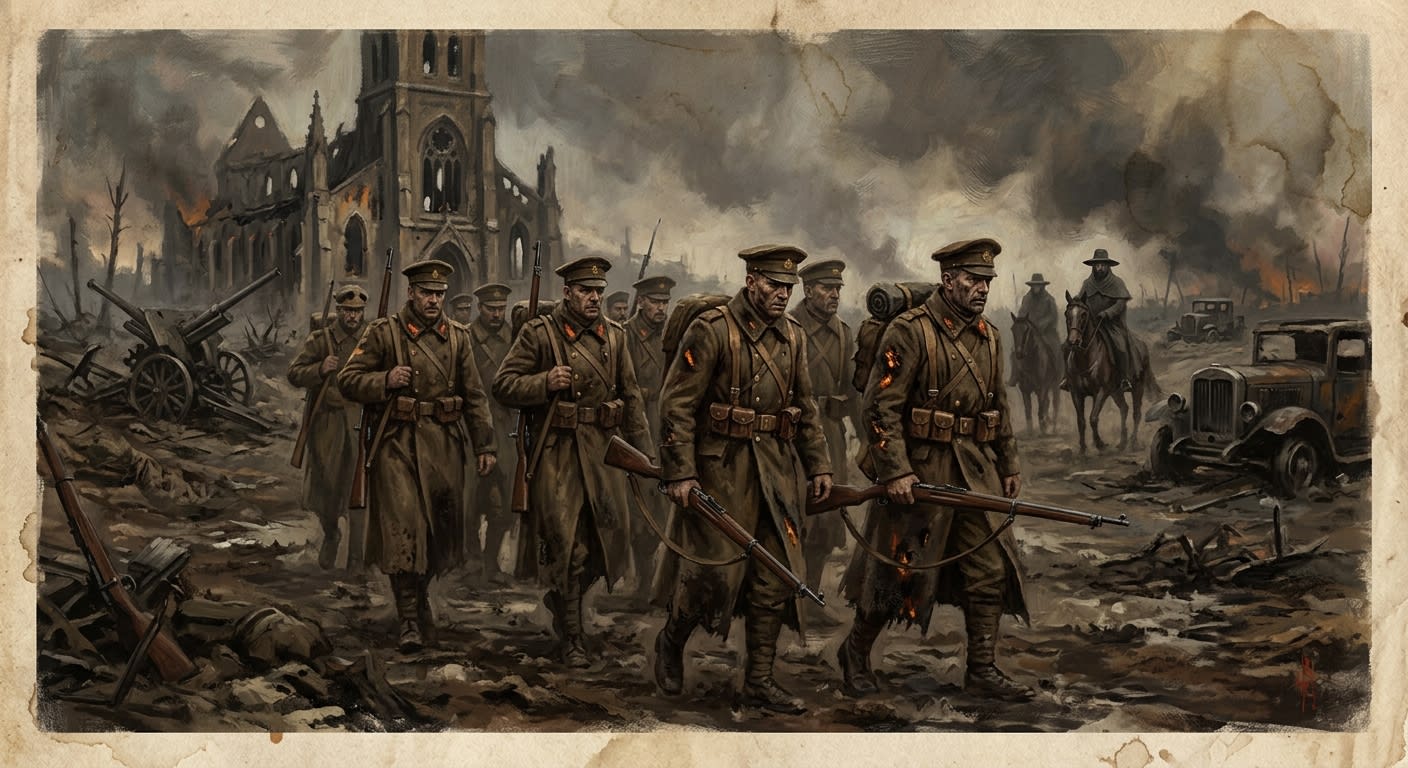
The old files, when they have not been improved beyond usefulness, identify the 14th as a parish artillery regiment assigned to the relic batteries along the Sixth Ravelin’s southern curtain. Three hundred and twelve men. Parish-raised, oath-bound, trained for bell-cannon service, sworn under Article 14 (Unregistered) of the Catechism of Obedience, lodged in barracks close enough to the powder magazine that any sensible commander would have forbidden torches after Vespers. Sensible commanders are not always the ones selected by history. History prefers men with keys.
To write of the 14th is to write from the scorch around a missing icon. The Bureau has left us absence, and absence, when filed carelessly, has edges.
#On Parish Artillery and Article 14
A parish regiment is a compromise between local devotion and military appetite. The parish provides sons, old banners, a chaplain with too many funerals ahead of him, and the fiction that service remains rooted in home. The Synod provides guns, oaths, uniforms, transport, discipline, and the corrective discovery that home itself can be requisitioned through the son.
The 14th’s oath lay under Article 14: oaths sworn under the Catechism are binding unto death, and collective dereliction is punishable at the discretion of competent authority. It is a beautiful clause, if one admires traps. No dereliction need be individual when the word collective has entered the room. One man’s hesitation may condemn a squad; a squad’s misstep may condemn a regiment; a regiment’s silence may condemn its ancestors if a clerk is sufficiently awake.
Relic artillery crews were prized precisely because their work required obedience at tolerances finer than courage. A bell-cannon does not forgive missed cadence. Relic ammunition does not tolerate private interpretation. The gun crew must hear, load, chant, witness, fire, cool, and record in one braided action. The wrong breath may ruin the throat. The wrong pause may invite what the manuals call hostile frequency. The wrong thought, after A.S. 196, may also be prosecutable, though in A.S. 170 the skull still enjoyed a few sentimental liberties.
The 14th lived under sound, powder, vow, and proximity to sacred machinery. That condition produces two kinds of men: the obedient and the men who have learned to resemble them closely enough for inspection. We have no lawful means of knowing which sort filled the barracks on the night of the Paper. The Bureau destroyed the category with the men.
#On the Night Paper
The Night Paper arrived on the evening of the 22nd of Argent, A.S. 170, before the Vigil of the Hollowed, carried under curfew by a grey-coated runner whose boots were reportedly worn through. It named the 14th Parish Regiment oath-broken under Article 14, §3. It gave no reason. Night Papers do not explain. They pronounce.
Protocol required the Paper to be read once aloud to a quorum of three, burned in a covered dish, and weighed before dawn. The colonel read it privately. He summoned no quorum. He burned it in his lamp. He took a torch in one hand and the powder key in the other. He walked to the barracks.
Commemorative abstracts once state that the colonel “fulfilled Night Paper protocol with exemplary zeal.”
Corrected. He violated the reading protocol, the quorum protocol, and the witnessed-burning protocol before committing an act later praised as preemptive compliance. The Bureau forgave the procedural sins because the ash weighed politically well.
The charge itself remains sealed, if any charge existed beyond the sentence. Theories are unhelpful but persistent: stanza drift in the relic batteries; suspected Maldrake contamination; a false denunciation under Article 19 before Article 19’s own time, an impossibility attractive to Records; Shadows interference; Doctrine foreknowledge; a line officer’s panic dressed in black wax. None has been ratified. Ratification is how rumour receives teeth.
The surviving account places the regiment’s destruction before midnight. Barracks burned. Powder stores went. Men inside did or did not wake before the second blast, depending on whether one reads Engineering soot analysis, Rites consolation notes, or the single surviving kitchen boy whose testimony was later reclassified as smoke fever and whose kitchen did not, according to Records, exist.
WITNESS FRAGMENT — SERVICE COURT, SIXTH RAVELIN Speaker: kitchen auxiliary, age disputed Statement: “They were singing the loading line from inside. After the roof fell, the line kept time.” Medical note: smoke fever; auditory contamination probable Records note: witness role unsupported by payroll Final disposition: ███████████████████████████
#On the Breach Made by Obedience
At first light, Maldrake’s Hellbow Legion struck the southern curtain. The four bell-cannon assigned to the 14th stood cold. Their crews were ash. Their ammunition remained blessed and unused, which is an affront to ordnance and a courtesy to Hell.
Seven Hollowed reached the wall. Six detonated. The seventh stood for eleven seconds, turned its head, and fell. One hundred and forty metres of curtain cracked into powder. The breach remained open for nine hours while the garrison held with rifle, hymn, bayonet, rubble, meat, and that final sour courage which appears only when command has already failed.
Doctrine later classified the sequence as miraculous zeal. The classification is insulting chiefly because it is not wholly false. Zeal existed. So did a missing regiment, an unmanned artillery curtain, a Night Paper that should have been ash, and a Bureau of Engineering pour-frame that arrived at the fourteenth bell with instructions ready for exactly the disaster that had occurred.
The 14th is remembered, when remembered at all, as prelude. This is unjust and typical. The forty-seven entered the wall and became sacred architecture. The 14th burned before the wall fell and became inconvenience. Pilgrimage loves the visible sacrifice. Archives prefer the erased one kept under a weight.
#On the Colonel Without a Name
The colonel’s name has been gridded under Administrative Dissolution. This means he is not dead in the ordinary legal sense. Death preserves a citizen as a completed entry. Dissolution converts him into revocation: present by consequence, absent by law, visible only where the ink failed to sink.
He is the perfect officer for the affair. If he obeyed a genuine Paper, he was an instrument. If he exceeded it, he was a murderer. If he was deceived, he was a dupe. If he collaborated, he was a traitor. Administrative Dissolution relieves the Bureau of choosing among these rude nouns. The grid is merciful to the institution.
His last act was competent in the mechanical sense. The barracks burned efficiently. The powder caught. The roll vanished. No surviving command roster lists a formal objection, though objections shouted inside a burning room are notoriously difficult to file. His posture at the desk was later described as edifying. His posture at the barracks door is not described.
Families of the dead received reduced doctrinal-cause handling. That phrase deserves preservation in a jar. Reduced because oath-broken men cannot earn full annuity. Doctrinal because the charge came under the Catechism. Cause because hunger, widowhood, fatherless children, and parish scandal must each be given an official parent before Mercy can deny them properly.
#On Relic Guns Left Cold
The military fact remains ugly. The 14th manned relic artillery along the exact curtain Maldrake struck. Their absence made the breach possible, or widened it, or merely denied the defence its first proper answer. Bureau memoranda distinguish these possibilities with exquisite care because guilt changes shape depending on whether a dead gun would have fired once, twice, or long enough to matter.
A relic gun crew is not interchangeable. Powder boys know the hand rhythm. Loaders know the throat’s temper. Cantors know which verse the brass hates in damp weather. Records witnesses know which crewman lies about shell count. A regiment destroyed before battle takes more than bodies with it. It takes habits, timing, grudges, superstition, and the small local competence by which a gun survives its official manual.
Hellbow bolts recovered after the Vigil made the absence crueller. One contained dry ash that formed the 14th’s seal when exposed to rain. Doctrine classified this as coincidence, then sealed the rainwater. The sensible reader will ask why coincidence needs a seal. The sensible reader will also stop asking before a grey coat arrives.
#On Memory, Denial, and Present Use
As of A.S. 201, the 14th Parish Regiment remains absent from official rolls and very present in the habits of command. Night Paper protocol is read with less swagger in artillery schools. Quorum requirements are enforced when witnesses can be found sober. Relic battery officers sleep with powder keys on chains under their shirts, not in wall boxes. No regiment at Bastion-Constantinople is lodged beside its own full magazine during Vigil week, though the regulation cites ventilation rather than fear.
Chamber 7 receives pilgrims. The forty-seven receive a single braided lamp. The colonel receives a grid. The 14th receives smoke, reduced annuity, and the sort of silence that gathers petitions under doors. In certain parish houses, old women still set out three hundred and twelve grains of salt on the 22nd of Argent, then sweep them into the stove before dawn. Purity has discouraged the practice. Old women, being older than several Bureaus and more patient than most armies, continue.
Field catechists sometimes teach that the destruction of the 14th proves the perfection of obedience under crisis.
Clarified. It proves the velocity of obedience under black wax. Perfection is a doctrinal judgement reserved for outcomes that do not leave an unmanned curtain before a Hellbow assault.
The lesson permitted for public instruction is narrow: oaths bind, Papers command, hesitation kills, zeal seals breaches. The lesson preserved for those of us burdened with intelligence is broader and less comfortable: a state that can erase a regiment can also forget why it needed the regiment alive.