
#On the Steel From Which All Approved Throats Descend
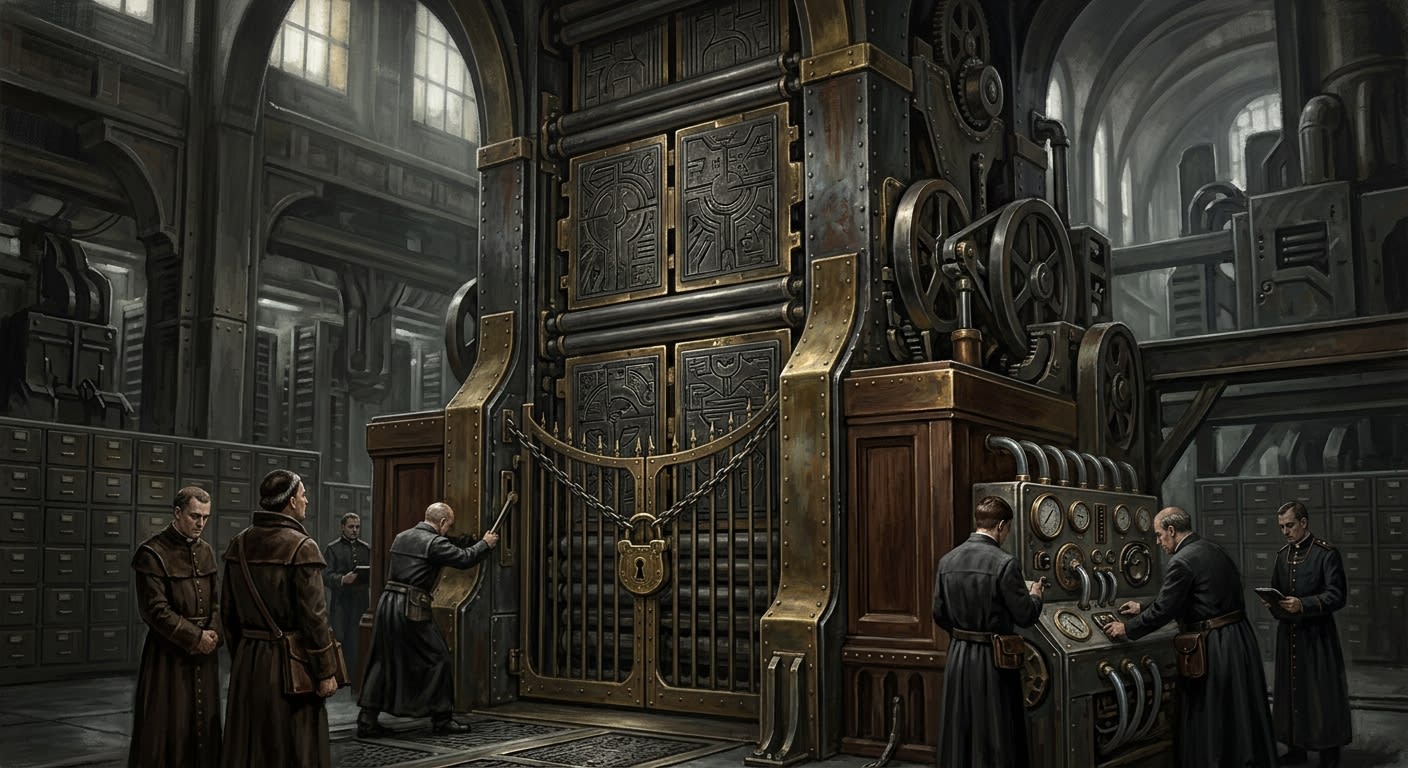
The Master Hymnal Plates are the Bureau of Orison and Song's cold scripture: engraved steel plates from which all authorised hymns, chant sheets, industrial pour-stanzas, broadcast cadences, curfew prayers, execution psalms, orphanage dormition measures, and calibration sequences are copied under seal. They sleep in the Cloister of Calibrated Breath at Strasbourg, chiefly in the Vault of Tuning, where Cantor-Scribes watch them with the glazed suspicion of men guarding a sleeping knife.
Every parish hymnbook claims descent from them. Every approved choir sheet owes obedience to them. Every hymnsteel pour at Essen-of-Hymnsteel receives, by copy, their command. This is the first doctrine of the Plate: the voice must not improvise while pretending to serve. Breath is animal. Song is social. Hymn is administrative.
The public speaks of them as sacred originals. The Bureau speaks of them as technical instruments. Both phrases are correct and insufficient. A Plate is a legal ancestor. It makes every later sheet legitimate by descent. Alter the Plate and a nation has always sung the alteration. Replace the Plate and memory becomes a parish error. Correct the Plate and the mouth apologizes.
#On Custody and the Ritual of Access
Access to the Plates requires three Orison seals, a Doctrine countersignature, a custody clerk from Records, and a strip-search by a Provost whose hands smell of cloves, iron, and professional disappointment. The search is not theatrical. Ink may hide under a nail. Wax may hide in a cuff. A breath mark may be carried by memory, which is why witnesses are made to hum baseline tones before entering and after leaving, so that any stolen note may be detected in the throat.
The Vault is colder than the rest of the Cloister. Orison claims this preserves steel and wax. I suspect the room merely enjoys being unpleasant. Plates lie in steel drawers under linen, beeswax seals, and custody ribbons. The drawers bear class marks: Parish Common, Parish Feast, War Directorate, Industrial Calibration, Broadcast, Penitential, Mercy, Execution, and Restricted. The Mercy shelf is thin. The Execution shelf has been polished by use.
A Plate may not be touched by an ungloved hand. It may not be warmed by common breath. It may not be rubbed without witness. A Cantor-Scribe reads the Plate while a second confirms interval, pause, syllable weight, stress, measure, and approved silence. Silence has marks. Silence always has marks. An unmarked silence is where the Enemy, the heretic, the mother, or the worker enters, and none of these persons is licensed to compose.
Copies descend in stages. The Plate produces a master rubbing. The master rubbing produces distribution sheets. Distribution sheets produce local books, choir slips, barracks cards, transmission packets, and furnace stanzas. Each layer receives its seal. Each seal asserts descent. A hymn may travel from Strasbourg to a trench chapel at Bastion-Przemyśl or a pour platform in the Hall of Measures, but the Plate remains the legal throat.
#On Classes and Uses
The parish Plates govern ordinary public devotion: morning hymn, evening hymn, funeral response, harvest procession, plague-lane prayer, child stillness measures, and the little verses by which exhausted citizens are persuaded to call exhaustion gratitude. Their danger is social. If a parish sings one line differently for long enough, it becomes memory; if memory is permitted to thicken, it becomes local doctrine; if local doctrine survives two winters, Strasbourg must either bless it or burn it. The Plate prevents this expensive fork.
The Broadcast Plates govern the Orison Hour, casualty rolls, ration announcements, work quotas, curfew prayers, and doctrinal notices sent through Orison Signal Engineers and saint-dust carriers. Here precision is more than piety. A wrong stress in a curfew packet can produce panic. A wrong interval in a casualty roll can invite under-voices into the carrier. Engineers learn early: if the signal speaks your name beneath the third verse, log nothing until another man hears it too.
The War Plates are uglier. They carry stimulant hymns for Shipka fog, coded cadences against Morwen's mimicry, counter-orisons against Velkara's perfumed invitations, and rupture chants for the Bureau's own throat-machines. The Bureau says these Plates defend the faithful. Naturally. A chain defends the prisoner from wandering.
The Industrial Calibration Plates are the most politically delicate. Essen's choirs sing from descendants of these steel authorities while metal cools, grains align, rivets learn moral coherence, and bell-cannon throats receive their obedient memory. A quarter-tone error in a parish makes a priest sour. A quarter-tone error in Essen may kill a gun crew months later on the Sagittal Line.
That is the public lesson. The private lesson has teeth.
#On Essen and the Cut Fourth Line
Before the Tri-Bureau Compact fixed Essen under Engines, Records, and Orison in A.S. 110, the old guild-forges used work-cants, hammer rhymes, whetstone mutters, river measures, and furnace songs too filthy for a choirbook and too effective to ignore. When the Compact buried the artisan quarter under calibrated halls, it did not abolish song. It stole it, washed it, engraved it, and called the result obedience.
The earliest Essen Plates contained forge stanzas whose fourth line produced sub-foundation speech during pours. That is the polite phrasing. The foundations spoke. They did not creak with heat, settle under load, or groan like timbers seeking attention. They answered in patterns the Bureau of Rites could not classify and Doctrine could not tolerate. The auditors heard the city become a respondent. They had enough cowardice to survive and enough rank to make cowardice policy.
Orison teaching copies state that the Essen Master Hymnal Plates were revised for singer safety, grain stability, and doctrinal standardisation.
Corrected under restricted Doctrine custody. Those reasons were useful covers. The private purpose was prevention of unauthorised sub-foundation articulation. The fourth line was cut because the floor had begun to speak back.
The revised Plates gagged the foundation voice during ordinary production. They also created the condition now called Resonance Bloom, or worsened it, or taught it to return through failure. The distinctions matter to engineers and cowards. To the worker whose teeth ache in sequence and whose street falls silent after a Bloom, the Plate is less origin than wound-cover.
No office admits authorship. Orison calls the change standardisation. Engineering claims no memory. Records lacks the revision trail with a delicacy so practised it should be illegal even by our generous standards. Doctrine denies the question's premise and keeps a copy of the premise under Vermillion lock.
SEALED PLATE NOTE — ESSEN REVISION / VERMILLION COPY Public line: grain-stability revision. Secondary line: singer safety. Suppressed line: █████████████████████████ produced answer beneath Pillar 17. Instruction: remove fourth line from industrial calibration descendants; retain one witness Plate; deny comparative access. Later annotation: Bloom not resolved. Bloom displaced.
#On the Mirror Choir's Theft of a Fact
The Mirror Choir became dangerous the moment it stole a fact from the Synod's locked drawer. Its doctrine is simple: the official frequencies are false; the Plates were altered; the old song survives beneath Essen; correction requires disobedience. This is poison of excellent vintage, because the first three statements contain enough truth to make the fourth feel like justice.
Mirror variants alter a syllable, breath mark, quarter-tone, oil-smudge, page turn, or sustain line. Some variants are crude and deserve burning for aesthetic reasons alone. Others are beautiful. They preserve metre, reduce singer strain, and sometimes produce hymnsteel of alarming purity before later failures appear. Beauty in a forgery is more offensive than ugliness. Ugliness flatters the inspector. Beauty asks whether authority has been hiring the wrong singers.
The Mirror Choir does not need to seize the original Plates. It needs only to persuade singers that the Plate is already a forgery. Once that suspicion enters the Throat Dorms, every approved stanza becomes a suspect object. A singer feels the forbidden line before hearing it. A Discord Scribe marks a breath where sustain is ordered. A batch cools obediently and fails later under fire. The metal remembers what the audit did not catch.
This is why the Plate vault is guarded more fiercely after every Bloom. The Bureau pretends to protect originals from heretics. In truth it protects the fact that the originals have histories, and histories are where obedience begins to rot.
#On Errors, Corrections, and Retroactive Truth
A Master Hymnal Plate is never wrong in public. It is corrected, clarified, restored, harmonised, regularised, or purified. These words describe the same act performed under different lighting. A line once sung by ten thousand parishes may be removed overnight; by morning, all loyal mouths have always omitted it. A pause may be lengthened; yesterday's shorter pause becomes regional drift. A mercy cadence may be hardened; tenderness becomes improper softness. The Plate does not change. The past is instructed to catch up.
The common citizen hears this as music. The trained clerk hears custody. The heretic hears opportunity. Every correction leaves ghosts: parish copies not yet recalled, old singers whose muscles remember a kinder interval, children who learned the prior line before the schoolmaster burned the cards, soldiers who tap a gun throat and hear something no current Plate admits.
The Plate system survives because most citizens are tired, most choirs are watched, and most mouths prefer safety to accuracy. Do not sneer. Safety is persuasive. A man who has seen a Tone Inquisitor inspect a child's lullaby develops respect for approved silence.
A.S. 181 Hymnal Directorate circular stated: “No authorised hymn has ever undergone doctrinal alteration after promulgation.”
Clarified. The statement remains doctrinally true because each alteration, once promulgated, becomes the authorising condition by which earlier witnesses are judged defective. The Bureau does not revise hymns. It revises singers.
#On the Present Custody, A.S. 201
As of A.S. 201, the Master Hymnal Plates remain secure in public record and nervous in private handling. The Cloister reports secure drawers, intact wax, acceptable Cantor-Scribe attrition, strained audit capacity, and persistent unauthorised melody pressure. Essen reports increasing Bloom. The Wrong Choir hums beneath the Foundry Core. Sister Rauth restricts access to industrial descendants. Purity demands variant seizures. Records demands custody fees for the seizures. Doctrine demands silence with the superb manners for which we are justly feared.
The Plates have become less archive than battlefield. Orison guards them as originals. The Mirror Choir invokes them as evidence. Engineers fear them as load-bearing lies. Workers curse them when teeth begin to ache. Priests kiss approved copies before singing. Soldiers trust the metal those copies taught. Somewhere under Essen, a line removed from steel continues trying to enter the world through rivet, jaw, bell throat, and blood.
The drawer closes. The wax cools. The Cantor-Scribe signs. The copy descends. The mouth obeys.
Under the floor, the old line waits.