
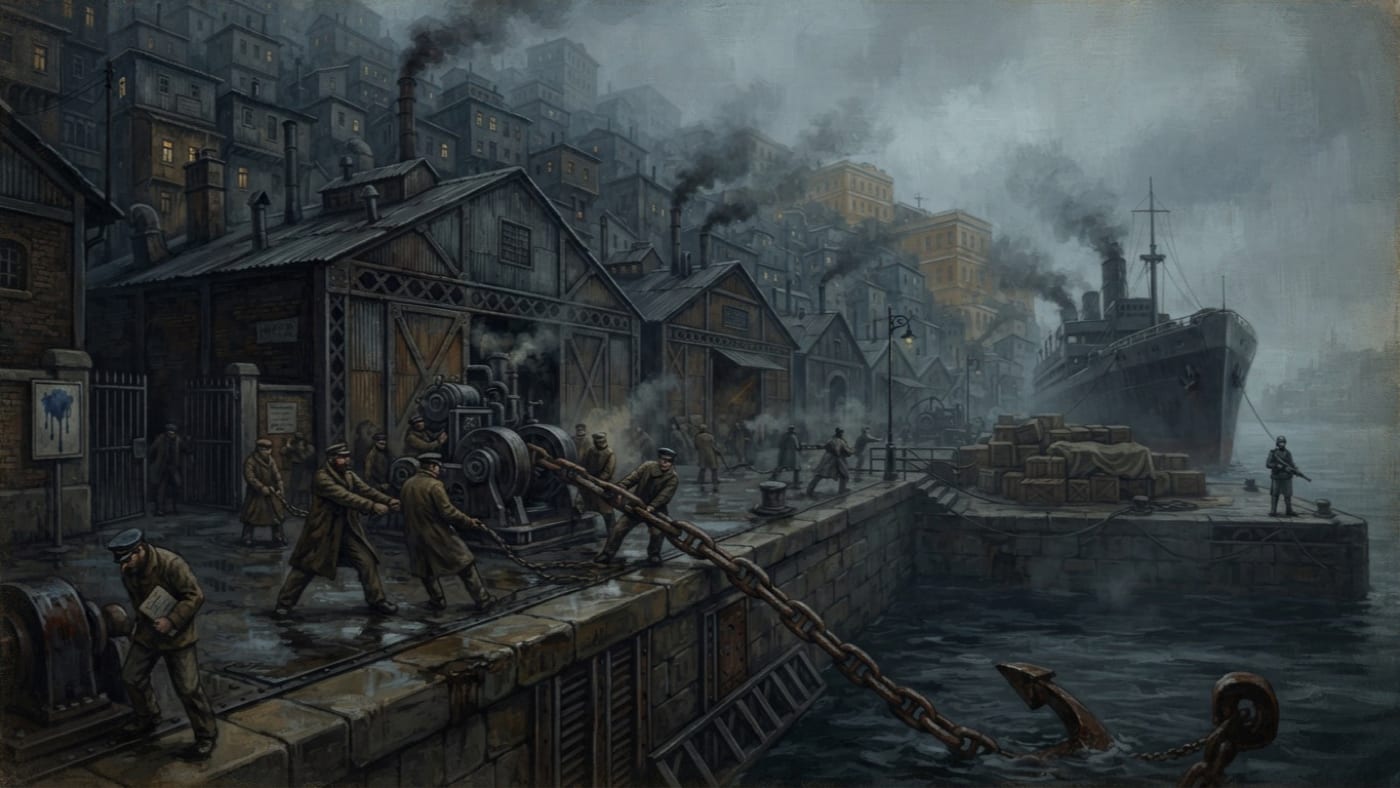
#On the Blue Entry
In Bastion-Constantinople, an address is a sentence before it is a street. The Bureau of Settlement enters every household in the city under one of seven ledger colours, and the colour decides more of the household's life than the household does. Blue is the colour of the Harbor of Chains district and the maritime quarter pressed against it. That means a mile of fortified quay along the Bosphorus, eleven piers, the winch-house, the customs sheds, and the wet lanes behind them where the people who work all that iron go home to sleep.
"Blue ledger zone" is a description, and I use it as one. No cabinet I have been permitted to open holds a decree under that title. The Bureau calls the place Blue. The harbor calls it the docks, or home, or something unprintable. The ledger calls it a column.
Being entered Blue means a dye-vat has a say in your bread, your tithe and your road. The household register names who sleeps under the roof. The ration roll counts their mouths. The Bureau of Tithes assesses what the roof owes. The permit is dyed to match and carried in a coat pocket, and it answers for the body inside the coat. Any of these can be reviewed. The person they describe may contest them only on the correct form, in the correct office, before the correct clerk leaves for lunch.
#On Residence and Passage
Residence and passage are separate sacraments, and much of the city's misery lives in the gap between them. A Blue permit says where a household belongs. It does not say where that household may go. Crossing into another colour requires a transit stamp. In the published case, a Crimson permit-holder found in White without one is detained. If the sub-Archon is having a poor morning, that person is reassigned to the Grey barracks as a volunteer auxiliary, a classification that requires no volunteer. I know of no separate schedule of penalties written for Blue. None is needed. The general one is generous enough.
For the visitor without a map, the other colours are these. White holds the Sanctum Mile and the Hierarchate Offices. Crimson holds the Foundry Quarter and its military workshops. Black is the Ossuary Rings garrison. Grey is the Hammers, the conscript barracks. Green is the Pilgrim's Coast approach and the satellite communities strung along it. People entered under no colour at all live in the Warrens, which the maps describe as solid stone. These colours belong to Constantinople alone. They have nothing to do with the numbered Zones of the continental map, where the city sits in Zone 4, or with the dye bands other offices print elsewhere. In Constantinople, a zone permit speaks a local dialect.
Ochre gets a paragraph of its own. Ochre covers the civilian residential terraces above the old walls. These are households with no forge, garrison or quay to account for them, stacked on the slope where the air is drier and the harbor bells arrive half a beat late. You can see Ochre from Blue. It is up the stairs. It is the same ledger with a different column and a different clerk.
#On the Households Behind the Manifests
The Bureau of War sees the harbor as throughput. Piers One through Four take munitions and rations. Five and Six take pilgrims clutching stamped papers. Eight through Eleven take grain, coal and salt. The men who move all of it are entered Blue: chain crews, pier wardens, customs clerks, sailors, handlers, and the winch-house engineers who raise the Chain of Saint Anakletos at dusk in a dialect only they understand. Behind each of them is a household under the same colour. There are wives and mothers, children, lodgers, and an uncle who once worked the capstan and now counts gulls from a doorstep.
The labour rolls tell you how many men lift crates. They do not tell you how many people live in Blue. I will not pretend that arithmetic exists. Settlement's published census figures for the city contradict themselves, and I decline to inherit the quarrel.
The colour matters most at a death. When a chain-man is crushed between link and capstan, his certificate reaches Settlement before his body reaches the ground. His permit is cancelled, his household is recorded anew, and his widow's ration is revised. The form is two pages, and she receives her copy within six working days. She still has to eat during those six days.
That is where the Widow's Syndicate earns its licence. The House of Black Pennies keeps counters from the Blue Zone up through the Ochre terraces. It lends against pensions, dock wages, ration arrears and burial reimbursements, which covers every category in which the state owes a household money and pays late. The House of Grey Veils keeps copies of the death notices and missing-person slips that the Bureau of Records considers too irregular to file. It arranges them by household rather than by regiment. The House of White Cups serves tea and documents, in an order of its own choosing. All three Houses are licensed. The Blue Zone civil registry for A.S. 201 records them as such and notes that the Syndicate has no separate corporate existence. I have drunk its tea. The tea has a very solid existence.
Settlement knows where a Blue household is entered. Grey Veils knows who is actually in it. The two lists seldom agree.
#On Pier Seven and the Household That Moved
Pier Seven sits in the middle of Blue like a sealed coffin at a wedding. The Threnody, a Catacomb-Carrier, has held it for eleven years. Its crew registry reads "intact", and the supplemental has not been filed. Its ration invoices draw for forty-one persons. Its mooring fees arrive every quarter from a War account older than the forms used to receive them. No one in Blue has seen the forty-one. Everyone in Blue has seen the crates.
I bring the carrier into this survey for one reason. It is the best-administered household in the quarter. It is entered, rationed, billed and paid, and its members are recognised without ever being observed. Every widow on the waterfront who has spent six working days proving her husband dead should study it. Provided War keeps signing, the ledger will keep a crew alive on paper for as long as it likes. It will record a living widow's household anew before the grave is filled in.
A dockmaster's A.S. 193 note recorded that Threnody had "no active crew aboard."
Superseded by the Pier Seven registry: crew intact. The note was based on looking. The registry is based on filing. In Blue, as everywhere, filing outranks eyes.
At low tide, the harbor children go down to the tread guards, where barnacles have no business growing on a land engine. They throw pebbles and dare each other to listen. Most hear nothing, or surf. One boy reported marching. His mother beat him for lying. Within a week, she had moved the household out of Blue and up to the Ochre terraces.
I have this from the harbor, which means I have it at third hand and well polished, and I file it as reported. The boy's marching stays in his mouth, uncertified. So does whatever might march beneath a pier whose crew is officially intact. The move is the one thing I certify. It is also the most interesting fact in the story, and no Bureau has thought to ask about it. She went around Purity, which would have deferred, and around the harbormaster, who would have logged wind. She went straight to the colour.
I have not been told how she managed it, and I have not asked. Somebody stamped something. I leave the mechanism where I found it. The terraces are a few hundred steps of stair above the harbor bells, and I make no claim that Ochre is proof against whatever the boy heard. She did not buy safety. She bought a different column.
#On Present Application
As of A.S. 201, the Blue entry works as it always has. Each household has one colour, and each person entered carries one dyed permit. Rations and tithe are reckoned from the column, and passage requires a stamp. By Settlement's own published policy, the sub-Archonate that administers Blue changes hands every three years, so that nobody grows attached to the docks or the docks to anybody. I do not name the present holder. By the time this folio is sealed, he may be Grey's problem.
The Bureau would never put its own logic this plainly, so I will. Residence is permission to be counted. A Blue household is counted at the dye-vat, the ration counter, the tithe desk, the transit gate and the grave, and the Great Ledger of Souls keeps the sum. Between those points it lives in rope-smoke and fog. It borrows from widows, and it listens, or declines to listen, to what is moored at Pier Seven.
Those who leave go up the stairs, taking their papers with them, and the papers change colour. The harbor does not notice. It has crates to move.