
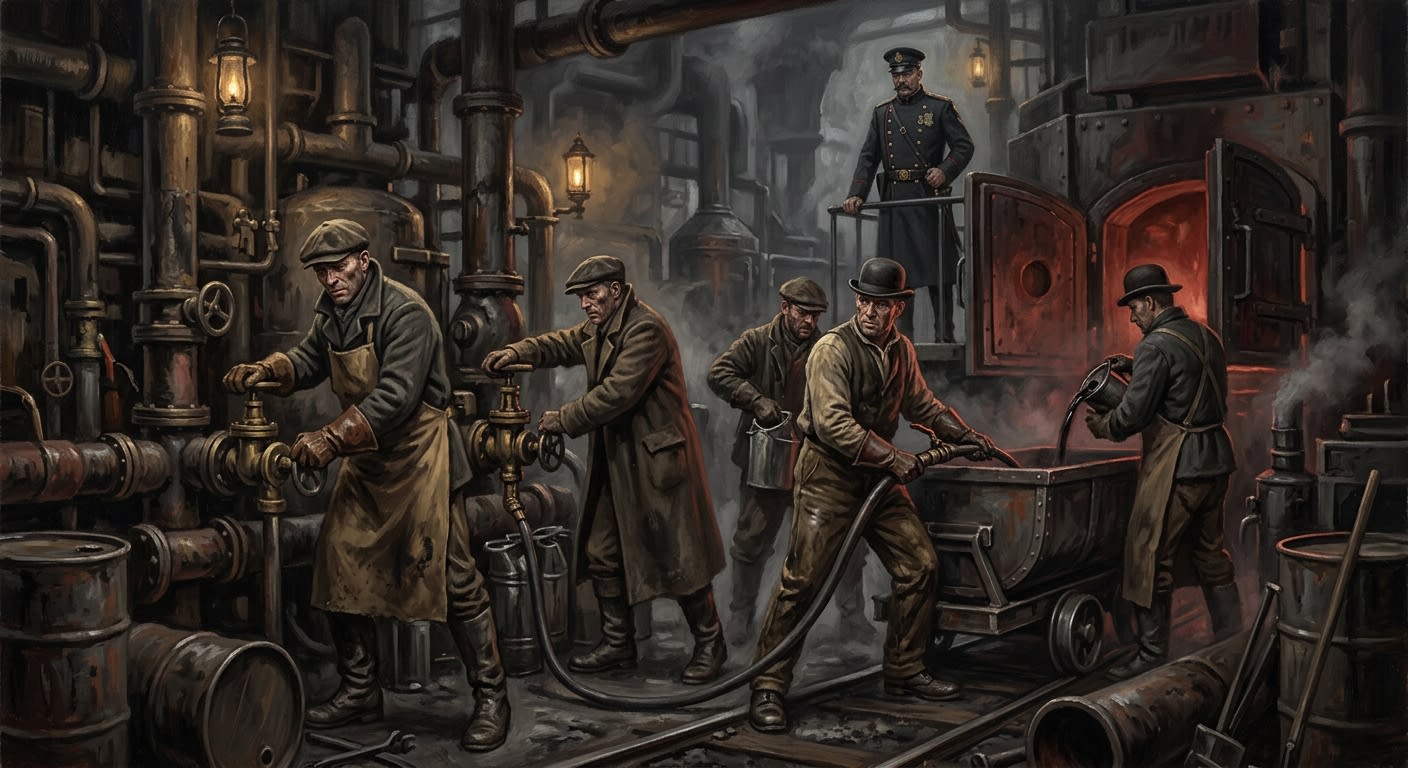
#On the Men Who Feed the Iron
The Furnace-Hardliners are the iron-handed faction of the Hidden Pipe-Runner trade: those practical, pitiless, soot-baptised distributors who prioritise kitchens, industry, trench engines, pump rooms, generator sheds, quartermaster furnaces, and every other hot-mouthed instrument by which a bastion remains a bastion rather than a memorial with battlements. If the Lamp-Mercer keeps the child’s cup warm, the Hardliner keeps the child’s father’s gun crew alive long enough to become regrettable correspondence.
They call this mercy at scale. Their enemies call it arithmetic with bodies in it. Both definitions have been stamped.
A Hardliner’s first article of faith is simple: heat belongs where its absence kills the most people fastest. This sounds charitable until one learns who does the counting. Homes wait. Sickrooms wait. Lantern blocks wait. A field-kitchen serving two hundred trenchmen outranks twenty private stoves; a drainage pump under Bastion-Brest outranks a chapel brazier; a shell-hoist engine at Bastion-Przemyśl outranks every grandmother in the ward unless the grandmother is cooking for sappers, in which case she is infrastructure and may receive fuel.
#On the Engine-Grade Sin
The Hardliners prefer engine-grade black diesel, which burns hotter, fouls faster, writes darker, and attracts Fume-Inspectors the way a feast attracts flies and theologians. Distillers cut it for pressure, not comfort. It spits in valves, stains prayer plates, gums hymn-baffles, and produces smoke with the greasy authority of a forged decree. It is magnificent fuel. This is its first offence.
Official fuel is chrismole when the convoy arrives, blessed coal when the rail line holds, sanctified lamp allotment when the clerk’s pen is awake, and apology when all three have failed. Black diesel arrives in dented drums under grain sacks, in false ash-carts, through pipe-veins laid beneath ration halls, or by night runners whose names are kept from the Ledger for their own convenience and the Bureau’s. The Hardliner receives it, grades it by smell and burn, and decides whether it goes to a kitchen boiler, a trench pump, a ward generator, or an engine whose crew will later swear, hand on relic, that no illicit fuel entered their care.
Bureau of War circulars forbid black diesel in field machinery except under “emergency auxiliary fuel protocols.”
Corrected for adult readers. Emergency auxiliary fuel protocols are black diesel with the spelling laundered.
The Hardliner’s tools resemble the Pipe-Runner’s kit after military promotion and moral decline: pressure gauges with scratched dials, tap keys cut for larger junctions, brass listening rods, seal wax, drum awls, soot filters, stolen War funnels, and a little black notebook that contains no names, no routes, and no evidence except, inconveniently, all three in cipher if one knows where to hold the page near heat.
#On Their Clients
Their clients are trench captains, Litany-Engineers, garrison cooks, quartermasters, rail-yard stokers, pump wardens, Diesel Resonance Plumbers, and those lean, sleepless officers who have discovered that requisition forms do not warm boilers and hymn-blessed fuel does not arrive because the paragraph requesting it has been written in a pious hand. The Bureau of War cannot acknowledge the Hardliner. The Bureau of War also cannot hold a winter line without him. This produces paperwork of rare delicacy.
A trench captain pays in captured brass, ration priority, quiet guard rotations, or the temporary disappearance of a patrol from the lane where the surrender cans will be discovered. A Litany-Engineer pays in access to engine sheds and a technical blessing that sounds enough like a curse to keep sensible men from interrupting. A quartermaster pays in seals. The seals are counterfeit, retired, stolen, or doctrinally ambiguous. All four categories function in a war economy if applied with confidence.
The Hardliner respects usefulness. He does not care whether a man is devout, frightened, corrupt, noble, or damned in seven ledgers. He cares whether the man’s furnace feeds two hundred mouths, his pump keeps a sap from drowning, his engine hauls shells uphill, or his boiler drives a ward-field whose failure would turn a district into a prayer request. This makes the Hardliner appear cold. He is warm only by professional consequence.
#On the Quarrel with the Lamp-Mercers
The quarrel with the Lamp-Mercers is not theatrical. It is intimate, bitter, and fought in valves. The Mercer steals quarter-hours for stairwells. The Hardliner steals them back for kitchens. The Mercer says children must read. The Hardliner says soldiers must eat. The Mercer says a district without household warmth rots into despair. The Hardliner says a bastion without engine heat becomes a slaughterhouse with good intentions.
Both factions keep lists of the other’s sins. Neither list is written down. The Pipe-Runner trade has survived because its grudges remain oral, and oral grudges burn poorly as evidence.
The Hardliners reserve special contempt for the Bell-Tappers, whose bellway runs risk scripture-smoke in exchange for profit and acoustic concealment. A Hardliner will use a dangerous line; he is no child. He will not romance it. Bell-Tappers speak of the pipe that hums as if it were an oracle. Hardliners speak of it as a pressure fault with delusions.
A Purity training gloss classifies Furnace-Hardliners as “industrial heretics with military sympathies.”
Amended. The sympathies are usually financial, occasionally logistical, and almost never military in the sentimental sense. Hardliners love engines because engines disclose gratitude by continuing to work.
#On Wormwood Hill and Other Sermons in Fire
The Hardliner’s nightmare has a name: Wormwood Hill. A.S. 163, engine-grade black diesel, source route suppressed, crew burned alive inside the hull, tank advancing for three days while the hymn-vox spoke through melted fittings. Every Hardliner knows the account. Every Hardliner has explained why his cut is cleaner, his drum safer, his pressure schedule saner, his client less idiotic, his circumstance exempt.
Exemption is the first sacrament of professionals who intend to continue.
After Wormwood, some Hardliners began marking hot-run drums with three slashes instead of two. Some refused hymn-vox vehicles unless a Litany-Engineer signed the housing. Some bled the first cup of every drum into ash and watched for letters. Others raised prices. Fear has always been convertible into revenue; the Synod did not invent commerce, it merely gave commerce better vestments.
HARDLINER FIELD RULE — ATTRIBUTION SEALED If the engine sings before ignition, do not start it. If it sings after shutdown, leave the shed. If it sings in your own voice, █████████████████████████████████. Rule recovered from burned pressure board, Bastion sector withheld.
#On Present Toleration
As of A.S. 201, Furnace-Hardliners operate anywhere the official fuel schedule fails in public while the war continues in private: Constantinople Warrens, Brest pump quarters, Przemyśl shell yards, Irongate pressure chapels, Shipka thaw sheds, Strasbourg rail depots, and the ugly middle corridors where convoys arrive late enough to make criminals useful and early enough to let officers deny panic.
The Bureau of Purity condemns them under Standing Order 14-K. The Bureau of War refuses to know them. The Bureau of Engineering reads their pressure repairs with professional envy and institutional disgust. The Bureau of Tithes, noblest of hypocrites, has found revenue in the heat plume.
The Hardliner’s funeral is smaller than the Mercer’s and better attended by men with rank who stand at the back in plain coats. No one thanks him aloud. A trench kitchen burns through the service. A pump keeps moving water. Somewhere, an officer signs a clean fuel receipt beside a stove that smells faintly of sin.