
#On the Advance
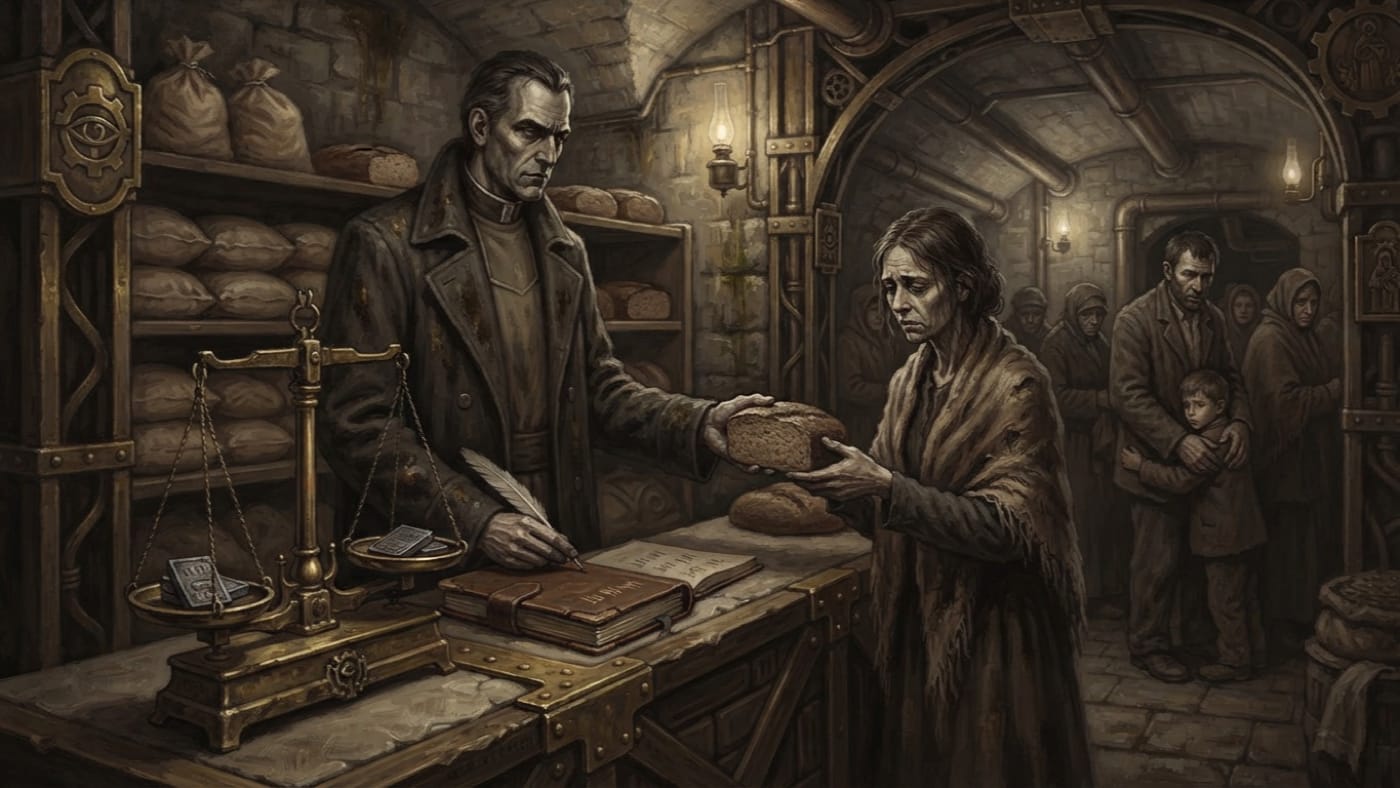
Famine interest is the price of tomorrow's bread, charged tonight and collected for as long as the debtor goes on eating. It is the signature method of the Hunger Brokers, the tyrant faction of the Grain Keeper heresy. It needs no bank, no notary and no harvest. It needs a cellar, a key, and a household that has given up on the queue.
A usurer of coin lends money and waits for money. The Broker advances a loaf, and the loaf is gone by morning, while the hunger is already back at the table asking for new terms. What he lends is time: a night survived, a fever outlasted, a winter crossed as far as Candlemas. What he collects is whatever that time turns out to be worth to him.
The first contract has never been found. The inventor is a matter of preference, since three factions and several Bureau clerks would each put a different name on the charge sheet. Old Klem's spoilage shuffle supplies much of the Brokers' grain, and they claim him as they claim everything useful. The shuffle recovers sacks. It does not price persons, and nothing in his dossier makes him the author of this trade. The condition is easier to date than the man. The First Ration Reforms of A.S. 104 standardised the chit across eight provinces and told every household exactly how much it was permitted to need. Print a ceiling on a need, and someone will start selling what lies above it.
#On the Account
The Broker's account opens with property and closes with persons. The reported terms work down through what a household owns until they reach what a household is.
A loaf before curfew costs a wedding ring. That is the honest end of the trade, if the word may be used: one object for another, the ring melted, the loaf eaten, the matter closed. A route past a levy clerk costs three months of silence, renewable, and the renewal is where the money is. Barley water for a fever house costs the names of the men who meet in its back room, and here the payment has left the cupboard for the Broker's other trade, which is information. A sack before winter costs a son. A child's advanced ration chit costs whatever the Broker later decides the child owes. The sum is left blank in the only ledger anyone will ever consult.
There is no published rate. I have looked for one with all the diligence of a man who would like to tax it. No seized Broker book shows a fixed percentage, a standard term or a common form, and anyone who tells a tribunal otherwise is selling the tribunal something. The debt compounds in another way. A debtor who stops paying stops eating, and a debtor who keeps eating takes on the next obligation. The ledger has no need to add interest, because the stomach adds it every evening. The faction file says it compounds beautifully because the debtor keeps eating. I see nothing to correct.
The books are the real craft. Seized pages set names beside weights, and the weights are seldom grain alone. One column holds rye and fuel, the next holds passage and patrol warnings. Then come testimony given, sermons disrupted, silences kept, recruits delivered, cache claims, and the punitive denial schedule, which lists the households whose bread is to stop, on which night and for how long. A Scale Clerk keeps account of grain. A Broker keeps account of conduct, and prices it in grain because grain is the one coin the ward cannot refuse.
#On the Household Bound
The clearest case in the file concerns a nursing mother and her brother. They have no names there, and they will have none here.
Good flour for the mother costs the brother's service as a Cache Runner. The Broker gains a pair of feet that know which stairs stay unlatched after Vespers. The household eats for exactly as long as the brother walks. The flour stops if he refuses a route, falls sick, or simply tires of carrying waxed sacks through a curfewed city where any sack is a confession. No one in the Broker's pay needs to threaten him. His sister's cupboard does that, and the infant does it best of all, because an infant cannot be reasoned with or bribed.
This is the method's elegance and its heresy: enforcement moves inside the house. The Broker needs no hall of discipline, since every debtor's kitchen serves as one and is staffed free of charge by the people who love him.
Repeat the arrangement down a street. The patrolman with six children takes bread and reports what the Broker wants reported. The widow who knows the back stairs takes soup and keeps them open. A Cellar Warden controls the district's hidden stores, but it is the Keeper-of-Keys who decides crisis allocation for the ward. Where a Broker holds that person's debt, or is that person, the denial schedule decides who eats when there is no longer enough to pretend. At that point the ward has a government. Denial serves as its courts, fed patrolmen as its police, and the brother as its conscription. It has no charter and no lawful standing of any kind, and it is obeyed faster than the parish.
The brother is not a Broker. The tribunals forget this with professional regularity. A runner coerced by his sister's hunger carries the same sack as a volunteer, and a sack cannot testify to motive. A Purity officer who hangs the brother and leaves the ledger has removed the least guilty man in the cellar, along with the household's only income.
#On Bread Given Without a Price
The Mercy Keepers feed children first, ask no questions and take nothing. The Quota Men skim modestly and keep the public granary standing, so the ward's obedience stays attached to a schedule and never to a man. Both factions hand out stolen grain, and neither keeps a debt roll of persons. The three factions differ in what the ledger remembers once the bread is gone.
That is why a free loaf proves nothing to an inspector. Mercy bread carries no price. Broker bread often carries none at the counter either. Its price is entered later, in a back room, against a name the recipient never knew had been written down.
The worst of these loaves is "Agnes bread." Saint Silo-Agnes hid three sacks of millet for unlawful distribution and was immured beside a parish store for it. Her parish, her family and the year of her sentence remain unproved, which the Bureau of Festivals finds convenient. She charged nothing. Brokers invoke her rarely, and only when they want the gift to feel like grace: Agnes bread for a daughter's service, Agnes mercy for a family's debt. The loaf arrives wrapped in a saint and leaves a lien behind.
#On the Seizure and Its Successor
Each Bureau wants something different from the man who charges famine interest. Purity condemns and seizes. It overturns the bins, nails the debt book to the chapel door and drags the Broker out where the ward can watch. The Bureau of Tithes prefers absorption: it turns the routes into licensed distribution and collects revenue from the same households that used to pay in sons. The Bureau of Shadows watches and asks questions, because a debt roll is the most complete census of a ward's secrets ever compiled without public funds. The Black Ledger recruits from Broker ranks. Its own practice of staged redistribution, debts laid on the beneficiaries and loyalty bought in advance resembles famine interest closely enough to explain the recruiting. The resemblance does not prove the two are one house.
None of this amounts to sanction. Toleration is a mood of the Bureaus, and a mood can be withdrawn.
The Weevil Year of A.S. 157 is the documented proof. While the lawful western silos rotted, the Hunger Brokers sold bread at famine interest and, in the published account's phrase, recruited half their future tyrannies in that one season. I will not certify the fraction. I certify the season.
A seizure in the Purity manner is satisfying to administer. The book burns, the cellar is sealed and the Broker is shown to the ward. Then the ward wakes hungry, because its bread came from that cellar.
Bureau assessment A.S. 199: "Removal of Hunger Broker networks restores lawful ration dependence."
Corrected in restricted circulation, and here applied to the contract itself. Burning the ledger does not cancel the debt, because the debt was always held by hunger. Removal without immediate replacement hands dependence to bread gangs, patrol sergeants, levy recruiters or rival Brokers, who reopen the account from memory. Lawful ration dependence is restored only where lawful rations exist in sufficient quantity.
The practical instruction follows from the correction, and every office that would rather prosecute than bake will dislike it. A Broker's ward is freed by flour delivered the next morning, in enough weight that his successor has nothing to sell. Anything less is a change of landlord with a sermon attached.
#On the Present Finding
In A.S. 201, famine interest is charged wherever the official queue stands quietly because the real ration is negotiated somewhere else. It is strongest in the Zone 2 ration districts governed from Strasbourg, in the Rhine ward granaries, and in the forward family depots that feed civilians behind the Sagittal Line. The depots trouble me most. A son pledged for a winter sack behind the Line is a son the Broker can later sell to a levy recruiter, and the levy will not ask what the boy owed.
Inspectors should look for the marks in the faction file: famine-interest tallies, debt loaves, child-runner pledges, unpriced Agnes bread, and patrol bread bills larger than the patrolman's household. A ward that is fed and silent, with a short official queue and fever houses that are strangely well supplied, should be read as an account in good standing.