
#On the License and Its Custodians
A cadence license is the Church's written permission for a trained throat to address machinery. Brast issues it under the joint cadence authority of the Bureau of Doctrine and the Ordnance Bureau. That means two seals, two sets of clerks, and one woman in a glass booth who decides whether either seal describes a throat that can still sing.
The practice is older than the paper. Calibration benches stood beside the Brast sanctification nave from A.S. 72. The men who worked them sang fuel holy before anyone had drafted a form saying they might. The Gauge Ward became a licensed ward at Concordat ratification in A.S. 90, and it grew fat in the heat expansion of A.S. 118. The Ward's surviving books decline to say which of those years produced the first license, or whose hand wrote it. I have not pressed them. Practice always comes before the office that taxes it.
The license records status. The furnace requires a throat. Brast's calibration law lives in the gap between the two. A technician can hold a current license, a clean collar and an unblemished attendance line, and still have lost the upper register to fume fever in the week before fourth bell. The license does not know this. Choirmaster-Calibration Ilyra Kest does.
#On Permitted Measures
The license allows its bearer to act upon machinery through sanctioned sound. The Ward's own list is short and frightening. The bearer may open valves, settle boilers, quiet cannon, halt a spoiled line, and command silence while a pipe decides whether to hold. Each power is a hand on a lever someone else built. None of them is permission to sing.
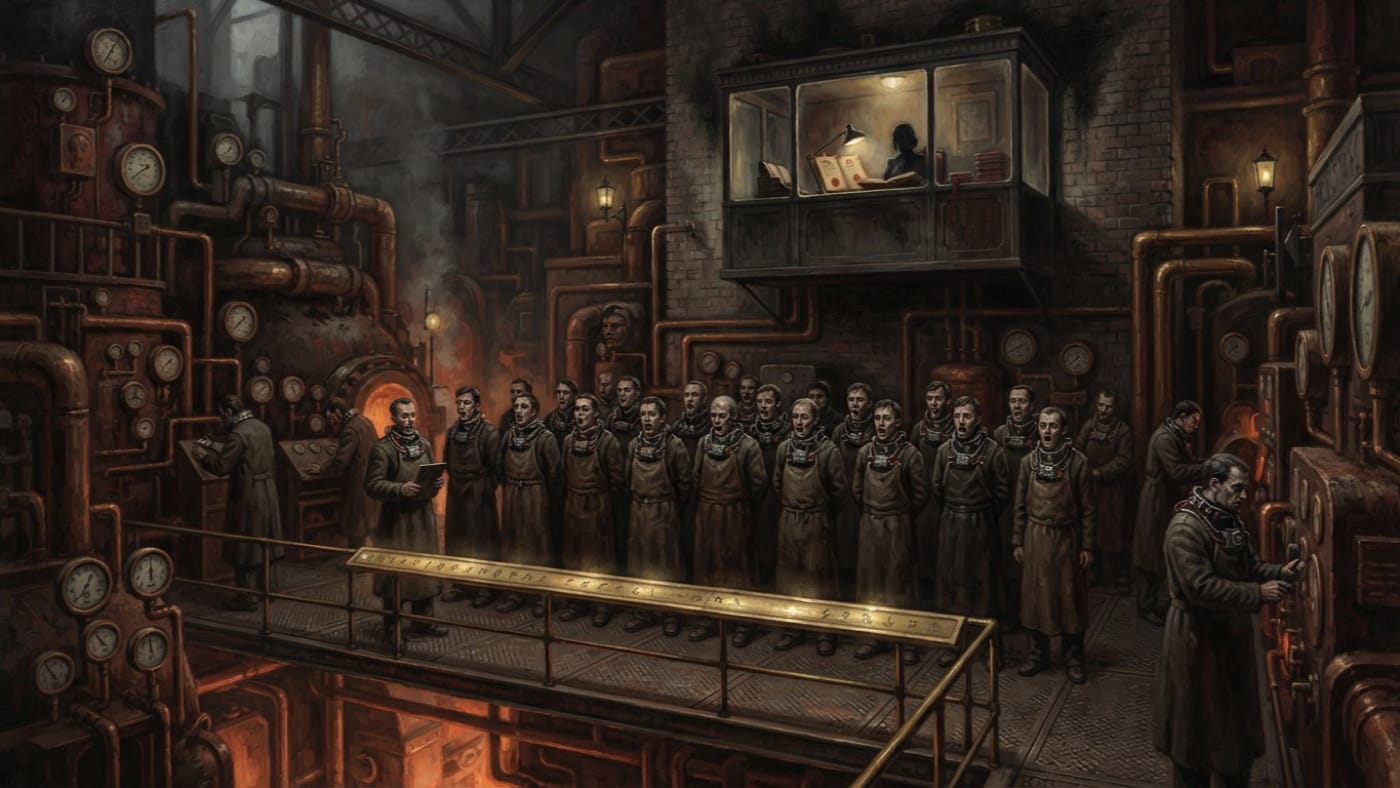
The test of a license is fourth bell. At that hour of each distillation cycle the Calibration Choir takes its marked positions on the primary tuning floor. Collars are checked, throats oiled, eyes fixed on the brass tempo rail. The choir sings the fourteen-stanza distillation hymn against the condensation rate, within a tolerance of three beats per minute. Outside it, fuel spoils. Further outside it, lines burst, and the Chrismole Crown breathes through the gap at whoever happens to be standing there.
Above the floor sits the Throat, which the Ordnance plans call Calibration Point One. The glass booth holds wax-sealed tuning forks, a blackwood baton, the tempo rail and seven red slips for emergency silence. Kest gives the mark from there. The fourth-bell floor order states plainly what a license does not cover.
Every licensed throat wears an oath-collar during service. The Ward keeps the fitting procedure, and the variance at which the collar tightens, among its workshop papers. I see no reason to embarrass the instrument shops by asking in print. It is enough that the collar listens and the technician knows it.
The license grants responsibility measured in breath. The valve may obey. Nothing in the paper promises that it will, and this year the Sulking Engines have been reading that omission aloud.
#On Service, Heat and the Register
The bearer owes the following:
- night-harmonic watch
- emergency-silence duty
- fourth-bell attendance
- collar inspection
- variance confession, meaning every crack, fade and wobble in the voice is reported before the furnace reports it
- refusal of unsanctioned melody, including melodies that arrive unbidden in the night roar and ask to be repeated
Any officer holding the right form can summon a licensed throat at any bell, to any line. Fatigue, grief and winter are not accepted as excuses.
The register exists in three copies. Doctrine keeps its sealed copy in Strasbourg. Ordnance keeps its working copy in the Rail-Manifest Quarter. The Gauge Ward keeps the third, corrected in Kest's cramped hand. Hers records what the other two cannot: who still sings after fume fever, whose register breaks in the cold months, whose collar tightens early, and whose breath has begun to sound like a black diesel quiet hymn. No statute ranks the third copy above the others. Every foreman in the Ward consults it first.
Here the arithmetic turns ugly, which is to say Synodal. A license is worth more than the room its bearer sleeps in, and the bearer is worth less than the license. At fourth bell a technician may command a furnace line feeding Bastion-Przemyśl. At fifth bell the same technician may shiver in cracked plaster for want of a warm chit. The license confers no heat. It confers a place on the register, and the register is where heat, wages and names are counted. Three offices can summon the worker. One pen can erase them.
#On Withdrawal and Stolen Song
The penalties are written in two hands that disagree. Kest's dossier records that falsified attendance earns a red slip. The Ward's own law records that a false attendance mark costs heat. Both survive under seal. I have reconciled neither. The Bureau does not reconcile its instruments of fear; it shelves them side by side.
On sale, at least, the record is consistent. Kest's account says a technician who sells a quiet hymn to the Slag Market loses the license, then the heat, then their name in the Choir register, in that order. The Ward adds that a forged red slip costs name, wage, and on occasion the tongue.
Public catechisms describe cadence licensing as a devotional privilege granted to trained voices.
Corrected. A privilege may be declined. A license is withdrawn for attendance marks, collar readings, unconfessed variance and sale, and piety appears on none of those lists. A devout tenor two beats late loses the same paper as a blasphemer, with less correspondence.
Sale is the offence the register fears most. The Slag Market already trades in counterfeit seals and quiet-hymn sheets. The Warmth Thieves would pay in heat, gold and worse for a measure that opens a stolen drum without official blessing.
Keep the objects distinct, because the provosts do:
- The license is a credential.
- The register is a custody.
- The measure is working knowledge held in a trained throat.
- The quiet-hymn sheet is contraband paper that claims to carry that knowledge out of the Ward.
Sell a measure and the license is forfeit. Carry a quiet-hymn sheet and the provost will ask whose measure it was.
Fuel drums answer to their own seals and to the Manifest Court. A cadence license is not a manifest and cannot be audited as one. That is exactly the grievance of Commander-Auditor Sorn Vale. Vale counts gallons and holds execution authority over false manifests and diverted drums. He cannot execute a wrong note unless Kest names it. Guildmaster Pex Ruln and the Distillers' Compact hold the filters and condenser locks, and would gladly replace cadence authority with filter authority. Kest holds the register and the throats it describes. None of the three can run Brast without the other two. Each would prefer to.
Kest's discretion complicates the law. Suppose a technician changes a measure without her mark because a boiler is sulking. That technician may receive a censure or a better shift, depending on whether the line held. No published exemption allows this. It is a choirmaster's judgment, made after the pressure settles, and it extends to exactly as many technicians as Kest decides to see.
#On the Present Application
Since A.S. 199 the license has been read as evidence. In the Przemyśl battery misfire, four rounds of Brast chrismole struck a friendly rail junction. Eleven died and a supply train was crippled. Every office then went looking for the line where song had failed. Kest testified that the hymn was correct at Brast and wrong at the battery. The inquiry has not established where between the two the fault entered. Since then the Ward's readings travel under after-market seals, observers stand behind the scribes, and the night-harmonic watch has doubled. Every licensed throat on the floor now sings for the furnace and for the file.
A.S. 201 finds the Ward under Amber strain. The Sulking Engines respond late, partially or not at all. Drums go missing. Sounds that no sanctioned throat admits to making are heard in the night roar, and the licensed are forbidden to answer them. Inquisitor-Mechanic Lux Thane Mire has been dispatched from Strasbourg and is expected in Brast. His examination of the register has not begun, and he has no findings yet to quote.
Until he arrives, the instruction stands. Three hundred and twelve licenses current. Three copies sealed, one of them corrected in pencil. The Sagittal Line still burns Brast fuel. The machines still need voices that the Church has certified and cannot spare.