
#On the Licensed Measure
"Sing it true, or it fails." — iron motto above the nave of the Chrismole Crown
The Distillation Hymn has fourteen stanzas, and every one of them is a valve. It is sung at the fourth pressure bell of each distillation cycle in the Chrismole Furnaces of Brast, over condensate on its way to becoming Chrismole. The fuel it governs travels along the Sagittal Line to guns that have never heard a note of it. The Church classifies the hymn as technical scripture. The Ordnance clerks file it as a calibration specification. The furnace feeders simply call it the hymn, as though there were no other. In Brast there is not.
Its history falls into two parts: what the Ledger holds and what it does not. By A.S. 72 / 1782 CE the doctrinal authority of the day had sent a Cantor and fourteen choir-technicians to sing over Brast's condensers. That authority was later styled the Bureau of Doctrine by clerks who enjoy renaming the dead. Singing over condensers is therefore older than the Synod's formal constitution of A.S. 90. The fourteen stanzas sung now are another matter. No composer is entered, and no year of composition is entered. A written score is kept. I have not been shown it, and I would not reproduce it here if I had. The auditors adore the fact that there were fourteen technicians in 72 and there are fourteen stanzas in 201. The Choir corrects them without smiling.
#On the Fourth Bell
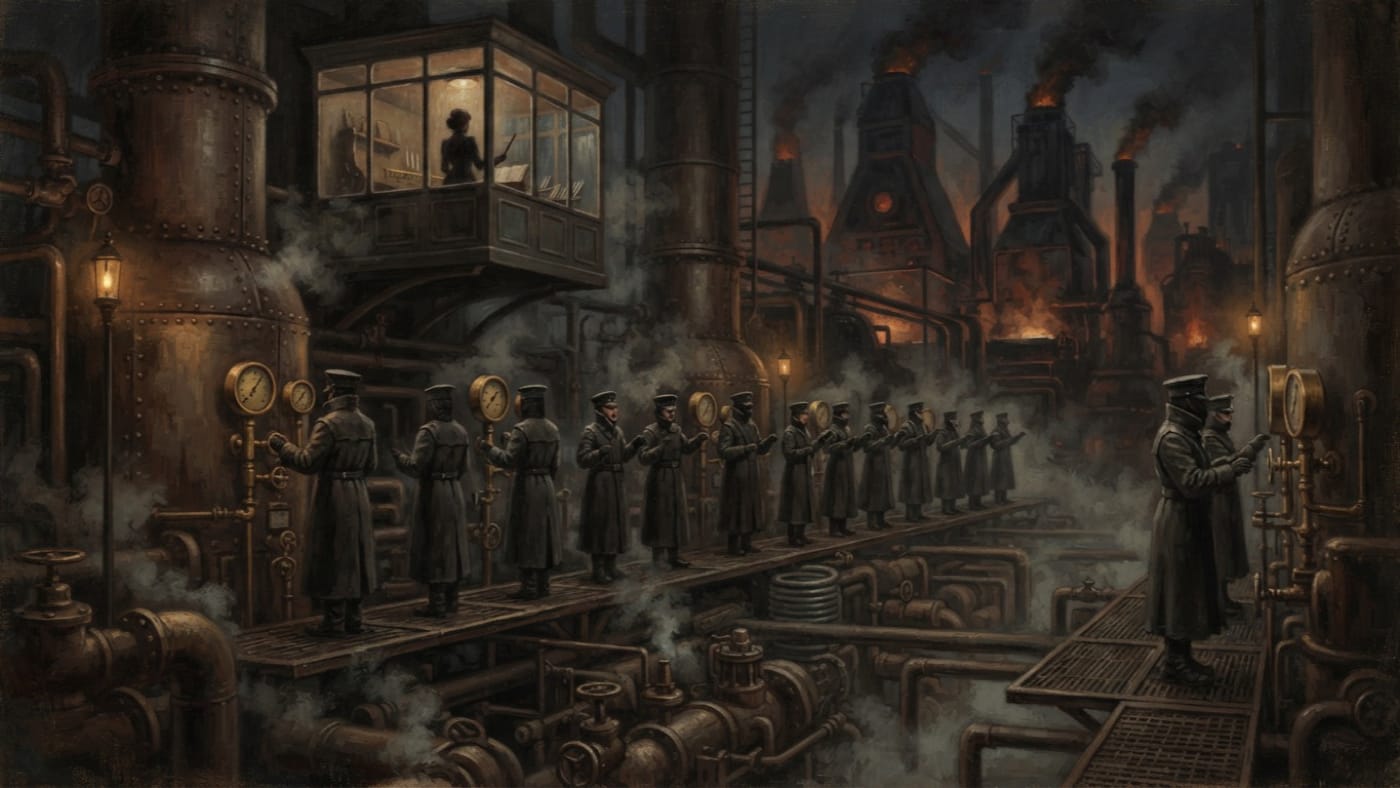
The Seventh Revision hangs its cycle on seven bells. At the first, the seventeen kilns of the Chrismole Crown take their charge. At the seventh, the finished fuel goes into sealed drums under wax. The hymn belongs to neither of them. It belongs to the fourth bell, when the condensate reaches the sanctification nave and a rotating shift of the Calibration Choir steps onto its marked positions on the floor.
The shift has no congregation. It sings to gauges. Brass needles shiver against their glass with the vibration of the pipework, and the technicians watch them the way confessors watch a penitent's hands. The air tastes of hot oil, incense and scorched pennies. Each singer stands at fourth-bell spacing, collar fastened, breath taken on the mark. The first stanza enters when the condensation rate says it may.
The rate is the master. The hymn's tempo must match it within three beats per minute, and the rate does not hold still. A kiln runs hot, a canal runs cold, a filter clogs upstream, and the condensate quickens or drags. The choir must follow it without being seen to follow, adjusting tempo stanza by stanza while keeping the pitch the score demands. Three beats is less than a tired throat drifts in a single verse. It is a margin measured for saints and staffed by people who have been breathing fume since the first bell.
Above the primary tuning floor of the adjoining Gauge Ward stands a glass booth that the technicians call the Throat and Ordnance calls Calibration Point One. From it Choirmaster-Calibration Ilyra Kest governs the measure. The booth holds a brass tempo rail, a rack of tuning forks under Bureau wax, a blackwood baton she seldom lifts, and seven red slips for emergency silence. Her voice has not risen above a murmur in fourteen years. Her pitch is perfect anyway. The shift hears her corrections through glass, steam and the roar of seventeen kilns because it has been trained to hear nothing else.
The Ward books enter the consequences of drift without poetry. Fuel sung off the rate spoils. Lines have burst under a bad measure. When a stanza is omitted, or a shift falls silent mid-hymn, the machinery stops obeying: valves open late, needles wander, and boilers keep their own counsel. The books do not say whether the Creator withholds favour, whether the Great Deceiver finds purchase, or whether iron simply misbehaves under the wrong vibration. They record what the gauge did, and the gauge has never once offered a theology.
#On the Custody of Song
A hymn that opens valves is property, and Brast guards property with collars. Every voice in the fourth-bell shift holds a cadence license under joint Doctrine–Ordnance authority. As of A.S. 201, Kest commands three hundred and twelve licensed technicians, though no single cycle needs them all. The Bureau of Orison and Song keeps its wider jurisdiction over hymnals and trained voices across the Church. Inside the Gauge Ward, Kest's Measures decide who stands on the marked floor and who may sing a corrective syllable. They also decide who receives a red slip and sits down.
The license certifies a credential. The floor tests a throat. These are different instruments, and the Ward knows which one fails first. Throats give way to fume fever, to winter cracks in the upper register, and to the slow coarsening that the Ash-Hospice Sisters record more faithfully than any Bureau. A licensed singer whose breath is ruined is a lawful hazard, and the law has no form for withdrawing a lung.
The hymn also sits at one corner of Brast's ugly triangle. Guildmaster Pex Ruln and the Distillers' Compact hold the filters, the condenser locks, the recipes and the substrate. Commander-Auditor Sorn Vale holds the manifests, the gallons, and the authority to execute anyone who diverts them. Kest holds the measure. A choir can sing all fourteen stanzas within tolerance over fouled feedstock, and the drum it fills can vanish from the ledger the next morning. Correct singing proves only correct singing.
Hence the market. In the Slag Market, failed apprentices sell quiet hymns. These are fragments, a breath-mark here and an interval there, good for coaxing a pump or warming a stolen pipe. They cannot stand in for the Distillation Hymn. The danger of them lies elsewhere: they prove that a measure can leave the Ward in someone's memory. A technician caught selling one loses the license, then the heat, then the name in the Choir register, in that order.
#On the Corrected Explanation
For most of its sealed life, the manual told its readers why the hymn worked. The sentence was short and committed: the hymn sanctified the fuel through divine resonance. It gave a cause, a mechanism and a verb. In A.S. 187 / 1897 CE the Bureau of Doctrine withdrew it.
"The hymn's sacred properties sanctify the fuel through divine resonance."
Corrected, Bureau of Doctrine, A.S. 187: "The hymn's properties, which are sacred, interact with the fuel through mechanisms that are doctrinally sufficient." Procedure unaltered. Sacred classification retained. Stanza count, tolerance and melody unaltered.
The fourth-bell shift noticed nothing, because nothing in its work changed. There were still fourteen stanzas and still a three-beat tolerance. The melody, the spacing, the bell and the booth stayed exactly where the old sentence had left them. Only the explanation was taken away. A smaller one was installed, cut to fit the vacancy without filling it.
Observe where the sacred went. In the withdrawn sentence, the hymn sanctifies. In the approved one, its properties are sacred in a subordinate clause and merely interact in the main clause. Holiness survived as a classification and was surrendered as a cause. The Furnace Chapterhouse of Saint-Combust still preaches the first sentence from its own pulpit. It may, since a chapterhouse is permitted interpretations the manual has declined to make. Engineering offers its own account in pressure and vibration. The Choir offers no account. It offers a shift.
#On the Answer Not Entered
In A.S. 199 / 1909 CE, a battery at Bastion-Przemyśl, which guards the western Carpathian passes, fired four rounds of Brast fuel into a friendly rail junction. Eleven people died. A supply train was crippled. The inquiry produced the usual antiphon: Ordnance sang sabotage, the Choir sang degraded feedstock, and the Compact sang the Choir. No verdict has been entered, and this Codex will not enter one on the inquiry's behalf.
Kest testified below conversational volume. Her sentence is the most quoted thing ever said about the hymn: it had been correct at Brast, wrong at the receiving battery, and answered somewhere between. That is her testimony, not the inquiry's finding. Seven sealed memoranda have copied the phrase "answered somewhere between", and every one of them has left it alone, the way a clerk leaves alone a drawer that has begun to smell.
What followed was procedure, the Church's preferred form of fear. Verification of the hymn at the fourth bell was doubled, and Brast went from Green to Amber. The Sulking Engines remain classified as a Category Two Localized Acoustic-Mechanical Disturbance. That is a filing category, and it settles nothing.
By the A.S. 201 survey, the Choir was reporting something else. During the night roar, the furnace harmonics carry a syllable no technician has sung and no hymnal contains. Kest recorded it on a wax cylinder, which now lies in Vault Brast-4 under Doctrine, Ordnance and Choir countermark. Its meaning is sealed, and so is its source. I have not heard it and I will not describe it. Anyone who proposes to number it as a fifteenth stanza may submit the proposal to the vault and wait there for a reply.
The fourth bell still rings. The shift still takes its marks, watches its gauges, holds the rate within three beats, and sings fourteen stanzas over condensate bound for the Line. The Line burns whether or not Strasbourg understands why. Inquisitor-Mechanic Lux Thane Mire has been dispatched from Strasbourg to examine the matter. Arrival, examination and findings are all pending.